


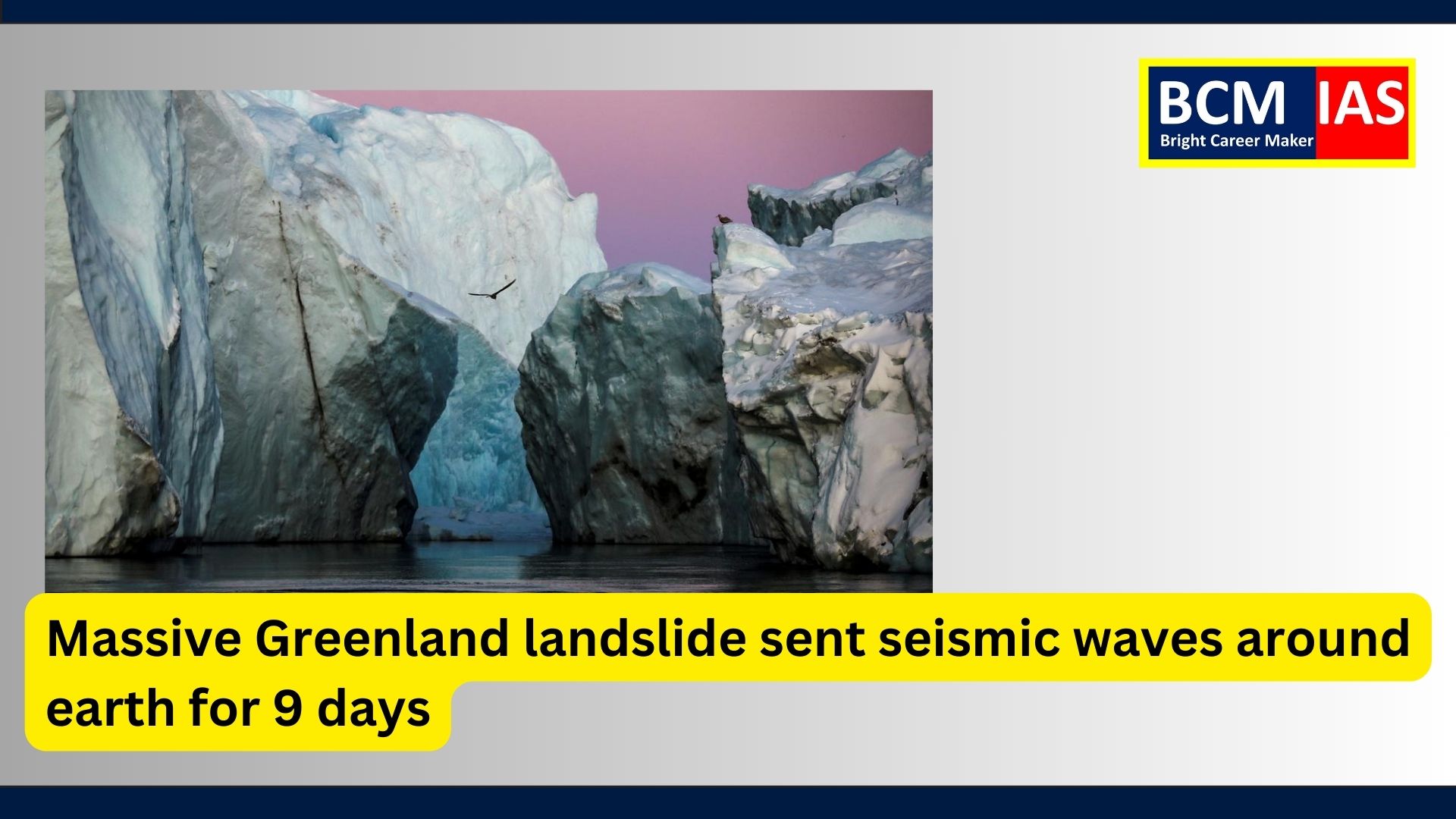
Massive Greenland landslide sent seismic
waves around earth for 9 days
·
The article discusses a significant geological event
that took place in Greenland in 2023, where a massive landslide caused a
seismic disturbance that reverberated across the globe for nine days.
·
The event not only highlights the growing impact of
climate change on polar regions but also signals potential dangers that could
become more frequent in the future due to global warming.
·
Here's a
breakdown and analysis of the key points from the event and its broader
implications:
Key
Points of the Event:
1. The
Landslide and Mega-Tsunami:
o A landslide of
approximately 25 million cubic meters of ice and rock from Hvide Støvhorn peak
splashed into the Dickson Fjord, triggering a mega-tsunami with waves reaching
up to 200 meters high.
o The sheer volume
of material displaced was enough to fill 10,000 Olympic-sized swimming pools.
o The massive
movement of rock and ice led to the generation of seismic waves that persisted
globally for nine days.
2. Seismic
Waves and Global Impact:
o Seismic stations
worldwide recorded these waves, but unlike earthquake-generated waves, they had
only one frequency and faded much more slowly than typical aftershocks from an
earthquake.
o The waves in the
fjord sloshed back and forth in a process known as seiche, where the
confined nature of the fjord led to a resonant oscillation of water waves.
o This phenomenon
caused the Earth to "ring" like a bell, with seismic waves detected
from the Arctic to Antarctica.
3. Cause
of the Landslide:
o The melting of
the glacier, which had supported the rocky slopes above the fjord, was
identified as the primary cause of the landslide.
o Due to global
warming, the glacier had been shrinking rapidly over the past decades, leading
to destabilization of the rock above.
o The collapse of
the glacier initiated the chain of events that culminated in the mega-tsunami
and global seismic reverberations.
4. Global
Warming and Its Role:
o Arctic regions
are warming at a rate two to three times faster than the rest of the planet.
This rapid warming is causing glaciers to melt and destabilizing slopes that
had been supported by permafrost and ice for centuries.
o As the ice melts
and exposes darker rock surfaces, more sunlight is absorbed, accelerating the
melting process further.
o Researchers warn
that such ice-rock avalanches and mega-tsunamis may become more common as
climate change intensifies, especially in polar and mountainous regions.
Analysis:
1.
Climate Change as a Driving Force: The event is a stark reminder of the
increasing risks posed by global warming. The melting of glaciers is not only
leading to rising sea levels but also triggering dangerous geological phenomena
such as landslides and tsunamis. As polar ice melts, the underlying structures
that once stabilized the landscape are weakened, resulting in more frequent and
potentially catastrophic events.
2.
Seismic and Geological Implications: The ability of such an event to send seismic waves
across the globe underscores the magnitude of the landslide. These kinds of
disturbances, which are not caused by tectonic movements, challenge traditional
seismic monitoring systems and require new approaches to understanding the
potential risks in vulnerable regions.
3.
The Importance of Monitoring and
Research:
The collaborative effort
of 68 researchers from 40 universities to piece together this event highlights
the importance of multidisciplinary research in addressing complex
environmental challenges. Satellite imagery, bathymetric data, and seismic
monitoring all played crucial roles in identifying and understanding the full
scale of the event.
4.
Future Risks: The article concludes with a warning that the
Greenland event may not be an isolated occurrence. As global warming
accelerates, more glaciers will melt, increasing the likelihood of similar
events in other polar and mountainous regions. This poses a significant risk
not only to local environments but also to global geological stability.
Conclusion:
The Greenland landslide and subsequent mega-tsunami provide a
dramatic illustration of how climate change is affecting the planet in
unexpected and profound ways. The event serves as a wake-up call for both
researchers and policymakers to focus on the growing risks posed by glacial
melt and its potential to trigger large-scale geological disasters. As the
planet warms, more such incidents may occur, and the scientific community will
need to develop better predictive models and monitoring systems to mitigate
their impact.
MCQs for Practice
1
What was the primary cause of the massive landslide in
Greenland in 2023 that led to a global seismic disturbance?
a) An earthquake underneath the glacier
b) Global warming-induced melting of the glacier
c) Volcanic eruption in Greenland
d) A sudden collapse of a mountain without external factors
Answer: b) Global warming-induced melting of the glacier
2
What unique feature of the seismic waves caused by the
Greenland landslide puzzled scientists?
a) The waves had multiple frequencies, like those from an earthquake
b) The waves had only one frequency, unlike typical earthquake tremors
c) The waves were accompanied by volcanic activity
d) The waves were too weak to be detected by global sensors
Answer: b) The waves had only one frequency, unlike typical earthquake tremors
3. What is a "seiche," as described in the article,
which occurred in the Dickson Fjord after the landslide?
a) A type of seismic wave caused by volcanic eruptions
b) A back-and-forth oscillation of water in a confined space
c) A tsunami wave that disperses over the open ocean
d) A slow-moving landslide caused by glacier melt
Answer: b) A back-and-forth oscillation of water in a confined space
4. Why are Arctic and subarctic regions more vulnerable to
events like the Greenland landslide?
a) They have more earthquakes compared to other regions
b) Global warming is causing rapid melting of glaciers, leading to unstable
slopes
c) These regions experience frequent volcanic eruptions
d) Permafrost strengthens the rock formations in these regions
Answer: b) Global warming is causing rapid melting of glaciers, leading to
unstable slopes
5. What was the global impact of the Greenland landslide
in 2023?
a) It caused a global earthquake that lasted for nine days
b) The landslide caused seismic waves that reverberated across the Earth for
nine days
c) It triggered a volcanic eruption in another part of the world
d) It had no significant impact outside Greenland
Answer: b) The landslide caused seismic waves that reverberated across the Earth
for nine days


Comments on “Massive Greenland landslide sent seismic waves around earth for 9 days”