

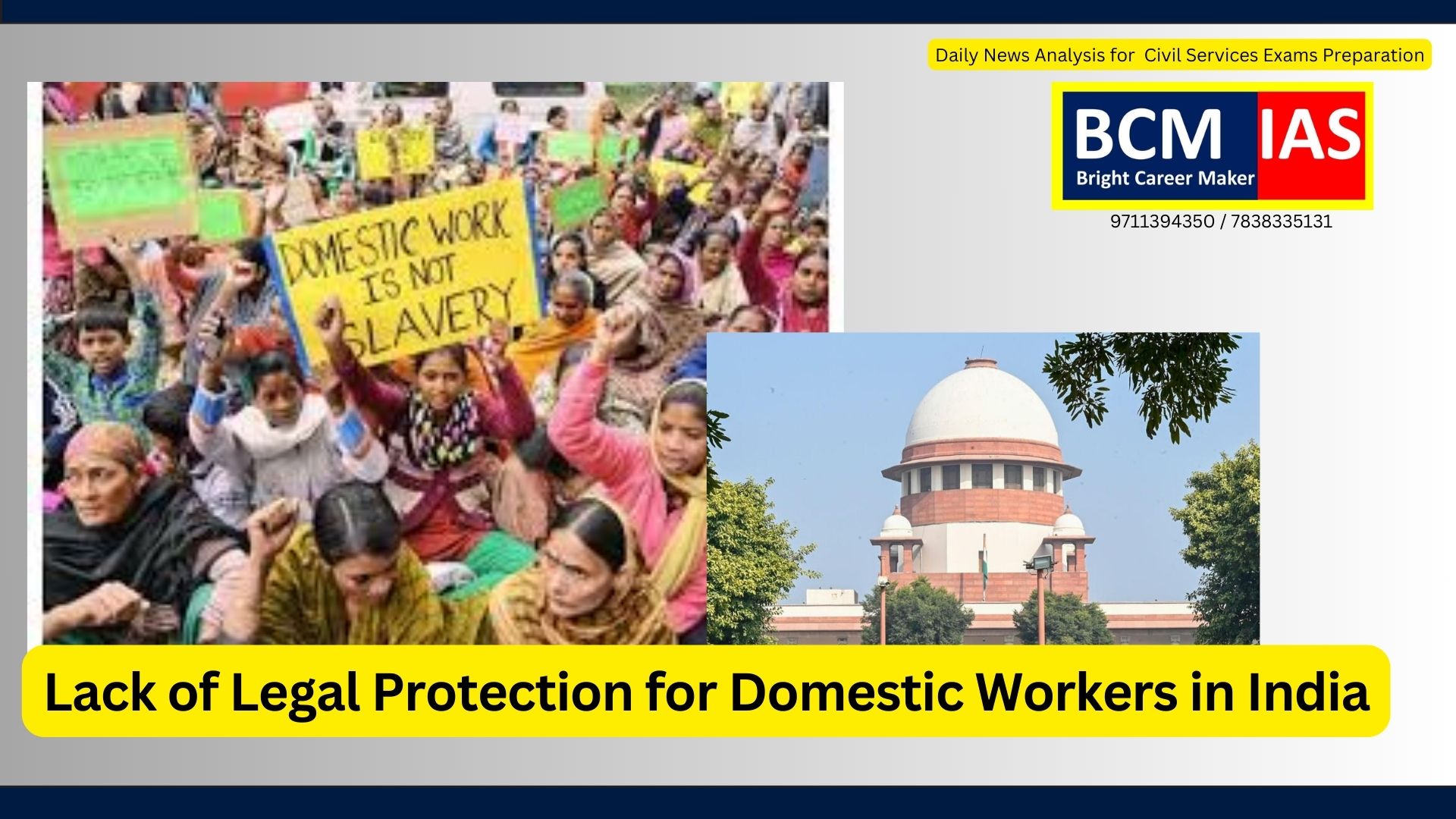
Lack of Legal Protection for Domestic Workers in India
The Supreme Court’s recent
directive to the Union government to consider enacting a law to protect
domestic workers highlights a longstanding
social and legal issue—the vulnerability of an unregulated and
marginalized workforce that plays a crucial role in urban households. Despite increasing
demand for domestic workers due to urbanization,
they remain unprotected by labor laws,
making them susceptible to exploitation, abuse, and poor working
conditions.
1. Understanding the Issue: The Plight
of Domestic Workers in India
A. The Growing Workforce and Rising
Exploitation
- Domestic
workers form a significant but invisible workforce in India,
primarily consisting of women
from marginalized communities (Scheduled Castes, Scheduled
Tribes, and Other Backward Classes).
- They
lack legal
recognition as formal workers, making them vulnerable to low wages, long working hours,
and abuse without effective legal recourse.
- Cases
like the abuse of
the Chhattisgarh tribal woman highlight the systematic mistreatment
many domestic workers face, particularly in metropolitan areas.
B. Lack of Legal Framework and State
Response
- India
lacks a
comprehensive central law governing the rights of domestic
workers.
- Some
states like Tamil
Nadu, Maharashtra, and Kerala have enacted progressive laws
to safeguard social
security benefits, maternity care, education assistance, and healthcare
for domestic workers.
- The
Supreme Court acknowledged that past
efforts to legislate protections at the central level have failed,
including the Domestic
Workers (Conditions of Employment) Bill, 1959, and Domestic Workers (Regulation of
Work and Social Security) Bill, 2017.
2. Social Challenges Faced by Domestic Workers
A. Low Wages and Economic Exploitation
- Domestic
workers often earn
below the minimum wage, with no structured payment system,
social security, or job security.
- Many
work on an informal
basis, relying on verbal
agreements that can be easily violated.
B. Harassment, Abuse, and Unsafe Working
Conditions
- Physical,
verbal, and sexual abuse is common, especially
for live-in
domestic workers who stay in their employer’s homes with
no independent support system.
- Long
and undefined working hours lead to severe physical and mental strain.
C. Caste and Gender Discrimination
- A
large portion of domestic workers belong to Dalit, Adivasi, and economically
weaker sections and face caste-based discrimination in
employment.
- Women
and young girls are particularly vulnerable
to exploitation and
trafficking.
D. Lack of Social Security and Legal
Recourse
- Domestic
workers are not
covered under national labor laws like the Minimum Wages Act, 1948, or the
Employees' Provident Fund (EPF) Act, 1952.
- Without
a formal grievance
redressal system, they cannot demand their rights legally.
3. Supreme Court’s Directive and Its
Implications
A. Formation of an Inter-Ministerial
Committee
- The
SC directed the Centre to form
a committee with representatives from the Ministries of Labour, Women and
Child Development, Law and Justice, and Social Justice to
examine the need
for a legal framework.
- The
committee must
submit a report within six months, after which the Centre
will decide whether to legislate a central
law for domestic workers.
B. Why is a Central Law Needed?
1.
To Ensure Uniform Protection
Nationwide – Different states have varied protections,
but a central law would
provide nationwide safeguards.
2.
To Recognize Domestic Work
as Formal Labor – This would bring job contracts, fair wages, working
hour regulations, and social security.
3.
To Provide Legal Recourse –
Domestic workers must
have access to labor courts and redressal mechanisms for abuse.
4. Suggested Measures for Protecting
Domestic Workers
A. Enacting a Comprehensive National Legislation
- A
law ensuring minimum
wages, job security, standard working hours, social security benefits, and
grievance redressal mechanisms must be introduced.
- Domestic
workers must be included
under existing labor laws such as EPF, ESI (Employee State Insurance),
and pension schemes.
B. Strengthening State Policies and
Implementation
- States
must follow Tamil
Nadu, Maharashtra, and Kerala in setting up dedicated boards for domestic
workers to regulate wages and provide welfare benefits.
- The
Centre must incentivize
states to register domestic workers and enforce labor rights.
C. Social Awareness and Empowerment
- Conduct
awareness campaigns
on the rights of domestic workers and educate employers on ethical
labor practices.
- Encourage
unionization of
domestic workers to help them negotiate better wages and
working conditions.
D. Use of Technology for Protection
- Develop
a national database
of domestic workers through Aadhaar-linked registrations.
- Set
up helplines and
digital complaint platforms for workers to report abuse.
5. Conclusion
The Supreme Court’s
intervention highlights a critical social and legal issue
affecting a large but invisible segment of India’s workforce. Without
a protective law, domestic workers remain at the mercy of unregulated
employment practices, facing economic exploitation and abuse.
Enacting a comprehensive national law,
coupled with state-level enforcement, social security
benefits, and awareness programs, will help secure
their rights and dignity in a rapidly urbanizing India.
Mains Question (GS
Paper 2 – Governance & Social Justice)
Q1. "The absence of a legal
framework for domestic workers in India has led to their economic exploitation
and social vulnerability." Discuss the challenges faced by domestic
workers and suggest measures to ensure their protection and welfare. (250 words)
Answer
Introduction
Domestic workers in India constitute a significant
yet unrecognized workforce, providing essential
household services but remaining outside the purview of labor laws.
The Supreme Court’s recent directive to
consider a legal framework for
their protection underscores the urgent need to regulate this sector to
prevent exploitation, abuse, and wage
discrimination.
Challenges Faced by Domestic Workers
1. Absence of Legal Recognition and
Rights
- Domestic
work is not
recognized as formal employment, leading to unregulated wages, excessive
working hours, and lack of job security.
- The
failure of past
legislative attempts (e.g., Domestic Workers (Regulation of
Work and Social Security) Bill, 2017) has left them
vulnerable.
2. Low Wages and Economic Exploitation
- Most
domestic workers receive wages
below the minimum wage level, with no structured payment system or
social security.
- Employers
frequently
terminate workers without notice, depriving them of
financial stability.
3. Vulnerability to Harassment and Abuse
- Domestic
workers, particularly women
and children, face verbal,
physical, and sexual abuse with no effective legal recourse.
- Live-in
workers are more vulnerable as they remain
confined within employers' homes.
4. Caste and Gender Discrimination
- Many
domestic workers belong to Scheduled
Castes (SCs), Scheduled Tribes (STs), and Other Backward Classes (OBCs)
and face discrimination
in wages and treatment.
- Women
form over 80% of
domestic workers, yet they lack maternity benefits, healthcare, and workplace
protections.
5. Absence of Social Security Benefits
- Domestic
workers are excluded
from labor welfare schemes like the Employees’ Provident Fund (EPF)
and Employees’ State Insurance (ESI).
- There
is no pension or
retirement benefit, leaving them financially insecure in
old age.
Measures to Ensure Protection and
Welfare
1. Enacting a National Legislation for
Domestic Workers
- Introduce
a comprehensive law
recognizing domestic workers as formal employees, ensuring
minimum wages,
social security, and fixed working hours.
- Mandate
employment contracts between workers and
employers to prevent arbitrary dismissals.
2. Expanding Social Security and Welfare
Benefits
- Include
domestic workers in EPF,
ESI, maternity benefits, and pension schemes.
- Provide
health insurance
and accident compensation under government welfare
programs.
3. Strengthening Monitoring and
Complaint Mechanisms
- Establish
special grievance
redressal cells to handle complaints of wage disputes and harassment.
- Set
up helplines and
digital complaint platforms for workers to report abuse.
4. Promoting Awareness and Unionization
- Conduct
awareness campaigns
to educate workers about their
rights and available legal protections.
- Encourage
unionization of
domestic workers to negotiate for better wages and working
conditions.
5. Encouraging State-Level Policy
Reforms
- States
like Tamil Nadu,
Maharashtra, and Kerala have already enacted laws for
domestic workers—these
should be replicated nationwide.
- The
Centre should provide financial
and administrative support to states for policy
implementation.
Conclusion
The Supreme Court’s
directive highlights the urgent need for a legal framework to
protect domestic workers from exploitation and abuse. Recognizing
domestic work as formal labor, ensuring
social security, and strengthening legal protections
will help provide dignity and economic stability to
this marginalized workforce. A multi-stakeholder
approach involving the government,
civil society, and labor organizations is essential to
secure their fundamental rights and workplace
dignity.


Comments on “Lack of Legal Protection for Domestic Workers in India”