


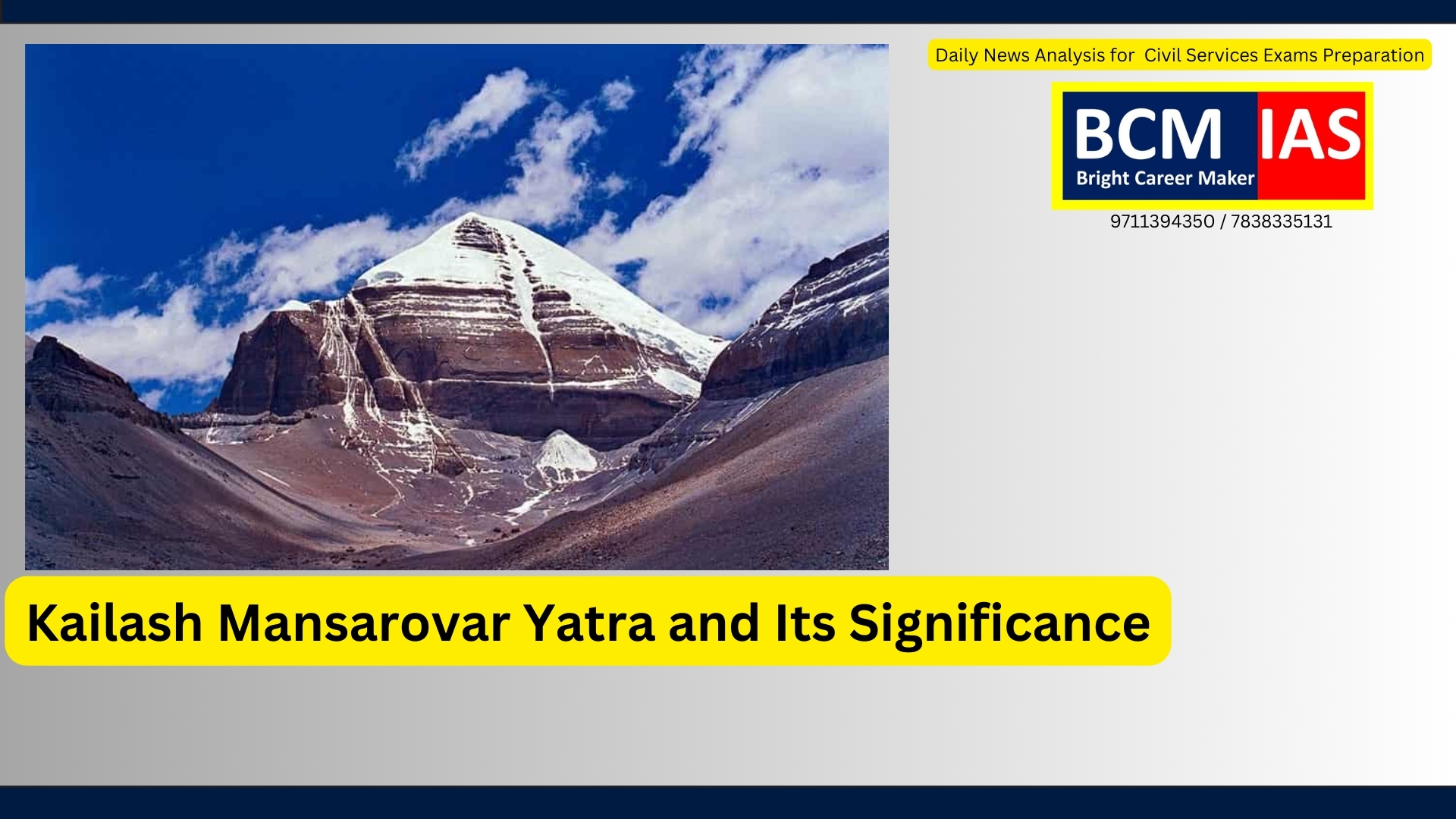
Kailash
Mansarovar Yatra and Its Significance
1. Introduction
The Kailash Mansarovar Yatra (KMY) is a pilgrimage
to Mount Kailash and Lake Mansarovar in Tibet, considered sacred in Hinduism,
Buddhism, Jainism, and the Bon religion. India and China have agreed to resume
the annual yatra, which was suspended due to geopolitical tensions and
COVID-19 restrictions.
2. Geographic & Religious Significance of Mount Kailash
A. Geographic Features
- Location:
Tibet Autonomous Region, China
- Elevation: 6,638
meters
- Composition:
Made of black rock, diamond-shaped peak
- Surrounding
Rivers: Source of four major Asian rivers:
- Indus
- Sutlej
- Brahmaputra
- Karnali
(a tributary of the Ganga)
Significance:
- These
rivers support millions of people across South Asia, making Kailash
a crucial hydrological landmark.
B. Religious Significance
|
Religion |
Belief
About Mount Kailash |
|
Hinduism |
Abode
of Lord Shiva & Goddess Parvati |
|
Buddhism |
Represents
Mount Meru, the cosmic axis connecting heaven and earth |
|
Jainism |
Known
as Ashtapada, where Rishabhanatha (first Tirthankara) attained
enlightenment |
|
Bon (Tibetan indigenous religion) |
Center
of spiritual energy |
Significance:
- Considered
the spiritual center of the Earth.
- Unclimbed
and protected due to its sacred nature,
unlike Mount Everest.
3. Kailash Mansarovar Yatra (KMY) – Routes & History
A. Yatra Routes
- Lipulekh
Pass, Uttarakhand (since 1981) –
Traditional & shorter route
- Nathu
La Pass, Sikkim (since 2015) – Easier and motorable
route
Significance:
- Strengthens
India-China religious diplomacy.
- Allows
devotees to perform circumambulation (parikrama) of Kailash.
B. Suspension & Revival of KMY
- Suspended
due to COVID-19 and India-China border tensions (Galwan
Conflict, 2020).
- 2025
Revival Agreement signifies improved
India-China cultural relations.
4. Lake Mansarovar – Sacred & Ecological Significance
- Location: At
the base of Mount Kailash, at an altitude of 4,590 meters.
- Name
Meaning: Mansa (mind) + Sarovar (lake) –
Created in the mind of Lord Brahma.
- Spiritual
Beliefs:
- Considered
one of the purest lakes in Hindu tradition.
- Believed
that drinking its water cleanses sins.
- Important
stop for ritual baths & meditation.
- Ecological
Role:
- Supports
local biodiversity, including migratory birds.
- Glacial-fed
freshwater lake, crucial for maintaining hydrological
balance.
5. Challenges & Conservation Efforts
A. Political & Diplomatic Issues
- India-China
border disputes affect pilgrimage access.
- China's
strict visa & security regulations
limit Indian pilgrim participation.
B. Environmental Concerns
- Climate
change impacts glaciers, affecting water sources.
- Tourism
pressure causes pollution in fragile Himalayan
ecosystems.
C. Conservation Initiatives
- Regulated
pilgrim access to minimize environmental
damage.
- Improved
infrastructure for waste management along
the route.
- Strict
climbing ban maintains spiritual
sanctity.
6. Way Forward
1. Strengthen Bilateral Agreements:
India-China cooperation should ensure safe & uninterrupted yatra access.
2. Sustainable Tourism Management:
Eco-friendly policies to preserve fragile ecosystems.
3. Digital Pilgrimage Initiatives: Virtual
yatras for those unable to visit physically.
4. Climate Adaptation Measures: Monitor glacial
health to protect Lake Mansarovar.
7. Conclusion
The Kailash Mansarovar Yatra is not just
a pilgrimage but a spiritual, cultural, and geopolitical bridge between India
and China. Its revival marks a positive diplomatic step, but
sustainable tourism and environmental conservation remain key to preserving
this sacred Himalayan heritage for future generations.
Mains Practice
Question (GS Paper 1 –
Indian Culture & Geography / GS Paper 2 – International Relations)
Q1.
"The Kailash Mansarovar Yatra is not just a pilgrimage but a symbol of
India's cultural heritage and diplomatic ties with China." Discuss. (250
words)
Answer:
Introduction
The Kailash Mansarovar Yatra (KMY) is an
annual pilgrimage to Mount Kailash (6,638 meters) and Lake Mansarovar in
Tibet. Revered in Hinduism, Buddhism, Jainism, and Bon tradition, it
is considered the spiritual center of the Earth. India and China have
recently agreed to resume the yatra, marking an important step in
bilateral relations.
Religious and Cultural Significance
1. Hinduism: Abode of
Lord Shiva and Goddess Parvati.
2. Buddhism:
Represents Mount Meru, the cosmic axis connecting heaven and
earth.
3. Jainism: Known as
Ashtapada, where Rishabhanatha (first Tirthankara) attained
enlightenment.
4. Bon Religion (Tibet): Sacred center
of energy.
This yatra preserves India's ancient pilgrimage
traditions and strengthens cultural ties with Tibetan Buddhism.
Geographical and Environmental Significance
- Hydrological
Importance: Mount Kailash is the source of four major
rivers – Indus, Sutlej, Brahmaputra, and Karnali.
- Lake
Mansarovar (4,590m altitude): Sacred and one of the
highest freshwater lakes in the world.
- Unclimbed
Peak: Unlike Mount Everest, Kailash remains
untouched due to its spiritual significance.
Sustaining this region is crucial for regional
water security and biodiversity.
Geopolitical and Strategic Importance
- India-China Diplomatic Ties:
- The
yatra route through Lipulekh Pass (Uttarakhand) and Nathu La
Pass (Sikkim) has been a point of cooperation and conflict.
- Suspended
after 2020 border clashes (Galwan Valley Conflict),
its revival indicates improving relations.
- Border Disputes &
Infrastructure Development:
- China’s
control over Tibet limits India’s access.
- India's
road expansion near Lipulekh has triggered Chinese
objections.
Ensuring uninterrupted yatra access requires
diplomatic negotiations.
Challenges in Conducting the Yatra
1. Political
& Diplomatic Issues: India-China border tensions impact pilgrimage
permits.
2. Harsh Terrain
& Weather: High
altitude, extreme cold, and lack of oxygen pose risks.
3. Environmental
Concerns: Increasing pilgrim traffic threatens fragile
Himalayan ecosystems.
4. Infrastructure
Limitations: Lack of medical aid and road connectivity limits
accessibility.
Way Forward
1. Strengthen
India-China Agreements: Maintain dialogue
for peaceful and uninterrupted access.
2. Sustainable
Pilgrimage Management: Eco-friendly
tourism to preserve fragile ecosystems.
3. Digital
Pilgrimage Alternatives: Virtual tours for elderly and unable pilgrims.
4. Enhance Border
Infrastructure: Improve medical
& transport facilities for safer journeys.
Conclusion
The Kailash Mansarovar Yatra is not just a religious journey but a symbol
of India's cultural heritage and diplomatic engagements with China. Despite
geopolitical tensions and environmental concerns, its continuation is
vital for spiritual tourism, bilateral relations, and regional ecology. A balanced
approach combining diplomatic dialogue, sustainable tourism, and improved
infrastructure is necessary for preserving this sacred pilgrimage for
future generations.
MCQs for Prelims Practice
1. Consider the following
statements regarding Mount Kailash and Lake Mansarovar:
1. Mount Kailash is considered sacred in Hinduism,
Buddhism, Jainism, and the Bon religion.
2. Lake Mansarovar is a saline water lake located at
the base of Mount Kailash.
3. Mount Kailash is the highest peak in the Tibetan
Plateau.
Which of the statements given above is/are correct?
A. 1 only
B. 1 and 2 only
C. 2 and 3 only
D. 1, 2, and 3
Answer:
A. 1 only
(Explanation: Lake Mansarovar is
a freshwater lake, not saline. Mount Kailash (6,638m) is not the
highest peak in the Tibetan Plateau—Mount Everest (8,849m) holds that title.)
2. Which of the following
statements about the Kailash Mansarovar Yatra (KMY) are correct?
1. The yatra is organized annually by the Government
of India through Lipulekh Pass in Uttarakhand and Nathu La Pass in Sikkim.
2. The yatra was suspended after the India-China
border clashes in 2020 but is now being revived.
3. The Government of India provides financial
assistance to all pilgrims undertaking the yatra.
Select the correct answer using the codes given
below:
A. 1 and 2 only
B. 2 and 3 only
C. 1 and 3 only
D. 1, 2, and 3
Answer:
A. 1 and 2 only
(Explanation: The Indian
government does not provide direct financial assistance to all pilgrims.
However, some states offer subsidies.)
3. Consider the following
statements regarding the geopolitical significance of Kailash Mansarovar:
1. The Lipulekh Pass, a route for the yatra, is a
disputed territory between India, Nepal, and China.
2. China exercises administrative control over the
Kailash Mansarovar region as part of the Tibet Autonomous Region.
3. The Nathu La route for the yatra was opened after
an agreement between India and China in 2015.
Which of the statements given above is/are correct?
A. 1 only
B. 1 and 2 only
C. 2 and 3 only
D. 1, 2, and 3
Answer:
D. 1, 2, and 3
(Explanation: The Lipulekh
Pass is a disputed region involving India, Nepal, and China. China controls
the Kailash Mansarovar region as part of Tibet. In 2015, the Nathu La
route was opened for the pilgrimage under an India-China agreement.)
4. The four major rivers
originating from the Mount Kailash region are:
A. Indus, Sutlej, Ganga, Yamuna
B. Brahmaputra, Sutlej, Karnali, Indus
C. Ganga, Brahmaputra, Narmada, Tapi
D. Yamuna, Godavari, Krishna, Mahanadi
Answer:
B. Brahmaputra, Sutlej, Karnali, Indus
(Explanation: The four major
rivers originating from Mount Kailash are Indus, Sutlej, Brahmaputra, and
Karnali (a tributary of the Ganga).)
5. With reference to Mount
Kailash, consider the following statements:
1. It remains unclimbed due to its religious
significance.
2. It is referred to as Mount Meru in Hindu and
Buddhist traditions.
3. It is located in Arunachal Pradesh, India.
Which of the statements given above is/are correct?
A. 1 and 2 only
B. 2 and 3 only
C. 1 and 3 only
D. 1, 2, and 3
Answer:
A. 1 and 2 only
(Explanation: Mount Kailash is located
in Tibet, not Arunachal Pradesh. It is considered sacred and remains
unclimbed due to religious prohibitions. It is also associated with Mount
Meru in Hindu and Buddhist traditions.)


Comments on “Kailash Mansarovar Yatra and Its Significance”