


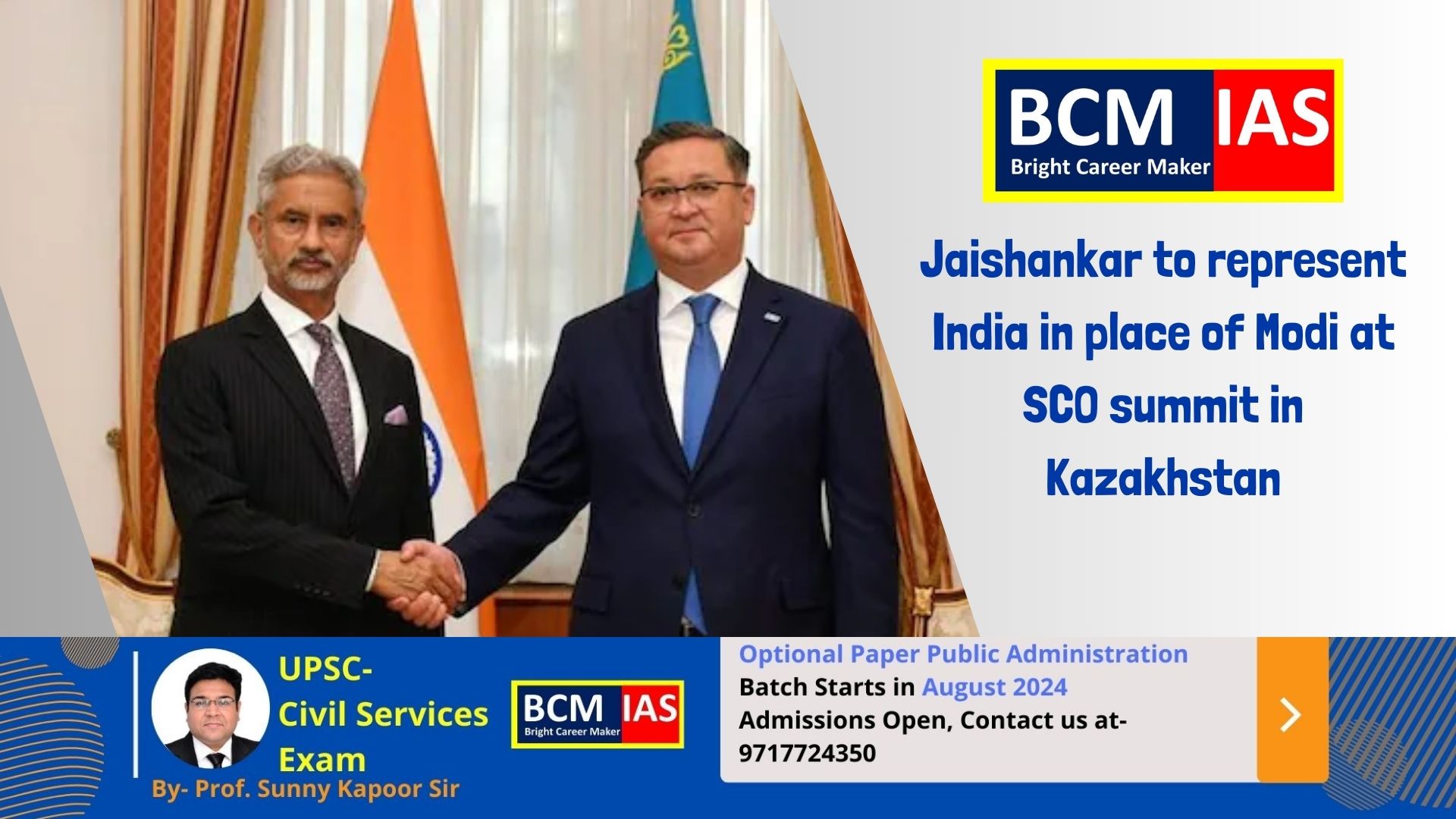
Jaishankar to
represent India in place of Modi at SCO summit in Kazakhstan
Analysis
· The
article discusses the decision of India's Prime Minister Narendra Modi to skip
the Shanghai Cooperation Organisation (SCO) summit in Kazakhstan, with External
Affairs Minister S. Jaishankar representing India instead.
· This decision comes amidst the participation
of key leaders such as Chinese President Xi Jinping, Russian President Vladimir
Putin, and Pakistani Prime Minister Shehbaz Sharif, and has significant
implications for India's foreign relations and engagement with Central Asia.
Event Details
Summit Attendance and Representation
- S. Jaishankar's Role: External Affairs Minister S.
Jaishankar is leading the Indian delegation at the SCO Council of Heads of
State in Astana, Kazakhstan. He reached Astana and has already engaged in
discussions with Kazakh Deputy Prime Minister and Foreign Minister Murat
Nurtleu.
- Key Attendees: Leaders of the newly expanded
SCO, including Presidents of Uzbekistan, Kyrgyzstan, Tajikistan, and
Belarus, are attending. Chinese President Xi Jinping and Russian President
Vladimir Putin are also present, while Iran’s President is likely to miss
the summit due to elections.
Modi's Absence
- Avoiding Awkward Interactions: Prime Minister
Modi's absence is seen as a strategic move to avoid awkward interactions
with leaders of China and Pakistan, given the current tense relations with
both countries.
- Impact on Central Asian Relations: Modi's decision may
disappoint Central Asian countries, as interactions have been cancelled
twice before—once during the Republic Day in 2022 due to COVID-19, and the
SCO Summit in 2023, which was held virtually.
Discussions and Agenda
Multilateral Cooperation
- Plenary Session: Jaishankar is expected to
address the plenary session, discussing the SCO’s activities over the past
two decades and prospects for multilateral cooperation in trade,
connectivity, and counter-terrorism.
- Astana Declaration: The summit will adopt the
Astana Declaration, focusing on strengthening economic ties, connectivity,
fighting terrorism, and regional developments.
Strategic Interests
·
Chabahar Port and INSTC: India has promoted
maximizing the utilization of the Chabahar Port and the International
North-South Transport Corridor (INSTC), which connects India to Central Asia
and Russia via Iran.
·
India-Middle East-Europe Economic
Corridor (IMEC): The IMEC has been stalled due to the Israel-Gaza conflict.
Geopolitical
Implications
India-Pakistan Dynamics
- Trade and Terrorism: India and Pakistan, both SCO
members since 2017, have often clashed over issues like terrorism and
transit trade during high-level meetings.
- Ports and Trade Routes: Pakistani PM Shehbaz Sharif is
expected to offer Qasim and Gwadar ports for Central Asia’s trade routes.
Afghanistan
- Taliban Regime: Developments in Afghanistan are
likely to be a key topic, as most SCO members are closely engaged with the
Taliban regime.
Conclusion
Prime Minister Modi’s decision to skip the SCO summit
in Kazakhstan has significant implications for India's foreign policy and
relations with Central Asia. While avoiding potentially awkward interactions
with leaders of China and Pakistan, this move may lead to disappointment among
Central Asian countries seeking engagement with India. The discussions at the
SCO summit, particularly the adoption of the Astana Declaration, will focus on
enhancing multilateral cooperation in trade, connectivity, and counter-terrorism,
alongside strategic interests such as the utilization of key ports and trade
corridors. The geopolitical dynamics, including India-Pakistan relations and
developments in Afghanistan, will also be central to the summit’s agenda.
Mains Practice Question
Question: Discuss
the implications of Prime Minister Narendra Modi's decision to skip the SCO
summit in Kazakhstan, considering the broader context of India's strategic
interests and foreign policy. How might this decision affect India's relations
with Central Asian countries and its geopolitical stance in the region?
Answer:
Introduction:
Prime Minister Narendra Modi's decision to skip the
Shanghai Cooperation Organisation (SCO) summit in Kazakhstan, with External
Affairs Minister S. Jaishankar representing India, is a significant move in the
context of India's foreign policy. This decision comes amidst participation
from key leaders such as Chinese President Xi Jinping, Russian President
Vladimir Putin, and Pakistani Prime Minister Shehbaz Sharif. The implications
of this decision are multifaceted, impacting India's strategic interests and its
relations with Central Asian countries.
Body:
1. Strategic Avoidance:
- Avoiding Tensions: Modi’s absence can be seen as a
strategic move to avoid awkward interactions with leaders from China and
Pakistan, given the ongoing border tensions with China and strained
relations with Pakistan.
- Diplomatic Message: This decision sends a subtle
diplomatic message, emphasizing India's discontent with the actions of
these neighboring countries, especially in the context of border conflicts
and issues related to terrorism.
2. Impact on Central Asian Relations:
- Disappointment Among Central Asian Leaders: Modi’s absence may
disappoint Central Asian countries, as his interactions with them have
been cancelled twice before, once during Republic Day in 2022 due to
COVID-19, and again in 2023 when the SCO summit was held virtually.
- Missed Opportunities for Engagement: Personal engagement
with Central Asian leaders is crucial for strengthening bilateral
relations and fostering cooperation in various sectors such as trade,
energy, and security.
3. India's Strategic Interests:
- Promotion of Strategic Projects: India has been
promoting key projects like the Chabahar Port and the International
North-South Transport Corridor (INSTC) to enhance connectivity with
Central Asia and Russia. Modi's absence might affect the momentum of these
projects.
- Economic Corridors: The India-Middle East-Europe
Economic Corridor (IMEC), which has faced delays due to the Israel-Gaza
conflict, also requires strong diplomatic push and cooperation from
regional partners.
4. Geopolitical Implications:
- Strengthening Multilateral Ties: The SCO summit is
expected to discuss multilateral cooperation in trade, connectivity, and
counter-terrorism. India's participation is crucial for influencing these
discussions and ensuring its strategic interests are considered.
- Balancing Regional Influence: With Russia and
China playing dominant roles in the SCO, India’s active participation is
essential to balance their influence and ensure a multipolar regional
order.
5. Future Prospects:
- Upcoming SCO Meetings: Given the next SCO Heads of
Government meet is due to be held in Pakistan later this year and the next
SCO Summit will be hosted by China in 2025, it remains to be seen whether
Modi will attend these future events, which could further shape India's
strategic positioning in the region.
Conclusion:
Prime Minister Modi’s decision to skip the SCO summit
in Kazakhstan has significant implications for India’s foreign policy and
strategic interests. While it serves as a strategic avoidance of potential
diplomatic tensions with China and Pakistan, it may also lead to missed
opportunities for direct engagement with Central Asian leaders. Strengthening
multilateral ties and balancing regional influence remain crucial for India’s
geopolitical stance. The success of India's strategic projects and its role in
the SCO will depend on its ability to navigate these complex diplomatic
landscapes effectively.
MCQs Practice
Question 1: Why did Prime Minister
Narendra Modi decide to skip the SCO summit in Kazakhstan?
A. Due to health reasons
B. To avoid awkward interactions with Chinese and
Pakistani leaders
C. Because India is no longer a member of the SCO
D. Due to the COVID-19 pandemic
Answer: B. To avoid awkward interactions
with Chinese and Pakistani leaders
Question 2: Who represented India at
the SCO summit in Kazakhstan in place of Prime Minister Narendra Modi?
A. National Security Advisor Ajit Doval
B. Finance Minister Nirmala Sitharaman
C. External Affairs Minister S. Jaishankar
D. Home Minister Amit Shah
Answer: C. External Affairs Minister S.
Jaishankar
Question 3: What significant
declaration is expected to be adopted at the SCO summit in Kazakhstan?
A. Delhi Declaration
B. Astana Declaration
C. Beijing Declaration
D. Moscow Declaration
Answer: B. Astana Declaration
Question 4: Which port has India
promoted for maximizing utilization to enhance connectivity with Central Asia?
A. Gwadar Port
B. Chabahar Port
C. Karachi Port
D. Port of Bandar Abbas
Answer: B. Chabahar Port
Question 5: Which of the following is
a key topic expected to be discussed at the SCO summit?
A. Space exploration
B. Global warming
C. Multilateral cooperation in trade and fighting
terrorism
D. Cybersecurity
Answer: C. Multilateral cooperation in trade
and fighting terrorism


Comments on “Jaishankar to represent India in place of Modi at SCO summit in Kazakhstan”