


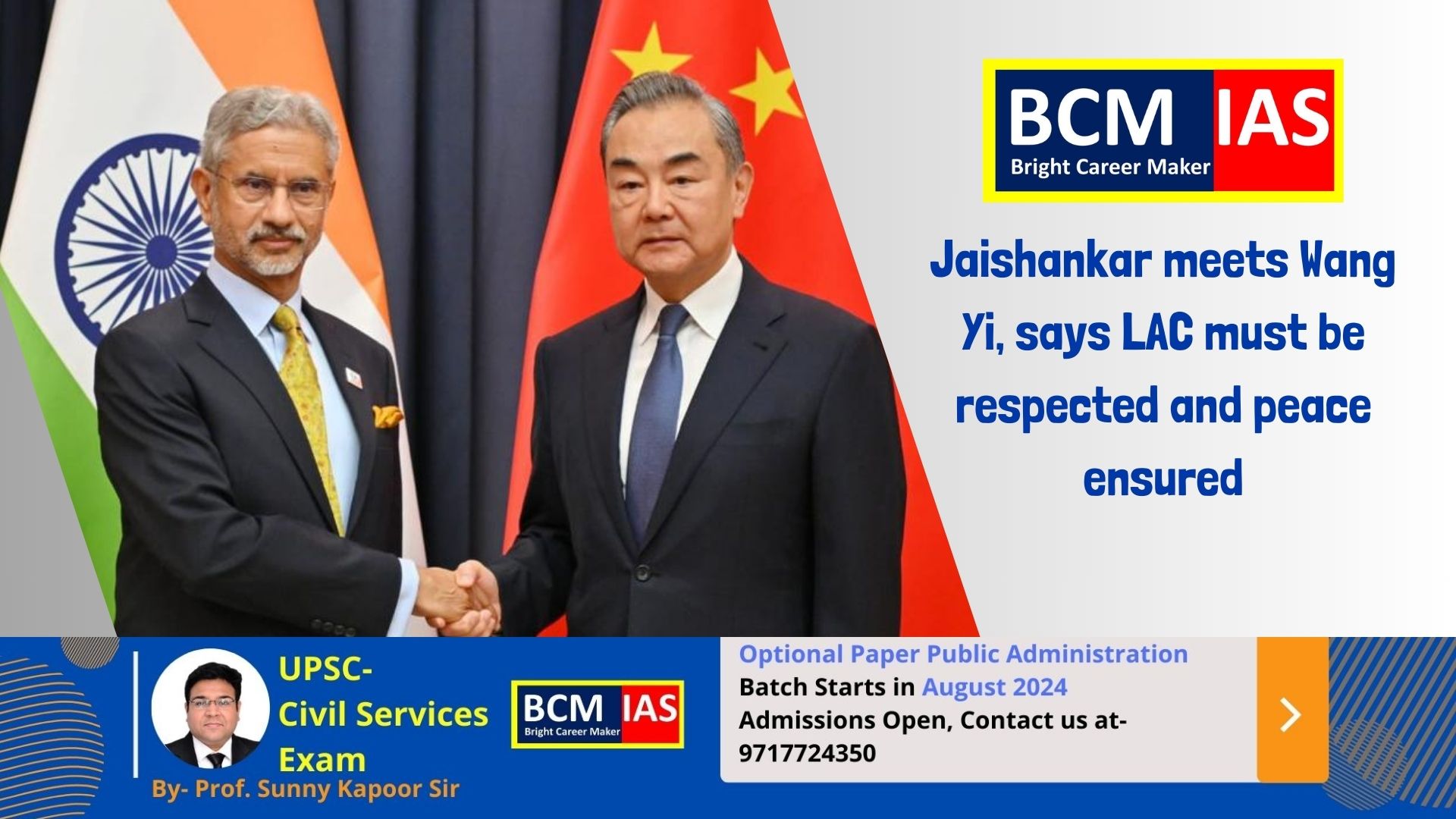
Jaishankar meets Wang Yi, says
LAC must be respected and peace ensured
Analysis
·
The recent meeting between External Affairs
Minister S. Jaishankar and Chinese Foreign Minister Wang Yi on the
sidelines of the Shanghai Cooperation Organisation (SCO) Council meeting
in Astana marks a significant moment in India-China relations.
·
This encounter, the first since the Lok Sabha
elections, underscores the continued emphasis on resolving the boundary
disputes and ensuring peace and tranquillity along the Line of Actual Control
(LAC).
Mutual Respect and LAC
During the meeting, both sides stressed the importance of
mutual respect in addressing the boundary issues that have strained their
bilateral relations for the past four years. Mr. Jaishankar emphasized the
necessity of respecting the LAC and maintaining peace in the border areas, a
stance reiterated in the statement issued by the Ministry of External Affairs
(MEA).
Prolongation of the Current Situation
The prolongation of the current situation in the border areas
was acknowledged as detrimental to both countries. Mr. Jaishankar highlighted
the urgency of achieving complete disengagement from the remaining contested
areas in Eastern Ladakh. This step is seen as essential for restoring peace and
removing obstacles to the normalization of bilateral relations.
Historical Context of the Border Standoff
The India-China border standoff has been ongoing since April
2020, with several high-level meetings failing to produce a significant
breakthrough. The persistence of this issue is linked to the Chinese stance at
the Demchok and Depsang sectors, which remains a critical point of contention
in the border negotiations.
Chinese Perspective
In a separate statement, the Chinese Ministry of Foreign
Affairs emphasized the need to find the "correct way" to handle the
situation. The Chinese approach advocates for balancing proper control of the
border situation with the resumption of normal exchanges and mutual promotion.
Global Situation and SCO Context
The MEA statement also indicated that the two leaders
discussed broader global issues and that India expressed support for China's
upcoming presidency of the SCO in 2025. At the SCO Council of Heads of State,
Mr. Jaishankar, reading Prime Minister Narendra Modi’s address, reiterated the
SCO's commitment to respecting sovereignty, independence, and territorial
integrity, subtly signaling concerns related to China.
Terrorism and Regional Stability
A key point in Mr. Modi's address was the emphasis on
combating terrorism, a fundamental goal of the SCO. This was particularly
directed at Pakistan, highlighting the ongoing regional security concerns that
India prioritizes within the SCO framework.
Conclusion
The meeting between Mr. Jaishankar and Mr. Wang Yi
underscores the complexity of India-China relations, particularly concerning
border issues. While both sides acknowledge the need for mutual respect and
peaceful resolution, the path to complete disengagement and normalization
remains fraught with challenges. The discussions at the SCO further reflect the
broader geopolitical considerations and India's stance on regional stability
and counter-terrorism.
The continued dialogue and efforts towards disengagement
signify a cautious optimism but also highlight the necessity for sustained
diplomatic engagement to address the underlying issues effectively.
Mains Practice Question
Discuss the significance of the recent meeting
between India's External Affairs Minister S. Jaishankar and Chinese Foreign
Minister Wang Yi on the sidelines of the SCO Council meeting, focusing on the
boundary dispute and its implications for India-China relations.
Answer
Introduction
The recent meeting between India's External Affairs Minister
S. Jaishankar and Chinese Foreign Minister Wang Yi on the sidelines of the
Shanghai Cooperation Organisation (SCO) Council meeting holds considerable
significance for the ongoing boundary dispute between India and China. This
interaction, occurring against the backdrop of prolonged tensions since April
2020, underscores the importance both nations place on dialogue and diplomatic
engagement to resolve their differences.
Body
Importance of Mutual Respect and LAC
Both ministers highlighted the need for mutual respect in
resolving boundary issues. Mr. Jaishankar emphasized the necessity of
respecting the Line of Actual Control (LAC) and maintaining peace and
tranquillity in the border areas. This stance was reiterated in the statement
issued by the Ministry of External Affairs (MEA). Respecting the LAC is crucial
for ensuring stability and preventing further escalation of tensions, which
have periodically led to violent clashes.
Prolongation of the Current Situation
The meeting underscored that the prolongation of the current
situation in the border areas is not in the interest of either side. Mr.
Jaishankar stressed the urgency of achieving complete disengagement from the
remaining contested areas in Eastern Ladakh. This step is essential for
restoring peace and normalcy in bilateral relations, which have been adversely
affected by the standoff.
Historical Context of the Border Standoff
The India-China border standoff has been ongoing since April
2020, with several high-level meetings failing to produce a significant
breakthrough. The persistence of this issue is linked to the Chinese stance at
the Demchok and Depsang sectors, which remains a critical point of contention.
The lack of progress in border negotiations highlights the complexities
involved in resolving territorial disputes between two major powers with a
history of mistrust.
Chinese Perspective
The Chinese Ministry of Foreign Affairs emphasized the need
to find the "correct way" to handle the situation, advocating for
balancing proper control of the border situation with the resumption of normal
exchanges. This approach suggests a desire to stabilize the border areas while
maintaining broader bilateral engagement, which is important for regional
stability and economic cooperation.
Global Situation and SCO Context
The MEA statement indicated that the two leaders also
discussed broader global issues, with India expressing support for China's
upcoming presidency of the SCO in 2025. At the SCO Council of Heads of State,
Mr. Jaishankar, reading Prime Minister Narendra Modi’s address, reiterated the
SCO's commitment to respecting sovereignty, independence, and territorial
integrity. This reflects India's broader strategic goals within the SCO
framework, signaling its concerns related to China while emphasizing the importance
of multilateral cooperation.
Terrorism and Regional Stability
A key point in Mr. Modi's address was the emphasis on
combating terrorism, a fundamental goal of the SCO. This was particularly
directed at Pakistan, highlighting the ongoing regional security concerns that
India prioritizes. The focus on terrorism within the SCO context underscores
the need for a collective approach to address security threats that affect
regional peace and stability.
Conclusion
The meeting between Mr. Jaishankar and Mr. Wang Yi
underscores the complexity of India-China relations, particularly concerning
the boundary dispute. While both sides acknowledge the need for mutual respect
and peaceful resolution, the path to complete disengagement and normalization
remains challenging. The discussions at the SCO further reflect broader
geopolitical considerations and India's stance on regional stability and
counter-terrorism.
Continued dialogue and diplomatic efforts are essential for
addressing the underlying issues effectively. The meeting represents a cautious
optimism, highlighting the necessity of sustained engagement to prevent further
escalation and promote peace and stability in the region.
MCQs for Practice
Question 1
What was the primary topic of discussion between External
Affairs Minister S. Jaishankar and Chinese Foreign Minister Wang Yi during
their recent meeting?
A. Economic cooperation
B. Combating terrorism
C. Boundary dispute and LAC issues
D. Cultural exchanges
Answer: C. Boundary dispute and LAC issues
Question 2
According to the MEA statement, what did Mr. Jaishankar
highlight as essential for removing obstacles towards the return of normalcy in
bilateral relations?
A. Increased economic trade
B. Complete disengagement from contested areas in Eastern Ladakh
C. Enhanced cultural exchanges
D. Joint military exercises
Answer: B. Complete disengagement from contested areas in Eastern Ladakh
Question 3
What has been a major point of contention in the India-China
border negotiations, according to the article?
A. Trade tariffs
B. Water sharing agreements
C. Chinese position at the Demchok and Depsang sectors
D. Environmental policies
Answer: C. Chinese position at the Demchok and Depsang sectors
Question 4
What broader topic did the MEA statement indicate was also
discussed by the two leaders?
A. Climate change
B. Global economic policies
C. The global situation and India’s support for China’s SCO presidency in 2025
D. Technological advancements
Answer: C. The global situation and India’s support for China’s SCO presidency
in 2025
Question 5
In the context of the SCO, what priority did Prime Minister
Narendra Modi's address emphasize?
A. Promoting free trade agreements
B. Combating terrorism
C. Increasing cultural exchanges
D. Developing new infrastructure projects
Answer: B. Combating terrorism


Comments on “Jaishankar meets Wang Yi, says LAC must be respected and peace ensured”