


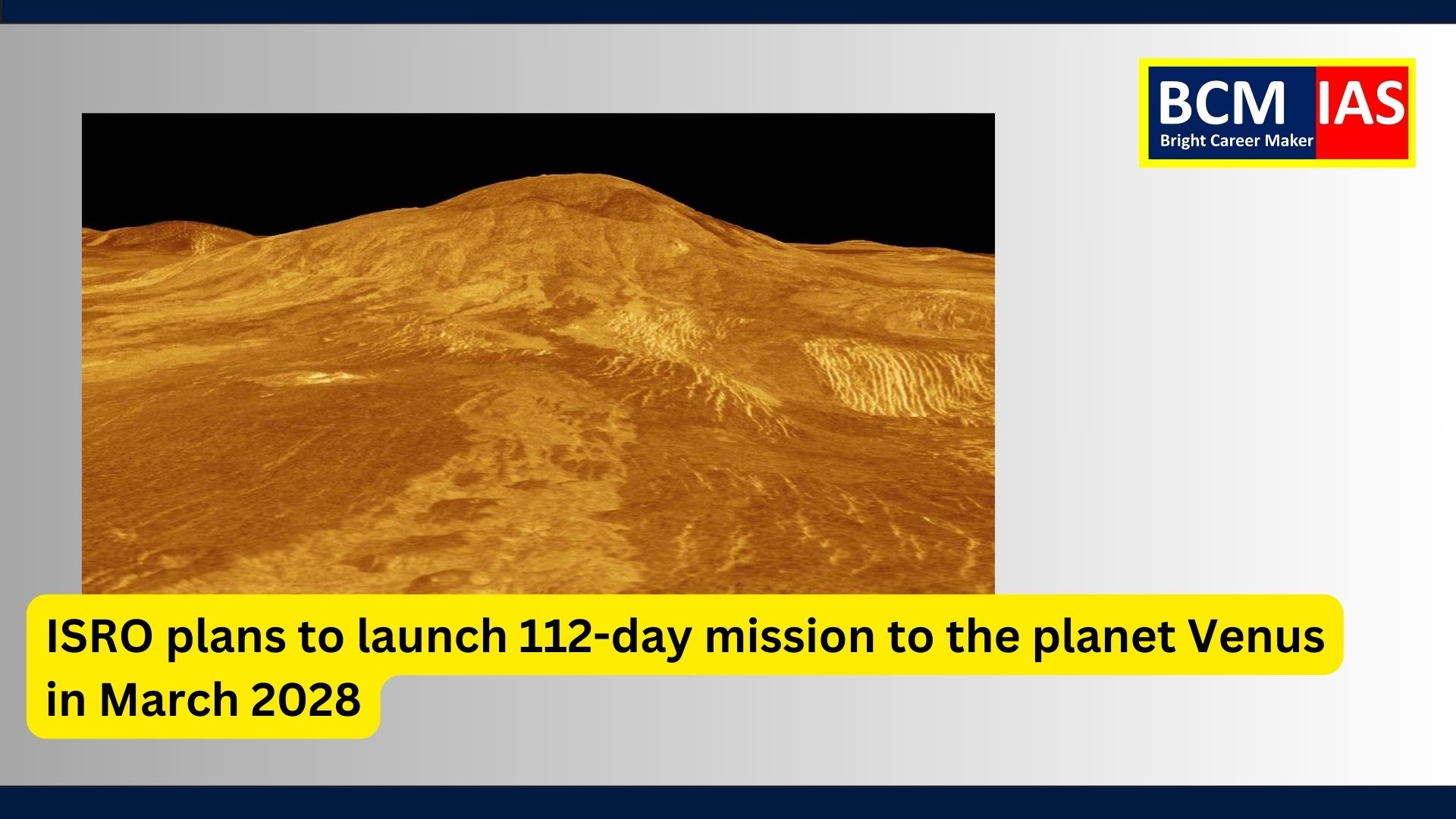
ISRO plans to launch 112-day
mission to the planet Venus in March 2028
India’s first mission to Venus, slated for March 2028, marks
a significant step in planetary exploration. Approved by the Union Cabinet with
a budget of ₹1,236 crore, the mission is set to cover a 112-day journey to
reach Venus by July 19, 2028. The Launch Vehicle Mark-3 (LVM-3) will carry the
Venus Orbiter Mission (VOM) into space.
Key
Mission Details:
- Launch
Window: Earth
departure is scheduled for March 29, 2028.
- Orbit
Details: The
spacecraft will be placed in an Elliptical Parking Orbit (EPO) around
Earth before its trajectory to Venus.
- Aerobraking: A crucial technique will be
used to gradually lower the orbit to a 200x600 km Science Orbit to
optimize scientific research.
Science
Objectives:
- Atmospheric
Studies:
Examination of Venus' atmosphere, focusing on dust, airglow, and solar
X-ray interaction.
- Surface
Mapping:
High-resolution topographical mapping and subsurface studies of Venus.
International
Collaboration:
- 19
payloads will be onboard, including 16 Indian payloads and three
international collaborative instruments, reinforcing global scientific
partnerships.
This mission underlines ISRO’s growing capacity in
interplanetary exploration and aims to provide a deeper understanding of Venus,
particularly its atmospheric and surface dynamics.
MCQs
1. What is the primary launch vehicle selected for India's
maiden mission to Venus?
A. PSLV
B. GSLV Mk-II
C. LVM-3
D. GSLV Mk-III
Answer: C. LVM-3
Explanation: ISRO has chosen the Launch Vehicle Mark-3 (LVM-3) to launch
the Venus Orbiter Mission (VOM) in 2028.
2. What method will be employed to reduce the spacecraft's
orbit around Venus from a high elliptical orbit to a low altitude Science
Orbit?
A. Gravitational slingshot
B. Aerobraking
C. Retrograde propulsion
D. Direct descent
Answer: B. Aerobraking
Explanation: ISRO will use aerobraking over a period of six to eight
months to reduce the spacecraft’s orbit to the desired low altitude Science
Orbit of 200x600 km.
3. How long is the expected cruise time for ISRO’s spacecraft
to reach Venus after its launch in March 2028?
A. 90 days
B. 100 days
C. 112 days
D. 120 days
Answer: C. 112 days
Explanation: The spacecraft is expected to take 112 days to reach Venus
after its scheduled launch on March 29, 2028.
4. What will be the primary focus of scientific study during
ISRO’s Venus Orbiter Mission?
A. Venus' moons and their properties
B. The Venusian atmosphere and its interaction with the sun
C. Discovery of new planets in the solar system
D. Life on Venus
Answer: B. The Venusian atmosphere and its interaction with the sun
Explanation: The mission’s objectives include studying Venus’
atmosphere, surface, and its interaction with solar radiation.
5. Which of the following is not among the key
scientific objectives of the Venus Orbiter Mission?
A. Mapping Venus’ topography in high resolution
B. Studying Venusian airglow
C. Searching for life forms on Venus
D. Investigating sub-surface characteristics of Venus
Answer: C. Searching for life forms on Venus
Explanation: While the mission focuses on studying atmospheric and
surface properties, there is no mention of searching for life forms on Venus.


Comments on “ISRO plans to launch 112-day mission to the planet Venus in March 2028”