


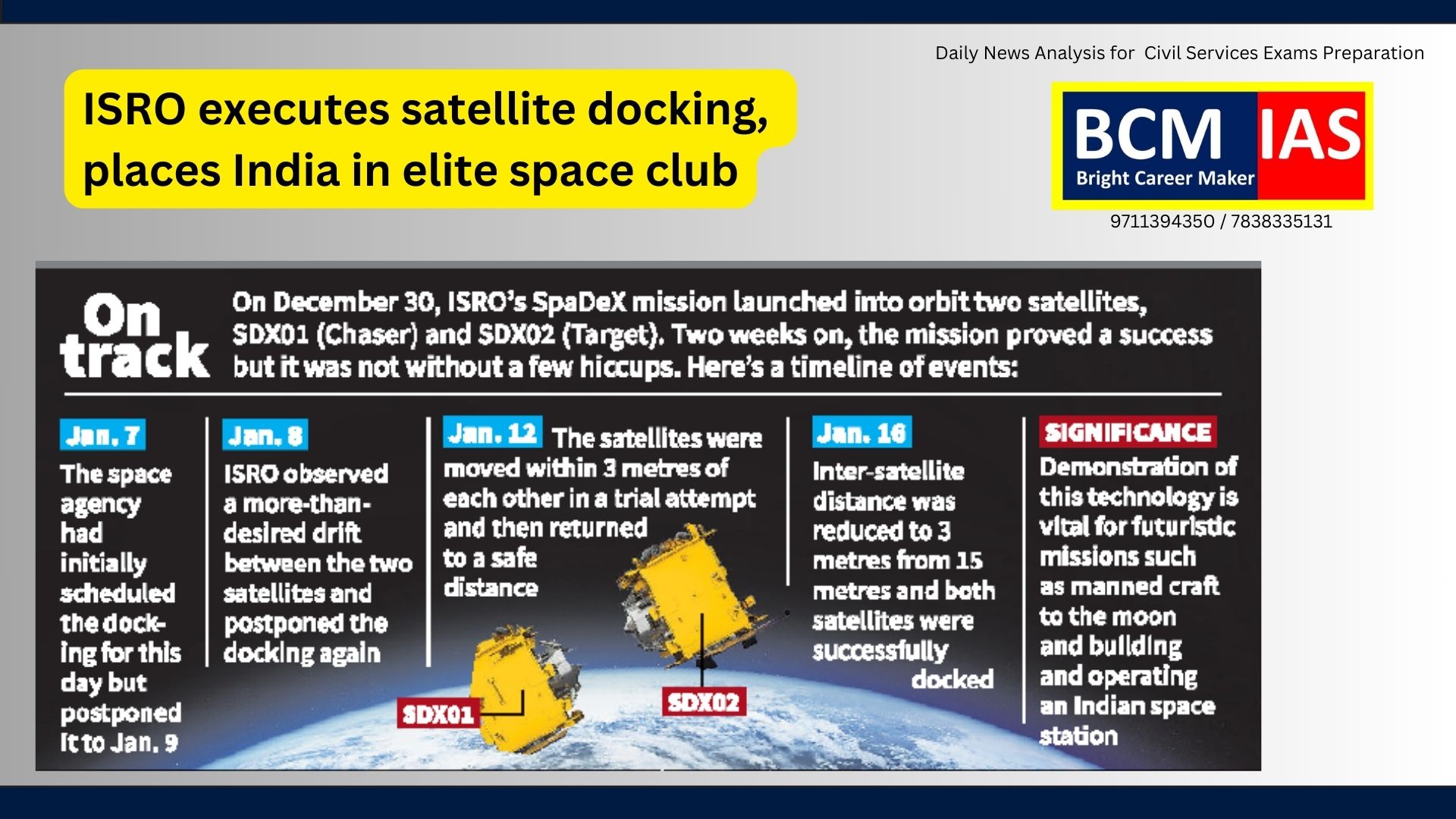
ISRO executes satellite docking, places India in elite
space club
This article describes ISRO's recent success
in satellite docking, marking India as the fourth country after the USA,
Russia, and China to achieve this feat. Below is a detailed analysis of the key
aspects of the event for better understanding:
Overview of the
Mission
- Mission
Name: SpaDeX (Space Docking Experiment).
- Satellites
Involved: SDX01 (Chaser) and SDX02 (Target).
- Launch
Vehicle: PSLV C60.
- Launch
Date: December 30, 2024.
- Orbital
Placement: 475-km circular orbit.
This mission aimed to develop and demonstrate docking technology, a critical step for future advanced space missions, including moon exploration and space station development.
What is Space Docking? 🚀✨
Imagine
two cars on a road trying to join together while moving. But instead of cars,
we have two spaceships in space! Space docking is when
one spaceship connects to another while flying in space.
How Does it Work? 🛰️🤝🚀
Think
of it like this:
1. Racing Towards a
Friend – One spaceship (like a
small car) moves closer to the other spaceship (like a big truck).
2. Slowing Down – It doesn’t just crash! It slows down and carefully
moves into position.
3. Holding Hands – The two spaceships have special hooks or magnets to
grab each other gently.
4. Locking Together – Once connected, they lock tight so astronauts can move
between them safely.
Why is Space Docking Important? 🌍🌌
- 🚀 Astronauts need supplies
like food, water, and air. A supply ship docks with a space station to
deliver them.
- 🛰️ Repairs and Upgrades
– Sometimes, a spaceship docks to fix or add new parts.
- 🌕 Big Space Missions
– When astronauts went to the Moon, they used space docking to join
different parts of their spaceship.
So, space docking is like a flying spaceship giving a
high-five to another spaceship, making sure astronauts stay safe and complete
their mission! 🚀👨🚀✨
Key Events and
Timeline
1. January
7, 2025:
o Initial
docking was scheduled but postponed due to the need for ground simulation
validations of an abort scenario identified earlier.
2. January
8, 2025:
o The
docking experiment faced another delay due to a larger-than-expected drift
between the two satellites. The issue was later corrected.
3. January
12, 2025:
o A
trial attempt brought the satellites to within 3 meters of each other before
moving them back to a safe distance for further validation.
4. January
18, 2025:
o Docking
successfully completed:
§ Inter-satellite
distance reduced from 15 meters to 3 meters.
§ Docking
involved precision maneuvers, retraction, and rigidization for stability.
§ The
two satellites were controlled as a single entity post-docking.
Significance of the
Achievement
1. Technological
Milestone:
o India
joins the elite club of spacefaring nations that have successfully achieved
satellite docking, demonstrating high precision and advanced engineering.
2. Future
Applications:
o Essential
for missions requiring composite spacecraft (e.g., interplanetary missions,
manned lunar expeditions).
o Facilitates
construction and operation of an Indian space station.
o Advances
in-space robotics and payload operations after undocking.
3. Power
Transfer Demonstration:
o Post-docking,
the mission aims to showcase the transfer of electrical power between the
satellites. This capability is crucial for enabling power-sharing in
multi-satellite configurations.
Challenges Faced
1. Drift
Management:
o A
key challenge was controlling and correcting unexpected drifts between the two
satellites.
2. Validation
Through Ground Simulations:
o The
docking was postponed multiple times to simulate abort scenarios, ensuring
mission safety and accuracy.
3. Complex
Docking Procedure:
o Required meticulous maneuvering (means moving carefully and skillfully to reach a goal.Example- A car maneuvers through traffic by turning and adjusting speed. )to reduce the distance from 15 meters to 3 meters and establish a stable docking connection.
Potential Impact
1. Manned
Space Missions:
o Docking
is a prerequisite for transferring crew and resources between spacecraft,
enabling manned lunar or interplanetary missions.
2. Space
Station Development:
o Sets
the foundation for creating an indigenous space station, enhancing India's
space capabilities.
3. Global
Recognition:
o Demonstrates
India's growing expertise in space technologies, boosting its global reputation
and opening avenues for international collaborations.
Conclusion
ISRO’s SpaDeX mission is a landmark
achievement showcasing India's ability to master complex space maneuvers. This
capability strengthens India's position as a leading spacefaring nation and
sets the stage for ambitious future projects, including manned moon missions
and space station development. The success highlights ISRO's commitment to
innovation and excellence in space technology.
Mains Question
Q. India has
become the fourth country to achieve successful satellite docking. Discuss the
significance of this achievement for India’s space program and its potential
applications in future missions.
Answer
Introduction
India's recent achievement in satellite docking
through ISRO's SpaDeX mission places the country among elite spacefaring
nations, alongside the USA, Russia, and China. This breakthrough is a key
milestone for advancing India's space exploration and technological
capabilities.
Significance of
Satellite Docking for India
1. Technological
Advancement:
o Demonstrates
India's capability in precision maneuvering and inter-satellite coordination.
o Paves
the way for mastering in-orbit assembly and maintenance.
2. Strategic
Importance:
o Enhances
India's position in global space technology leadership.
o Strengthens
international collaboration opportunities in advanced space missions.
3. Capacity
Building for Human Spaceflight:
o A
prerequisite for manned missions to the Moon and beyond.
o Supports
the Gaganyaan program and future Indian lunar expeditions.
4. Space
Station Development:
o Essential
for constructing and operating an indigenous space station.
o Facilitates
long-term habitation and research in low Earth orbit.
5. Cost
Efficiency:
o Enables
resource-sharing and enhances mission flexibility.
o Reduces
the need for redundant systems in multi-satellite missions.
Potential
Applications of the Achievement
1. Manned
Lunar and Interplanetary Missions:
o Allows
for spacecraft docking during crewed missions.
o Supports
lunar sample-return missions and exploration beyond Earth’s orbit.
2. In-Space
Robotics and Payload Operations:
o Demonstrates
the ability to transfer power and control between docked satellites.
o Crucial
for operating modular payloads after undocking.
3. Repair
and Refueling:
o Facilitates
satellite servicing and refueling missions, extending the operational life of
spacecraft.
4. Space
Research and Experiments:
o Creates
opportunities for complex experiments in microgravity conditions.
5. National
Security:
o Dual-use
technology can support defense-related satellite missions.
Challenges in
Achieving Satellite Docking
1. Technological
Barriers:
o Requires
precise control over inter-satellite distances and orientation.
o Managing
unexpected drift between satellites poses operational challenges.
2. Cost
and Resource Allocation:
o Developing
and maintaining such technologies demands substantial investments.
3. Long-Term
Sustainability:
o Requires
advancements in reusable systems and energy-efficient designs for sustained
operations.
Conclusion
The successful execution of ISRO’s SpaDeX
mission is a monumental achievement, marking India’s entry into an exclusive
club of nations capable of satellite docking. This milestone enhances India’s
capability for future space exploration, human spaceflight, and space station
development. By leveraging these advancements, India is poised to make
significant contributions to global space exploration efforts while fostering
technological self-reliance.
MCQs
1. Q1.
Which of the following countries has successfully demonstrated satellite
docking before India?
A. Japan, USA, Russia
B. USA, China, Russia
C. USA, Japan, China
D. USA, Russia, European Union
Answer: B.
USA, China, Russia
2. Q2.
What was the primary objective of ISRO’s SpaDeX mission?
A. To test reusable launch vehicle technology
B. To demonstrate inter-satellite docking and related technologies
C. To develop low-cost satellite launch mechanisms
D. To establish a permanent Indian space station
Answer: B.
To demonstrate inter-satellite docking and related technologies
3. Q3.
Why is satellite docking significant for India’s space program?
1.
It enables the development of in-space
refueling and repair technologies.
2.
It is a critical step for constructing a
space station.
3.
It enhances India’s strategic defense
capabilities.
4.
It facilitates the development of low-cost
satellite launches.
Select the correct answer
using the codes below:
A. 1 and 2 only
B. 1, 2, and 3 only
C. 2, 3, and 4 only
D. 1, 2, 3, and 4
Answer: B.
1, 2, and 3 only
4. Q4.
What additional functionality is planned to be demonstrated as part of ISRO’s
SpaDeX mission after successful docking?
A. Solar panel deployment from the Chaser satellite
B. Electric power transfer between docked satellites
C. Creation of a composite satellite for interplanetary missions
D. Establishment of a deep space communication network
Answer: B.
Electric power transfer between docked satellites
5. Q5.
In the context of ISRO’s SpaDeX mission, which of the following accurately
describes the terms "Chaser" and "Target"?
A. Chaser performs the docking, and Target remains stationary during the
process.
B. Chaser is a communication satellite, and Target is a navigation satellite.
C. Both Chaser and Target are used for Earth observation purposes.
D. Chaser is responsible for power transfer, and Target collects data.
Answer: A.
Chaser performs the docking, and Target remains stationary during the process.


Comments on “ISRO executes satellite docking, places India in elite space club”