


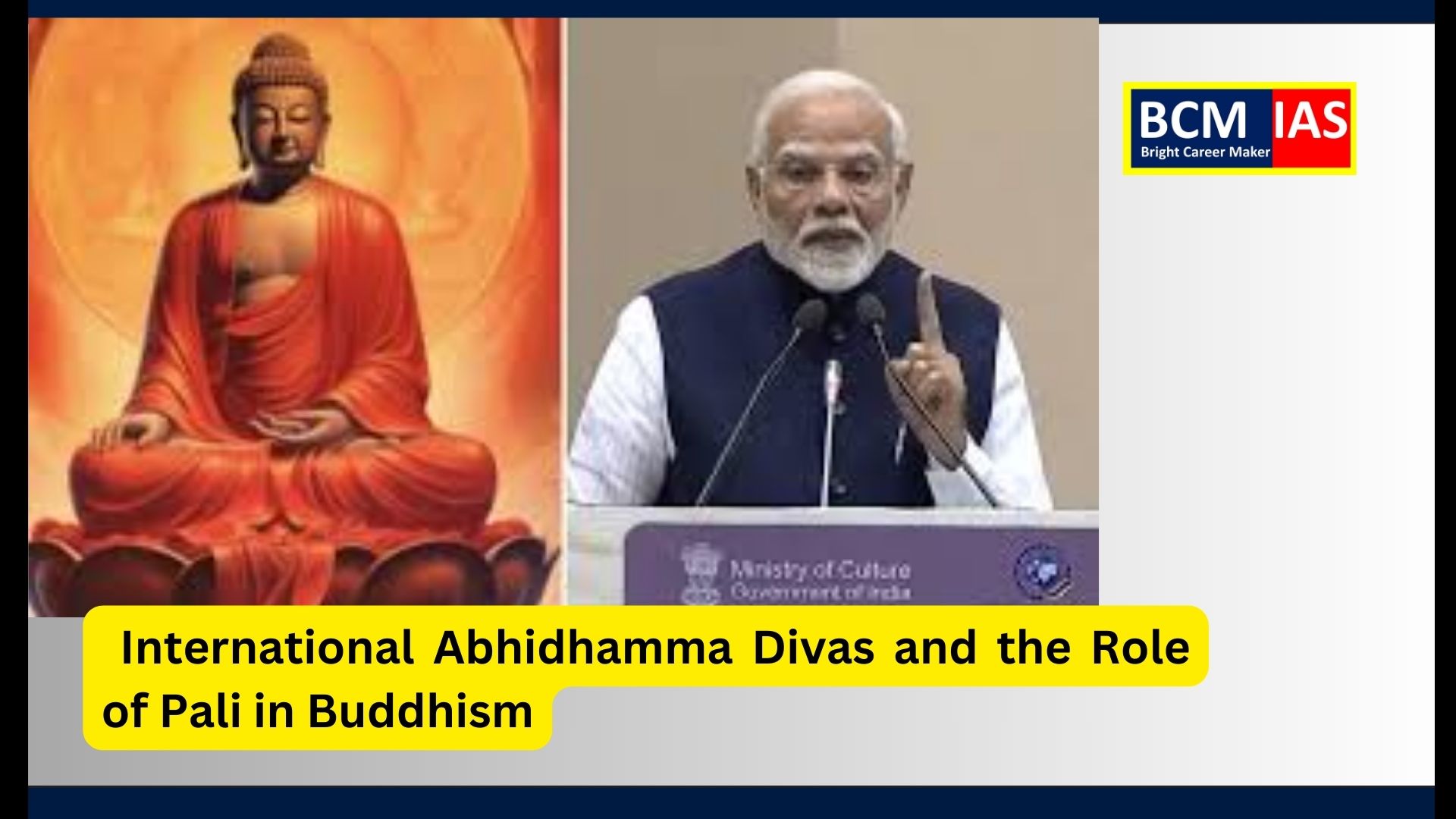
International Abhidhamma Divas
and the Role of Pali in Buddhism
Background:
Recently, India’s Prime Minister addressed a ceremony
celebrating International Abhidhamma Divas (IAD) and the recognition of Pali
as a classical language. The event, organized by the International
Buddhist Confederation (IBC) and the Ministry of Culture, highlights
the cultural and historical significance of Buddhist traditions and the Pali
language in India.
What
is International Abhidhamma Divas (IAD)?
1.
Significance:
o International
Abhidhamma Divas
commemorates the descent of Lord Buddha from the celestial realm of the
thirty-three divine beings (Tāvatiṃsa-devaloka) to Sankassiya (modern-day
Farrukhabad, Uttar Pradesh). This event is symbolized by the Asokan Elephant
Pillar at the location.
o According to Pali
texts, Buddha preached the Abhidhamma first to the gods of Tavatimsa,
including his mother, and later conveyed these teachings to his disciple Sariputta
on Earth.
2.
Connection to Buddhist Festivals:
o The event
coincides with the end of the rainy retreat (Vassa), a three-month
monastic period observed mainly in the Theravada Buddhist tradition
during the monsoon season.
o It also marks
the Pavāraņā festival, which concludes Vassa. During Pavāraṇā, monks confess any faults made during the retreat and invite others to
point out any shortcomings.
Understanding
the Abhidhamma Pitaka:
1.
Part of the Pali Canon:
o The Abhidhamma
Pitaka is one of the three Pitakas in the Pali Canon of Theravada
Buddhism. It is a scholastic analysis of the Buddha's teachings, focusing
on philosophy, psychology, metaphysics, and ethics.
o The other two
Pitakas are:
§ Vinaya
Pitaka: Rules of
conduct for monks and nuns.
§ Sutta Pitaka: Discourses and teachings of Buddha.
2.
Structure of Abhidhamma Pitaka:
o It consists of seven
books:
§ Dhammasangani: Enumeration of phenomena.
§ Vibhanga: Book of treaties.
§ Dhatukatha: Discussion with reference to the
elements.
§ Puggalapanatti: Description of personality.
§ Kathavatthu: Points of controversy.
§ Yamaka: Book of pairs.
§ Patthana: Book of relations.
Key
Facts About Pali Language:
1.
Historical Background:
o Pali is an ancient language that belongs
to the Indo-European family. Initially, it was thought to be identical
with Magadhi, the language of Magadha (modern-day Bihar), but recent
studies indicate closer ties to Prakrits of Western India.
o Emperor Ashoka's
inscriptions were often written in Pali, reflecting its importance in
promoting Buddhist teachings.
2.
Recognition as a Classical Language:
o The Union
Cabinet recognized Pali, along with Prakrit, Marathi, Assamese,
and Bengali, as classical languages, underlining its historical and
cultural value.
o Pali is the language of the Theravada
Buddhist Canon, encompassing the Vinaya, Sutta, and Abhidhamma
Pitakas.
3.
Scripts and Spread:
o Originally
written in Brahmi and Kharosthi scripts, as Buddhism spread across Asia,
Pali began to be inscribed in local scripts like Sinhalese, Burmese, Thai,
and Khmer. This facilitated the widespread dissemination of Buddhist
texts.
Cultural
and Religious Significance:
1.
Promoting Buddhist Heritage:
o The celebration
of International Abhidhamma Divas and the recognition of Pali highlights the
role of India as the birthplace of Buddhism and underscores its responsibility
in preserving and promoting Buddhist cultural heritage.
2.
Global Buddhist Community:
o Events like IAD
foster a sense of unity among the global Buddhist community, encouraging
collaboration and cultural exchange through shared traditions.
Conclusion:
The celebration of International Abhidhamma Divas is
not just a commemoration of a historical event but also a reminder of the
enduring legacy of Buddhism in India and the role of languages like Pali in
spreading its teachings. Recognizing Pali as a classical language emphasizes
its importance in preserving ancient texts and promoting a deeper understanding
of Buddhist philosophy. As the cultural custodian of Buddhism, India
continues to play a pivotal role in supporting and revitalizing this ancient
tradition for future generations.
Probable Mains Question
"Discuss the significance of International
Abhidhamma Divas and the recognition of Pali as a classical language in
promoting India’s Buddhist heritage and cultural diplomacy."
MCQs for Practice
1. International Abhidhamma Divas commemorates which event
in Buddhist tradition?
o
(a) The enlightenment
of Lord Buddha
o
(b) The first sermon
at Sarnath
o
(c) The descent of
Buddha from the celestial realm to Sankassiya
o
(d) The establishment
of the Sangha by Lord Buddha
Answer: (c)
The descent of Buddha from the celestial realm to Sankassiya
2. Which of the following is NOT a part of the Pali Canon in
Theravada Buddhism?
o
(a) Vinaya Pitaka
o
(b) Sutta Pitaka
o
(c) Abhidhamma Pitaka
o
(d) Mahayana Sutras
Answer: (d)
Mahayana Sutras
3. Pali was recently recognized as a classical language by
the Indian government. Which of the following is a correct statement about the
Pali language?
o
(a) It is an ancient
Dravidian language
o
(b) It was primarily
used in Ashokan inscriptions
o
(c) It is the
language of Mahayana Buddhist texts
o
(d) It has no
relation to the Indo-European language family
Answer: (b)
It was primarily used in Ashokan inscriptions
4. The Abhidhamma Pitaka consists of how many books?
o
(a) Three
o
(b) Five
o
(c) Seven
o
(d) Nine
Answer: (c)
Seven
5. Which of the following statements about the Pavāraṇā
festival is correct?
o
(a) It marks the
beginning of the Buddhist monastic retreat
o
(b) It coincides with
the full moon day at the end of Vassa
o
(c) It is a festival
celebrated only in Mahayana Buddhism
o
(d) It celebrates the
birth of Lord Buddha
Answer: (b)
It coincides with the full moon day at the end of Vassa
6. Consider the following pairs:
1.
Dhammasangani -
Enumeration of Phenomena
2.
Vibhanga -
Book of Treaties
3.
Kathavatthu -
Book of Verses
Which of the pairs given
above are correctly matched?
o
(a) 1 and 2 only
o
(b) 2 and 3 only
o
(c) 1 and 3 only
o
(d) 1, 2, and 3
Answer: (a)
1 and 2 only
7. Which of the following scripts was originally used to
write the Pali texts?
o
(a) Devanagari
o
(b) Brahmi
o
(c) Grantha
o
(d) Modi
Answer: (b)
Brahmi
8. What is the significance of the Asokan Elephant Pillar at
Sankassiya?
o
(a) It marks the
place of Buddha's enlightenment
o
(b) It commemorates
Buddha's descent from Tāvatiṃsa heaven
o
(c) It celebrates the
establishment of the Sangha
o
(d) It marks the site
of Buddha's first sermon
Answer: (b)
It commemorates Buddha's descent from Tāvatiṃsa heaven
9. Which of the following accurately describes the language
classification of Pali?
o
(a) It belongs to the
Sino-Tibetan family
o
(b) It is a dialect
of Sanskrit
o
(c) It is part of the
Indo-European language family
o
(d) It has no known
linguistic family association
Answer: (c)
It is part of the Indo-European language family
10.
The recognition of
Pali as a classical language aims to:
o
(a) Promote it as the
official language of India
o
(b) Encourage the
study and preservation of Buddhist texts
o
(c) Use it as a
medium for modern scientific research
o
(d) Replace Sanskrit
as the primary liturgical language
Answer: (b)
Encourage the study and preservation of Buddhist texts


Comments on “International Abhidhamma Divas and the Role of Pali in Buddhism”