


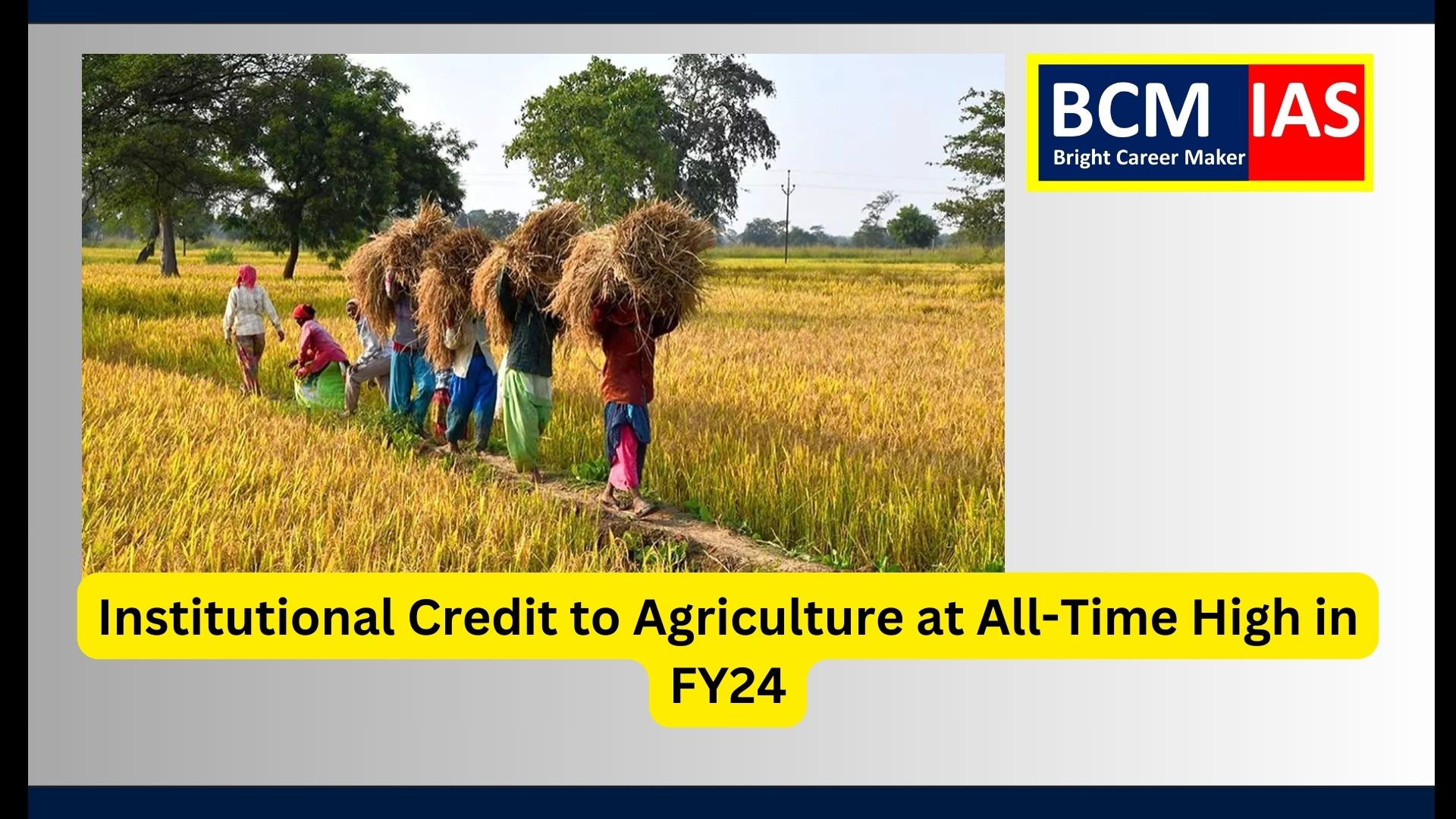
Institutional Credit to
Agriculture at All-Time High in FY24
News Analysis
Introduction:
Institutional credit to the agriculture sector in India
reached an unprecedented level of ₹25.10 lakh crore during the financial year
2023-24, demonstrating the crucial role that financing plays in fostering
agricultural growth. This was highlighted by the Reserve Bank of India (RBI)
Deputy Governor Swaminathan J. in his recent address.
Key Highlights:
1.
All-Time High Credit to Agriculture:
o Institutional
credit to agriculture surged to ₹25.10 lakh crore in FY24, marking a
significant milestone.
o This increase
reflects the growing importance of credit in supporting the agricultural sector
and promoting its growth.
2.
Demographic Challenge in Agriculture:
o The average age
of Indian farmers is now 50.1 years, signaling a demographic challenge in the
sector.
o The ageing
farming population highlights the need to attract younger generations to
agriculture, which can be critical for the sector's sustainability.
3.
Role of Kisan Credit Cards (KCCs):
o Approximately
7.4 crore active Kisan Credit Cards (KCCs) have been issued.
o KCCs are vital
in providing timely and flexible credit, particularly for farmers' short-term
financial needs.
o Despite the
success of KCCs, regional disparities in access to credit remain a pressing
issue.
4.
Challenges of Sustainability and Regional Disparities:
o Mr. Swaminathan
emphasized the importance of ensuring equal access to financing across all
regions of the country.
o Addressing
regional imbalances in credit availability is crucial to ensure sustainable
agricultural growth and resilience.
5.
Need for Innovative Financial Solutions:
o Traditional
lending practices often fail to meet the dynamic needs of the agricultural
sector.
o There is a need
for flexible and innovative financial solutions tailored to the specific
requirements of farmers.
o These
innovations will better address challenges related to sustainability and
financial resilience in agriculture.
Conclusion:
The record-high institutional credit to agriculture in FY24
underscores the sector’s reliance on financing to drive growth. However,
challenges such as an ageing farmer population, regional disparities in credit
access, and the limitations of traditional lending models highlight the need
for innovative financial solutions to ensure the continued success and
sustainability of Indian agriculture.
MCQs for Practice
1. The role of Kisan Credit Cards (KCCs) in Indian
agriculture is primarily to:
a) Provide crop insurance to farmers
b) Facilitate long-term investment in farm machinery
c) Offer flexible and timely credit to meet short-term needs of farmers
d) Support export-related agricultural activities
Answer: c) Offer flexible and timely credit to meet short-term needs of farmers
Explanation: Kisan Credit Cards (KCCs) are designed to provide farmers
with quick and flexible credit, mainly for short-term agricultural needs like
purchasing inputs (seeds, fertilizers, etc.), which helps enhance productivity.
2. Which of the following challenges is NOT directly
associated with Indian agriculture as highlighted by RBI Deputy Governor
Swaminathan J.?
a) Regional disparities in access to agricultural credit
b) The ageing demographic of farmers
c) Lack of innovation in crop insurance schemes
d) Limitations of traditional lending practices
Answer: c) Lack of innovation in crop insurance schemes
Explanation: While the challenges mentioned include regional disparities,
the ageing farmer population, and traditional lending limitations, crop
insurance innovations were not specifically highlighted by the Deputy Governor
in this context.
3. Why is the demographic challenge of Indian agriculture
significant for policymakers?
a) It indicates that farmers are shifting towards high-tech
farming.
b) It highlights the need for creating retirement plans for older farmers.
c) It underscores the necessity to attract younger generations into farming to
ensure the sector’s sustainability.
d) It shows that the agricultural sector is becoming more reliant on exports.
Answer: c) It underscores the necessity to attract younger generations into
farming to ensure the sector’s sustainability.
Explanation: The average age of farmers being 50.1 years points to the
challenge of ageing in the agricultural workforce, requiring efforts to
encourage younger individuals to take up farming.
4. What could be the potential outcome of addressing regional
disparities in agricultural credit, as emphasized by Mr. Swaminathan?
a) Reduced reliance on public sector banks for rural credit
b) Increased sustainability and resilience of agriculture across all regions
c) Decreased use of digital payment methods in rural areas
d) Higher dependency on international agricultural loans
Answer: b) Increased sustainability and resilience of agriculture across all
regions
Explanation: Ensuring equitable access to credit across regions can
enhance sustainability and help the agricultural sector adapt to various
challenges, making it more resilient.
5. The need for innovative financial solutions in agriculture
is driven by:
a) The inadequacy of traditional lending practices to meet
diverse agricultural needs
b) A shift towards organic farming across the country
c) The government's focus on reducing subsidies for farmers
d) The expansion of multinational agricultural companies in India
Answer: a) The inadequacy of traditional lending practices to meet diverse
agricultural needs
Explanation: Traditional lending models often lack the flexibility
required to meet the unique and changing financial needs of farmers,
necessitating the development of innovative, tailored financial solutions.


Comments on “Institutional Credit to Agriculture at All-Time High in FY24”