


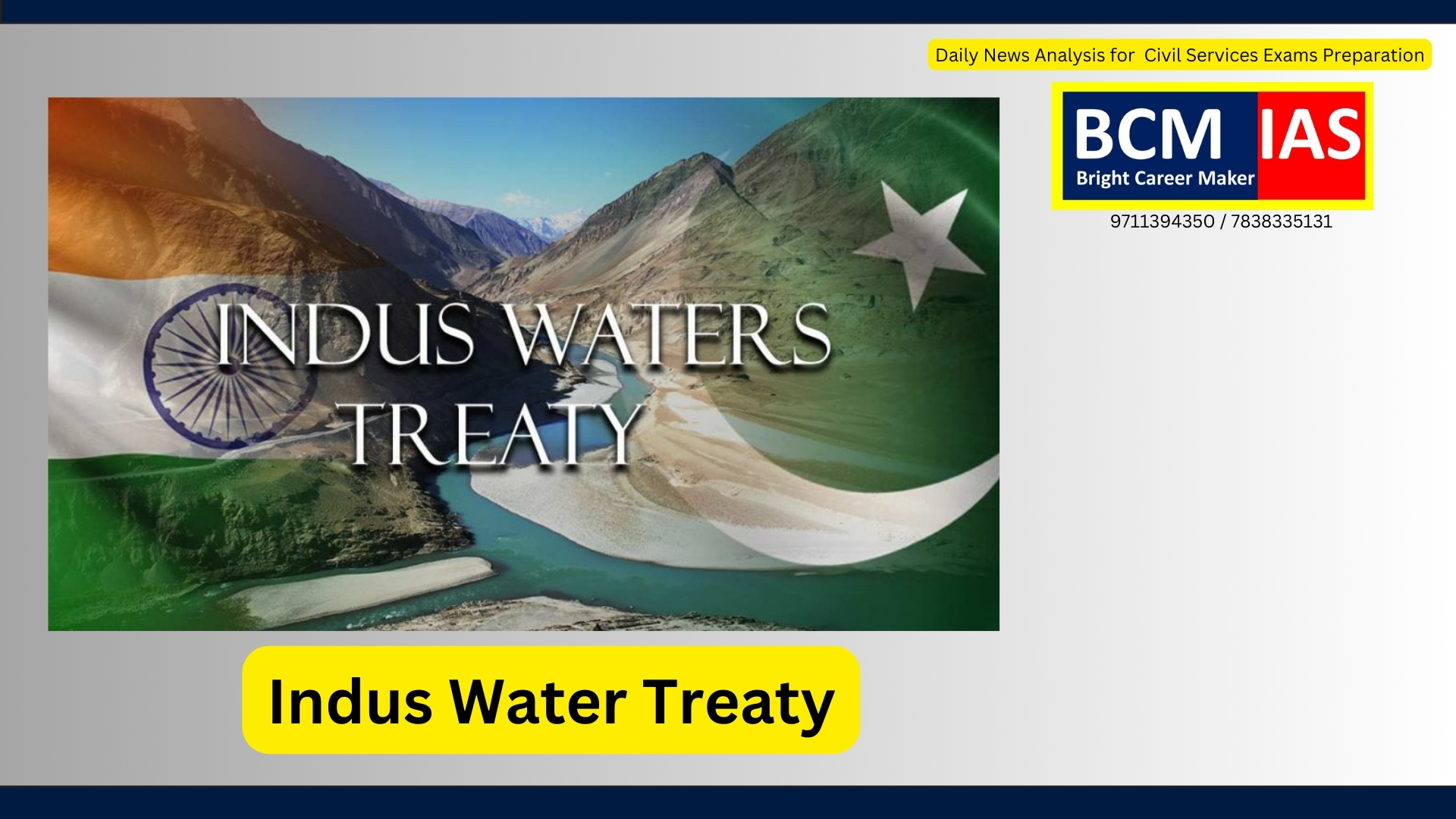
Indus Water Treaty
Why
in News?
The Neutral Expert
(NE) appointed by the World Bank under the Indus
Waters Treaty (IWT) declared that he is “competent” to adjudicate
disputes concerning the Kishenganga and Ratle
hydroelectric projects in Jammu and Kashmir(J&K).
§ This supports India’s stance to exclude
the Permanent Court of Arbitration (PCA), reinforcing its
diplomatic and legal efforts to assert rights over the Indus waters.
--------------------------------------------------------------------------------------------
The Indus
Waters Treaty (IWT) and its associated disputes
reflect a complex interplay of geopolitical tensions, outdated provisions, and
evolving environmental challenges. Below is an analysis of the key issues and
potential solutions:
Key Disputes Related to IWT
1.
Water
Sharing Disputes:
o Kishanganga Hydroelectric Project:
Pakistan claims that India's diversion of water for power generation violates
the IWT. The project affects downstream water flow, raising concerns about
compliance with the treaty’s provisions.
o Ratle Hydroelectric Project:
Pakistan has objected to the dam design, asserting that the spillway gates
could provide India with excessive control over river flow. This is seen as a
potential threat to downstream water availability.
2.
Dispute
Over Resolution Procedures:
o Pakistan has sought resolution through the Permanent Court of Arbitration (PCA),
bypassing the treaty’s prescribed hierarchy that prioritizes the Neutral Expert (NE).
o India emphasizes that disputes must first be
addressed by the NE, asserting that Pakistan’s direct approach to the PCA
undermines the treaty framework.
Challenges Associated with IWT
1.
Outdated
Provisions:
o The treaty, signed in 1960, does not account
for climate change,
which has significantly altered water availability due to glacial melt, erratic
rainfall, and increased evaporation.
o Changes in hydrology require modern, adaptive
water management strategies, which are absent in the treaty.
2.
Lack
of Flexibility:
o The rigid allocation of water resources under
the treaty does not allow adjustments for changing circumstances, such as
rising water demand or reduced water availability.
3.
Parallel
Proceedings:
o The simultaneous initiation of NE and PCA
processes by the World Bank has highlighted ambiguities in the dispute
resolution mechanism. This creates confusion and undermines the treaty’s
credibility.
4.
Geopolitical
Tensions:
o Hostilities and mistrust between India and
Pakistan further complicate cooperation on water-sharing and treaty
implementation, making technical resolutions more challenging.
Way Forward
1.
Renegotiation
of the Treaty:
o A review of the treaty is necessary to address
its limitations and incorporate provisions for climate resilience and sustainable water
management. For instance, adaptive mechanisms can be introduced to manage
reduced water flows due to glacial melt.
2.
Enhanced
Bilateral Dialogue:
o Regular meetings of the Permanent Indus Commission (PIC)
can help rebuild trust and address disputes at an early stage. Collaborative
data-sharing and joint studies can further improve transparency.
3.
Third-Party
Mediation:
o Neutral entities like the World Bank can play a
more proactive role in clarifying dispute resolution mechanisms and ensuring
both parties adhere to the treaty framework.
4.
Focus
on Technical Solutions:
o Both countries should prioritize scientific and
technical approaches to address disputes, such as agreeing on dam designs or
water flow management based on joint studies.
Conclusion
The Indus Waters Treaty, while
a cornerstone of India-Pakistan water diplomacy, faces significant challenges
due to outdated provisions, geopolitical tensions, and environmental changes.
Addressing these issues requires both structural reforms in the treaty and
trust-building measures between the two nations. By adopting a cooperative and
technical approach, India and Pakistan can ensure equitable water management
while reducing conflict.
Mains
Question and Answer
Question:
Discuss the key challenges associated with the implementation of
the Indus Waters Treaty (IWT) in the context of evolving geopolitical and
environmental dynamics. Suggest measures to address these challenges.
Answer:
Introduction
The Indus Waters Treaty (IWT),
signed in 1960 under the aegis of the World Bank, is a landmark water-sharing
agreement between India and Pakistan. It allocates the waters of the Indus
River and its tributaries, granting Pakistan control over the three western
rivers (Indus, Jhelum, Chenab) and India the three eastern rivers (Beas, Ravi,
Sutlej). However, contemporary challenges like climate change, geopolitical
tensions, and disputes over hydroelectric projects have tested its relevance
and implementation.
Key Challenges Associated with
IWT
1.
Outdated
Provisions:
o The treaty does not account for climate
change-induced factors such as glacial melt, erratic rainfall, and increased
evaporation, leading to altered water availability.
o The rigid water allocation framework limits
flexibility in adapting to these changing conditions.
2.
Hydroelectric
Disputes:
o Kishanganga Project:
Pakistan claims that India's diversion of water for power generation violates
the treaty.
o Ratle Project:
Pakistan alleges that India's dam design grants it excessive control over river
flow, undermining downstream water access.
3.
Ambiguities
in Dispute Resolution Mechanism:
o The simultaneous initiation of Neutral Expert (NE) and Permanent Court of Arbitration (PCA)
processes by the World Bank in 2022 exposed inconsistencies in the treaty's
dispute resolution framework.
4.
Geopolitical
Tensions:
o Hostilities between India and Pakistan hinder
dialogue and cooperation on water-sharing issues, making the treaty vulnerable
to political manipulation.
5.
Inadequate
Climate Resilience:
o The treaty's failure to address sustainable
water management and climate adaptation reduces its relevance in addressing
modern hydrological challenges.
Measures to Address the
Challenges
1.
Renegotiation
of the Treaty:
o Update the treaty to include provisions for
climate resilience, adaptive water management strategies, and sustainable use
of shared resources.
2.
Enhanced
Bilateral Cooperation:
o Revive and strengthen the Permanent Indus Commission (PIC)
as a platform for dialogue, data-sharing, and trust-building to resolve
disputes amicably.
3.
Third-Party
Facilitation:
o The World Bank and other neutral entities
should streamline dispute resolution mechanisms and mediate when bilateral
efforts fail.
4.
Technical
and Scientific Approach:
o Conduct joint studies on water availability,
dam designs, and river management to develop solutions based on scientific
evidence rather than political considerations.
5.
Confidence-Building
Measures (CBMs):
o Initiate water-sharing dialogues alongside
other diplomatic efforts to reduce mistrust and promote cooperation.
Conclusion
The Indus Waters Treaty has
been a cornerstone of water diplomacy between India and Pakistan for over six
decades. However, it needs urgent reform to address modern challenges like
climate change and geopolitical dynamics. By fostering dialogue, adopting
technical solutions, and renegotiating outdated provisions, both nations can
ensure equitable water management and regional stability.
MCQs
Question 1:
Which of the following is NOT
a key feature of the Indus Waters Treaty (IWT) of 1960?
A. India
has unrestricted use of the three eastern rivers – Beas, Ravi, and Sutlej.
B.
Pakistan has exclusive control over the three western rivers – Indus, Jhelum,
and Chenab.
C. The
treaty permits India to construct storage facilities on the western rivers
without any restrictions.
D. The
World Bank acts as a guarantor for the treaty's implementation.
Answer:
C. The
treaty permits India to construct storage facilities on the western rivers
without any restrictions.
(Explanation: India is allowed
limited use of western rivers for specific purposes like domestic use,
agriculture, and hydropower generation, but it cannot construct storage
facilities without adhering to the treaty's provisions.)
Question 2:
The Neutral Expert (NE) under
the Indus Waters Treaty is appointed to resolve disputes when:
A. The
Permanent Indus Commission fails to resolve an issue.
B. A
project violates environmental provisions not explicitly mentioned in the
treaty.
C. Both
India and Pakistan seek arbitration simultaneously.
D.
Disputes involve matters of treaty interpretation or technical differences.
Answer:
D.
Disputes involve matters of treaty interpretation or technical differences.
(Explanation: The NE is
appointed for technical issues or interpretation disputes, while the Permanent
Court of Arbitration (PCA) is used for broader disagreements.)
Question 3:
Which of the following rivers
is NOT covered under the Indus Waters Treaty?
A.
Sutlej
B.
Jhelum
C.
Brahmaputra
D.
Chenab
Answer:
C.
Brahmaputra
(Explanation: The Brahmaputra
is not part of the Indus River system and hence is not covered under the
treaty.)
Question 4:
Under the Indus Waters Treaty,
India can use the waters of the western rivers (Indus, Jhelum, Chenab) for
which of the following purposes?
A.
Hydroelectric projects without restrictions
B.
Domestic and non-consumptive use
C.
Large-scale irrigation and industrial use
D. No
use is permitted for India
Answer:
B.
Domestic and non-consumptive use
(Explanation: India can use
the western rivers for limited purposes such as domestic use, non-consumptive
activities, agriculture, and specific hydroelectric projects under stringent
conditions.)
Question 5:
What is the primary role of
the Permanent Indus Commission (PIC) established under the IWT?
A. To
act as a final adjudicating authority for disputes.
B. To
ensure the annual implementation of the treaty and facilitate bilateral
dialogue.
C. To
supervise the construction of hydroelectric projects on western rivers.
D. To
appoint the Neutral Expert when disputes arise.
Answer:
B. To
ensure the annual implementation of the treaty and facilitate bilateral
dialogue.
(Explanation: The PIC is a
bilateral body established to implement the treaty, address minor issues, and
promote cooperation between the two countries.)


Comments on “Indus Water Treaty”