


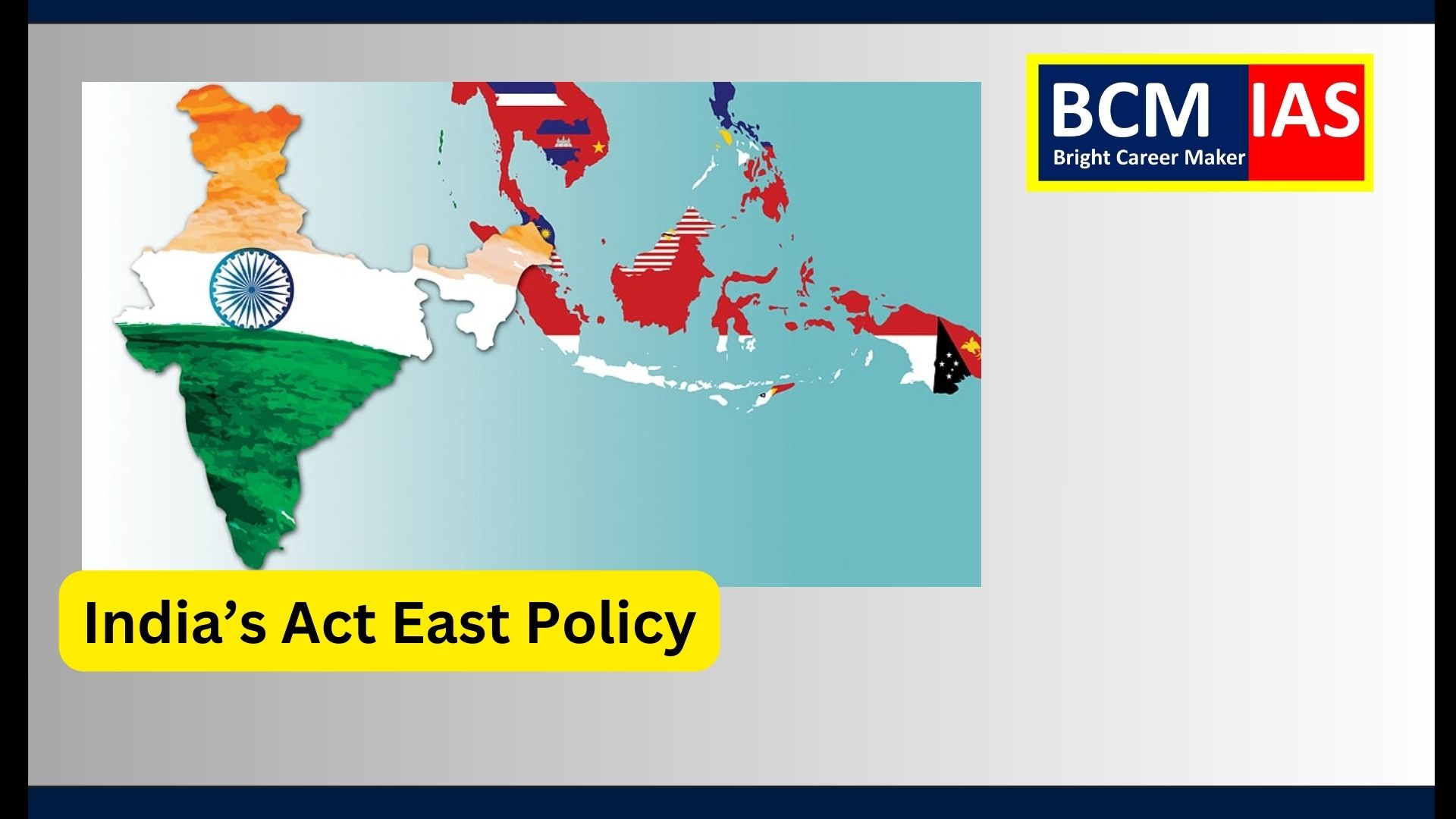
India’s Act East Policy: An Analytical Overview
Introduction:
India’s Act East Policy is a strategic initiative
aimed at strengthening India’s ties with the Indo-Pacific region,
particularly focusing on ASEAN countries. It was launched in 2014
as a continuation of the Look East Policy of 1992 and aims to bolster economic,
cultural, and strategic relationships with countries in the Asia-Pacific.
Key Objectives of the Act East Policy:
1.
Economic Cooperation:
o The policy
emphasizes improving trade, investment, and connectivity
between India and Southeast Asia. The ASEAN region is central to this
approach, given its strategic and economic importance.
2.
Cultural Ties:
o Promoting people-to-people
connections through cultural exchange programs and collaborations in
education, art, and heritage.
3.
Strategic Partnerships:
o Enhancing defense
cooperation and security ties with Southeast Asian countries to
ensure stability in the Indo-Pacific. India’s growing involvement in
regional security frameworks, such as Quad (Quadrilateral Security Dialogue),
is part of this strategic thrust.
Key Features of the Act East Policy:
1.
Indo-Pacific Focus:
o The policy
places ASEAN at its core, with broader outreach to Japan, South
Korea, and Australia. The Indo-Pacific is emerging as a
critical region for global trade and security, and India aims to play a pivotal
role.
2.
Connectivity Projects:
o Strengthening
connectivity between India’s Northeastern states and neighboring
countries is a vital focus. Several infrastructure projects are in place to
boost trade and socio-economic ties with Southeast Asia.
3.
Three Pillars of Cooperation:
o Political and
Security Matters:
Engagement through defense cooperation and strategic dialogue.
o Socio-Cultural
Exchange: Building
strong cultural ties and fostering cooperation in fields like education and
tourism.
o Economic
Partnerships:
Boosting trade, investments, and exploring joint ventures in industries like technology,
agriculture, and manufacturing.
Major Initiatives under the Act East Policy:
1.
India-Myanmar-Thailand Trilateral Highway:
o A crucial
infrastructure project connecting India’s Northeast with Myanmar
and Thailand to enhance trade and travel in the region.
2.
Kaladan Multi-modal Transit Transport Project:
o Aimed at
improving connectivity between India and Myanmar, this project
also benefits the development of India’s landlocked Northeastern states.
3.
Agartala-Akhaura Rail Link:
o This project
connects India and Bangladesh, promoting cross-border trade and
ease of transportation.
4.
Mahabahu-Brahmaputra Inland Waterway Programme:
o Designed to
improve inland waterways and transport links in India’s
Northeastern region, fostering intermodal connectivity.
Significance of the Act East Policy:
1.
Countering China's Influence:
o The policy
serves as India’s strategic response to China’s growing dominance in Southeast
Asia, particularly in areas like the South China Sea. By deepening
engagement with ASEAN and other countries, India offers a balanced and
collaborative approach in contrast to China’s assertive stance.
2.
Ensuring Security in the Indo-Pacific:
o The Act East
Policy aligns with India’s broader goal of maintaining freedom of navigation
and upholding the rule of law in the Indo-Pacific region. India’s
involvement in defense collaborations and initiatives like BrahMos
missile sales to the Philippines underscores its commitment to regional
security.
3.
Enhancing Regional Security:
o Through forums
like Quad, India strengthens regional cooperation with Japan, Australia,
and the US, addressing security challenges, including maritime disputes
and the need for greater collaboration on terrorism and cybersecurity.
Challenges in Implementing the Act East Policy:
1.
Infrastructure Gaps:
o While several
connectivity projects are underway, delays and infrastructure bottlenecks
remain major challenges. The full potential of India’s Northeast as a
gateway to ASEAN can only be realized with improved infrastructure.
2.
Economic Slowdown:
o The global
economic slowdown, exacerbated by the COVID-19 pandemic, has impacted
trade relations and investment flows between India and Southeast Asia. Reviving
these ties is crucial for the success of the Act East Policy.
3.
Regional Stability:
o Political
instability in neighboring countries like Myanmar and Bangladesh
poses challenges for India’s regional outreach. Sustained engagement with ASEAN
countries is necessary to navigate these complexities.
What Lies Ahead?
1.
Strengthening Trade Relations:
o India must
continue negotiating comprehensive free trade agreements (FTAs) with
Southeast Asian countries to boost market access for Indian businesses.
2.
Addressing Regional Challenges:
o India’s focus
should remain on maintaining a stable Indo-Pacific region by addressing
geopolitical challenges, including the growing influence of China, territorial
disputes, and trade protectionism.
3.
Deepening Partnerships:
o Beyond ASEAN,
India must explore partnerships with like-minded countries to tackle global
issues such as climate change, digital economy, and sustainable
development. Strengthening bilateral relations with Japan, Australia,
and South Korea remains crucial.
Conclusion:
India’s Act East Policy is a cornerstone of its foreign
policy in the Indo-Pacific, aimed at fostering economic, strategic,
and cultural ties with ASEAN and other key regional players. As
global dynamics evolve, India’s proactive engagement with Southeast Asia will
be vital to ensuring regional stability and mutual prosperity. The successful
implementation of various infrastructure projects and addressing security
concerns in the Indo-Pacific will be key to achieving the policy’s objectives.
Mains Question:
Q: Discuss the significance of India's Act East
Policy in the context of regional security and economic cooperation. What
challenges does India face in implementing this policy, and how can they be
addressed?
Answer:
Introduction:
India’s Act East Policy, launched in 2014, aims
to strengthen ties with countries in Southeast Asia and the Indo-Pacific
region. It focuses on economic integration, strategic
partnerships, and cultural exchanges with ASEAN and beyond.
The policy is a continuation of the Look East Policy (1992) but
emphasizes a more proactive and strategic approach to regional engagement. This
policy is significant not only for boosting India’s economic and trade
relations but also for maintaining regional security in the face of
emerging challenges in the Indo-Pacific.
Significance of Act East Policy:
1.
Economic Cooperation and Connectivity:
o ASEAN is one of India’s largest trading
partners, with bilateral trade reaching $100 billion. The Act East
Policy aims to further enhance economic ties through infrastructure projects
such as the India-Myanmar-Thailand Trilateral Highway and the Kaladan
Multi-modal Transit Transport Project, which improve connectivity between
India’s Northeast and Southeast Asia.
o The policy also
promotes free trade agreements (FTAs) and investments in key sectors
like technology, manufacturing, and agriculture, boosting
economic growth in the region.
2.
Regional Security and Strategic Partnerships:
o With the
increasing importance of the Indo-Pacific as a global trade route, the
Act East Policy aligns with India’s strategic interests in maintaining freedom
of navigation and upholding international law in the region,
particularly in the South China Sea.
o India’s
partnerships with countries like Japan, Australia, and Vietnam
strengthen regional security. The Quadrilateral Security Dialogue (Quad),
which includes India, the US, Japan, and Australia, is an example of a
collaborative security arrangement aimed at countering China’s assertiveness
and ensuring peace in the region.
3.
Countering China’s Influence:
o China’s Belt
and Road Initiative (BRI) has significantly increased its economic and
strategic presence in Southeast Asia. The Act East Policy serves as a
counterbalance to China’s influence by deepening India’s relationships with
ASEAN nations and investing in alternative connectivity projects that
bypass China’s infrastructure networks.
o India’s BrahMos
missile deals with countries like the Philippines highlight its
growing role as a regional defense partner, providing an alternative to Chinese
military dominance.
4.
Cultural and People-to-People Connectivity:
o India’s
historical and cultural ties with Southeast Asia are strengthened through
initiatives promoting tourism, education, and cultural
exchanges. These initiatives enhance soft power diplomacy, helping
India build long-term relationships with its neighbors.
Challenges in Implementing the Act East Policy:
1.
Infrastructure and Connectivity Deficits:
o Although key
projects like the Trilateral Highway and the Kaladan Multi-modal
project are underway, delays in completion due to funding, bureaucratic
hurdles, and local resistance have hampered progress. These delays
limit the economic potential of India’s Northeastern states as gateways
to Southeast Asia.
2.
Economic Slowdown and Trade Barriers:
o The global
economic slowdown, compounded by the COVID-19 pandemic, has affected
trade volumes and investment flows. Additionally, unresolved trade disputes and
non-tariff barriers between India and ASEAN countries hinder the smooth
functioning of economic partnerships.
o India’s
withdrawal from the Regional Comprehensive Economic Partnership (RCEP)
over concerns about cheap imports from China and other countries highlights the
challenges India faces in integrating into regional trade networks while
protecting its domestic industries.
3.
Geopolitical Instability:
o Political
instability in countries like Myanmar, with its military coup and
ongoing civil unrest, poses challenges for implementing connectivity
projects and ensuring regional security. Similarly, the rise of extremist
groups and border disputes in Northeast India affect the stability
required for effective economic engagement with ASEAN.
4.
China’s Assertiveness:
o China’s
expanding influence in the region through the BRI and its aggressive
stance in the South China Sea challenge India’s efforts to assert itself
as a regional leader. Chinese investments in infrastructure and defense
have already gained a significant foothold in countries like Myanmar, Sri
Lanka, and Nepal, making it harder for India to counterbalance
Chinese influence.
Steps to Address the Challenges:
1.
Accelerating Infrastructure Projects:
o The government
must ensure the timely completion of key connectivity projects by
improving coordination between central and state authorities and
addressing local concerns. Engaging with multilateral development banks
like the Asian Development Bank (ADB) for funding can help expedite
infrastructure development.
2.
Strengthening Regional Trade Frameworks:
o India can
explore bilateral trade agreements with ASEAN countries while
renegotiating its terms in multilateral trade arrangements like RCEP.
Addressing non-tariff barriers and promoting cross-border e-commerce can
further boost trade.
3.
Deepening Strategic Engagement:
o Expanding
defense cooperation with countries like Japan, Vietnam, and Australia,
including joint military exercises and technology transfer agreements, will
enhance India’s strategic presence in the region.
o India should
also work to strengthen regional institutions like the ASEAN Regional Forum
(ARF) and the East Asia Summit (EAS) to promote peace and security.
4.
Enhancing Cultural Diplomacy:
o India should
further leverage its soft power by promoting cultural exchanges, tourism,
and educational partnerships with ASEAN nations. Initiatives like scholarship
programs for Southeast Asian students and increased tourism through
enhanced connectivity can solidify India’s influence in the region.
Conclusion:
India’s Act East Policy is pivotal in enhancing economic
ties, ensuring regional security, and countering China’s growing
influence in Southeast Asia and the Indo-Pacific. Despite challenges
related to infrastructure development, economic integration, and geopolitical
instability, India can strengthen its position through strategic
partnerships, accelerated infrastructure projects, and greater cultural
diplomacy. By doing so, India will not only secure its interests in the
Indo-Pacific but also contribute to regional peace and prosperity.
MCQs
1. Consider the following statements regarding India's Act
East Policy:
1.
The Act East Policy focuses solely on strengthening
economic ties between India and Southeast Asia.
2.
The policy emphasizes strategic partnerships with
countries in the Indo-Pacific region, including Japan and Australia.
3.
Cultural and people-to-people connectivity is a core
component of the Act East Policy.
Which of the above statements is/are correct?
A) 1 only
B) 2 and 3 only
C) 1 and 2 only
D) 1, 2, and 3
Answer: B) 2 and 3 only
2. Which of the following are major infrastructure projects
under the Act East Policy aimed at improving connectivity with Southeast Asia?
1.
Kaladan Multi-modal Transit Transport Project
2.
India-Myanmar-Thailand Trilateral Highway
3.
Agartala-Akhaura Rail Link
4.
Sagarmala Project
Select the correct answer using the code below:
A) 1, 2, and 3 only
B) 1 and 2 only
C) 2 and 4 only
D) 1, 2, 3, and 4
Answer: A) 1, 2, and 3 only
3. Consider the following statements regarding the strategic
importance of the Act East Policy:
1.
The policy aims to counter China’s influence in
Southeast Asia by promoting India’s connectivity and defense partnerships.
2.
The Quadrilateral Security Dialogue (Quad), consisting
of India, Japan, the US, and Australia, is part of India’s strategic outreach
under the Act East Policy.
3.
The Act East Policy aims to strengthen ties with only
the ASEAN countries and does not involve Japan or Australia.
Which of the above statements is/are correct?
A) 1 only
B) 1 and 2 only
C) 3 only
D) 1, 2, and 3
Answer: B) 1 and 2 only
4. Consider the following statements about the significance
of India’s Act East Policy:
1.
It enhances regional security by maintaining freedom
of navigation in the Indo-Pacific region.
2.
The policy helps boost economic cooperation between
India and ASEAN, focusing on trade and connectivity.
3.
India’s Act East Policy does not involve cultural and
educational exchanges with Southeast Asian countries.
Which of the above statements is/are correct?
A) 1 and 2 only
B) 1 only
C) 2 and 3 only
D) 1, 2, and 3
Answer: A) 1 and 2 only
5. Which of the following challenges affect the successful
implementation of the Act East Policy?
1.
Infrastructure bottlenecks in connectivity projects
like the Trilateral Highway.
2.
Political instability in countries like Myanmar.
3.
Over-dependence on trade with China for the success of
the Act East Policy.
Select the correct answer using the code below:
A) 1 and 2 only
B) 1 and 3 only
C) 2 only
D) 1, 2, and 3
Answer: A) 1 and 2 only


Comments on “India’s Act East Policy: An Analytical Overview”