


Daily
Current Affairs Analysis
20 June
2024
-------------------------------------------------------------------------------------------------------------
India-U.S. Collaboration on Critical Minerals
Meaning of Headline-
"India
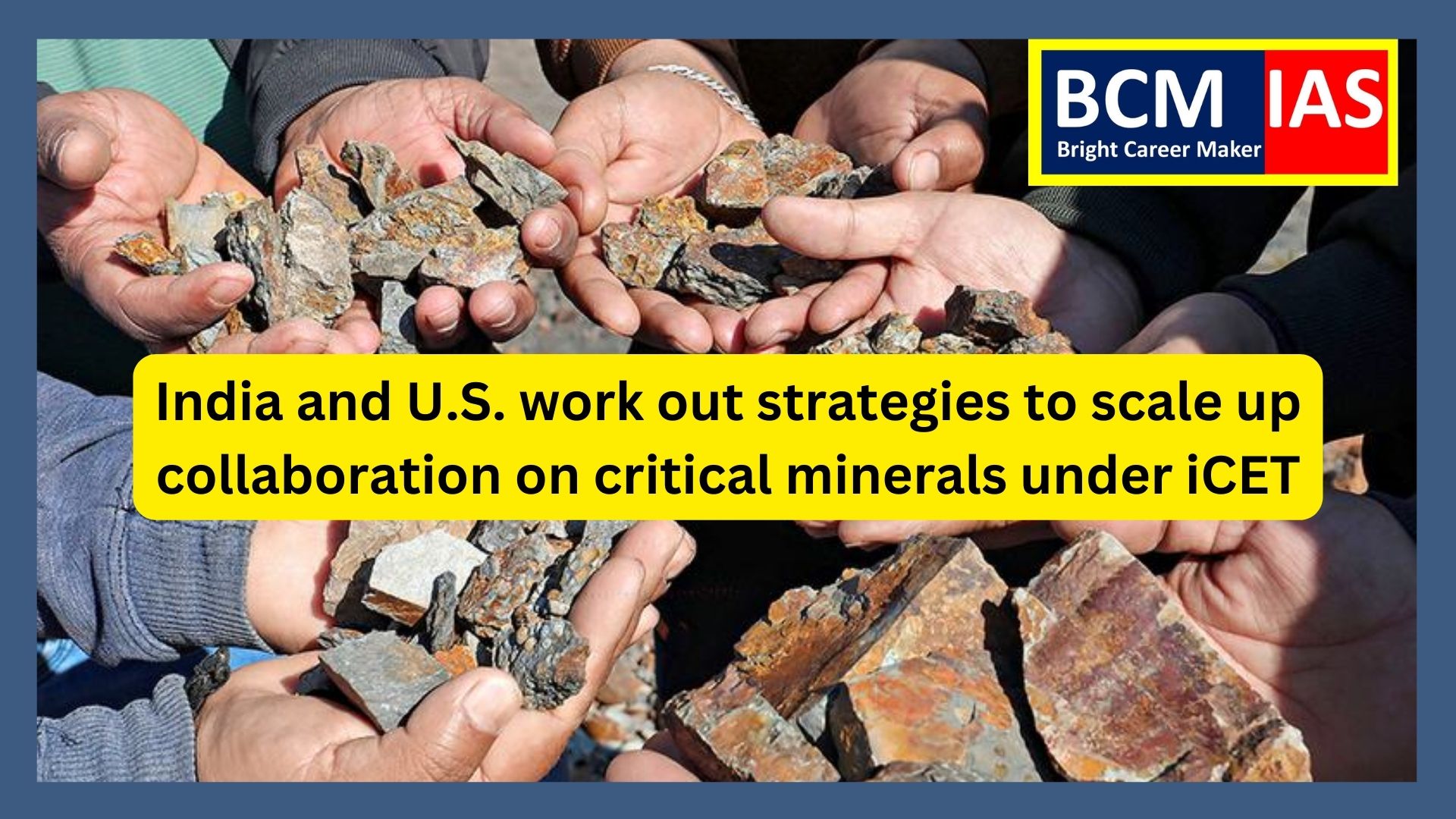
and U.S. work out strategies to scale up collaboration on critical minerals
under iCET"
This
headline indicates that India and the United States are developing plans to
enhance their partnership in the area of critical minerals. This collaboration
is part of the India-U.S. Initiative for Critical and Emerging Technology
(iCET). The goal is to secure supply chains for essential minerals such as
graphite, gallium, and germanium, which are vital for various high-tech and
strategic industries.
Related Topic (as per UPSC
Syllabus)
|
Prelims |
Mains |
Interview |
|
1. Economic and Social Development: Sustainable Development, Poverty,
Inclusion, Demographics, Social Sector Initiatives, etc. 2.
Geography: Resources – types, distribution, and uses. |
1.
General Studies Paper II: a)
International Relations: Bilateral, regional, and global
groupings and agreements involving India and/or affecting India’s interests.
b)
Government Policies and Interventions: Development processes and the
development industry, the role of NGOs, SHGs, various groups and
associations, donors, charities, institutional and other stakeholders.
2.
General Studies Paper III: a)
Economic Development: Government policies and interventions
for development in various sectors and issues arising out of their design and
implementation. b)
Science and Technology: Developments and their applications and
effects in everyday life, Achievements of Indians in science &
technology, Indigenization of technology and developing new technology. c)
Environment: Conservation, environmental pollution
and degradation, environmental impact assessment.
|
1. Current Affairs: Questions on recent government policies,
international collaborations, and their impact on the economy and society.
2.
Economic Policies: Discussions on strategic partnerships,
technological advancements, and sustainable development. |
News
Analysis
Introduction
The recent development in India-U.S.
relations focusing on the collaboration in critical minerals signifies a
strategic alignment between the two countries. This cooperation aims to enhance
the supply chain security of essential minerals such as graphite, gallium, and
germanium. The initiative falls under the broader framework of the India-U.S.
Initiative for Critical and Emerging Technology (iCET). This article will delve
into the specifics of the collaboration, its strategic importance, and the
potential implications for both nations.
Details
of the Collaboration
Bilateral
Agreement
India and the U.S. are working towards
concluding a bilateral agreement involving the U.S. Department of Commerce and
India's Ministry of Commerce and Industry, and Ministry of Mines. This
agreement aims to:
- Promote
India's role in the Mineral Security Partnership.
- Co-invest
in lithium resource projects in South America and rare earth deposits in
Africa.
- Diversify
and secure critical mineral supply chains sustainably and responsibly.
Critical
Minerals List
In July 2023, India released a list of 30
minerals deemed critical for the country's economic and strategic interests.
This list includes minerals essential for various high-tech industries and
national security.
Legislative
and Organizational Support
- MMDR
Amendment Act, 2023: The Mines and Minerals (Development and Regulation) Act, 1957, was
amended to facilitate the acquisition of mines abroad and expand domestic
exploration.
- Khanij
Bidesh India Ltd. (KABIL): This joint venture company, formed by three Central Public Sector
Enterprises (National Aluminium Company Ltd, Hindustan Copper Ltd, and
Mineral Exploration and Consultancy Ltd), aims to acquire critical mineral
assets abroad. KABIL is exploring opportunities in Australia, Argentina,
and Chile for minerals like lithium and cobalt.
Mineral
Security Partnership
India has joined the Mineral Security
Partnership led by the U.S. This partnership focuses on securing the supply
chain of critical minerals for member countries by facilitating investments in
mineral-rich countries.
Research
and Development Collaboration
- Establishment
of an India-U.S. advanced materials research and development forum to
expand collaboration between universities, national laboratories, and
private sector researchers in both countries.
- Exploring
opportunities for collaboration in technologies for neodymium-iron-boron
metal, alloy, and magnet making, and other Department of Energy entities.
Strategic
Importance
Enhancing
Supply Chain Security
The collaboration aims to secure the supply
chain of critical minerals, essential for various high-tech industries,
including electronics, renewable energy, and defense. By diversifying sources
and investing in resource-rich countries, both nations aim to reduce dependency
on single sources and mitigate risks associated with supply disruptions.
Promoting
Sustainable Mining Practices
The partnership emphasizes responsible and
sustainable mining practices, ensuring that the extraction and processing of
critical minerals do not lead to environmental degradation or social conflicts.
This approach aligns with global sustainability goals and enhances the
credibility of both nations in international forums.
Strengthening
Bilateral Ties
This collaboration strengthens the
strategic partnership between India and the U.S., highlighting their shared
interests in securing critical resources and advancing technological
cooperation. It also demonstrates their commitment to addressing common challenges
through joint efforts.
Potential
Implications
Economic
Growth
Securing a stable supply of critical
minerals is vital for India's economic growth, particularly for its high-tech
manufacturing and renewable energy sectors. The collaboration is expected to
boost these industries by ensuring a steady supply of essential materials.
Technological
Advancements
The joint research and development
initiatives will drive technological advancements in critical materials,
enhancing the capabilities of both nations in fields such as energy storage,
electronics, and advanced manufacturing.
Geopolitical
Influence
By diversifying their sources of critical
minerals, India and the U.S. can reduce their dependence on China, which
currently dominates the global supply of many critical minerals. This shift
could alter the geopolitical dynamics, giving both nations more leverage in
international negotiations.
Conclusion
The India-U.S. collaboration on critical
minerals under the iCET framework is a strategic move aimed at securing supply
chains, promoting sustainable mining practices, and strengthening bilateral
ties. The agreement to co-invest in mineral projects abroad and the focus on
advanced materials research and development underscore the commitment of both
nations to address common challenges and enhance their technological and
economic capabilities. This collaboration not only supports economic growth and
technological advancements but also contributes to reshaping the geopolitical
landscape by reducing dependency on dominant suppliers like China. Moving
forward, the success of this initiative will depend on effective
implementation, continuous innovation, and sustained commitment to responsible
and sustainable practices.
Mains Probable Question
Analyze the
strategic importance of India-U.S. collaboration on critical minerals for both
countries' technological and economic security.
Model Answer
Introduction
The strategic
collaboration between India and the United States on critical minerals under
the India-U.S. Initiative for Critical and Emerging Technology (iCET) marks a
significant development in bilateral relations. This partnership aims to secure
supply chains for essential minerals like graphite, gallium, and germanium,
which are crucial for various high-tech industries, including electronics,
renewable energy, and defense. The collaboration also seeks to promote
sustainable and responsible mining practices, co-invest in global mineral
projects, and drive research and development in advanced materials. This essay
explores the strategic importance of this collaboration for both countries'
technological and economic security.
Demand of the
Question
Strategic
Importance of the Collaboration
1. Securing
Supply Chains: The collaboration aims to diversify and secure supply
chains for critical minerals, reducing dependency on single-source suppliers.
This is particularly important given the geopolitical risks associated with
relying on a few countries for essential raw materials. For instance, China
currently dominates the global supply of many critical minerals, and
diversifying sources through bilateral cooperation can mitigate supply
disruptions and enhance resilience.
2.
Technological Advancements: Critical minerals are vital for various
high-tech applications, including semiconductors, batteries, and renewable
energy technologies. The India-U.S. collaboration will drive technological
advancements by ensuring a steady supply of these essential materials. Joint
research and development initiatives will foster innovation in fields such as
neodymium-iron-boron magnets, crucial for wind turbines and electric vehicles.
3. Economic
Growth: Ensuring a reliable supply of critical minerals is essential for
sustaining economic growth in both countries. For India, access to these
minerals supports its ambitious plans for renewable energy expansion and
high-tech manufacturing. For the U.S., it bolsters its strategic industries and
reduces vulnerabilities in its supply chains.
4.
Environmental Sustainability: The partnership emphasizes
responsible and sustainable mining practices. By co-investing in global mineral
projects and promoting environmentally friendly extraction methods, both
countries can minimize the ecological footprint of mining activities. This
aligns with global sustainability goals and enhances the environmental
credentials of both nations.
5.
Strengthening Bilateral Relations: The collaboration on critical
minerals strengthens the strategic partnership between India and the U.S. It
reflects their shared commitment to addressing common challenges through joint
efforts and mutual support. This partnership enhances diplomatic ties and opens
avenues for further cooperation in other strategic areas.
Technological
and Economic Security
1. Reducing
Geopolitical Risks: By diversifying their sources of critical minerals,
India and the U.S. can reduce their dependency on geopolitically sensitive
regions. This diversification mitigates the risks associated with political
instability, trade restrictions, and other disruptions in supply chains. It
enhances national security by ensuring a steady supply of essential materials
for strategic industries.
2. Enhancing
Competitive Edge: Access to critical minerals is crucial for
maintaining a competitive edge in high-tech industries. By securing supply
chains and promoting technological collaboration, both countries can strengthen
their positions in global markets. This collaboration supports the development
of cutting-edge technologies and boosts the competitiveness of their high-tech
sectors.
3. Promoting
Innovation: Joint research and development initiatives will drive
innovation in advanced materials and critical technologies. Collaborative
efforts in areas such as neodymium-iron-boron magnet production, alloy making,
and energy storage technologies will spur technological breakthroughs. This
innovation will have far-reaching impacts on various industries, from renewable
energy to defense.
4. Supporting
Sustainable Development: The focus on sustainable mining practices and
responsible resource management supports broader sustainable development goals.
By promoting environmentally friendly extraction methods and investing in
resource-rich regions, the collaboration ensures that economic growth does not
come at the expense of environmental degradation. This approach aligns with the
global shift towards sustainable and responsible resource use.
5. Economic
Resilience: Ensuring a stable supply of critical minerals
enhances economic resilience. It reduces vulnerabilities to supply chain
disruptions and supports the continuity of high-tech manufacturing and other
strategic industries. This resilience is crucial for maintaining economic
stability and growth, particularly in the face of global uncertainties.
Way Forward
1.
Strengthening Institutional Frameworks: To ensure the success of the
collaboration, both countries need to strengthen institutional frameworks for
cooperation. This includes establishing clear protocols for joint research,
investment, and resource management. Effective institutional mechanisms will
facilitate smooth coordination and maximize the benefits of the partnership.
2. Expanding
Collaborative Research: Expanding collaborative research initiatives in
advanced materials and critical technologies is essential. By leveraging the
expertise of universities, national laboratories, and private sector
researchers, both countries can drive innovation and develop cutting-edge
technologies. Collaborative research will also foster knowledge exchange and
capacity building.
3. Promoting
Private Sector Participation: Encouraging private sector
participation is crucial for the success of the collaboration. By involving
private companies in joint ventures, investment projects, and research
initiatives, both countries can harness the resources and expertise of the private
sector. This participation will enhance the scale and impact of collaborative
efforts.
4. Enhancing
Regulatory Frameworks: Strengthening regulatory frameworks for
sustainable mining and resource management is essential. By adopting best
practices and enforcing stringent environmental standards, both countries can
ensure that mining activities are conducted responsibly. Robust regulatory
frameworks will also enhance the credibility and sustainability of their
mineral supply chains.
5. Fostering
Global Partnerships: Expanding the scope of collaboration to include other
like-minded countries and international organizations can amplify the impact of
the partnership. By fostering global partnerships, India and the U.S. can
create a broader coalition for securing critical mineral supply chains and
promoting sustainable resource management. This approach will enhance global
cooperation and address common challenges more effectively.
6. Investing
in Capacity Building: Investing in capacity building initiatives is crucial
for developing the skills and expertise needed for advanced materials research
and sustainable mining practices. By providing training and educational
opportunities, both countries can build a skilled workforce capable of driving
innovation and ensuring responsible resource management.
Conclusion
The
India-U.S. collaboration on critical minerals under the iCET framework is a
strategic move aimed at securing supply chains, promoting sustainable mining
practices, and strengthening bilateral relations. This partnership holds
significant importance for both countries' technological and economic security,
driving innovation, enhancing competitive edge, and supporting sustainable
development. Moving forward, strengthening institutional frameworks, expanding
collaborative research, promoting private sector participation, enhancing
regulatory frameworks, fostering global partnerships, and investing in capacity
building will be crucial for maximizing the benefits of the collaboration. By
adopting a holistic approach, India and the U.S. can ensure a stable supply of
critical minerals, bolster their strategic industries, and contribute to global
sustainability goals.
MCQs for Prelims Practice
Question 1:
What is the
primary objective of the India-U.S. collaboration on critical minerals under
the iCET framework?
a) To
establish new trade routes
b) To enhance
supply chain security for critical minerals
c) To develop
new agricultural techniques
d) To increase
tourism between the two countries
Answer: b) To
enhance supply chain security for critical minerals
Explanation: The main
objective of the India-U.S. collaboration under the iCET framework is to secure
the supply chains for critical minerals like graphite, gallium, and germanium,
which are essential for various high-tech and strategic industries.
Question 2:
Which of the
following is NOT a mineral mentioned as part of the critical minerals supply
chain collaboration between India and the U.S.?
a) Graphite
b) Gallium
c) Germanium
d) Gold
Answer: d)
Gold
Explanation: The
collaboration focuses on critical minerals like graphite, gallium, and
germanium. Gold is not mentioned as part of this specific collaboration.
Question 3:
Which
organization in India is responsible for acquiring critical mineral assets
abroad to ensure a consistent supply to the domestic market?
a) National
Mineral Development Corporation (NMDC)
b) Khanij
Bidesh India Ltd. (KABIL)
c) Indian
Bureau of Mines (IBM)
d) Geological
Survey of India (GSI)
Answer: b)
Khanij Bidesh India Ltd. (KABIL)
Explanation: KABIL, a
joint venture company formed by three Central Public Sector Enterprises, is
responsible for acquiring critical mineral assets abroad to ensure a consistent
supply of critical minerals to the Indian domestic market.
Question 4:
In July 2023,
how many minerals did India identify as critical for the country?
a) 20
b) 25
c) 30
d) 35
Answer: c) 30
Explanation: India
released a list of 30 minerals that are considered critical for the country in
July 2023.
Question 5:
Which
legislative act was amended to facilitate the acquisition of mines abroad by
India?
a) The Mines
Act, 1952
b) The
Mineral Concession Rules, 1960
c) The Mines
and Minerals (Development and Regulation) Act, 1957
d) The Coal
Mines (Nationalization) Act, 1973
Answer: c)
The Mines and Minerals (Development and Regulation) Act, 1957
Explanation: The Mines
and Minerals (Development and Regulation) Act, 1957, was amended through the
MMDR Amendment Act, 2023, to facilitate the acquisition of mines abroad and
expand domestic exploration.


Comments on “India-U.S. Collaboration on Critical Minerals”