


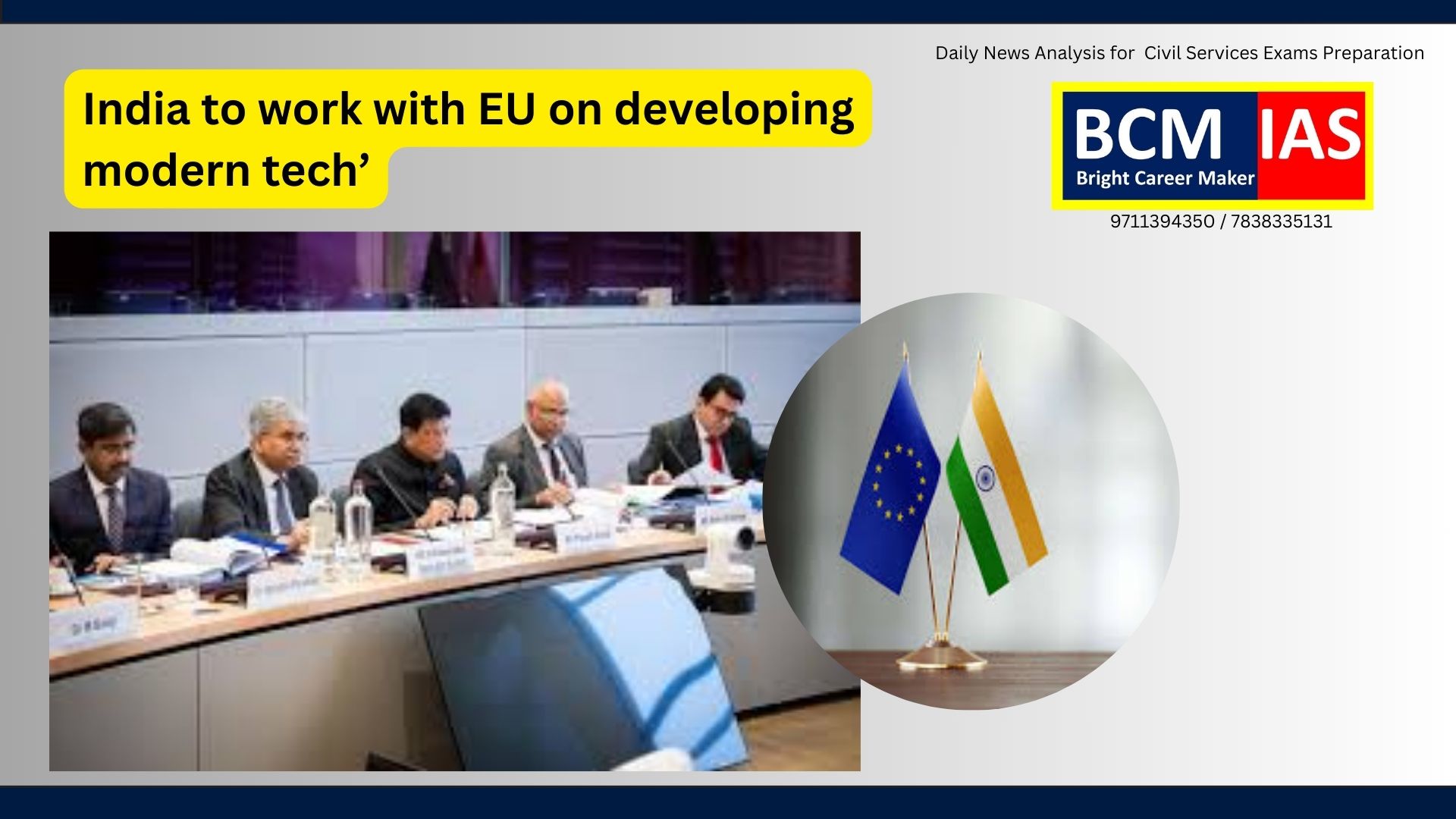
India
to work with EU on developing modern tech’
The recent meeting between India’s Commerce
and Industry Minister Piyush Goyal and
European Commissioner for Trade and Economic Security Maros
Sefcovic underscores the growing momentum in India-EU
relations, particularly in the domains of technology,
raw materials, and trade.
Key Highlights of the
Meeting
1. Technology
Development:
o India
and the EU aim to collaborate on cutting-edge
technologies such as artificial intelligence, clean energy, and
advanced manufacturing.
o This
partnership seeks to strengthen technological innovation and ensure
competitiveness in the global market.
2. Critical
Raw Materials:
o Both
sides are committed to securing
critical raw material supply chains, crucial for industries
like semiconductors, renewable energy, and electric vehicles.
o The
move intends to reduce dependencies on non-market
economies, particularly China, and foster resilient supply
chains.
3. Free
Trade Agreement (FTA):
o A mutually beneficial FTA
is being pursued to simplify tariff and non-tariff barriers, enhancing cost
competitiveness for businesses on both sides.
o This
agreement could address long-standing challenges such as intellectual property
rights, labor standards, and environmental regulations.
4. Resilient
Supply Chains:
o India
and the EU are working towards building resilient
and diversified supply chains, reducing vulnerabilities to
external shocks and geopolitical risks.
Strategic
Implications
1. Economic
Synergy:
o A
commercially meaningful trade agenda will drive bilateral trade growth and create
opportunities for sectors such as pharmaceuticals, green technology, and
digital innovation.
o Simplification
of trade norms will promote cost
competitiveness, benefitting businesses and fostering economic
integration.
2. Technological
Leadership:
o Collaboration
in emerging technologies positions India and the EU as leaders in global
innovation.
o Joint
initiatives can counter China’s
dominance in critical sectors like AI and renewable energy.
3. Global
Supply Chain Resilience:
o Securing
critical raw materials and reducing dependence on non-market economies
align with broader global efforts to diversify supply chains.
o This
strategy enhances economic security and mitigates risks from supply
disruptions.
4. Geopolitical
Realignment:
o The
partnership reflects a shared vision for economic
security and democratic values, aligning with broader efforts
to counter authoritarian regimes.
Challenges to Address
1. FTA
Negotiations:
o Long-standing
disagreements on intellectual
property, labor, and environmental standards could delay
progress.
o Balancing
the EU's stringent regulatory framework with India’s development priorities
remains critical.
2. Technological
Gaps:
o While
India focuses on affordability and scalability, the EU emphasizes sustainability
and advanced technology. Bridging these priorities will require aligned
strategies.
3. Geopolitical
Dynamics:
o Aligning
policies on contentious global issues, such as Russia and China, remains a
challenge for deeper cooperation.
Way Forward
1. Focus
on FTA:
o Both
sides must prioritize finalizing a fair
and equitable FTA, addressing tariff and non-tariff barriers to
enhance bilateral trade.
2. Strengthen
Technology Collaboration:
o Establish
frameworks for joint R&D in emerging technologies, leveraging platforms like
the EU-India Trade and
Technology Council (TTC).
3. Critical
Raw Material Partnership:
o Develop
long-term agreements for securing critical raw materials, investing in
exploration, and fostering sustainable mining practices.
4. Promote
Sustainable Trade Practices:
o Align
trade policies with global environmental goals, emphasizing green technologies and renewable
energy collaboration.
Conclusion
The India-EU partnership on developing modern
technologies and resilient supply chains is a strategic move to bolster economic
and technological ties while addressing shared global challenges. By addressing
barriers in FTA negotiations and leveraging platforms like the TTC, both sides
can unlock the full potential of this relationship, driving sustainable growth
and innovation.
About India-EU Relationship
The India-EU relationship
holds strategic importance, with shared democratic values, economic synergies,
and mutual challenges. Despite its potential, the partnership faces hurdles in
achieving consistent outcomes.
Significance of the
India-EU Partnership
1. Shared
Democratic Values:
o Both
India and the EU uphold democracy, multilateralism, and prosperity.
o The
collaboration can act as a bulwark against the rise of authoritarian regimes
like China and Russia.
2. Economic
Potential:
o India
offers the EU access to a vast and growing market, while the EU contributes
significant investments, technology, and innovation.
o The bilateral trade (goods
and services) valued at nearly $190
billion (2023-24) underscores the importance of economic ties.
3. Technological
Collaboration:
o Joint
efforts in AI, green
technology, and space can counter China’s technological
dominance.
o The Trade and Technology Council (TTC)
serves as a platform to align strategies on emerging technologies, clean energy,
and cybersecurity.
4. Strategic
Cooperation:
o Maritime
security initiatives, such as the India-EU
joint naval exercise in the Gulf of Guinea, signify cooperation
in securing the Indian Ocean—crucial for global trade and stability.
5. Environmental
Leadership:
o Collaboration
in green technologies, renewable energy, and sustainable development aligns
with global climate goals.
Challenges in the
India-EU Relationship
1. Geopolitical
Divergences:
o India’s
neutral stance
on Russia’s invasion of Ukraine contrasts with the EU’s sanctions, creating a
trust deficit.
o Diverging
approaches to China: While India views China as a competitor, the EU continues
to trade extensively with it.
2. Economic
Barriers:
o Stalled
FTA negotiations
due to disagreements on intellectual property rights, labor, and environmental
standards (e.g., Carbon Border Adjustment Mechanism).
o Protectionist
policies in sensitive sectors such as agriculture and pharmaceuticals.
3. Defense
Cooperation Limitations:
o India’s
reliance on Russian
defense systems hampers deeper defense collaboration with
Europe.
o A
lack of strategic dialogue and the EU’s restrictive knowledge-sharing policies
hinder defense partnerships.
4. Structural
Barriers in the EU:
o Fragmentation
among EU member states complicates the formulation of unified foreign policies
toward India.
Strengthening
India-EU Relations
1. Countering
Authoritarianism:
o A
shared commitment to democracy can foster a united front against authoritarian
regimes.
o Enhanced
cooperation through initiatives like Democracy
Summits can address global challenges in the Atlantic and
Indo-Pacific regions.
2. Strengthening
Economic Ties:
o Finalizing
the FTA can unlock new avenues for trade and investment.
o Joint
ventures in pharmaceuticals,
renewable energy, and critical raw materials can deepen
economic integration.
3. Leveraging
Technology and Innovation:
o The
TTC can serve as a high-level forum to align technology policies, focusing on
innovation in AI,
quantum computing, and biotech.
o Co-development
in sunrise sectors can help Europe revive its manufacturing capabilities and
bolster India’s industrial growth.
4. Enhanced
Defense Cooperation:
o The
EU can complement India’s partnerships with the US and Russia by investing in
advanced technologies and joint defense projects.
o Increased
collaboration in the Indo-Pacific
can address regional security challenges.
5. Environmental
Action:
o Joint
investments in clean
energy, electric vehicles, and sustainable agriculture can
enhance global leadership in climate action.
Mains Question:
Discuss the significance
of the India-EU collaboration on technology development and trade in
strengthening bilateral ties and addressing global challenges. Highlight the
potential benefits and challenges of this partnership.
Answer:
The India-EU partnership on technology and
trade is pivotal in strengthening bilateral relations and addressing shared
global challenges. This collaboration reflects their commitment to promoting
democracy, multilateralism, and economic security.
Significance of the
Partnership
1. Technological
Leadership:
o Joint
development of cutting-edge
technologies like artificial intelligence, renewable energy,
and advanced manufacturing can position both India and the EU as global
innovation leaders.
o Platforms
like the Trade and
Technology Council (TTC) enhance collaboration in emerging
technologies, green energy, and cybersecurity.
2. Securing
Supply Chains:
o By
working together to secure critical
raw materials, the partnership mitigates supply chain
vulnerabilities and reduces dependence on non-market economies like China.
o This
ensures the resilience and sustainability of industries, including
semiconductors and electric vehicles.
3. Strengthening
Economic Ties:
o A Free Trade Agreement (FTA)
can enhance bilateral trade, already valued at $190 billion in goods and
services (2023-24).
o Simplified
tariff and non-tariff barriers will promote economic integration and benefit
businesses from both regions.
4. Global
Geopolitical Alignment:
o The
partnership fosters a rules-based
international order, countering authoritarian regimes and
aligning strategies for Indo-Pacific security.
Potential Benefits
1. Economic
Growth:
o Enhanced
trade will boost exports, create jobs, and increase market access for both
sides.
o Indian
sunrise sectors, such as green technology and pharmaceuticals, can complement
the EU’s focus on sustainability.
2. Technological
Advancement:
o Collaboration
in R&D and
innovation will accelerate technological progress, benefiting
sectors like biotech, quantum computing, and space exploration.
3. Climate
Action:
o Joint
investments in clean
energy, electric vehicles, and sustainable agriculture will
advance global climate goals and foster environmental leadership.
4. Strategic
Security:
o Cooperation
in securing critical raw
materials and maritime security strengthens resilience against
geopolitical risks.
Challenges
1. FTA
Negotiation Hurdles:
o Disagreements
over intellectual
property rights, labor standards, and environmental regulations
could delay progress.
2. Technological
Gaps:
o India’s
focus on affordability contrasts with the EU’s emphasis on advanced technology
and sustainability.
3. Geopolitical
Differences:
o India’s
neutral stance on Russia and the EU’s sanctions policy create a trust deficit.
o Diverging
approaches to China complicate a unified strategy in the Indo-Pacific.
4. Regulatory
Barriers:
o The
EU’s stringent regulatory framework may pose challenges for Indian businesses.
Way Forward
1. Finalize
the FTA:
o Prioritize
addressing barriers related to tariffs, intellectual property, and
sustainability to achieve a fair agreement.
2. Enhance
Technology Collaboration:
o Focus
on joint R&D initiatives, leveraging platforms like the TTC to align
strategies in emerging sectors.
3. Secure
Raw Material Supply Chains:
o Develop
long-term partnerships for critical raw materials through sustainable mining
and diversification efforts.
4. Strengthen
Strategic Dialogue:
o Build
consensus on geopolitical issues to align policies on Indo-Pacific security and
global governance.
Conclusion
The India-EU partnership on technology and
trade has the potential to transform bilateral ties, fostering economic growth,
innovation, and sustainability. By overcoming challenges in FTA negotiations
and aligning their strategic goals, both sides can address global challenges,
counter authoritarianism, and promote a resilient and inclusive global order.
MCQs
Question1:
Which of the following statements about the India-EU Trade and Technology
Council (TTC) is/are correct?
1.
It is the first such mechanism established by
the European Union with any partner country.
2.
The council focuses on cooperation in
critical technologies, green energy, and cybersecurity.
3.
The TTC aims to finalize a Free Trade
Agreement (FTA) between India and the EU.
Options:
a) 1 and 2 only
b) 2 and 3 only
c) 1 and 3 only
d) 1, 2, and 3
Answer: a)
1 and 2 only
Question 2:
Why is the collaboration between India and the EU on critical raw materials
important?
1.
It reduces dependence on non-market economies
like China.
2.
It strengthens supply chains for industries
like semiconductors and electric vehicles.
3.
It directly facilitates the creation of a
single market within the EU.
Options:
a) 1 and 2 only
b) 2 and 3 only
c) 1 and 3 only
d) 1, 2, and 3
Answer: a)
1 and 2 only
Question 3:
Which of the following statements about the European Union is incorrect?
a) Germany has the largest population in the EU.
b) France is the largest EU country by area.
c) The United Kingdom remains a member of the EU after Brexit.
d) Malta is the smallest country in the EU by size.
Answer: c)
The United Kingdom remains a member of the EU after Brexit.
Question 4:
The European Union has set which of the following climate-related targets?
1.
Achieving climate neutrality by 2050.
2.
Reducing greenhouse gas emissions by 55% by
2030 compared to 1990 levels.
3.
Eliminating the use of coal-based energy
entirely by 2025.
Options:
a) 1 and 2 only
b) 2 and 3 only
c) 1 and 3 only
d) 1, 2, and 3
Answer: a)
1 and 2 only
Question 5:
Consider the following statements regarding India-EU economic relations:
1.
The EU is India’s largest trading partner in
goods.
2.
The EU accounts for 17% of total Foreign
Direct Investment (FDI) inflows into India.
3.
The bilateral trade in services surpassed
$100 billion in 2023-24.
Options:
a) 1 and 2 only
b) 2 and 3 only
c) 1 and 3 only
d) 1, 2, and 3
Answer: a)
1 and 2 only


Comments on “India to work with EU on developing modern tech”