


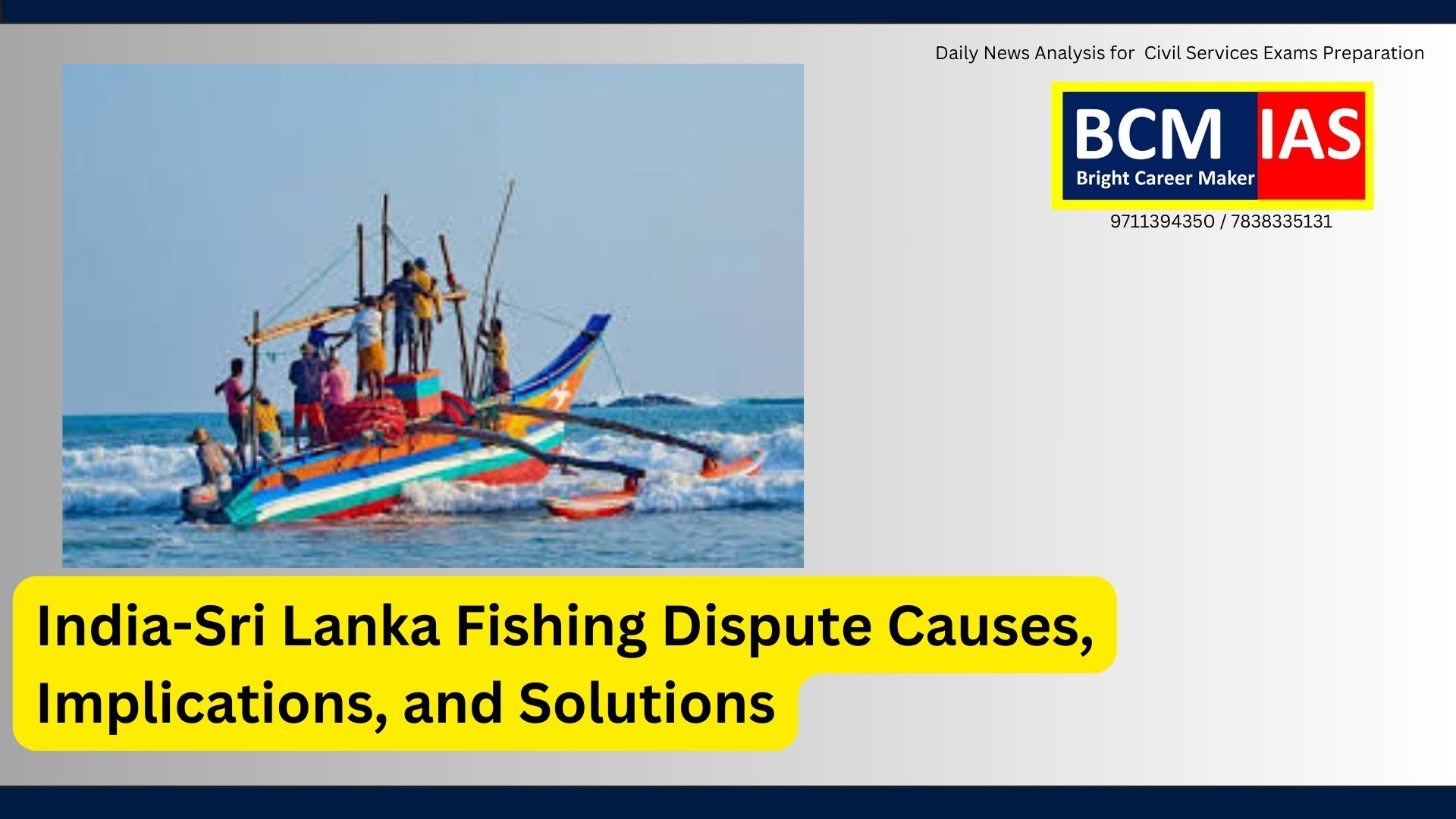
India-Sri Lanka Fishing Dispute: Causes,
Implications, and Solutions
1. Introduction
The India-Sri Lanka fishing
dispute has been a persistent maritime conflict, primarily affecting
the Palk Bay region. The recent arrest of Indian fishermen by the Sri
Lankan Navy has reignited tensions. With over 500 Indian fishermen
arrested in 2024, the issue highlights challenges related to territorial
rights, marine resource depletion, national security, and economic livelihoods.
This conflict is shaped by historical
fishing rights, the International Maritime Boundary Line (IMBL), environmental
concerns, and legal frameworks like the UNCLOS (1982) and the UN Fish Stocks
Agreement (1995).
2. Understanding the
Core Issues of the Dispute
(A)
Maritime Boundary and Fishing Rights Conflict
- The Palk Bay region, shared by Tamil
Nadu (India) and the Northern Province of Sri Lanka, has historically
been a fishing hotspot.
- IMBL (International Maritime Boundary
Line) was established under bilateral agreements (1974,
1976), dividing territorial waters.
- Indian fishermen often cross the IMBL
into Sri Lankan waters, citing traditional rights and declining
fish stocks on the Indian side.
(B) Recurrent Arrests and Security Concerns
- Indian fishermen are regularly arrested
and their boats confiscated by Sri Lanka for "poaching."
- The Sri Lankan government considers
unauthorized Indian fishing as a security risk, fearing it could be
exploited by criminal networks or Tamil militant groups.
- Destruction of Indian boats and heavy
penalties imposed by Sri Lankan authorities
exacerbate tensions.
(C)
Overfishing and Ecological Damage
- Indian fishermen face depleting fish
stocks due to overfishing in Indian waters,
leading them to cross into resource-rich Sri Lankan zones.
- The Sri Lankan government opposes
"bottom trawling", a destructive fishing practice that
depletes marine biodiversity.
(D)
Katchatheevu Island Dispute
- Katchatheevu islet (285 acres)
was ceded to Sri Lanka by India in 1974.
- Tamil Nadu fishermen argue that they historically
used the island for drying nets and resting,
but their access has been restricted.
- Tamil Nadu politicians periodically demand
the return of Katchatheevu, adding a political
dimension to the dispute.
(E)
Expansion of the Conflict Beyond Palk Bay
- Indian fishermen, due to depleting
resources, are venturing into Maldivian and even British-controlled
waters near Diego Garcia, leading to arrests by foreign navies.
- This highlights the need for
sustainable fishing practices and alternative livelihood
opportunities.
3. International
Legal Framework and Maritime Regulations
(A)
United Nations Convention on the Law of the Sea (UNCLOS, 1982)
- Defines territorial waters, exclusive
economic zones (EEZ), and IMBLs.
- Article 87
restricts unregulated fishing on the high seas, ensuring sovereign
control over territorial waters.
(B)
UN Fish Stocks Agreement (UNFSA, 1995)
- Mandates Regional Fisheries Management
Organizations (RFMOs) to regulate fishing activities.
- Encourages international cooperation
for sustainable fishing.
(C)
Bilateral India-Sri Lanka Agreements (1974, 1976)
- Established the IMBL, legally dividing
Palk Bay into Indian and Sri Lankan zones.
- Recognized Sri Lanka’s sovereignty over
Katchatheevu Island but allowed Indian fishermen to access it for traditional
activities.
4. Implications
of the India-Sri Lanka Fishing Dispute
(A)
Economic and Livelihood Challenges
- Indian fishermen suffer income losses
due to arrests, boat confiscations, and fines.
- Sri Lankan fishermen face economic
hardship due to Indian trawlers depleting fish
stocks.
(B)
Political and Diplomatic Ramifications
- Tensions over fishing rights have strained
India-Sri Lanka diplomatic relations.
- Tamil Nadu politicians strongly oppose the
arrest of Indian fishermen, pressuring the Indian
government for intervention.
(C)
Environmental Consequences
- Bottom trawling destroys marine habitats,
leading to:
- Coral reef destruction
- Loss of fish breeding grounds
- Ecosystem imbalance
- This negatively impacts both Indian and
Sri Lankan fisheries in the long run.
(D)
National Security Risks
- Sri Lanka fears that illegal fishing
routes could be exploited for smuggling or
militant activities.
- The Indian Coast Guard also faces
difficulties distinguishing between fishermen and
smugglers.
5. Possible
Solutions and the Way Forward
(A)
Strengthening Maritime Regulations and Surveillance
- Enhanced patrolling and real-time
satellite tracking of fishing vessels to prevent
unauthorized incursions.
- Establishing a Joint Monitoring System
between India and Sri Lanka for effective IMBL enforcement.
(B)
Promoting Alternative Livelihoods for Fishermen
- Tamil Nadu should invest in alternative
sources of income, such as:
- Seaweed farming
- Mariculture (fish breeding in controlled
environments)
- Marine tourism and deep-sea fishing
- The Indian government must provide
financial aid, training, and technology for sustainable fishing practices.
(C)
Bilateral Fisheries Management Agreements
- Creating a Joint Marine Resource Authority
for fishing quota allocations and seasonal fishing regulations.
- Both governments must establish a
sustainable framework for shared fishing rights in
disputed waters.
(D)
Expansion of Deep-Sea Fishing Programs
- Encouraging Indian fishermen to venture
into deep-sea fishing rather than relying on Palk Bay.
- Providing subsidies, training, and
technological assistance for deep-sea vessels.
(E)
Addressing Political and Diplomatic Concerns
- Regular diplomatic engagements through Joint
Working Groups (JWG) to ensure:
- Quick release of arrested fishermen
- Fair resolution of fishing conflicts
- Exploring the possibility of limited
access agreements to allow seasonal fishing rights.
6.
Conclusion
The India-Sri Lanka fishing
dispute remains a complex issue involving economic livelihoods,
environmental concerns, national security, and diplomatic relations. The escalating
arrests of Indian fishermen highlight the need for a long-term,
sustainable resolution.
To ensure peaceful
coexistence and maritime security, both countries must:
- Enforce joint fisheries management systems
- Promote sustainable fishing techniques
- Encourage deep-sea fishing as an
alternative
- Enhance diplomatic cooperation and
regional partnerships
A balanced approach
prioritizing economic, ecological, and security interests is essential for
a permanent solution to the India-Sri Lanka fishing conflict.
UPSC Mains Probable Question
"The India-Sri Lanka fishing dispute in
the Palk Bay is a recurring maritime conflict with deep economic,
environmental, and security implications. Analyze the root causes of the
conflict and suggest a multi-pronged approach to resolving it in a sustainable
manner." (250 words)
Answer
Introduction
The India-Sri Lanka fishing dispute is a long-standing
conflict primarily affecting fishermen from Tamil Nadu and Northern Sri
Lanka in the Palk Bay region. Indian fishermen are frequently arrested
and their boats confiscated by the Sri Lankan Navy for crossing the International
Maritime Boundary Line (IMBL). The issue involves historical fishing
rights, environmental concerns, maritime security, and diplomatic challenges.
1. Root Causes of the
Conflict
(A) Disputed Fishing Rights & IMBL Violation
- Indian
fishermen argue historical access to fishing grounds, but the 1974
& 1976 agreements established an IMBL restricting access.
- IMBL
enforcement is strict from Sri Lanka’s side, leading to frequent arrests.
(B) Declining Fish Stocks & Overfishing
- Depleting
fish stocks in
Indian waters push fishermen into Sri Lankan Exclusive Economic Zone
(EEZ).
- Unregulated
trawling and overfishing have worsened the crisis.
(C) Destructive Fishing Practices (Bottom Trawling)
- Indian
fishermen use bottom trawlers, which damage marine ecosystems
and breeding grounds.
- Sri
Lanka opposes bottom trawling as it severely impacts local fisheries.
(D) Security & Political Concerns
- Sri
Lanka sees illegal trawler movement as a security risk, fearing militant
infiltration and smuggling.
- The Katchatheevu
Island dispute remains politically sensitive in Tamil Nadu.
2. Implications of the
Dispute
(A) Economic and Livelihood Issues
- Fishermen’s
livelihoods are at stake, affecting thousands of families.
- Sri
Lanka suffers economic losses of $730 million annually due to poaching.
(B) Diplomatic Strains between India and Sri Lanka
- Frequent
diplomatic tensions arise due to arrests and boat seizures.
- Tamil
Nadu’s political pressure complicates India’s stance.
(C) Environmental Degradation
- Bottom
trawling destroys marine biodiversity, affecting long-term fisheries sustainability.
3. A Multi-Pronged
Approach to Resolving the Dispute
(A) Strengthening
Maritime Regulations & Surveillance
- Joint
patrolling & monitoring of IMBL to prevent unauthorized fishing.
- Real-time
vessel tracking technology for better enforcement.
(B) Alternative Livelihood Programs
- Promote
deep-sea fishing with modern technology.
- Encourage
seaweed farming, mariculture, and inland fisheries for employment
diversification.
(C) Sustainable Fisheries Management
- Ban
bottom trawling
and introduce scientific fishery management plans.
- Establish
joint fishing zones & seasonal fishing regulations.
(D) Bilateral Cooperation & Diplomatic Engagement
- Establish
a permanent Joint Working Group (JWG) for real-time issue
resolution.
- Negotiate
a bilateral fishing treaty with catch quotas and rotational
fishing rights.
(E) Community-Based Conflict Resolution
- Fishermen’s
cooperatives from both countries should be included in negotiations.
- Trust-building
measures like
knowledge-sharing on sustainable fishing.
Conclusion
The India-Sri Lanka fishing dispute is a complex issue
involving livelihoods, marine conservation, and security concerns. A combination
of policy interventions, alternative employment generation, and strong
diplomatic engagement is essential for a long-term, sustainable
resolution. India and Sri Lanka must shift from confrontation to
cooperation, ensuring peaceful coexistence and maritime harmony.
MCQs
Q1. Consider the
following statements regarding the India-Sri Lanka Fishing Dispute:
1.
The International Maritime Boundary Line (IMBL)
between India and Sri Lanka was established under bilateral agreements in 1974
and 1976.
2.
The main cause of the dispute is the demand for the
return of Katchatheevu Island to India.
3.
Bottom trawling by Indian fishermen in Sri Lankan
waters is a major ecological concern.
Which of the statements given above is/are correct?
(a) 1 and 2 only
(b) 2 and 3 only
(c) 1 and 3 only
(d) 1, 2, and 3
Q2. What is the primary
reason why Sri Lanka opposes bottom trawling by Indian fishermen?
(a)
It damages marine ecosystems and depletes fish stocks.
(b) It leads to the illegal smuggling of weapons into Sri Lanka.
(c) It violates the United Nations Convention on the Law of the Sea
(UNCLOS).
(d) It increases Sri Lanka's dependency on Indian seafood imports.
Q3. Which of the
following international agreements or laws regulate fishing activities in
territorial and international waters?
1.
United Nations Convention on the Law of the Sea
(UNCLOS), 1982
2.
UN Fish Stocks Agreement (UNFSA), 1995
3.
Convention on Biological Diversity (CBD), 1992
Select the correct answer using the codes given below:
(a) 1 and 2 only
(b) 2 and 3 only
(c) 1 and 3 only
(d) 1, 2, and 3
Q4. Katchatheevu Island,
a key element in the India-Sri Lanka fishing dispute, was ceded to Sri Lanka
through:
(a)
The Indo-Sri Lanka Accord of 1987
(b) The 1974 and 1976 Maritime Agreements
(c) The United Nations Convention on the Law of the Sea (UNCLOS), 1982
(d) The Shimla Agreement, 1972
Q5. Which of the
following measures would be most effective in resolving the India-Sri Lanka
fishing dispute?
1.
Promoting deep-sea fishing among Indian fishermen.
2.
Strengthening joint maritime surveillance by India and
Sri Lanka.
3.
Allowing unlimited fishing rights to Indian fishermen
in Sri Lankan waters.
4.
Establishing a bilateral marine resource management
authority.
Select the correct answer using the codes given below:
(a) 1, 2, and 4 only
(b) 2 and 3 only
(c) 1 and 4 only
(d) 1, 2, 3, and 4
Answers:
1.
(c) 1 and 3 only
Explanation:
- The IMBL
was established through the 1974 and 1976 bilateral agreements,
legally dividing the territorial waters (Statement 1 is correct).
- While
Katchatheevu is a politically sensitive issue, the primary cause of
the dispute is overfishing, bottom trawling, and livelihood concerns
(Statement 2 is incorrect).
- Bottom
trawling damages marine ecosystems, making it a significant environmental issue in
the dispute (Statement 3 is correct).
2. (a) It damages marine ecosystems and depletes fish
stocks.
Explanation:
- Bottom
trawling is an unsustainable
fishing practice that damages coral reefs, destroys breeding
grounds, and leads to overfishing, which Sri Lanka strongly opposes.
3. (a) 1 and 2 only
Explanation:
- UNCLOS
(1982) defines territorial
waters, EEZs, and maritime boundaries, governing fishing rights.
- UNFSA
(1995)
regulates shared fish stocks and promotes sustainable fishing
practices.
- The
Convention on Biological Diversity (CBD) focuses on biodiversity
conservation,
but it does not directly regulate fishing in territorial waters (Statement
3 is incorrect).
4. (b) The 1974 and 1976 Maritime
Agreements
Explanation:
- Katchatheevu
Island was ceded to Sri Lanka in 1974, with India formally agreeing to its sovereignty
in the 1976 maritime boundary agreement.
- However,
Tamil Nadu politicians continue to demand its return, citing traditional
fishing rights.
5. (a) 1, 2, and 4 only
Explanation:
- Deep-sea
fishing can
provide alternative livelihoods to Indian fishermen, reducing
dependence on Sri Lankan waters (Statement 1 is correct).
- Joint
maritime surveillance will help prevent illegal fishing and enhance security (Statement
2 is correct).
- Unlimited
fishing rights for Indian fishermen in Sri Lankan waters are unrealistic, as they would violate
international agreements (Statement 3 is incorrect).
- A
joint marine resource management authority can promote sustainable
fishing and conservation (Statement 4 is correct).


Comments on “India-Sri Lanka Fishing Dispute: Causes, Implications, and Solutions”