


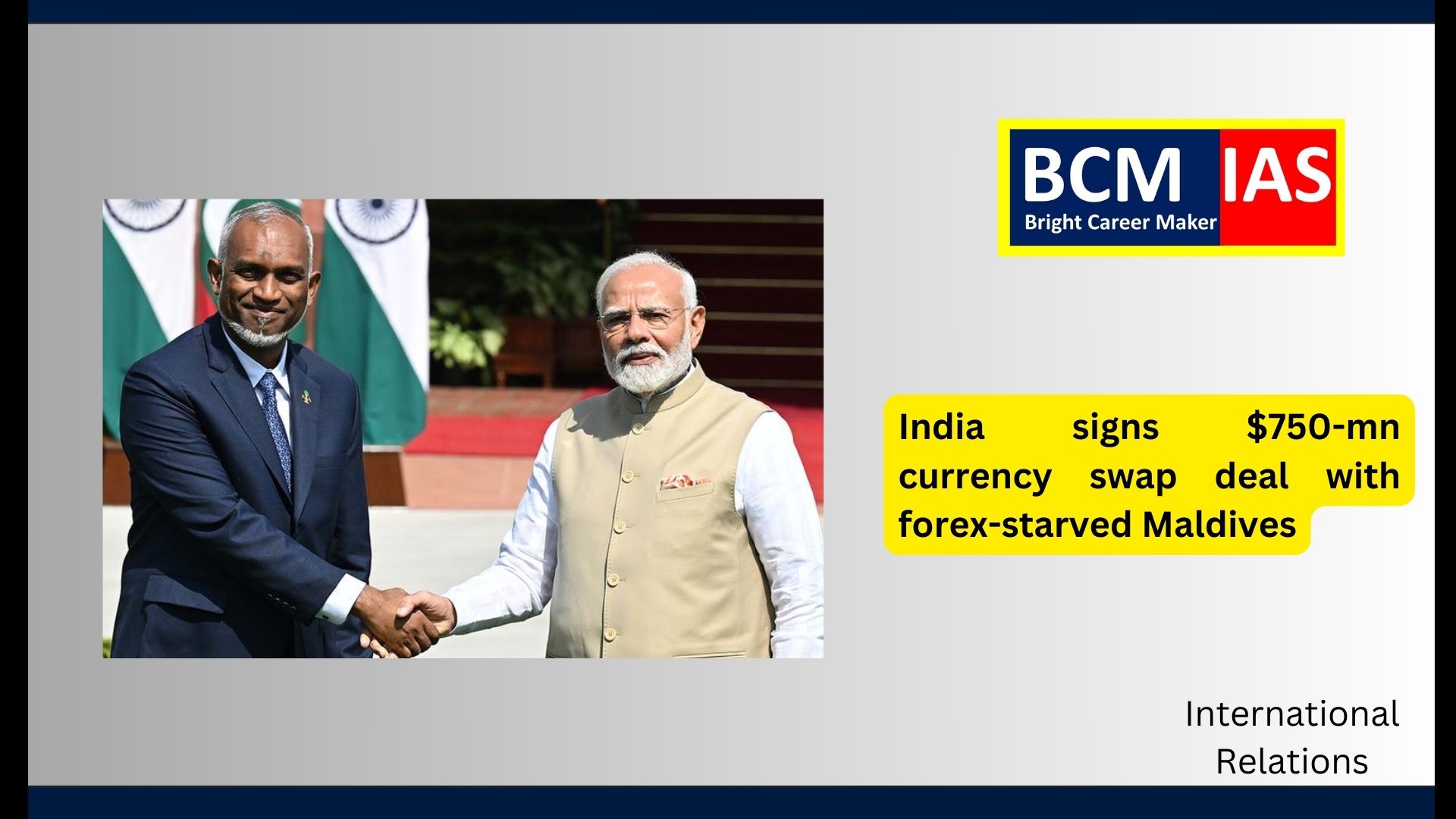
India signs $750-mn currency swap deal with
forex-starved Maldives
·
The article discusses the India-Maldives relations
following the visit of Maldivian President Mohamed Muizzu to India,
marking his first bilateral trip to the country.
·
The key focus of the visit was on strengthening
economic and diplomatic ties, with India providing crucial economic
assistance to the foreign exchange-starved Maldives.
·
The currency swap agreement, worth $750
million, is the most significant outcome of the talks between Prime
Minister Narendra Modi and President Muizzu. This agreement aims
to help the Maldives overcome its current foreign currency crunch.
Key Points of the News:
1. Currency
Swap Agreement:
o India and the
Maldives signed a currency swap arrangement for a total of $750
million. This includes a $400 million agreement and an additional ₹3,000
crore ($357 million) under the SAARC Currency Swap Framework.
o The agreement is
designed to stabilize the Maldives' foreign exchange reserves, which had
fallen to record lows of $440 million. This assistance will be available
until 2027, giving the Maldives time to manage its economic challenges.
o Currency swap
agreements allow the two countries to exchange currency, enabling the Maldives
to pay for imports and stabilize its economy without needing to purchase
foreign currency on the open market.
2. Additional
Agreements Signed:
o Other agreements
were signed to promote people-to-people ties and economic cooperation.
This includes the launch of the RuPay card in the Maldives, which will
facilitate financial transactions between the two countries and boost tourism
and trade.
o India handed
over 700 houses built with Indian assistance, demonstrating India’s
commitment to infrastructure development in the Maldives.
o MoUs were signed
between the CBI and the Anti-Corruption Commission of the Maldives,
as well as between policing institutes and judicial training institutes. These
agreements aim to enhance cooperation in law enforcement, judicial
training, and anti-corruption efforts.
3. Tourism
and People-to-People Ties:
o Tourism plays a
significant role in the Maldivian economy, and India has been one
of the largest source markets for tourists to the Maldives. However, tensions
in the past year due to criticism of Indian leadership led to a “boycott
Maldives” campaign, which halved the number of Indian tourists visiting the
Maldives.
o President
Muizzu emphasized
the need to restore Indian tourism, stating that the Maldives hopes to
welcome more Indian tourists, which would contribute to economic growth and
strengthen ties between the two nations.
4. Economic
and Trade Cooperation:
o India and the
Maldives agreed to step up cooperation on trade in national currencies
and work towards a Free Trade Agreement (FTA). The discussions
highlighted the importance of building a comprehensive economic and maritime
security partnership between the two countries.
o Further credit
lines and economic assistance were discussed, though they will be
evaluated and decided in the coming weeks or months.
o A new international
airport runway constructed jointly by the two countries at Hanimadhoo
island was inaugurated, symbolizing India's involvement in enhancing the
Maldives’ infrastructure.
5. Maritime
Security and Coast Guard Cooperation:
o The two sides
also focused on maritime security, with India agreeing to support the refit
of a Maldivian Coast Guard ship, Huravee, at an Indian facility. This
agreement strengthens India’s strategic position in the Indian Ocean,
where the Maldives occupies a key location.
o The Indian
military personnel issue, which caused tensions earlier when the Maldives
demanded their withdrawal, was not revisited. India withdrew its personnel
in 2023, replacing them with technical staff, which helped normalize relations.
6. India’s
Role as a “First Responder”:
o Prime
Minister Modi
emphasized India's long-standing role as the Maldives’ “First Responder”,
referring to India’s assistance in various crises, including supplying drinking
water during emergencies, providing vaccines during the COVID-19 pandemic, and
helping in the aftermath of the 2004 tsunami.
o The currency
swap agreement is seen as another example of India’s commitment to regional
stability and economic support for its neighbors, reflecting its policy of
supporting economic recovery and maritime security in the Indian
Ocean Region.
7. Maldives’
Relations with China:
o Although President
Muizzu had earlier visited China, where multiple agreements,
including currency swap arrangements and debt repayment waivers, were signed,
the article notes that India-Maldives discussions remained focused on
bilateral relations during this visit.
o The growing
influence of China in the Maldives, especially through investments and
defense cooperation, is a factor that India continues to monitor closely, given
the Maldives' strategic importance in the Indian Ocean.
Analysis of the Visit
and Agreements:
1. Economic
Support and Regional Stability:
o The $750
million currency swap is vital for the Maldives, as its foreign exchange
reserves were critically low. This financial assistance will help stabilize
the Maldivian economy and avoid potential financial crises, like currency
devaluation or inflation spikes, that could lead to social unrest.
o By extending
this support, India is asserting its role as a regional leader and ensuring
that the Maldives remains within its sphere of influence amid growing
Chinese investments.
2. Strengthening
Bilateral Ties:
o The visit marks
a full turnaround in India-Maldives relations after tensions had arisen
from the “India Out” campaign. The agreements signed in this visit
reflect a new chapter in the diplomatic relationship, emphasizing economic
cooperation, security ties, and people-to-people connections.
o The launch of RuPay
cards and agreements on tourism and infrastructure development will enhance
the economic interdependence between the two countries.
3. Strategic
Importance of the Maldives:
o The Maldives is
geographically significant for India’s maritime security strategy in the
Indian Ocean. With increasing competition from China for
influence in the Maldives, India’s agreements on maritime cooperation,
such as refitting Maldivian coast guard ships and investing in infrastructure
development, are essential for maintaining security partnerships.
o The agreement
for Hanimadhoo airport and support for the Maldivian Coast Guard
align with India's long-term goals of maintaining stability and influence in
the Indian Ocean.
4. Balancing
Relations with China:
o Although Maldives-China
relations have grown, especially with recent economic and defense
agreements, President Muizzu's visit to India shows the importance of
maintaining balanced relations with both India and China. India’s
assistance through currency swaps and economic support can act as a
counterbalance to China's growing presence.
o The Maldives
benefits from both India’s immediate financial assistance and China’s long-term
investments, reflecting its diplomatic strategy of engaging with multiple
global powers.
Conclusion:
The India-Maldives bilateral agreements, particularly
the $750 million currency swap, signify the strengthening of ties
between the two nations amid the Maldives’ economic challenges. This
cooperation is not only a financial lifeline for the Maldives but also
enhances India's strategic interests in the Indian Ocean Region.
By offering timely support, India has reaffirmed its role as a trusted
partner and First Responder for the Maldives, balancing geopolitical
influence while ensuring stability in its neighborhood.
MCQs for Practice-
1. What was the total amount of the currency swap agreement
signed between India and the Maldives during President Muizzu's visit to India?
a) $400 million
b) $500 million
c) $750 million
d) $1 billion
Answer: c) $750 million
Explanation:
The total amount of the currency swap agreement signed between India and the
Maldives is $750 million, which includes $400 million under the SAARC
framework and an additional ₹3,000 crore ($357 million).
2. Under which framework was part of the currency swap
agreement between India and the Maldives signed?
a) BRICS Economic Framework
b) South Asian Association for Regional Cooperation (SAARC) Currency Swap
Framework
c) Indian Ocean Rim Association Framework
d) Shanghai Cooperation Organization Framework
Answer: b) South Asian Association for Regional Cooperation (SAARC) Currency
Swap Framework
Explanation:
Part of the currency swap agreement for $400 million was signed under
the SAARC Currency Swap Framework.
3. What is the significance of the currency swap agreement
between India and the Maldives?
a) It allows the Maldives to pay for imports and stabilize
its economy without needing to purchase foreign currency.
b) It provides military support to the Maldives.
c) It increases the Maldives' tourism revenue.
d) It removes tariffs on goods between India and the Maldives.
Answer: a) It allows the Maldives to pay for imports and stabilize its economy
without needing to purchase foreign currency.
Explanation:
A currency swap agreement helps the Maldives manage its foreign
exchange reserves and stabilize its economy by enabling payments for
imports without purchasing foreign currency on the market.
4. Which of the following was NOT part of the agreements
signed between India and the Maldives during President Muizzu's visit?
a) Launch of the RuPay card in the Maldives
b) MoUs for cooperation in sports and youth affairs
c) Signing of a Free Trade Agreement (FTA)
d) Handover of 700 houses built with Indian assistance
Answer: c) Signing of a Free Trade Agreement (FTA)
Explanation:
While India and the Maldives discussed the possibility of a Free Trade
Agreement (FTA), it was not signed during this visit. However, agreements like
the launch of RuPay cards, housing handovers, and MoUs for
cooperation in sports and youth affairs were part of the discussions.
5. Why is the Maldives significant for India from a
geopolitical perspective?
a) It is a key trading partner in Southeast Asia.
b) It is a major oil producer in the region.
c) It is strategically located in the Indian Ocean, important for maritime
security.
d) It shares a land border with India.
Answer: c) It is strategically located in the Indian Ocean, important for
maritime security.
Explanation:
The Maldives' location in the Indian Ocean makes it strategically
important for India’s maritime security and influence in the region,
especially in light of growing Chinese investments and security cooperation in
the area.


Comments on “India signs $750-mn currency swap deal with forex-starved Maldives”