


Daily
Current Affairs Analysis
19
Feb 2025
-------------------------------------------------------------------------------------------------------------
India-Qatar Strategic Partnership
Elevation
News
Explanation
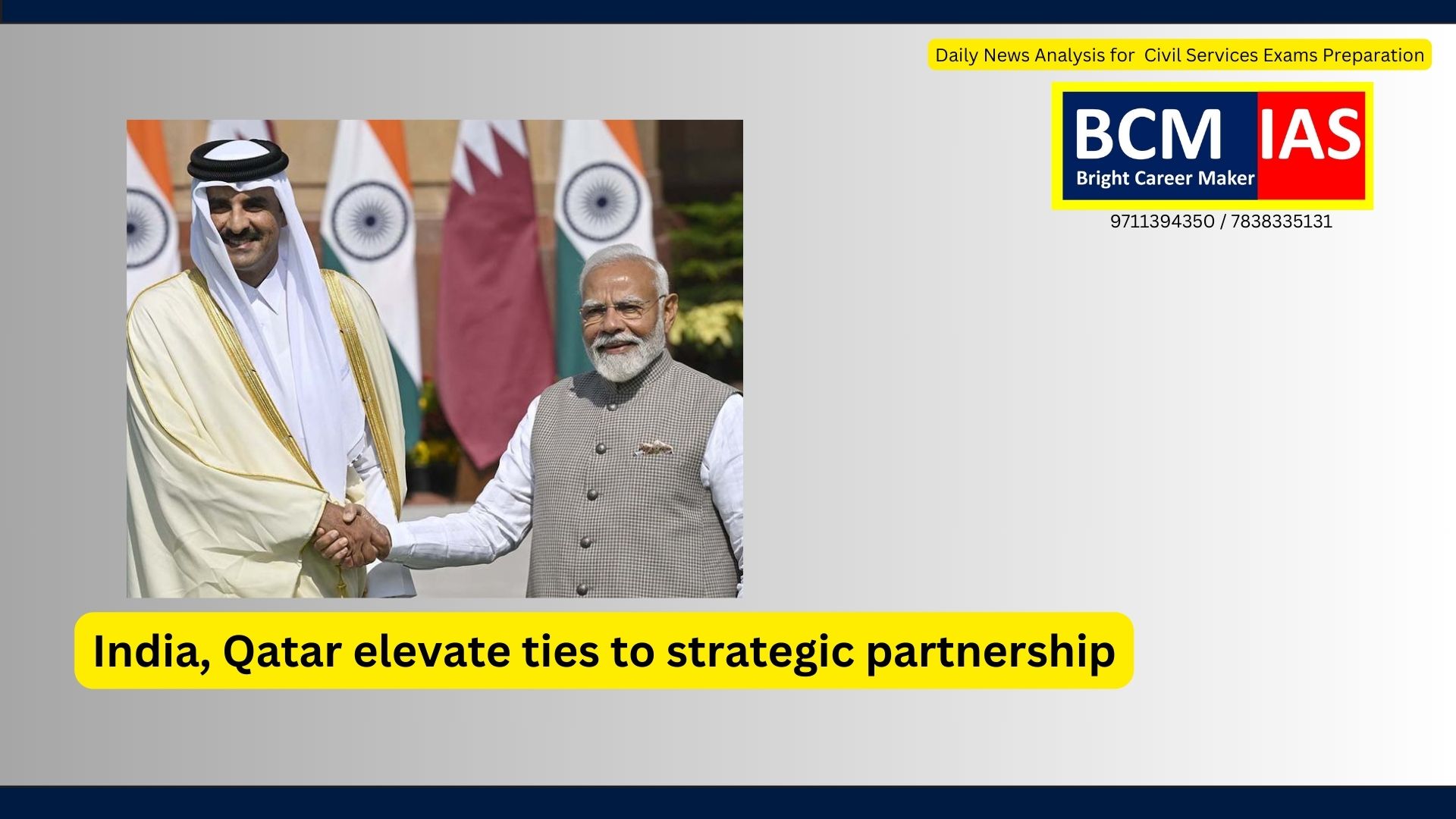
The recent visit of the Emir of Qatar, Sheikh
Tamim Bin Hamad Al-Thani, to India and his meeting with Prime Minister Narendra
Modi marked a significant
milestone in India-Qatar relations. The key takeaways from this
diplomatic engagement indicate a broadening
of ties in trade, investment, security, and regional diplomacy.
Key Developments and Their Significance
1. Strategic Partnership Agreement
- Qatar
and India agreed to elevate
their relationship to a strategic partnership.
- This
means a more
structured engagement in areas such as trade, energy security, and
defense cooperation.
- India
has similar agreements with other GCC nations,
including Kuwait,
UAE, Oman, and Saudi Arabia, further strengthening its
Gulf outreach.
Significance:
- It
enhances political trust
and long-term cooperation.
- Ensures
deeper economic and
security collaboration.
- Strengthens
India's energy
security, given that Qatar is a major supplier of LNG (Liquefied
Natural Gas) to India.
2. Free Trade Agreement (FTA) Discussion
- India
and GCC (Gulf Cooperation Council) are already negotiating an FTA.
- India
and Qatar are considering a bilateral
FTA as an alternative to speed up trade liberalization.
Significance:
- Boosts
trade and investment, reducing tariffs and
increasing market access.
- Enhances
energy and business
collaboration, especially in finance and infrastructure.
- India’s
engagement with Qatar’s
sovereign wealth fund could attract investment into Indian projects.
3. Economic Commitments – Doubling Bilateral Trade
- Qatar
aims to double trade with India to $28 billion.
- 38
Qatari entities from retail, finance, and energy
sectors participated in the discussions.
Significance:
- Strengthens
India's economic
footprint in the Gulf.
- Encourages
Qatari investments
in India, particularly in infrastructure, startups, and digital economy.
- Provides
a stable energy
supply for India, crucial for economic and industrial growth.
4. Double Taxation Avoidance Agreement
- India
and Qatar signed a double
taxation avoidance treaty to prevent businesses and
individuals from being taxed twice on the same income.
Significance:
- Encourages
investment and
cross-border business activity.
- Provides
tax relief
to Indian professionals working in Qatar.
- Makes
Indian exports and
services more competitive.
5. Security Cooperation
- The
partnership will include
a security component, but details were not disclosed.
Significance:
- Could
involve counterterrorism cooperation, intelligence sharing, and
cybersecurity initiatives.
- Maritime
security in the Indian Ocean could be a key area of
focus.
- Helps
in securing India’s
workforce in Qatar, which is the largest expatriate community
in the country.
6. Challenges – The Case of Ex-Navy Commander Purnendu
Tiwary
- Commander
Purnendu Tiwary remains in Qatari custody,
while seven other
Indian Navy veterans were repatriated in February 2024.
- India
is diplomatically
engaging with Qatar for his release.
Significance:
- Highlights
bilateral tensions
despite strong economic ties.
- The
case could test
India's diplomatic influence in the Gulf region.
- A
positive resolution
could strengthen
diplomatic goodwill between the two countries.
Geopolitical Context – India, Qatar & West Asia
7. Israel-Palestine Conflict and India’s Position
- India
and Qatar discussed the Israel-Hamas war.
- India
reiterated its stance on a two-state
solution.
- Qatar
has historically mediated
in West Asian conflicts.
Significance:
- India
balances its
relations with Israel and Arab nations.
- As
a leading gas
supplier, Qatar holds economic leverage.
- India
avoided commenting
on Donald Trump’s proposal to relocate
Palestinians, signaling a neutral diplomatic stance.
8. India's Growing Influence in the Gulf
- India’s
strategic
partnerships with Kuwait,
Oman, UAE, and Saudi Arabia signal a broader Middle East policy.
- The
Gulf region is critical
for India’s energy security, trade, and workforce
(millions of Indian workers contribute to the Gulf economy).
Significance:
- Strengthens
India’s role in
regional diplomacy.
- Ensures
energy security
and economic
partnerships.
- Positions
India as a major
economic and strategic player in West Asia.
Conclusion
The India-Qatar strategic partnership agreement
is a landmark
development that deepens
economic, security, and political ties. The commitment to double trade, discuss a bilateral FTA,
and sign a taxation treaty highlights the growing economic interdependence.
However, challenges
remain, particularly regarding the detention of Indian naval personnel
and the uncertainties in
West Asia.
This development strengthens India's Gulf policy
and reinforces its strategic
presence in West Asia, ensuring energy security and economic growth while
balancing regional
geopolitics. 🚀📈
Mains
Probable Question
Q1: India and Qatar recently elevated their ties to a
strategic partnership. Discuss the significance of this development in the
context of India's energy security, trade, and geopolitical positioning in the
Gulf region. (250 words)
Answer:
India and Qatar's decision to elevate their
ties to a strategic
partnership marks a crucial milestone in bilateral relations.
This partnership encompasses trade,
investment, energy security, and security cooperation,
strengthening India's engagement in the Gulf region.
1. Energy Security
- Qatar
is a major supplier
of Liquefied Natural Gas (LNG) to India and plays a
critical role in ensuring
stable energy imports.
- Enhanced
cooperation in energy
infrastructure investment and supply chain security will
help India diversify
energy sources and meet its growing demand.
2. Economic and Trade Relations
- Bilateral
trade is set to double to $28 billion,
boosting exports,
investments, and financial cooperation.
- India
and Qatar are exploring
a Free Trade Agreement (FTA), which will reduce trade
barriers and facilitate economic
integration.
- The
double taxation
avoidance agreement will encourage cross-border investments
and benefit Indian professionals working in Qatar.
3. Strategic and Security Cooperation
- The
partnership
includes a security component, potentially involving counterterrorism, intelligence
sharing, and maritime security.
- India’s
expatriate
workforce in Qatar will benefit from improved diplomatic
engagement.
4. Geopolitical Considerations
- India
maintains a balanced
position on the Israel-Palestine issue, aligning with its strategic interests in West Asia.
- Stronger
ties with Qatar reinforce India’s
influence in the Gulf Cooperation Council (GCC), where it
has similar agreements with UAE,
Saudi Arabia, Kuwait, and Oman.
Conclusion
India-Qatar strategic partnership is a significant step toward deeper
economic and security engagement in the Gulf region. It
enhances energy
security, trade relations, and regional influence,
strengthening India's presence in West Asia while balancing evolving
geopolitical dynamics.
Q2: What are the major challenges in India-Qatar relations,
and how can they be addressed?
Model Answer:
While India and Qatar have strengthened their
ties through a strategic
partnership, certain challenges remain that require diplomatic
and policy-driven solutions.
1. The Case of Ex-Navy Commander Purnendu Tiwary
- An
ex-Indian Navy commander remains in
Qatari custody, despite the release of seven other
detained naval officers in 2024.
- India
must use diplomatic
channels to secure his repatriation without straining
bilateral ties.
2. Dependence on Energy Imports
- India's
high dependence on
Qatari LNG poses risks in case of global price fluctuations or
supply chain disruptions.
- India
should diversify
its energy sources and strengthen renewable energy collaborations
with Qatar.
3. Geopolitical Uncertainties in West Asia
- Qatar
is a key player in Israel-Palestine
negotiations and holds influence over Hamas.
- India's
neutral stance on
the conflict and growing ties with both Israel and Arab states
require careful diplomatic maneuvering.
4. Bilateral Free Trade Agreement (FTA) Negotiations
- While
discussions are ongoing, achieving
consensus on trade terms remains challenging.
- A
well-negotiated FTA
must address tariffs, investment protection, and worker rights.
5. Indian Expatriate Issues in Qatar
- India
has the largest
workforce in Qatar, with around 600 Indians currently in Qatari prisons.
- Legal
aid, labor rights advocacy, and diplomatic interventions
should be strengthened to protect Indian workers.
Conclusion
Despite these challenges, India can enhance bilateral ties
through diplomatic
engagement, economic diversification, and security cooperation.
Strengthening institutional frameworks and deepening trust with Qatar will ensure a long-term strategic relationship.
Q3: Discuss the importance of the Gulf region in India's
foreign policy, particularly in the context of the India-Qatar strategic
partnership. (250 words)
Model Answer:
The Gulf
region is crucial to India's energy security, trade, and expatriate welfare,
making it a key focus
area in India's foreign policy. The India-Qatar strategic partnership
aligns with India's wider
Gulf engagement, strengthening its position in West Asia.
1. Energy Security
- The
Gulf supplies over
60% of India’s crude oil and LNG; Qatar is a top LNG supplier.
- A
strategic partnership ensures
stable pricing, supply security, and energy cooperation.
2. Economic and Trade Relations
- Bilateral
trade with the Gulf exceeds $180 billion,
and Qatar aims to double
trade with India to $28 billion.
- India
is negotiating an FTA
with GCC, which includes Qatar, to enhance trade and
investments.
3. Indian Diaspora and Remittances
- Over
9 million Indians
live in the Gulf, contributing billions
in remittances.
- Strengthening
labor laws, security,
and legal support for Indian workers in Qatar is
essential.
4. Regional Security and Strategic
Influence
- The
Gulf region is politically
volatile, with conflicts like Israel-Palestine and Iran-Saudi
tensions.
- India
maintains balanced
diplomacy, engaging with Qatar, Saudi Arabia, UAE, and Israel.
5. Maritime and Defense Cooperation
- The
Indian Navy ensures freedom
of navigation and counter-piracy operations in the Gulf.
- A
security partnership with Qatar could boost India's naval presence in the region.
Conclusion
India’s engagement with Qatar and the Gulf region
is critical for its
energy needs, economic growth, and strategic security.
Strengthening these partnerships aligns with India’s vision of becoming a global economic and
strategic power.
Q4: Examine the role of the Gulf Cooperation Council (GCC)
in India's trade and economic diplomacy. (250 words)
Model Answer:
The Gulf
Cooperation Council (GCC), comprising Saudi Arabia, UAE, Qatar, Oman,
Kuwait, and Bahrain, is one
of India's largest trading partners, playing a vital role in energy security, trade,
and economic diplomacy.
1. GCC as a Trade and Investment Partner
- The
India-GCC trade is
over $180 billion, making it one of India’s top trading blocs.
- GCC
nations are major
investors in Indian infrastructure, startups, and real estate.
2. Energy Security and Economic Growth
- GCC
supplies over 60%
of India's crude oil and LNG.
- Strategic
partnerships with Qatar,
UAE, and Saudi Arabia ensure long-term energy security.
3. Free Trade Agreement (FTA) Negotiations
- India
and GCC are negotiating a bilateral
FTA to remove trade
barriers and enhance investment flows.
- A
potential
India-Qatar FTA further strengthens regional trade.
4. Indian Diaspora and Remittances
- Over
9 million Indians
work in the Gulf, sending $50+
billion annually in remittances.
- Strengthening
labor laws and
welfare support for expatriates is crucial.
5. Strategic and Security Cooperation
- India
is expanding
defense and counterterrorism cooperation with GCC nations.
- A
stronger naval
presence in the Indian Ocean and Gulf ensures regional
stability.
Conclusion
The GCC
plays a crucial role in India's energy, trade, and geopolitical strategy.
A comprehensive FTA and
enhanced security cooperation will further solidify India’s engagement with the Gulf
region.
MCQs
for Prelims Practice
1. Consider the following statements
regarding the India-Qatar Strategic Partnership Agreement:
1.
It primarily focuses on defense and military
cooperation between the two nations.
2.
The agreement aims to strengthen trade,
investment, energy security, and security cooperation.
3.
India has similar strategic partnerships with
other Gulf Cooperation Council (GCC) countries.
Which of the statements given above
is/are correct?
A) 1 and 2 only
B) 2 and 3 only
C) 1 and 3 only
D) 1, 2, and 3
✅ Answer: B
🔹 Explanation: The
strategic partnership encompasses
trade, investment, and security cooperation but does not focus
solely on defense and
military cooperation. India has signed strategic agreements with Kuwait, UAE, Oman, and
Saudi Arabia within the GCC
framework.
2. With reference to India-Qatar
economic relations, consider the following statements:
1.
Qatar is a major supplier of crude oil to
India.
2.
India and Qatar have signed a Double Taxation
Avoidance Agreement (DTAA).
3.
Both nations are negotiating a bilateral Free
Trade Agreement (FTA) independent of the ongoing India-GCC FTA negotiations.
Which of the statements given above
is/are correct?
A) 1 and 2 only
B) 2 and 3 only
C) 1 and 3 only
D) 1, 2, and 3
✅ Answer: B
🔹 Explanation: Qatar is a major supplier of Liquefied
Natural Gas (LNG), not crude oil. India and Qatar have signed a
Double Taxation
Avoidance Agreement (DTAA), and they are exploring the possibility of a
bilateral FTA, independent of the India-GCC FTA negotiations.
3. Which of the following best describes
India’s stance on the Israel-Palestine conflict?
A) India supports Israel’s occupation of
Palestine.
B) India follows the United States' position on the issue.
C) India supports a two-state solution and has called for peaceful resolution
of the conflict.
D) India has taken no official stance on the issue.
✅ Answer: C
🔹 Explanation: India supports a two-state solution
to resolve the Israel-Palestine conflict and has called for a peaceful resolution,
aligning with its
diplomatic neutrality and strategic interests in West Asia.
4. Consider the following statements
about the Gulf Cooperation Council (GCC) and India's trade relations with it:
1.
The GCC is India's largest trading partner in
the world.
2.
The GCC supplies over 60% of India's crude
oil and natural gas.
3.
India is currently negotiating a Free Trade
Agreement (FTA) with the GCC to enhance trade relations.
Which of the statements given above
is/are correct?
A) 1 and 2 only
B) 2 and 3 only
C) 1 and 3 only
D) 1, 2, and 3
✅ Answer: B
🔹 Explanation: The GCC is not India’s largest trading
partner but is one
of the most important economic blocs for India. The GCC supplies over 60% of India's crude
oil and natural gas, and FTA
negotiations between India and the GCC are ongoing.
5. Why is Qatar significant for India's
foreign policy?
A) It is India’s largest trading partner
globally.
B) It plays a key role in India’s energy security, providing LNG and crude oil.
C) It is a major destination for Indian defense exports.
D) It is the headquarters of the Gulf Cooperation Council (GCC).
✅ Answer: B
🔹 Explanation: Qatar is one of India’s largest LNG suppliers,
ensuring energy security.
It is not India’s
largest trading partner, nor is it a major importer of Indian defense
equipment. The GCC
headquarters is in Riyadh, Saudi Arabia.


Comments on “India-Qatar Strategic Partnership Elevation”