


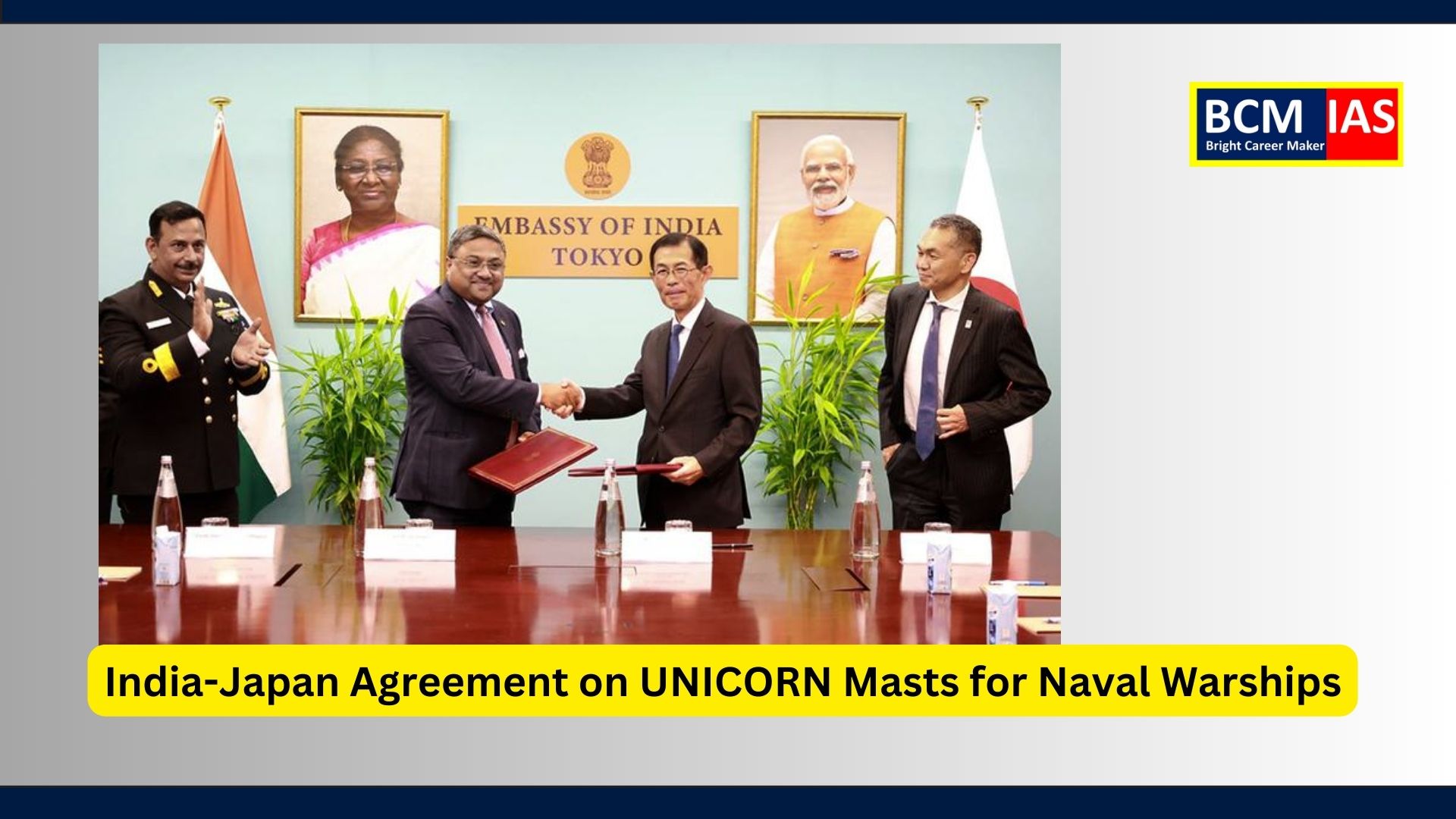
India-Japan Agreement on UNICORN Masts for Naval Warships
1. Introduction
India and Japan signed a Memorandum of Implementation (MoI) for the
co-development of UNICORN (Unified Complex Radio Antenna) masts for Indian
naval warships under the India-Japan Defence Technology Cooperation framework.
This is a landmark step in bilateral defence collaboration and marks Japan's
first defence technology export under the 2015 agreement.
2. Key Highlights of the Agreement
- Objective: Co-development of UNICORN
masts, which enhance stealth characteristics of naval warships by
integrating communication systems into a conical structure.
- Signatories: Indian Envoy to Japan
Sibi George and Ishikawa Takeshi, Commissioner of Japan's Acquisition
Technology and Logistics Agency, signed the MoI in Tokyo.
- Framework: Part of the India-Japan 2+2
inter-Ministerial dialogue on defence and security cooperation.
3. Strategic Importance
- Stealth and Communication: The
UNICORN mast is a cutting-edge solution that improves communication
capabilities while minimizing the radar cross-section of warships, crucial
for naval stealth operations.
- Indigenous Development:
Co-development with Bharat Electronics Limited (BEL) signifies a step
forward in India's defence indigenization goals under the "Make in
India" initiative.
- Bilateral Cooperation: This
project strengthens India-Japan defence ties and aligns with shared
strategic interests in the Indo-Pacific region.
4. Historical Context
- Defence Equipment and Technology Agreement: The
MoI stems from the 2015 bilateral pact on defence equipment and technology
transfer.
- Past Negotiations:
Japan's attempt to export amphibious planes to India earlier failed due to
cost concerns and competing naval priorities.
- Evolving Japanese Policy:
Japan's pacifist constitution imposes strict conditions on military
exports, making this agreement a significant policy shift.
5. Implications and Challenges
- For India:
- Access to advanced naval technology.
- Boost to domestic defence manufacturing
capabilities.
- For Japan:
- Expands Japan's footprint in defence exports, a
priority under its new strategic framework.
- Strengthens security cooperation in the
Indo-Pacific.
- Challenges:
- High costs and complex co-development processes.
- Regulatory and bureaucratic hurdles in Japan's defence
export policy.
6. Conclusion
The India-Japan agreement on UNICORN masts represents a significant step in
bilateral defence collaboration, with potential long-term benefits for both
nations’ naval capabilities and strategic interests. It underscores the growing
convergence between India and Japan in fostering stability and security in the
Indo-Pacific region.
Mains Question
Discuss the significance of the India-Japan agreement for
co-development of UNICORN masts in the context of India’s indigenization goals
and Japan’s evolving defence export policy. (250 words)
Answer
Introduction
India and Japan signed an agreement for the co-development of UNICORN (Unified
Complex Radio Antenna) masts, which integrate advanced communication systems
while enhancing naval warships' stealth characteristics. This marks a pivotal
collaboration under the India-Japan Defence Technology Cooperation framework.
Significance for India
1. Strategic
Capability Enhancement: UNICORN masts will improve naval communication systems
and reduce radar visibility, boosting India’s maritime security and operational
effectiveness.
2. Support for
Indigenization: The collaboration with Bharat Electronics Limited (BEL)
aligns with India’s "Make in India" initiative, fostering domestic defence
manufacturing and reducing dependency on imports.
3. Strengthening
Bilateral Ties: This partnership reinforces India-Japan strategic ties,
particularly in defence and technology, contributing to shared goals in the
Indo-Pacific region.
Significance for Japan
1. First
Defence Export: This agreement is Japan’s first implementation of defence
technology export under its 2015 policy, showcasing its shift from pacifism to
a more active global defence role.
2. Expanding
Strategic Partnerships: The deal strengthens Japan’s position as a defence
technology partner for democracies, enhancing its geopolitical influence.
Challenges
1. Cost and
Technology Integration: High costs and complexities in co-development may
pose challenges.
2. Japan’s
Strict Export Policies: Bureaucratic and regulatory hurdles in Japan’s
defence export framework could slow implementation.
Conclusion
The India-Japan agreement for UNICORN masts is a milestone in bilateral defence
cooperation, advancing India’s indigenization goals and Japan’s defence export
ambitions. It exemplifies mutual commitment to a stable, secure Indo-Pacific,
paving the way for deeper collaboration in high-end technology and defence.
MCQs for
Practice-
1. Consider the following
statements regarding the UNICORN mast co-development agreement between India
and Japan:
1. It is
designed to enhance stealth characteristics and integrate advanced
communication systems on naval warships.
2. It is the
first case of co-development of defence equipment under the 2+2
inter-Ministerial dialogue framework.
3. The
co-development will involve Bharat Electronics Limited in collaboration with a
Japanese agency.
Which of the above statements
is/are correct?
- (a) 1 and 2 only
- (b) 2 and 3 only
- (c) 1 and 3 only
- (d) 1, 2, and 3
Answer: (d) 1, 2,
and 3
2. Which of the following best
describes the significance of the UNICORN mast?
- (a) A navigation system for submarines.
- (b) A radar for long-range missile detection.
- (c) A conical structure integrating communication
systems and reducing radar visibility on naval warships.
- (d) A satellite-based naval communication system.
Answer: (c) A
conical structure integrating communication systems and reducing radar
visibility on naval warships.
3. With reference to Japan’s
defence policies, consider the following statements:
1. Japan has
traditionally imposed strict conditions on defence exports due to its pacifist
constitution.
2. The UNICORN
mast agreement represents the first export of defence technology from Japan to
any country.
3. Japan’s
defence export policy was liberalized under an agreement signed with India in
2020.
Which of the above statements
is/are correct?
- (a) 1 only
- (b) 1 and 2 only
- (c) 2 and 3 only
- (d) 1, 2, and 3
Answer: (b) 1 and
2 only
4. Which Indian organization is
collaborating with Japan for the co-development of the UNICORN mast?
- (a) Hindustan Aeronautics Limited (HAL)
- (b) Bharat Electronics Limited (BEL)
- (c) Defence Research and Development Organisation
(DRDO)
- (d) Mazagon Dock Shipbuilders Limited (MDL)
Answer: (b)
Bharat Electronics Limited (BEL)
5. The India-Japan agreement on the
UNICORN mast falls under which broader framework of bilateral cooperation?
- (a) Comprehensive Economic Partnership Agreement
(CEPA)
- (b) India-Japan Defence Technology Cooperation
Framework
- (c) Quadrilateral Security Dialogue (Quad)
- (d) Indo-Pacific Economic Framework (IPEF)
Answer: (b)
India-Japan Defence Technology Cooperation Framework


Comments on “India-Japan Agreement on UNICORN Masts for Naval Warships”