


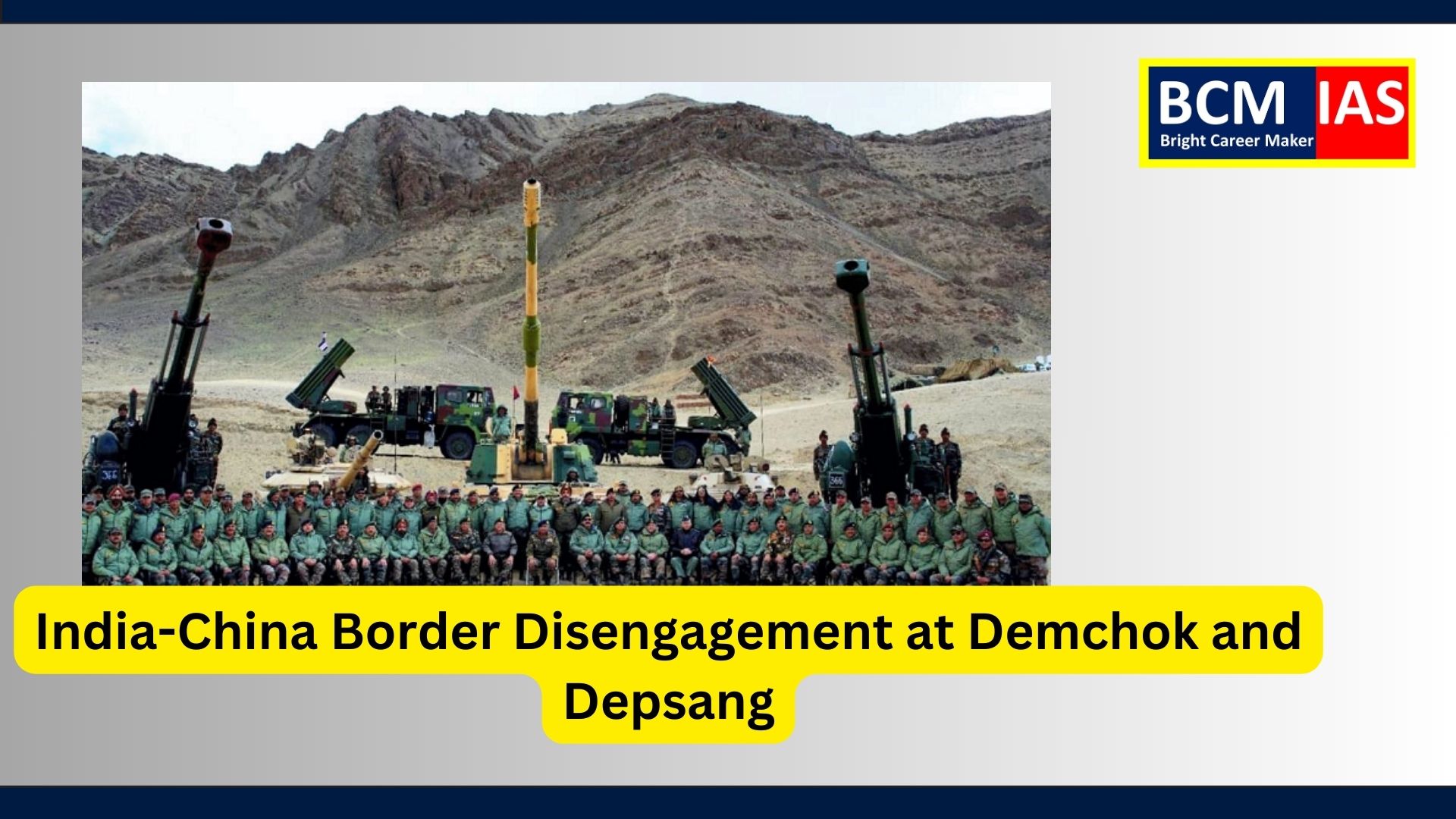
India-China Border
Disengagement at Demchok and Depsang
News Analysis
Introduction:
The ongoing border standoff between India and China in
Eastern Ladakh, which began in May 2020, has been one of the most significant
military and diplomatic challenges for both countries. Despite several rounds
of military and diplomatic talks, disengagement at certain friction points,
particularly Demchok and Depsang, has seen little progress over
the past two years. This news article provides a critical overview of the
situation, highlighting both the progress made and the remaining issues between
the two nations.
1.
Background of the Disengagement Process:
- The
standoff between India and China along the Line of Actual Control (LAC) in
Eastern Ladakh began in 2020, following heightened tensions and a violent
clash at Galwan Valley.
- To
manage the situation, both nations agreed to military and diplomatic
talks through mechanisms such as Corps Commander-level meetings and
working group dialogues.
- Five friction points have seen successful disengagement so far:
- Galwan
Valley (after June 2020 clash)
- North
and South Banks of Pangong Tso (February 2021)
- Patrolling
Point (PP) 17 in Gogra-Hot Springs (August 2021)
- Patrolling
Point (PP) 15 (September 2022)
- These
disengagements were a result of mutual understanding and verification on
the ground by both sides, signaling incremental progress toward restoring
peace along the LAC.
2.
Unresolved Friction Points: Demchok and Depsang:
- Despite
significant progress, the Demchok and Depsang areas remain
unresolved friction points.
- Demchok is located in Eastern Ladakh,
close to the disputed border between India and China. Depsang is a
strategically important plateau that grants access to critical areas, such
as the Karakoram Pass.
- In
these areas, the military build-up and patrolling by both sides continue,
with no headway towards disengagement since 2021. This has raised concerns
about the future trajectory of India-China relations in this region.
3.
Comments by Officials and Government Representatives:
- External
Affairs Minister S. Jaishankar, during his remarks in Geneva on
September 12, 2024, noted that approximately 75% of disengagement
has been completed. However, he also acknowledged the need for further
disengagement and de-escalation, particularly in terms of demilitarization
of the border.
- Chinese
authorities,
including spokesperson Mao Ning, have also reiterated that the
overall situation along the LAC is "generally stable" and that
disengagement has been completed in four major areas.
4.
Challenges to Achieving Full Disengagement:
- Strategic importance: Both Demchok and Depsang hold critical
strategic importance for India and China. Control over these areas would
impact the broader security and military balance along the northern
border.
- Military Build-up: The border remains heavily militarized, with troops from
both sides stationed in close proximity. The article highlights that the
rhetoric around the restoration of "status quo ante" (i.e., the
situation before the 2020 stand-off) is now being mentioned less often,
raising questions about future de-escalation.
- Diplomatic Complexities: Despite disengagement in most areas, the broader
diplomatic relationship between India and China remains complex. The BRICS
Summit in October 2024, which both Prime Minister Narendra Modi and
Chinese President Xi Jinping are expected to attend, has raised hopes for
renewed dialogue, but tangible progress on the ground remains limited.
Conclusion:
While progress has been made in achieving
disengagement in multiple friction points along the LAC in Eastern
Ladakh, the lack of resolution in the Demchok and Depsang areas
represents a significant challenge. The disengagement process, though steady,
has not resulted in a complete restoration of peace in the region. The heavy
military presence and strategic importance of these areas make it difficult to
resolve tensions quickly. However, there remains cautious optimism about the
potential for further diplomatic breakthroughs, especially during upcoming
international forums such as the BRICS Summit. As both India and China
continue to engage diplomatically and militarily, the resolution of these
friction points will be crucial for long-term peace and stability along their
shared border.
Mains Practice Question
Q. Analyze the current status of disengagement between India and
China along the Line of Actual Control (LAC), with particular reference to the
friction points of Demchok and Depsang. Discuss the challenges in resolving
these friction points and the way forward.
Introduction:
The ongoing border standoff between India and China along the
Line of Actual Control (LAC) in Eastern Ladakh has been a key security
and diplomatic issue for India since May 2020. Despite multiple rounds of
military and diplomatic talks, some friction points remain unresolved,
particularly Demchok and Depsang, which are of strategic
importance to both nations. While disengagement has been achieved in other
areas, the situation at these two points has seen no substantial progress over
the past two years. This question aims to analyze the current status of disengagement,
the challenges associated with it, and possible solutions.
Body:
1. Current Status of Disengagement:
- Disengagement Achieved: The disengagement process between India and China
has led to the withdrawal of forces from five major friction points:
- Galwan
Valley (June
2020)
- North
and South Banks of Pangong Tso (February 2021)
- Patrolling
Point 17 (Gogra-Hot Springs) (August 2021)
- Patrolling
Point 15
(September 2022)
- Unresolved
Friction Points:
- The
disengagement process remains incomplete at Demchok and Depsang,
which are strategically located in Eastern Ladakh.
- While
progress has been made in other regions, no tangible progress has been
made at these friction points in the last two years. Diplomatic and
military talks have so far failed to yield results, and these areas
remain heavily militarized.
- Statements
from Officials:
- External
Affairs Minister S. Jaishankar recently commented that 75% of
disengagement has been completed, acknowledging that some areas still
require attention.
- Chinese
authorities have similarly echoed the sentiment that the situation along
the LAC is "generally stable," but they remain firm in their
positions regarding these unresolved points.
2. Challenges in Resolving the Disengagement at
Demchok and Depsang:
- Strategic
Importance of Demchok and Depsang:
- Demchok lies close to critical
communication routes and is essential for India's connectivity projects
in the region.
- Depsang is a plateau that provides
access to the Karakoram Pass, a strategic area that both nations
regard as essential for maintaining control over their northern borders.
The Chinese military seeks to restrict India's ability to patrol in this
area, making disengagement difficult.
- Heavy
Militarization of the Border:
- Since
2020, both sides have heavily militarized the region, with troops
stationed in close proximity. Any significant military withdrawal would
affect the strategic balance, making disengagement a complex issue.
- Both
sides have increased infrastructure development along the border, which
further complicates efforts to reduce military presence.
- Lack
of Mutual Trust:
- The
Galwan Valley clash in June 2020, where soldiers from both sides
lost their lives, has significantly eroded trust between the two
militaries. Both nations now approach disengagement with caution, fearing
that a withdrawal could be perceived as a sign of weakness.
- Diplomatic
Hurdles:
- While
diplomatic engagements have continued, the broader geopolitical
competition between India and China influences the disengagement
process. India’s strategic alignment with other global powers, such as
the United States, and China’s regional ambitions, including its Belt
and Road Initiative, further complicate bilateral relations.
3. The Way Forward:
- Continued
Diplomatic Engagement:
- Both
nations should continue to engage diplomatically to avoid further
escalations. The upcoming BRICS Summit provides an opportunity for
high-level engagement between Indian Prime Minister Narendra Modi
and Chinese President Xi Jinping.
- Confidence-building
measures, such as restoring communication between military commanders and
political leaders, could help rebuild trust and lead to progress in
disengagement talks.
- Demilitarization
and Status Quo Ante:
- Both
sides should aim for a gradual demilitarization of the border areas.
While restoring the status quo ante (i.e., the situation before
the 2020 stand-off) may be challenging, agreeing on verifiable
de-escalation steps could help reduce tensions in the long term.
- Establishment
of Buffer Zones:
- Buffer
zones, similar to those established at Galwan Valley and Pangong
Tso, could be created at Demchok and Depsang to reduce the likelihood
of future clashes. These zones should be monitored and verified by both
sides to ensure mutual compliance.
- Infrastructure
and Development Dialogue:
- The
rapid pace of infrastructure development by both sides near the LAC has
contributed to rising tensions. A dialogue to manage the extent and
impact of infrastructure projects could help mitigate some of these
tensions, preventing misunderstandings and potential military
confrontations.
- International
Mediation and Oversight:
- While
both India and China have historically resisted international mediation
in their bilateral disputes, the involvement of neutral third parties,
such as the United Nations, to monitor disengagement might offer a
viable solution if tensions persist.
Conclusion:
The disengagement process between India and China along the
LAC has made significant progress, but key challenges remain at Demchok
and Depsang. These unresolved areas hold strategic importance for both
sides, complicating the process of military withdrawal and de-escalation.
Continued diplomatic engagement, coupled with confidence-building measures and
possible creation of buffer zones, will be critical in moving forward. The
upcoming BRICS Summit presents a potential opportunity for further
dialogue. However, restoring the status quo ante and ensuring long-term
peace and stability will require persistent efforts from both nations, coupled
with a realistic and pragmatic approach to managing their border disputes.
MCQs for Practice
1. Which of the following correctly describes the Line of
Actual Control (LAC) between India and China?
A.
A formally demarcated international border recognized by both India and China.
B. A de facto boundary separating Indian-controlled and
Chinese-controlled territories.
C. A disputed maritime boundary between India and China in the South
China Sea.
D. An economic corridor connecting India and China via trade routes.
Answer: B
Explanation: The LAC is a de facto boundary that separates
Indian-controlled territory from Chinese-controlled territory. It is not a
formally agreed upon international border, and its exact location remains
disputed in some sectors, leading to frequent standoffs.
2. The Galwan Valley clash between India and China in June
2020 primarily occurred due to:
A.
Economic trade issues between India and China.
B. China's construction activities near the LAC, resulting in a military
confrontation.
C. India's refusal to participate in the Belt and Road Initiative (BRI).
D. Misunderstandings related to joint military exercises in the region.
Answer: B
Explanation: The clash occurred due to Chinese construction activities
near the Galwan Valley in Ladakh, which India perceived as an attempt to alter
the status quo along the LAC. This resulted in a violent confrontation between
the two sides in June 2020.
3. The Depsang Plains, one of the friction points between
India and China, is strategically important because:
A.
It is a key water source for the region.
B. It provides direct access to the Karakoram Pass, a critical point for
military movement.
C. It is an area rich in natural resources like oil and gas.
D. It is a cultural and religious site of historical significance.
Answer: B
Explanation: The Depsang Plains are strategically important as they
provide direct access to the Karakoram Pass, which is crucial for military
movement and maintaining strategic dominance in the region. Control of the area
is of great importance to both India and China.
4. The term "Status Quo Ante" often mentioned in
the context of India-China border talks refers to:
A.
The restoration of pre-conflict boundaries and military positions.
B. The establishment of a new international border between the two
countries.
C. The temporary cessation of hostilities without any change in
positions.
D. The mutual sharing of border security responsibilities by both
countries.
Answer: A
Explanation: "Status Quo Ante" refers to the restoration of
the situation that existed before the border conflict or stand-off, including
the positions held by both sides before the escalation occurred.
5. Which of the following measures has been commonly employed
by India and China to de-escalate tensions along the LAC?
A.
Deployment of UN peacekeeping forces.
B. Buffer zones established to separate troops from both sides.
C. Permanent withdrawal of troops from disputed areas.
D. International arbitration through the World Court.
Answer: B
Explanation: Buffer zones have been established in several friction
points, including Pangong Tso and Galwan, to keep the troops from both sides
apart and avoid any potential clashes, thereby de-escalating tensions.


Comments on “India-China Border Disengagement at Demchok and Depsang”