


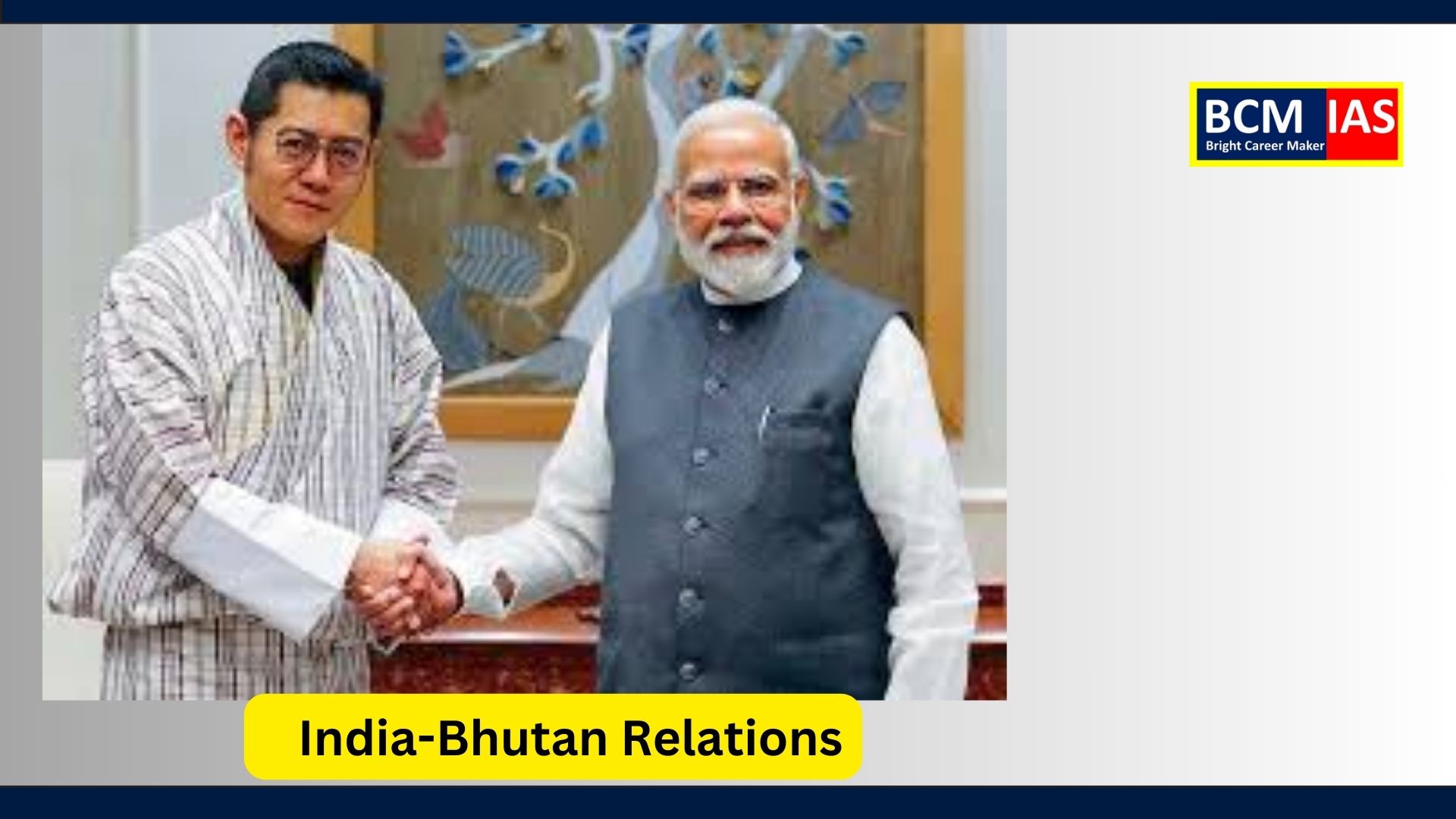
India-Bhutan Relations:
Cooperation, Challenges, and Future Prospects
Background:
The recent visit of Bhutanese Prime Minister Tshering Tobgay
to India emphasized the strong diplomatic ties between the two nations.
India-Bhutan relations, grounded in the 1949 Treaty of Friendship and
Cooperation (updated in 2007), showcase shared commitments to sustainability,
green energy, and development cooperation. This analysis examines the key
areas of collaboration, challenges, and the way forward for enhancing bilateral
ties.
Key
Highlights of the Bilateral Meeting:
1. Green
Hydrogen Technology:
o India showcased
its advancements in green hydrogen technology by presenting a
hydrogen-fueled bus. This highlights India's leadership in sustainable
energy solutions and emphasizes opportunities for collaboration.
o Bhutan expressed
interest in adopting green hydrogen mobility, aligning with its commitment to environmental
sustainability.
2. Energy
Collaboration:
o India and Bhutan
have a strong history of cooperation in the energy sector, particularly
hydropower. Discussions focused on expanding this to include renewable
energy and green hydrogen, building on their shared vision for sustainable
development.
Significance
of India-Bhutan Relations:
1. Diplomatic
and Cultural Ties:
o Diplomatic ties
were established in 1968, with strong cultural connections rooted in Buddhism.
The India-Bhutan Foundation promotes educational, cultural, and scientific
exchanges.
o Bhutan awarded
the Order of the Druk Gyalpo to India's Prime Minister for contributions
to bilateral relations, reflecting deep mutual respect.
2. Development
Partnership:
o India has been a
key partner in Bhutan's socio-economic development, supporting its Five-Year
Plans. For Bhutan’s 12th Five-Year Plan, India contributed ₹5,000
crores.
o Hydropower
cooperation remains
a cornerstone, with India assisting in the construction of major hydroelectric
projects, allowing Bhutan to sell surplus electricity to India.
3. Trade
and Commerce:
o India is
Bhutan's largest trading partner, with bilateral trade increasing from USD
484 million (2014-15) to USD 1,615 million (2022-23). Free trade agreements
and duty-free transit facilitate commerce.
o Indian
investments account for 50% of Bhutan's FDI, covering sectors like banking,
manufacturing, and education.
Challenges
in India-Bhutan Relations:
1. Boundary
Disputes with China:
o China's
infrastructure development near the Doklam plateau has raised concerns
due to the strategic significance of the area. This situation poses geopolitical
risks for India, particularly concerning the Siliguri corridor.
o Bhutan and China
have been engaging diplomatically to resolve boundary issues, creating a
delicate situation for India's strategic interests.
2. Hydropower
Concerns:
o Although
hydropower is a significant economic asset for Bhutan, concerns have emerged
about favorable conditions for India leading to public dissent within
Bhutan.
o Addressing
perceptions of economic imbalance is necessary to sustain long-term
cooperation.
3. BBIN
Motor Vehicles Agreement (MVA):
o Bhutan's environmental
concerns led to its decision not to endorse the original BBIN MVA. The
other three countries (Bangladesh, India, and Nepal) proceeded with the BIN-MVA,
limiting regional connectivity initiatives.
Way
Forward for Strengthening India-Bhutan Relations:
1. Address
Economic Concerns:
o Ensure equitable
terms in trade agreements and hydropower projects, addressing dependency
concerns to promote a balanced partnership.
o Encourage Indian
investments in diverse sectors, reducing Bhutan's reliance on hydropower and
fostering sustainable development.
2. Adapt
to Geopolitical Changes:
o India should
monitor and adapt to China's growing influence, ensuring Bhutan feels
secure and supported in its foreign policy decisions.
o Collaboration on
multilateral forums can promote regional stability and economic
growth.
3. Promote
Tourism and Cultural Exchanges:
o Develop joint
initiatives to boost tourism, encouraging Indian visitors to explore Bhutan's
cultural sites and natural beauty.
o Organize
cultural festivals to enhance people-to-people connections,
strengthening mutual appreciation and understanding.
Conclusion:
India and Bhutan share a deep bond rooted in historical,
cultural, and economic ties. To sustain and strengthen this partnership, it
is crucial to address existing challenges, particularly related to hydropower
cooperation, strategic security, and regional connectivity. By prioritizing
equitable economic practices, cultural exchanges, and mutual respect,
both nations can deepen their cooperation and work towards shared prosperity.
Probable Mains Question
"Examine the key areas of cooperation and
challenges in India-Bhutan relations. Suggest measures to strengthen the
partnership for mutual benefit and regional stability."
MCQs for Practice
1.
Which of the following agreements forms the basis of
India-Bhutan diplomatic relations?
o (a) Treaty of
Sugauli
o (b) Treaty of
Tashkent
o (c) Treaty of
Friendship and Cooperation (1949)
o (d) Treaty of
Peace and Friendship (1950)
Answer: (c) Treaty of Friendship and Cooperation (1949)
2.
Which of the following correctly describes Bhutan's
status in terms of carbon emissions?
o (a)
Carbon-neutral country
o (b) Net carbon
emitter
o (c) Largest
carbon emitter in South Asia
o (d)
Carbon-negative country
Answer: (a) Carbon-neutral country
3.
The India-Bhutan Friendship Treaty was updated in
2007. What was the primary purpose of this update?
o (a) To include
provisions for military alliances
o (b) To reflect
contemporary needs and greater autonomy for Bhutan
o (c) To restrict
cross-border trade between India and Bhutan
o (d) To establish
free movement of labor between the two countries
Answer: (b) To reflect contemporary needs and greater autonomy for Bhutan
4.
Which of the following is a cornerstone of
India-Bhutan relations?
o (a) Space
technology collaboration
o (b) Hydropower
cooperation
o (c) Defense
procurement
o (d) Cross-border
tourism
Answer: (b) Hydropower cooperation
5.
Consider the following statements about the BBIN Motor
Vehicles Agreement:
1.
It was signed by Bangladesh, Bhutan, India, and Nepal
in 2015.
2.
Bhutan opted not to ratify the agreement due to
environmental concerns.
Which of the statements given above is/are correct?
o (a) 1 only
o (b) 2 only
o (c) Both 1 and 2
o (d) Neither 1
nor 2
Answer: (c) Both 1 and 2
6.
Which of the following best explains the strategic
significance of Bhutan for India?
o (a) Its vast
mineral resources
o (b) Its location
between India and China, acting as a buffer state
o (c) Its large
agricultural exports to India
o (d) Its status
as a global technology hub
Answer: (b) Its location between India and China, acting as a buffer state
7.
Which initiative launched by India and Bhutan aims to
enhance digital payments and financial inclusion?
o (a) India Stack
o (b) BharatNet
o (c) RuPay Card
and BHIM App
o (d) Unified
Payments Interface (UPI)
Answer: (c) RuPay Card and BHIM App
8.
Which of the following sectors has seen significant
Indian investments in Bhutan?
o (a) Agriculture
and forestry
o (b) Information
technology and software
o (c) Banking, hospitality,
and education
o (d) Defense
manufacturing
Answer: (c) Banking, hospitality, and education
9.
Which of the following projects marks a recent
collaboration in space technology between India and Bhutan?
o (a) India-Bhutan
SAT
o (b) SAARC
Communication Satellite
o (c) Gaganyaan
Mission
o (d)
Chandrayaan-3
Answer: (a) India-Bhutan SAT
10.
What was the significance of the financial support
provided by India to Bhutan under the SAARC currency swap arrangement in 2022?
o (a) To finance
hydropower projects in Bhutan
o (b) To manage
Indian rupee liquidity and ease foreign exchange pressures
o (c) To fund
tourism infrastructure in Bhutan
o (d) To support
Bhutan's defense sector
Answer: (b) To manage Indian rupee liquidity and ease foreign exchange pressures


Comments on “India-Bhutan Relations: Cooperation, Challenges, and Future Prospects”