


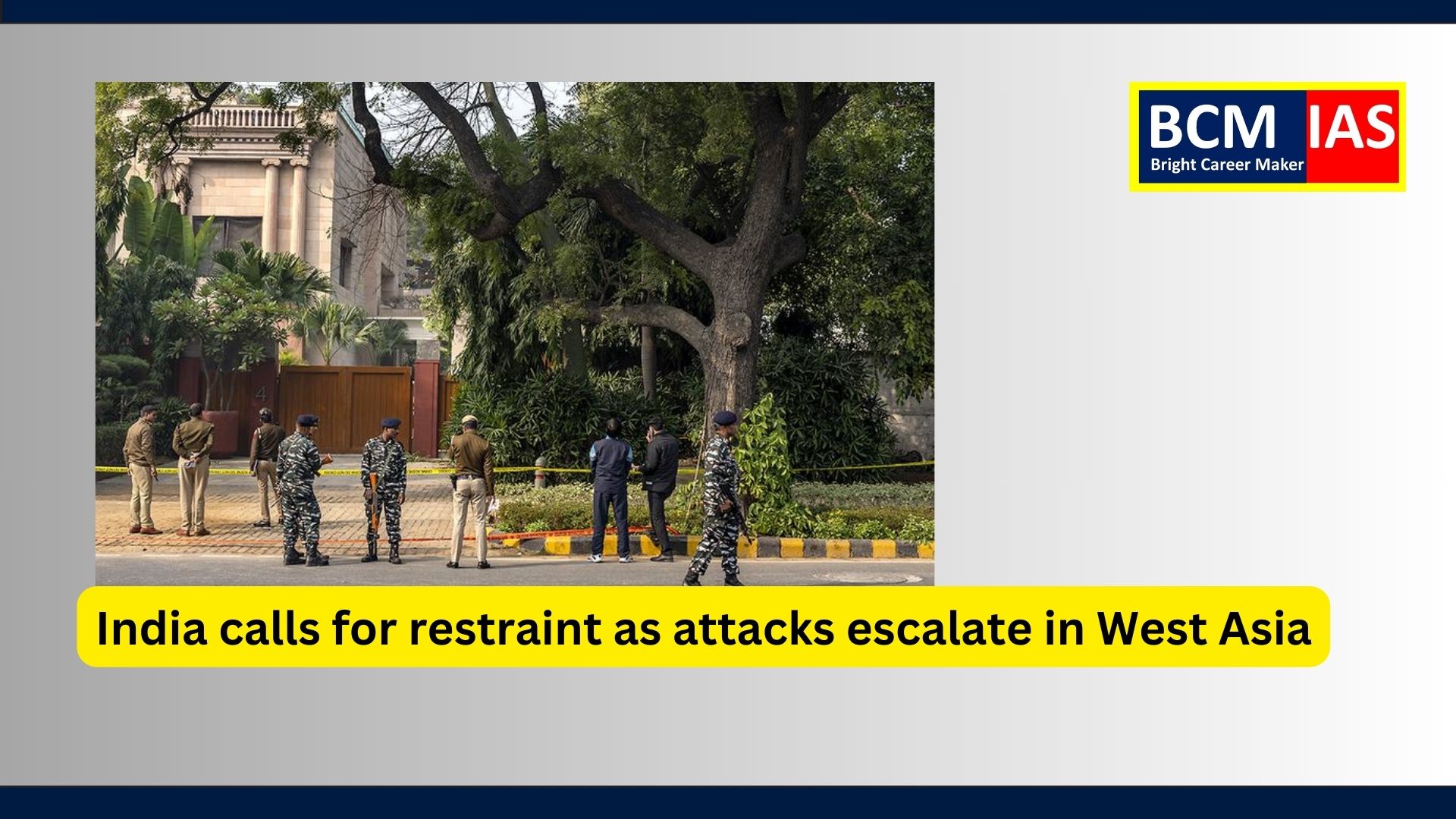
India's response to the escalating conflict in West Asia
News Analysis
The article focuses on India's response to the escalating
conflict in West Asia (Middle East), particularly following a missile attack by
Iran on Israeli targets. The situation has prompted the Indian government to
call for restraint and stress the importance of resolving the conflict through
diplomatic means. Here’s a detailed analysis suitable for UPSC preparation:
Key Points from the Article:
1. India’s Concern about Escalation in West Asia:
o India’s Ministry
of External Affairs (MEA) has expressed deep concern regarding the escalation
of conflict between Iran and Israel. The article mentions that Iran launched
hundreds of missiles targeting Tel Aviv, which could potentially worsen the
already fragile security situation in West Asia.
o India's MEA has
called for restraint and emphasized that the conflict should not widen or take
a regional shape, urging that diplomatic dialogue be the path forward.
2. India’s Diplomatic Approach:
o The MEA
statement highlights India's commitment to peace and security in the region.
India's response stresses the importance of protecting civilians and avoiding
actions that could escalate the conflict into a larger regional confrontation.
o India's
diplomatic stance is a reiteration of its consistent policy of advocating for dialogue
and diplomacy to resolve conflicts, avoiding taking sides while supporting
peaceful resolutions.
3. Advisory for Indian Nationals:
o India has issued
an advisory for its citizens living in West Asia, particularly in Israel and
Iran. The advisory urges Indian citizens in the region to avoid non-essential
travel to Iran and remain vigilant.
o There are around
4,000 Indian nationals in Iran and 30,000 in Israel, including
students, researchers, and professionals. India has instructed its nationals to
stay in close touch with the Indian Embassy and avoid unnecessary travel.
4. Potential Regional Impact of the Conflict:
o The conflict
between Iran and Israel is part of the broader geopolitical tensions in the
West Asia region. The risk of the conflict spreading and affecting other
countries in the region, such as Lebanon (where Hezbollah is active) or Syria,
could create a wider humanitarian crisis.
o India's call for
restraint reflects its concern that an escalation could have global
ramifications, including disruption to the global oil supply (West Asia
being a significant oil-exporting region), which could affect India’s economic
interests.
5. India-Israel Relations:
o The article also
touches on Prime Minister Narendra Modi’s warm greeting to Israeli Prime
Minister Benjamin Netanyahu on the occasion of Jewish New Year (Rosh Hashanah),
reflecting the strong bilateral ties between India and Israel.
o India’s
relationship with Israel, especially in defense and technology, has grown
stronger over the years. However, India balances this with a neutral stance in
Middle Eastern conflicts to maintain its relations with other regional powers
like Iran.
Detailed Analysis
1. India’s Foreign
Policy in West Asia:
- Balanced Diplomacy: India has traditionally
followed a balanced approach in West Asia, maintaining good
relations with conflicting parties like Israel and Iran. India's foreign
policy in the region is largely driven by its energy security needs,
as it imports a significant portion of its oil from the Gulf countries.
- Non-Interference in Internal
Conflicts: India adheres to the principle
of non-interference in the internal affairs of other countries,
especially in regions like West Asia, where conflicts are often rooted in
deep-seated political and religious rivalries.
2. Strategic
Importance of West Asia for India:
- Energy Security: West Asia is crucial for
India’s energy security as it supplies a significant amount of oil and
gas. Any instability in this region directly affects India’s energy needs
and economic stability.
- Indian Diaspora: India has a large diaspora in
West Asia, especially in the Gulf countries, where millions of Indian
workers reside. Any escalation of conflict poses a direct risk to these
citizens, which explains India’s advisory to nationals in the region.
- Trade and Investment: India’s trade with West Asian
countries is substantial, including defense cooperation with Israel and
economic partnerships with Gulf countries like Saudi Arabia and the UAE.
3. India’s
Call for Restraint:
- India's
call for restraint aligns with its broader approach of advocating peaceful
resolution of conflicts. The statement from the MEA underscores
India’s commitment to the UN Charter principles of maintaining
international peace and security.
- India’s
focus on protecting civilians and preventing the conflict from
escalating shows concern for the humanitarian aspects of the conflict,
which is consistent with its global peacekeeping efforts.
4. India’s
Position on Iran-Israel Conflict:
- India
has strong bilateral ties with both Iran and Israel, making the conflict
in West Asia a delicate issue for Indian diplomacy. India must balance its
strategic partnership with Israel (in areas such as defense and
technology) while maintaining good relations with Iran (important
for energy security and connectivity projects like Chabahar Port).
- This
careful diplomatic balancing act reflects India’s interest in maintaining stability
in the region without getting involved in regional conflicts.
5. Implications
for India’s Security and Economy:
- Any regional
instability in West Asia could have serious economic consequences for
India, particularly regarding energy prices, trade routes, and the safety
of Indian nationals.
- India's
security concerns are also linked to the possibility of terrorism
or radicalization in the region, which could indirectly affect India. As a
result, India’s proactive stance in urging dialogue and diplomacy is
intended to prevent further destabilization of the region.
Conclusion:
India's call for restraint in West Asia reflects its balanced
foreign policy and commitment to peace through diplomacy. As the situation
escalates, India must continue to navigate the complexities of its
relationships with both Israel and Iran, while protecting its strategic and
economic interests in the region.
Mains Question & Answer-
Analyze India's response to the escalating
conflict in West Asia, particularly in light of its foreign policy principles
and strategic interests in the region. How does India balance its relations
with Iran and Israel amidst ongoing tensions?
Answer:
India’s response to the escalating conflict in West Asia,
specifically the recent missile attacks by Iran on Israel, underscores its
commitment to peace and stability in the region. India's Ministry of External
Affairs (MEA) has called for restraint, emphasizing that the conflict should
not be allowed to expand into a larger regional confrontation. This diplomatic
stance aligns with India’s broader foreign policy principles, which prioritize
non-interference, peaceful conflict resolution, and maintaining strategic
partnerships.
India’s Foreign Policy in West Asia:
1. Balanced
Diplomacy:
o India has
traditionally maintained a balanced diplomatic approach in West Asia,
seeking to foster good relations with countries across the region, including
both Israel and Iran. India’s energy security and economic interests in
the Gulf nations, along with its defense and technology partnerships with
Israel, drive this approach. India avoids taking sides in regional conflicts,
instead advocating for dialogue and peaceful resolutions.
2. Non-Interference
and Strategic Autonomy:
o India's foreign
policy is based on the principle of non-interference in the internal
matters of other countries, especially in volatile regions like West Asia. This
approach allows India to maintain strategic autonomy and build relationships
with diverse nations, even those that have adversarial relations with each
other, such as Israel and Iran.
3. Advocacy
for Peace and Diplomacy:
o In response to
the recent attacks, the MEA statement emphasized India’s commitment to
addressing conflicts through dialogue and diplomacy. This reflects
India’s global stance as a peace-promoting nation that supports the principles
of the United Nations Charter, particularly in terms of maintaining
international peace and security.
o India’s call for
restraint also aligns with its focus on protecting civilians and
preventing further destabilization in West Asia, a region critical to global
energy security.
India’s Strategic Interests in West Asia:
1. Energy
Security:
o West Asia is a key supplier of oil and gas to
India, making the region vital for India’s energy security. Around 60% of
India’s oil imports come from the Middle East, particularly from countries
like Saudi Arabia, Iraq, and the UAE. Therefore, any escalation of conflict in
the region directly threatens India’s energy supplies and could cause
disruptions in global oil prices, affecting India’s economy.
2. Indian
Diaspora and Economic Ties:
o India has a
large expatriate population in the Gulf, with millions of Indian nationals
working in countries such as the UAE, Saudi Arabia, and Qatar. Escalating
conflicts in West Asia can endanger the safety of these nationals, prompting
India to issue advisories to its citizens, as seen in the recent situation
where the MEA urged Indians in Iran and Israel to remain cautious.
o India also has
strong trade and investment partnerships in the region, particularly
with the Gulf Cooperation Council (GCC) nations, which contribute significantly
to India’s foreign exchange reserves through remittances and trade.
3. Defense
and Technology Cooperation with Israel:
o Over the years,
India has built a robust defense partnership with Israel, with
cooperation in areas like missile systems, drones, and intelligence sharing.
Israel is a key supplier of high-tech military equipment to India, and this
defense cooperation has deepened under successive Indian governments.
o At the same
time, India seeks to maintain neutrality in conflicts involving Israel and
other regional players, to avoid alienating countries like Iran, with which
India shares critical economic and strategic interests.
Balancing Relations with Iran and Israel:
1. Strategic
Autonomy in Diplomatic Relations:
o India has
carefully balanced its relations with both Iran and Israel, two
countries that are often in conflict with each other. With Israel, India
has cultivated a strong defense and technology partnership, while with Iran,
India has important strategic interests, particularly with projects like the Chabahar
Port, which is critical for India’s connectivity to Afghanistan and Central
Asia.
o India’s
diplomacy in the region emphasizes strategic autonomy, meaning it does
not align itself exclusively with any single country or bloc. This approach
allows India to engage with all regional powers and safeguard its diverse
interests.
2. Iran-India
Cooperation:
o Iran is an important partner for India in
terms of energy security and regional connectivity. Although U.S. sanctions on
Iran have complicated India’s ability to trade with Iran, particularly in oil,
India continues to maintain diplomatic ties and cooperation in other areas such
as the Chabahar Port. The port provides India with a key route to
Afghanistan and Central Asia, bypassing Pakistan, and has strategic
significance in India’s regional connectivity plans.
- India
also depends on Iran for regional stability and in its efforts to
counterbalance the influence of countries like Pakistan and China in the
region. Despite the complex international landscape, India’s relationship
with Iran remains vital for its geopolitical and economic interests.
3. Israel-India
Cooperation:
o On the other
hand, Israel is a significant defense partner for India, with
collaboration in areas like missile defense systems, counter-terrorism, cyber
security, and agriculture. The Indo-Israel defense partnership has
flourished over the last few decades, with India purchasing advanced technology
and military equipment from Israel, including drones, radar systems, and
precision-guided munitions.
o Beyond defense,
Israel is a major contributor to India’s innovation ecosystem, particularly in
sectors like agriculture, water management, and cybersecurity. The
bilateral relationship has also strengthened due to the personal rapport
between Indian Prime Minister Narendra Modi and Israeli Prime Minister Benjamin
Netanyahu, as seen in their frequent diplomatic exchanges.
Challenges of Balancing These Relationships:
1. U.S.
Sanctions on Iran:
o One of the
significant challenges for India in balancing its relations with Iran and
Israel comes from the U.S. sanctions on Iran. The U.S. sanctions regime
has forced India to reduce its oil imports from Iran, impacting energy
security. India must tread carefully to maintain its strategic ties with Iran
while complying with international sanctions to avoid diplomatic friction with
the U.S.
o India’s efforts
to continue its cooperation with Iran through projects like Chabahar Port
(which has a waiver from U.S. sanctions) reflects India’s determination to
protect its long-term interests in the region despite external pressure.
2. Regional
Volatility and Strategic Risks:
o The ongoing Iran-Israel
conflict and the broader volatility in West Asia pose risks for India,
especially as it navigates its relations with various actors in the region.
While India seeks to strengthen its relationship with both nations, any escalation
of tensions could force India into a difficult position, requiring it to
prioritize one relationship over another.
o Additionally,
any military confrontation or instability in the Gulf region could affect
global oil prices, disrupt supply chains, and threaten the large Indian
diaspora working in the Gulf Cooperation Council (GCC) countries.
India’s Diplomatic Strategy:
1. Advocating
for Diplomacy and Peace:
o India’s call for
restraint and its emphasis on dialogue and diplomacy as a solution to
conflicts in West Asia reflect its commitment to maintaining peace and
stability in the region. This approach is consistent with India’s broader
foreign policy of avoiding direct involvement in regional conflicts while
promoting peaceful conflict resolution.
o India’s multilateral
diplomacy in forums like the United Nations and the Non-Aligned Movement
(NAM) has consistently advocated for the peaceful settlement of disputes. By
emphasizing the importance of dialogue in resolving the Iran-Israel conflict,
India positions itself as a responsible global player advocating for stability
in volatile regions.
2. Non-Alignment
and Strategic Autonomy:
o India continues
to follow the principle of non-alignment by maintaining relationships
with multiple conflicting nations, including Iran, Israel, Saudi Arabia, and
the UAE. India’s strategic autonomy allows it to pursue its national
interests without becoming entangled in the alliances or conflicts of other
countries.
o This strategy
enables India to maximize its benefits from both Israel and Iran. It helps in
maintaining access to energy resources, defense technology, and regional
connectivity projects, while also ensuring that India is not viewed as partisan
in regional conflicts.
Conclusion:
India’s response to the escalating conflict in West Asia,
particularly its call for restraint and emphasis on diplomatic dialogue, is
aligned with its foreign policy principles of non-interference, peaceful
resolution of disputes, and strategic autonomy. India’s strategic interests
in the region, particularly related to energy security, the Indian diaspora,
and defense cooperation, require a delicate balancing act between its
relationships with Iran and Israel.
India has skillfully navigated these relationships,
maintaining strong bilateral ties with both nations while advocating for
regional stability. This balanced approach is critical for India as it seeks to
protect its national interests in a region that is both volatile and
strategically significant. For UPSC preparation, understanding the nuances of
India’s West Asia policy provides insight into India’s global diplomatic
stance and its efforts to maintain peace, security, and economic
stability in complex international contexts.
MCQs for Practice-
1. What is India's official response to the escalating
conflict between Iran and Israel in West Asia?
a) India supported Israel’s military action.
b) India condemned the conflict and called for sanctions.
c) India urged restraint and emphasized dialogue and diplomacy.
d) India remained silent on the issue.
Answer: c) India urged restraint and emphasized dialogue and diplomacy.
Explanation: India’s Ministry of External Affairs (MEA) expressed concern
over the conflict and called for restraint, urging the parties to resolve the
issue through dialogue and diplomacy to prevent the situation from escalating
further.
2. Which principle is reflected in India's approach to the
conflict in West Asia, as per the official statement?
a) Military interventionism
b) Non-alignment and peaceful conflict resolution
c) Supporting military alliances in the region
d) Economic sanctions and isolation
Answer: b) Non-alignment and peaceful conflict resolution
Explanation: India’s foreign policy is based on non-alignment, promoting
peaceful resolutions to conflicts, and advocating dialogue and diplomacy rather
than taking sides or supporting military interventions.
3. Why is India particularly concerned about stability in the
West Asia region?
a) India has large defense bases in the region.
b) India imports a significant portion of its oil from West Asia.
c) India exports arms to the region.
d) India is a member of the Gulf Cooperation Council (GCC).
Answer: b) India imports a significant portion of its oil from West Asia.
Explanation: West Asia is crucial for India’s energy security, as a
significant portion of India’s oil imports come from the Gulf countries. Any
instability in the region could disrupt oil supplies and affect India's
economy.
4. What is one of the key reasons behind India’s balanced
diplomatic stance between Iran and Israel?
a) To align with U.S. sanctions on Iran.
b) To safeguard its strategic interests with both nations.
c) To support only defense cooperation with Israel.
d) To maintain religious ties in the region.
Answer: b) To safeguard its strategic interests with both nations.
Explanation: India has important strategic interests with both
Israel and Iran. While Israel is a key partner in defense and technology, Iran
is critical for India’s energy security and regional connectivity, including
projects like the Chabahar Port.
5. Which of the following projects reflects India’s strategic
cooperation with Iran?
a) INSTC Corridor
b) Gwadar Port
c) Chabahar Port
d) Ashgabat Agreement
Answer: c) Chabahar Port
Explanation: Chabahar Port in Iran is an important project for
India as it provides direct access to Afghanistan and Central Asia, bypassing
Pakistan, and is a crucial element of India’s regional connectivity strategy.


Comments on “India's response to the escalating conflict in West Asia”