

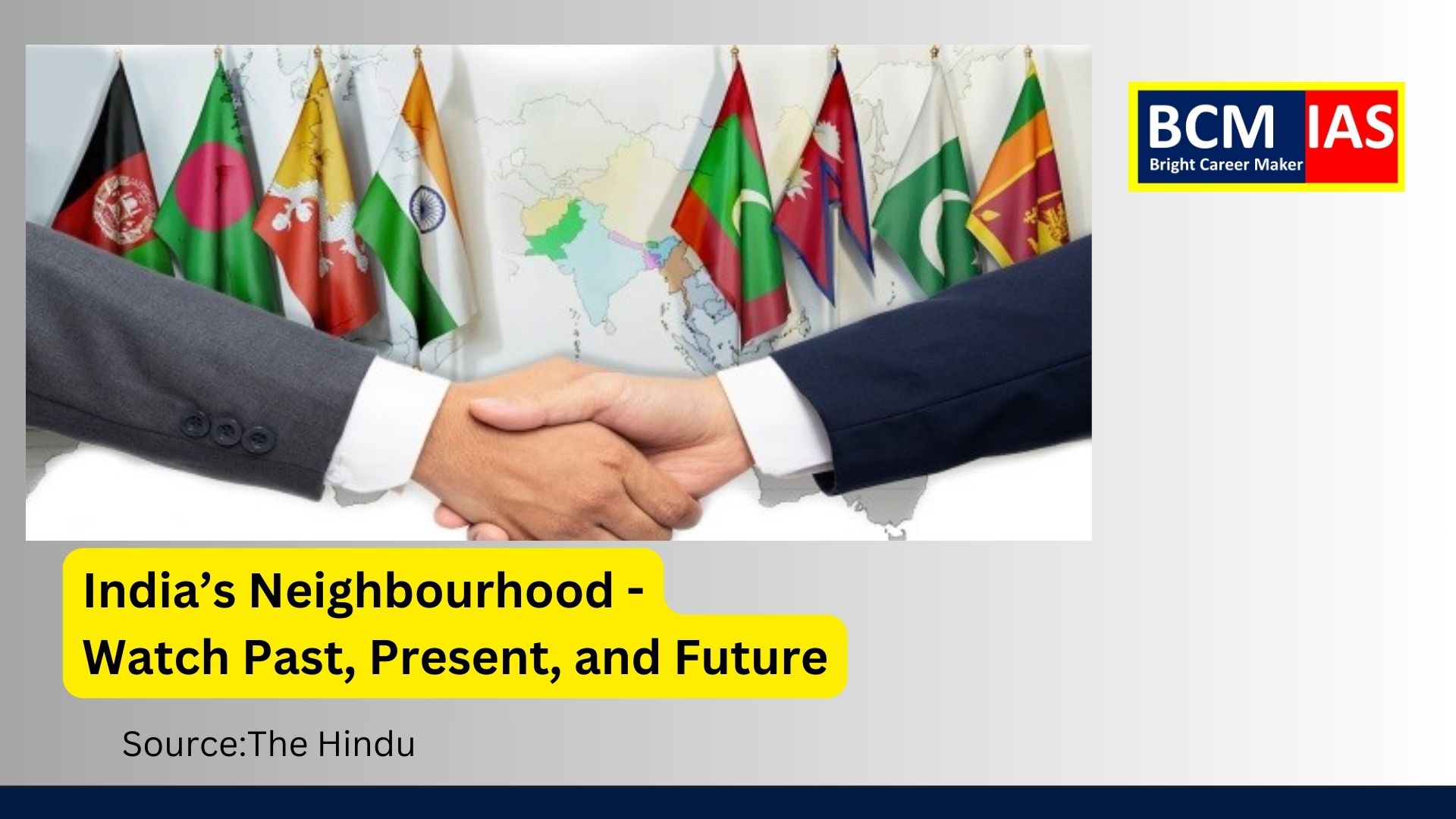
India’s
Neighbourhood Watch: Past, Present, and Future
News Analysis
Introduction:
The geopolitical environment surrounding India has seen
significant changes over the years, marked by periods of stability, democratic
transitions, and economic partnerships, as well as political upheavals,
conflicts, and instability. India's approach toward its neighborhood, often
referred to as its "neighbourhood first" strategy, has focused on
promoting democracy, providing economic assistance, and enhancing regional
cooperation. However, recent challenges have strained relationships and posed
risks to regional stability, necessitating a strategic recalibration. This
analysis provides a structured overview of India’s role in shaping its
neighborhood’s dynamics from 2008 to 2010, the emergence of recent challenges,
and a strategic roadmap for the future.
India’s Role in Promoting Democracy and Development
(2008-2010):
1. Bangladesh’s Shift to Democracy:
Between 2008-2010, India played a catalytic role in
supporting Bangladesh’s transition to democracy. Indian diplomacy helped ensure
that elections were conducted free from military interference. This marked a
significant step in stabilizing relations between the two nations, with India
extending a $1 billion line of credit to Bangladesh to support
infrastructure and connectivity projects.
2. Rebuilding Northern Sri Lanka:
In the aftermath of the Sri Lankan civil war, India
supported the reconstruction efforts in the war-torn northern region of Sri
Lanka. Indian diplomacy was instrumental in helping the Sri Lankan government
defeat the Liberation Tigers of Tamil Eelam (LTTE) in 2009. India's diplomatic,
military, and economic support was crucial in bringing the 33-year conflict
to an end.
3. Supporting the Maldives’ Democratic Transition:
India backed the first multi-party elections in the
Maldives in 2008, which resulted in Mohamed Nasheed becoming President. By
providing budgetary support to stabilize the nascent democracy, India
helped the Maldives embark on a democratic journey.
4. Nepal’s Democratic Transition:
India was a key player in Nepal’s transition from a
monarchy to a federal democratic republic, facilitating dialogue between
conflicting factions and supporting the drafting of Nepal’s new constitution.
India’s role in this democratic transition highlights its commitment to
promoting stability in the Himalayan region.
Recent Challenges in India’s Neighborhood:
While India’s efforts from 2008-2010 were largely successful,
the geopolitical landscape has shifted dramatically in recent years, presenting
a series of challenges for India’s foreign policy.
1. Political Instability in Bangladesh:
Bangladesh’s democracy has faced severe strains. Widespread
economic downturns, violent protests, and accusations of democratic deficits
have weakened the Sheikh Hasina government, leading to the collapse of
the 15-year partnership between India and Bangladesh.
2. Economic Crisis in Sri Lanka:
In 2022, mass protests (the "Aragalaya"
movement) erupted in Sri Lanka over political corruption and economic
mismanagement. The crisis led to the flight of President Gotabaya Rajapaksa and
the collapse of Sri Lanka’s economy. India’s timely bailout package of
$4 billion helped stabilize the situation, but challenges remain for long-term
recovery.
3. "India Out" Campaign in the Maldives:
The unexpected victory of Mohamed Muizzu in the 2024
Maldivian presidential elections, a figure associated with the "India
Out" campaign, poses a significant diplomatic challenge for India.
This campaign calls for the removal of India’s military presence in the
Maldives, reflecting growing nationalist sentiments.
4. Military Takeover in Myanmar:
Despite holding elections in 2020, Myanmar saw the military
seize power again, disrupting democratic progress. The situation has triggered
conflicts spilling into India’s northeast, further complicating India’s
engagement with Myanmar.
5. Taliban’s Return to Power in Afghanistan:
In 2021, the Taliban’s return to power in Afghanistan
raised security concerns for India, particularly regarding cross-border
terrorism and regional stability. Afghanistan’s instability presents a
complex challenge for India’s engagement in Central and South Asia.
6. Pakistan’s Political Unrest:
Pakistan has continued to experience political instability,
with the civilian government being toppled under military influence in 2022.
This recurring pattern of military intervention weakens India’s prospects for
consistent dialogue with Pakistan.
Strategic Roadmap for India’s Future Engagement:
In light of the recent upheavals in the region, India must
adopt a strategic, flexible, and long-term approach to promote stability and
cooperation in its neighborhood.
1. Strengthen Diplomatic Engagement:
Diplomatic engagement must be recalibrated to maintain
balanced relations with neighboring countries. For example:
- Bangladesh: India should rebuild ties by
engaging with both the ruling party and the opposition to promote
stability and ensure future partnerships.
- Sri
Lanka: India is
already in a favorable position, having built relations across the
political spectrum. This ensures that irrespective of election outcomes,
India will continue to have influence.
2. Promote Economic Diplomacy:
India should leverage economic cooperation as a tool to
foster stronger relations. Trade agreements and development assistance, such as
those extended to Sri Lanka during its economic crisis, are vital for
maintaining influence. India’s infrastructure projects in Afghanistan
are examples of how economic initiatives can protect geopolitical interests.
3. Adapt to Changing Dynamics:
India must be prepared to adjust its strategies in response
to the evolving political landscapes of its neighbors. For instance:
- Maldives: India has extended friendship
and patience to the newly elected Maldivian government despite the
challenges posed by the “India Out” campaign.
- Afghanistan: India has expressed willingness
to engage with the Taliban to safeguard its regional interests.
4. Monitor Trends and Exercise Strategic Patience:
India should closely monitor shifting political and economic
trends in the region and practice strategic patience when necessary. Myanmar is
teetering on the edge of civil war, and Bangladesh is struggling to
restore its democracy. India must be cautious in balancing support for
democratic forces while safeguarding its security interests.
5. Enhance Regional Cooperation:
India must foster greater cooperation through regional
platforms like SAARC and BIMSTEC, promoting initiatives that
address common challenges such as terrorism, economic instability, and climate
change. These platforms can be used to enhance regional integration and
foster a sense of shared destiny among neighbors.
Conclusion:
India’s geopolitical environment is undergoing significant
changes, with instability and uncertainty prevalent in many neighboring
countries. While India’s earlier efforts in promoting democracy and extending
development assistance were largely successful, the current challenges demand a
more nuanced and adaptive approach. Strengthening diplomatic ties, promoting
economic diplomacy, and enhancing regional cooperation are key to ensuring that
India can navigate the complex dynamics of its neighborhood while safeguarding
its national interests and contributing to regional stability.
Mains Question and Answer:
Question:
Evaluate the evolving geopolitical challenges
India faces in its neighborhood and suggest strategies India should adopt to
ensure regional stability and cooperation in the future.
Answer:
Introduction:
India’s geopolitical environment is marked by both
opportunities and challenges in its immediate neighborhood. While India has
played a key role in promoting democracy and development, recent years have
seen increasing instability in countries such as Bangladesh, Sri Lanka,
Myanmar, and the Maldives. With security concerns and political unrest
mounting, it is crucial for India to adopt a multi-pronged strategy to
safeguard its national interests while promoting regional stability.
Geopolitical Challenges Facing India’s
Neighborhood:
1.
Bangladesh’s Political Instability:
o After years of
relative stability, Bangladesh has recently experienced political
unrest, including economic downturns and student protests. The collapse of Sheikh
Hasina’s government has strained India-Bangladesh relations, ending a
15-year partnership.
2.
Sri Lanka’s Economic Crisis:
o In 2022, Sri
Lanka faced a severe economic and political crisis, culminating in
President Gotabaya Rajapaksa’s resignation. The widespread
anti-government “Aragalaya” protests highlighted economic mismanagement and
corruption. India’s $4 billion bailout package helped stabilize Sri
Lanka’s economy, but long-term recovery is still uncertain.
3.
Maldives and the “India Out” Campaign:
o The unexpected
victory of President Mohamed Muizzu in the 2024 Maldivian elections has
raised concerns for India, as Muizzu was associated with the "India
Out" campaign, which calls for the removal of Indian military presence
in the Maldives. This reflects growing anti-India sentiment and necessitates
recalibrated diplomatic efforts.
4.
Myanmar’s Return to Military Rule:
o Despite
democratic progress, Myanmar experienced a military coup in 2021,
reversing years of democratic governance. The military crackdown has led to
increased conflict, with violence spilling into India’s northeast,
raising security concerns along India’s borders.
5.
Afghanistan’s Taliban Takeover:
o The return of
the Taliban to power in Afghanistan in 2021 raised regional
security risks, particularly with the potential rise of cross-border
terrorism. India’s projects in Afghanistan are at risk, and maintaining
engagement with the Taliban poses diplomatic challenges.
6.
Political Instability in Pakistan:
o Pakistan continues to experience political
instability, with its civilian government being toppled by military influence
in 2022. The army’s dominance in Pakistan’s political sphere hampers India’s
efforts to maintain stable and peaceful relations.
Strategies for India to Ensure Regional
Stability and Cooperation:
1.
Strengthen Diplomatic Engagement:
o India must focus
on diplomatic engagement with both ruling and opposition parties in
countries like Bangladesh and Sri Lanka to maintain balanced
relations. In Sri Lanka, India’s ability to build relations across the
political spectrum gives it an advantageous position, regardless of future
electoral outcomes.
o Bangladesh: India should rebuild its ties by
encouraging democratic reforms and supporting economic recovery to prevent
further political and social unrest.
2.
Promote Economic Diplomacy:
o Economic
cooperation is
crucial in stabilizing India’s neighborhood. India must leverage trade
agreements and development assistance to foster stronger ties with
its neighbors. In the case of Sri Lanka, India should continue
supporting its economic recovery, while in Afghanistan, India should
engage in development projects that benefit the local population, thus
discouraging hostility from the Taliban.
o Maldives: India should focus on economic
cooperation with the new Maldivian government to counter the “India Out”
sentiment and prevent it from affecting broader bilateral relations.
3.
Adapt to Changing Dynamics:
o India must be
flexible in responding to changing political dynamics. For example,
despite anti-India sentiments, India has shown patience with the new
Maldivian government and demonstrated a willingness to engage with the Taliban
in Afghanistan to protect its geopolitical interests. This adaptive strategy
will ensure India remains relevant in rapidly changing regional scenarios.
o Myanmar: India should monitor the situation
closely, as the country teeters on the brink of civil war. Diplomatic
engagement with Myanmar's military and support for humanitarian efforts could
prevent further violence spilling over into India.
4.
Monitor Trends and Exercise Strategic Patience:
o India needs to
remain vigilant about emerging political and economic trends in its
neighborhood. Strategic patience is crucial in balancing India’s support
for democratic forces with safeguarding its own security interests.
o Pakistan: While political instability persists
in Pakistan, India should continue its diplomatic engagements cautiously while
ensuring robust security measures along the border to counter potential
cross-border terrorism.
5.
Enhance Regional Cooperation through Multilateral
Platforms:
o India should
reinvigorate multilateral platforms like SAARC and BIMSTEC to
foster regional cooperation. These platforms can help address common
challenges, such as terrorism, climate change, and economic development. By
promoting regional integration, India can create a sense of shared interests
and responsibilities among its neighbors.
o Vaccine
Diplomacy: India’s vaccine
diplomacy during the COVID-19 pandemic was a prime example of using
regional cooperation to strengthen ties. Extending similar initiatives in
health and education can boost India’s regional standing.
6.
Promote Stability through Connectivity Projects:
o Regional
connectivity projects
such as the Kaladan Multi-Modal Transit Transport Project and the India-Bangladesh
Connectivity Initiative are essential for fostering economic integration
and shared prosperity. These initiatives can strengthen India’s leadership in
regional development, particularly in Southeast and South Asia.
Conclusion:
India’s neighborhood has become increasingly complex, with
political instability, economic crises, and security threats posing significant
challenges. However, by strengthening diplomatic ties, promoting economic
cooperation, adapting to changing dynamics, and enhancing regional cooperation,
India can continue to play a pivotal role in ensuring regional stability.
India’s strategic patience and engagement will be key to navigating the
evolving geopolitical landscape, ensuring that India not only protects its own
interests but also promotes peace and prosperity across the region.
MCQs for practice
1. What was the key focus of India's role in Bangladesh
between 2008-2010?
A) Supporting military rule in Bangladesh
B) Facilitating elections free of military interference
C) Providing military aid to the ruling government
D) Promoting trade agreements with Bangladesh
Answer: B) Facilitating elections free of military
interference
2. What was India's primary contribution to Sri Lanka during
its civil conflict in 2009?
A) Providing military personnel for combat
B) Supporting Sri Lanka diplomatically, militarily, and economically
C) Offering financial assistance to the LTTE
D) Facilitating peace talks between the LTTE and the Sri Lankan government
Answer: B) Supporting Sri Lanka diplomatically, militarily,
and economically
3. What is the “India Out” campaign in the Maldives primarily
advocating?
A) The promotion of Indian tourism in the Maldives
B) The removal of Indian military and security presence
C) Increased economic cooperation between India and the Maldives
D) The election of pro-India leaders in the Maldives
Answer: B) The removal of Indian military and security
presence
4. Which of the following platforms does India use to enhance
regional cooperation with its neighbors?
A) NATO
B) SAARC and BIMSTEC
C) ASEAN and NATO
D) G7 and G20
Answer: B) SAARC and BIMSTEC
5. What major political shift occurred in Afghanistan in 2021
that raised concerns for India?
A) The election of a new democratic government
B) The return of the Taliban to power
C) The signing of a peace treaty between India and Afghanistan
D) The establishment of a new Indian embassy in Kabul
Answer: B) The return of the Taliban to power


Comments on “India’s Neighbourhood Watch: Past, Present, and Future”