


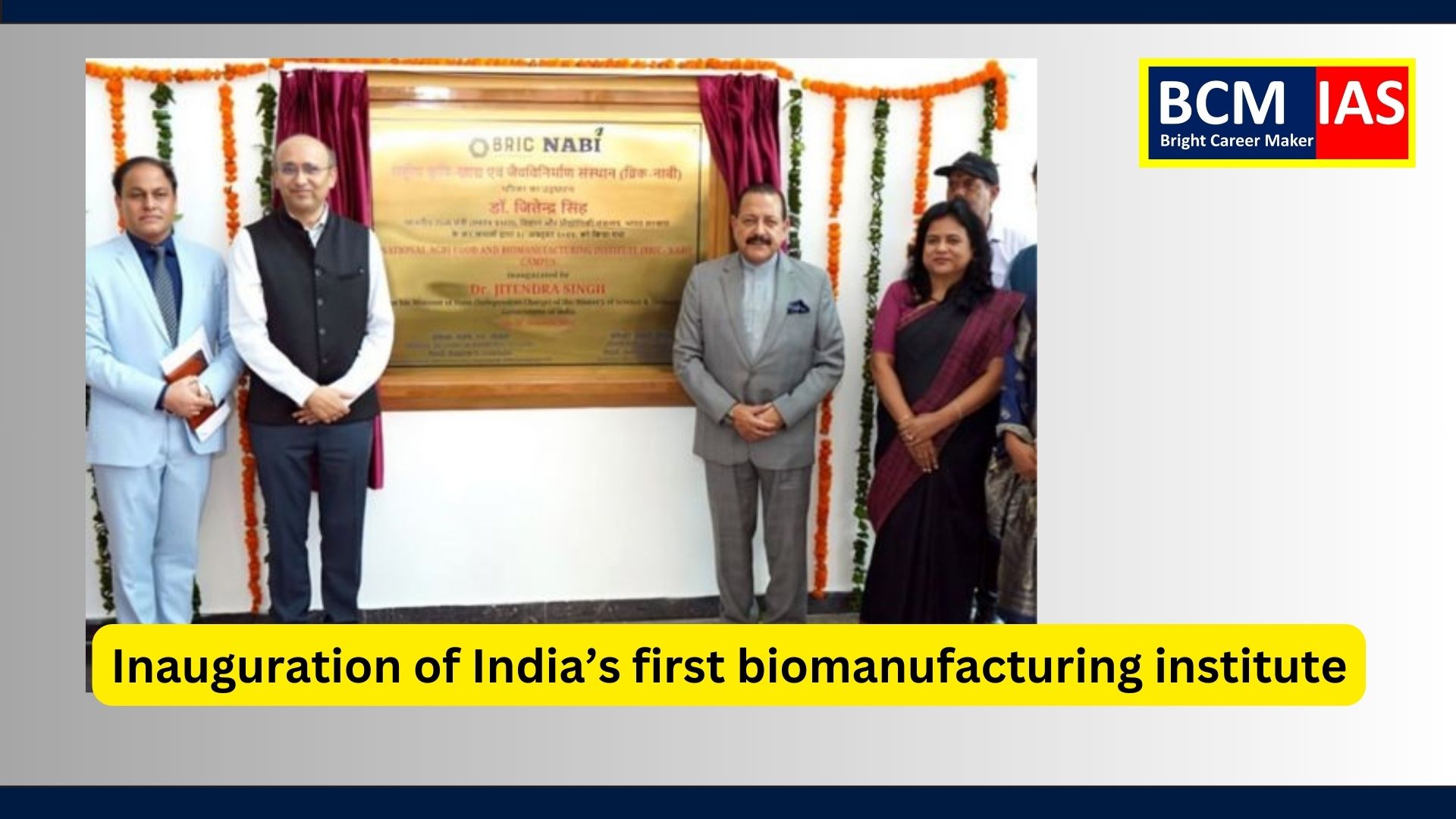
Inauguration of India’s first
biomanufacturing institute
The
inauguration of India’s first biomanufacturing institute, the BRIC-National
Agri-Food Bio-Manufacturing Institute (BRIC-NABI), in Mohali represents a
significant advancement in the country’s biotechnology sector, especially in
the agri-food domain. Formed by merging the National Agri-Food Biotechnology
Institute (NABI) and the Center of Innovative and Applied Bioprocessing (CIAB),
this institute brings together expertise in biotechnology and bioprocessing,
aiming to innovate and scale up technologies for sustainable agriculture.
Key Highlights of BRIC-NABI
1. Agri-Food
Biotechnology Innovation: BRIC-NABI is set to enhance agricultural R&D by
focusing on high-yield, disease-resistant crops, biofertilizers, and
biopesticides, thereby promoting sustainable agricultural practices and
improving food security in India.
2. BioNest
Incubation Center: This center aims to support agri-food startups,
bridging research and industry. It provides a platform for young entrepreneurs,
especially local youth, women, and farmers, to transform agricultural
innovations into viable businesses, thus contributing to rural empowerment and
economic growth.
3. BioE3 Policy: The BioE3
policy underlines the importance of biotechnology for economic growth, job
creation, and environmental sustainability. With applications across
agriculture, food, pharmaceuticals, and energy sectors, this policy aligns with
eco-friendly goals and encourages the adoption of green technologies.
4. Towards a
Science-Driven Economy: The establishment of BRIC-NABI is a step towards a
science-driven economy, positioning India as a global leader in sustainable
biomanufacturing. It aligns with the government’s broader vision of fostering
knowledge-based industries to support sustainable development.
Implications for India’s Agri-Food Sector
The BRIC-NABI institute is likely
to accelerate advancements in agri-tech innovations, thereby enhancing productivity
and sustainability in the agri-food sector. By supporting local startups and
creating employment opportunities, it will foster a resilient rural economy.
Furthermore, its focus on sustainable practices through biomanufacturing aligns
with India’s climate goals, promoting a low-carbon, eco-friendly economy.
Conclusion
The inauguration of BRIC-NABI
signifies India’s commitment to leveraging biotechnology for sustainable
growth. As a model for future biotechnology institutes, it will not only
strengthen India’s agricultural sector but also position the country as a
global hub for sustainable biomanufacturing, contributing to both economic
development and environmental protection.
MCQs
for Practice-
1. The
recently inaugurated BRIC-National Agri-Food Bio-Manufacturing Institute
(BRIC-NABI) is located in which of the following places?
(a) Pune
(b) Bengaluru
(c) Hyderabad
(d) Mohali
Answer: (d) Mohali
2. The
BRIC-NABI institute was formed by merging which of the following two entities?
(a) National Institute of Plant Genome Research (NIPGR) and Indian Agricultural
Research Institute (IARI)
(b) National Agri-Food Biotechnology Institute (NABI) and Center of Innovative
and Applied Bioprocessing (CIAB)
(c) Indian Council of Agricultural Research (ICAR) and National Institute of
Agricultural Extension Management (MANAGE)
(d) Council of Scientific and Industrial Research (CSIR) and Indian Institute
of Horticultural Research (IIHR)
Answer: (b)
National Agri-Food Biotechnology Institute (NABI) and Center of Innovative and
Applied Bioprocessing (CIAB)
3. Which of
the following is one of the primary goals of the BioE3 Policy associated with
BRIC-NABI?
(a) Promoting fossil fuel usage in agriculture
(b) Encouraging sustainable and eco-friendly biomanufacturing in agriculture,
food, pharmaceuticals, and energy sectors
(c) Increasing foreign dependency on agricultural biotechnology
(d) Enhancing traditional agricultural practices without biotechnology
intervention
Answer: (b)
Encouraging sustainable and eco-friendly biomanufacturing in agriculture, food,
pharmaceuticals, and energy sectors
4. The BioNest
Incubation Center at BRIC-NABI primarily aims to support which of the following
groups?
(a) International biotech corporations
(b) Urban industrialists and tech companies
(c) Local youth, women, and farmers in the agri-food sector
(d) Large-scale food processing companies
Answer: (c) Local
youth, women, and farmers in the agri-food sector
5. The
establishment of BRIC-NABI is an important step toward which of the following?
(a) Building a fossil fuel-based economy
(b) Creating a science-driven economy focused on sustainable biomanufacturing
(c) Increasing traditional farming methods over biotechnology
(d) Eliminating biotechnology research from the agricultural sector
Answer: (b)
Creating a science-driven economy focused on sustainable biomanufacturing


Comments on “Inauguration of India’s first biomanufacturing institute”