


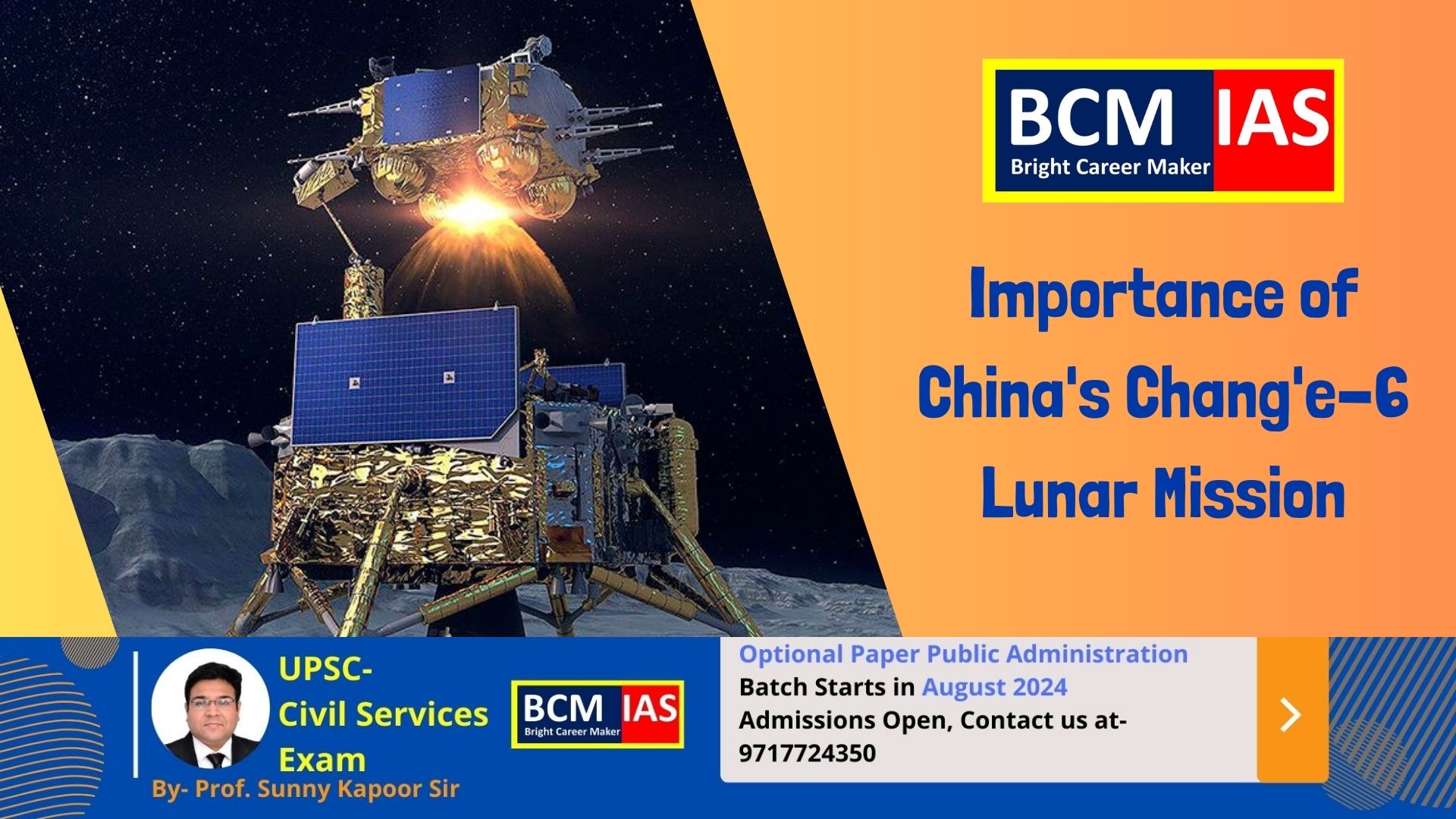
Importance of China's Chang'e-6
Lunar Mission
News Analysis
·
China’s Chang'e-6 mission has marked a significant milestone
in space exploration by successfully returning samples from the Moon's far
side.
·
This mission, which involves complex technological
maneuvers, showcases China's growing capabilities in space science and has
far-reaching implications for lunar research and future space exploration.
Background of Chang'e-6 Mission
The Chang'e-6 mission is notable for several reasons:
- First
Mission to Return Samples from the Far Side: Chang'e-6 is the first
spacecraft to bring back samples from the Moon's far side, an area that
never faces Earth. The far side is characterized by its difficult terrain
and giant craters, which pose significant challenges for landing and
communication.
- Sample
Collection: The
lander descended on the Moon on June 1 and collected rocks and soil from
the South Pole-Aitken (SPA) basin, one of the oldest and largest lunar
craters. The samples were then transferred to the Chang'e-6 orbiter and
subsequently brought back to Earth.
Historical Context
While this is not the first instance of lunar sample return,
it is unique in its scope and technological achievement:
- Previous
Missions: The
US Apollo 11 mission in 1969 and the Soviet Luna 16 mission in 1970
successfully brought lunar samples back to Earth. More recently, China’s
Chang'e-5 mission returned with 2 kg of lunar soil in December 2020, but
these missions were limited to the Moon’s near side.
- Technological
Feats: The
ability to land on the far side, collect samples, and return them to Earth
highlights China’s advanced space exploration capabilities. The mission
required overcoming significant communication challenges and precise
coordination between lander, orbiter, and return modules.
Significance of Sample Return Missions
Sample return missions are crucial for several reasons:
- Advanced
Analysis:
Samples returned to Earth can be analyzed using sophisticated laboratory
instruments, providing detailed insights into their chemical, isotopic,
mineralogical, structural, and physical properties. This level of analysis
is not possible with in situ robotic explorations.
- Long-Term
Study: Samples
can be preserved for future generations, allowing scientists to re-examine
them as technology advances. For instance, the samples brought back by the
Apollo missions continue to yield new information.
- Understanding
Lunar History:
The SPA basin samples can help scientists understand the geological
history of the Moon, including the timeframe for lunar cratering and the
Moon’s origins. These samples could provide clues about the differences
between the near and far sides of the Moon.
Potential Discoveries from Chang'e-6 Samples
The samples from the SPA basin could reveal several important
insights:
- Geological
Differences:
The far side of the Moon has a thicker crust, more craters, and fewer
plains. Understanding these differences could help scientists learn more
about the Moon’s geological processes.
- Lunar
History: The
collision that created the SPA basin may have exposed material from the
Moon’s lower crust and upper mantle. Analyzing these samples could provide
information about the Moon’s early history and its formation.
- Resource
Utilization:
The samples could suggest ways to use lunar resources for future
exploration. For example, lunar soil could potentially be used to produce
building materials for lunar bases through 3D printing. Additionally, the
presence of ice at the Moon’s poles could be significant for sustaining
human activities, providing water, oxygen, and hydrogen for fuel.
The New Race to the Moon
There is a renewed interest in lunar exploration, with
several countries and private companies planning missions:
- Global
Efforts: In
2023, India, China, Japan, the US, and Russia launched lunar missions. By
2030, over 100 missions are expected.
- Long-Term
Goals: Unlike
the US-USSR space race, today’s missions aim to establish a long-term
human presence on the Moon and utilize its resources. The Moon could serve
as a launch pad for deeper space exploration.
Conclusion
The success of China’s Chang'e-6 mission is a significant
achievement in space exploration, demonstrating advanced technological
capabilities and opening new frontiers in lunar research. The samples returned
from the Moon’s far side will enhance our understanding of lunar geology and
support future missions aimed at sustained human presence and resource
utilization on the Moon. As countries continue to explore the Moon, these
efforts will pave the way for deeper space exploration and potential human missions
to other celestial bodies.
Mains Practice Question
Why does the success of China’s Chang'e-6 lunar
mission matter? Discuss the technological achievements, scientific
significance, and implications for future space exploration.
Answer:
Introduction
The success of China’s Chang'e-6 lunar mission is a landmark
achievement in space exploration. This mission, which returned samples from the
Moon's far side, demonstrates significant technological prowess, holds
substantial scientific value, and sets the stage for future space exploration
endeavors.
Technological Achievements
China’s Chang'e-6 mission stands out due to several
technological milestones:
- Far
Side Sample Return: It is the first mission to return samples from the far side of the
Moon, an area never visible from Earth. This feat required advanced
landing, sample collection, and return technologies.
- Complex
Operations: The
mission involved a series of complex operations, including landing in the
South Pole-Aitken (SPA) basin, collecting samples using a robotic arm and
drill, launching an ascent module, and transferring samples to an orbiter
for return to Earth.
- Communication
Challenges:
Communicating with the far side of the Moon, which is always facing away
from Earth, posed significant challenges. China overcame these by using a
relay satellite to maintain communication with the lander and rover.
Scientific Significance
The scientific value of the Chang'e-6 mission is immense:
- Geological
Insights: The
samples from the SPA basin can provide insights into the Moon’s geological
history. The SPA basin, being one of the oldest and largest lunar craters,
holds clues about the early solar system and the processes that shaped the
Moon.
- Understanding
Lunar Differences: The far side of the Moon is geologically distinct from the near
side, with a thicker crust and more craters. The samples can help
scientists understand why these differences exist and the processes that
led to them.
- Material
Analysis: The
samples brought back to Earth can be analyzed using advanced laboratory
instruments. This allows for detailed studies of their chemical, isotopic,
mineralogical, and physical properties, which is not possible with in situ
analyses conducted by landers or rovers.
Implications for Future Space Exploration
The success of the Chang'e-6 mission has broad implications
for future space exploration:
- Lunar
Resource Utilization: Understanding the composition and properties of lunar materials
can aid in the development of technologies to utilize these resources. For
example, lunar soil could be used to produce building materials for future
lunar bases.
- Sustained
Human Presence:
The mission supports plans for a sustained human presence on the Moon.
Resources such as water ice at the lunar poles can be used to support
human life and generate fuel for further space missions.
- Deeper
Space Exploration: The technological advancements demonstrated by Chang'e-6 pave the
way for more ambitious missions. The Moon could serve as a launch pad for
missions to Mars and other parts of the solar system.
Conclusion
China’s Chang'e-6 lunar mission is a testament to the
country’s growing capabilities in space exploration. The technological
achievements and scientific discoveries from this mission provide valuable
insights into lunar history and support future space exploration. By overcoming
the challenges of landing on and returning samples from the far side of the
Moon, China has taken a significant step toward a future where humans can
sustainably explore and utilize space resources.
MCQs Practice
Question 1:
What is the significance of the Chang'e-6 mission in the
context of lunar exploration?
1.
It is the first mission to land on the Moon's near
side.
2.
It is the first mission to return samples from the
Moon's far side.
3.
It is the first mission to orbit the Moon.
4.
It is the first mission to land humans on the Moon.
Answer: 2. It is the first mission to return samples from the
Moon's far side.
Question 2:
Which lunar basin did the Chang'e-6 mission collect samples
from?
1.
Imbrium Basin
2.
South Pole-Aitken Basin
3.
Serenitatis Basin
4.
Crisium Basin
Answer: 2. South Pole-Aitken Basin
Question 3:
What technological challenge was particularly significant for
the Chang'e-6 mission?
1.
Building a rover that could travel for months.
2.
Communicating with the lander on the far side of the
Moon.
3.
Ensuring a soft landing on the Moon's near side.
4.
Developing a nuclear-powered spacecraft.
Answer: 2. Communicating with the lander on the far side of
the Moon.
Question 4:
Why is it important to return lunar samples to Earth for
analysis?
1.
To display them in museums.
2.
To determine the age and origin of lunar rocks with
advanced instruments.
3.
To use them as souvenirs for astronauts.
4.
To avoid contamination of the Moon.
Answer: 2. To determine the age and origin of lunar rocks
with advanced instruments.
Question 5:
What potential future use of lunar resources is highlighted
by the Chang'e-6 mission?
1.
Mining gold and silver.
2.
Producing bricks for lunar bases through 3D printing.
3.
Establishing tourist resorts.
4.
Building space elevators.
Answer: 2. Producing bricks for lunar bases through 3D printing.


Comments on “Importance of China's Chang'e-6 Lunar Mission”