


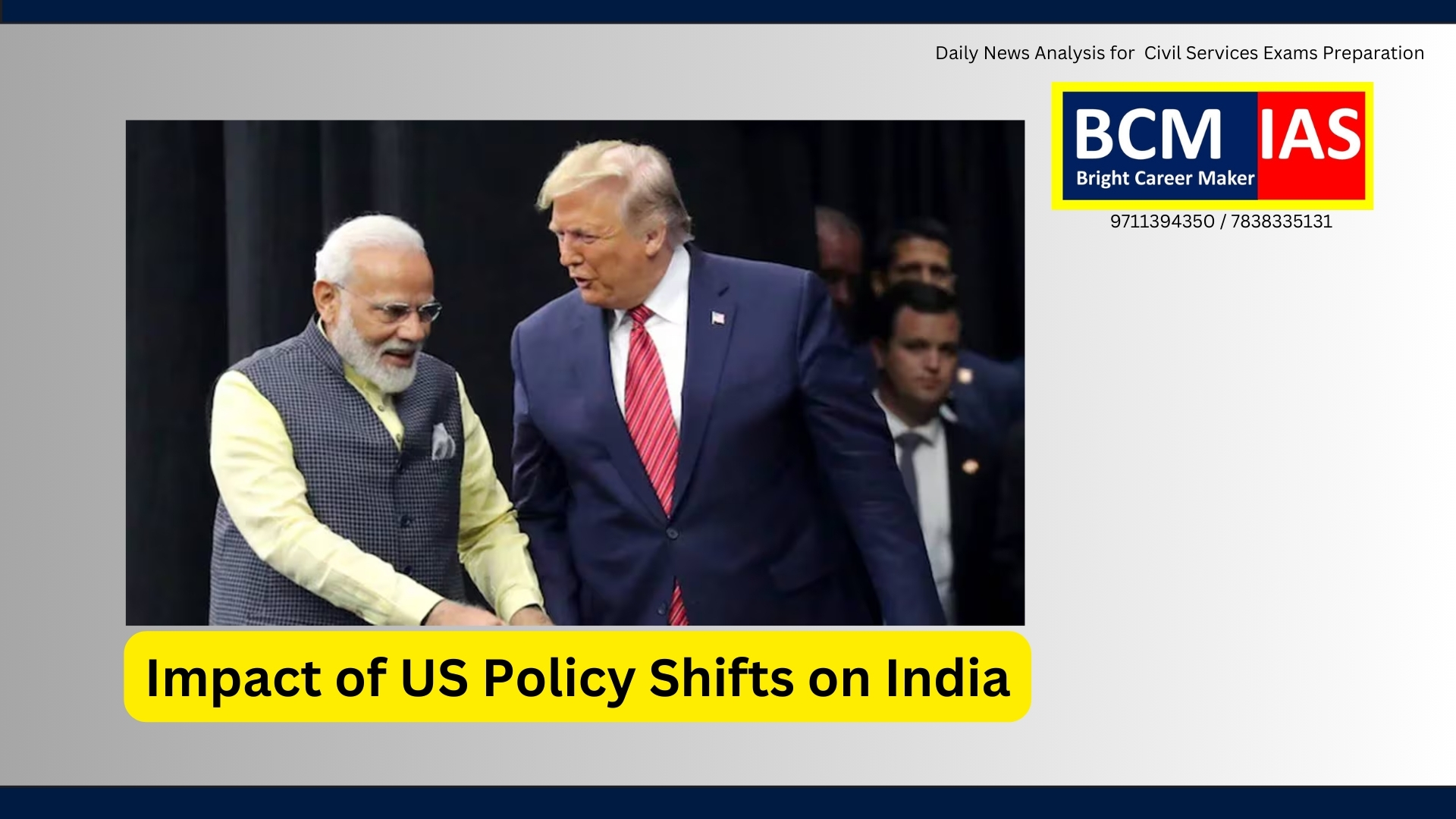
Impact of US Policy Shifts on India
The US policy changes under
President Trump, including revocation of birthright
citizenship, withdrawal from the Paris
Agreement and WHO,
and rejection of the Global Corporate Minimum Tax (GCMT)
deal, have far-reaching implications for India. These policies intersect with
India's economic, climate, immigration, and global health priorities,
necessitating a strategic response.
Key Policy
Shifts and Their Impacts
1.
Revocation of Birthright Citizenship
·
Policy
Context:
- Birthright
citizenship (jus soli) grants US citizenship to individuals born on
American soil. The executive order restricts this to children of citizens
or legal residents.
- Aimed
at curbing "birth tourism" and illegal migration.
·
Impact
on India:
- H-1B
Visa Holders: Families of Indian
professionals face uncertainties about their children’s citizenship,
discouraging long-term migration.
- Skilled
Worker Migration: Indian nationals may
increasingly migrate to countries with more favorable policies, such as
Canada or Australia.
- Rise
in Deportations: About 7.25 lakh
undocumented Indians face heightened deportation risks, disrupting
families and remittances.
- Economic
Impact on the US: Skilled Indian
migrants contribute to IT, healthcare, and innovation sectors. Reduced
migration may create talent shortages, impacting US competitiveness.
2.
Withdrawal from the Paris Agreement
·
Policy
Context:
- The
Paris Agreement is a global framework to limit global warming to below
2°C.
- The
US, as the second-largest greenhouse gas emitter, plays a critical role
in global climate action.
·
Impact
on India:
- Climate
Finance Cuts: The US exit reduces
funding for mitigation and adaptation projects, affecting India’s
renewable energy goals.
- Increased
Global Emissions: US rollback on fossil
fuel regulations could worsen climate challenges, disproportionately
impacting developing countries like India.
- India’s
Leadership Opportunity: The vacuum in
global climate leadership opens opportunities for India to spearhead
initiatives, especially in the Global South.
3.
Withdrawal from the WHO
·
Policy
Context:
- The
US cited WHO’s alleged mishandling of the COVID-19 pandemic and excessive
political influence as reasons for withdrawal.
- The
US accounted for 20% of WHO funding, supporting global health programs.
·
Impact
on India:
- Global
Health Disruption: Reduced funding could
slow WHO-backed programs in India, such as tuberculosis and HIV control
initiatives.
- Leadership
Role: India can fill the void by
leveraging its healthcare expertise, advocating for collaborative efforts
among developing nations.
- Domestic
Implications for the US: The withdrawal
limits US influence in shaping global health policy, indirectly
benefiting India’s rising role in global health governance.
4.
Rejection of the Global Corporate Minimum Tax (GCMT)
·
Policy
Context:
- GCMT
aims to curb tax avoidance by multinational corporations, setting a
global minimum tax rate of 15%.
- The
US withdrawal disrupts global consensus, citing sovereignty and competitiveness
concerns.
·
Impact
on India:
- Taxation
Policies: India’s “wait and
watch” approach shields its tax system from immediate disruptions, as
domestic legislation aligned with GCMT remains limited.
- Global
Efforts: US withdrawal
undermines global tax fairness, but India can collaborate with the EU and
BRICS to advocate for equitable tax reforms.
India's
Strategic Responses
1.
Immigration Advocacy:
- Use
diplomatic channels to safeguard the rights of Indian immigrants,
particularly H-1B visa holders and Green Card applicants.
- Strengthen
bilateral ties with the US to advocate for inclusive immigration policies.
2.
Accelerate Climate Action:
- Scale
up renewable energy initiatives under the National Solar Mission and National Wind-Solar Hybrid Policy.
- Collaborate
with EU and Japan to secure alternative climate financing and demonstrate
leadership in green projects.
3. Global
Health Leadership:
- Leverage
India’s pharmaceutical
capabilities and expertise in vaccine diplomacy to fill
gaps left by the US in global health programs.
- Promote
Indian professionals for key roles in WHO and other global health bodies.
4.
Multilateral Alliances:
- Partner
with BRICS and other Global South nations to build coalitions for
addressing climate, health, and tax-related challenges caused by US policy
shifts.
Conclusion
The evolving US policies
present both challenges and opportunities for India. While immigration
restrictions and reduced climate finance pose immediate risks, they also open
avenues for India to assert leadership in global health, climate action, and
multilateral platforms. Strategic engagement, technical innovation, and strong
diplomacy can help India navigate and leverage these policy shifts effectively.
Mains
Question and Answer
Question
Discuss the implications of
recent US policy shifts, including withdrawal from the Paris Agreement and the
World Health Organization (WHO), and the revocation of birthright citizenship,
on India. How can India navigate these challenges?
Answer
Introduction
US policy changes, including
withdrawal from the Paris Agreement
and WHO,
revocation of birthright citizenship,
and rejection of the Global Corporate Minimum Tax (GCMT)
deal, have far-reaching consequences for India’s interests. These policies
affect India’s diaspora, climate goals, and global health collaborations,
necessitating strategic responses.
Implications
of US Policy Shifts on India
1.
Revocation
of Birthright Citizenship:
o Impact on Indian Diaspora:
Indian H-1B visa holders face uncertainty as US-born children may lose
automatic citizenship. This creates challenges in family planning and long-term
migration.
o Migration Trends:
Indian skilled workers may shift to countries with favorable policies, such as
Canada, Australia, and the UK.
o Economic Impact:
Reduced migration may harm US sectors dependent on Indian talent, like IT and
healthcare.
2.
Withdrawal
from the Paris Agreement:
o Climate Finance:
The US exit reduces funds for climate adaptation and mitigation in developing
nations, affecting India’s renewable energy goals.
o Global Emissions:
Increased US fossil fuel use exacerbates climate change, disproportionately
affecting developing countries like India.
o Leadership Opportunity:
India has an opportunity to emerge as a global climate leader, especially among
Global South nations.
3.
Withdrawal
from the WHO:
o Global Health Funding:
US withdrawal creates funding gaps in WHO programs, slowing efforts on
tuberculosis and HIV in India.
o Leadership Role:
India can leverage its expertise in pharmaceuticals and vaccine diplomacy to
fill gaps and enhance its role in global health governance.
4.
Rejection
of Global Corporate Minimum Tax (GCMT):
o Tax Policy Stability:
India remains unaffected in the short term, as it has not implemented major
domestic legislation under the GCMT framework.
o Global Tax Governance:
US rejection undermines international efforts to curb tax havens, but India can
align with other nations to push for fair tax reforms.
How India
Can Navigate These Challenges
1.
Strengthening
Immigration Advocacy:
o Use diplomatic channels to safeguard the rights
of Indian immigrants, particularly H-1B visa holders and Green Card applicants.
o Build alliances with other affected nations to
advocate for inclusive US immigration policies.
2.
Accelerating
Climate Action:
o Enhance domestic renewable energy projects
under the National Solar
Mission and National
Wind-Solar Hybrid Policy.
o Collaborate with the EU, Japan, and other Paris
Agreement signatories to secure alternative climate finance and strengthen
global commitments.
3.
Global
Health Leadership:
o Expand India’s role in WHO by promoting Indian
professionals for leadership positions.
o Collaborate with developing nations to fill
funding and expertise gaps in global health programs.
4.
Building
Multilateral Alliances:
o Partner with BRICS, the Quad, and other nations
affected by US policy shifts to push for collective action in areas like
climate, health, and taxation.
o Strengthen India’s engagement in platforms like
G20 to advocate for equitable solutions.
Conclusion
While recent US policy shifts
pose challenges to India’s interests, they also present opportunities for India
to assert leadership in climate action, global health, and multilateral
governance. By adopting a strategic, collaborative, and innovative approach,
India can mitigate the negative impacts and enhance its global standing.
MCQs
Question 1:
Which of the following countries is not part of the Paris Agreement?
A. India
B. United States (after 2017 withdrawal under Trump administration)
C. China
D. United Kingdom
Answer:
B. United States (after 2017 withdrawal under Trump administration)
(Explanation: The US withdrew from the Paris Agreement in 2017 under
President Trump but later rejoined under President Biden in 2021.)
Question 2:
What percentage of the World Health Organization’s (WHO) total funding was
contributed by the United States before its withdrawal?
A. 10%
B. 15%
C. 20%
D. 25%
Answer:
C. 20%
(Explanation: The US accounted for approximately 20% of WHO funding, both
through assessed and voluntary contributions.)
Question 3:
What is the global minimum corporate tax rate proposed under the OECD’s GloBE
rules?
A. 10%
B. 12%
C. 15%
D. 18%
Answer:
C. 15%
(Explanation: The OECD proposed a 15% global minimum corporate tax rate to
curb tax avoidance by multinational corporations.)
Question 4:
The Paris Agreement aims to limit global warming to:
A. Below 1.5°C above pre-industrial levels.
B. Below 2°C above pre-industrial levels, with efforts to limit to
1.5°C.
C. Below 2.5°C above pre-industrial levels.
D. Below 3°C above pre-industrial levels.
Answer:
B. Below 2°C above pre-industrial levels, with efforts to limit to
1.5°C.
(Explanation: The Paris Agreement encourages countries to limit global
warming to below 2°C and make efforts to keep it under 1.5°C.)
Question 5:
What constitutional amendment guarantees birthright citizenship in the United
States?
A. 12th Amendment
B. 14th Amendment
C. 16th Amendment
D. 19th Amendment
Answer:
B. 14th Amendment
(Explanation: The 14th Amendment of the US Constitution guarantees citizenship
to all individuals born or naturalized in the United States.)


Comments on “Impact of US Policy Shifts on India”