


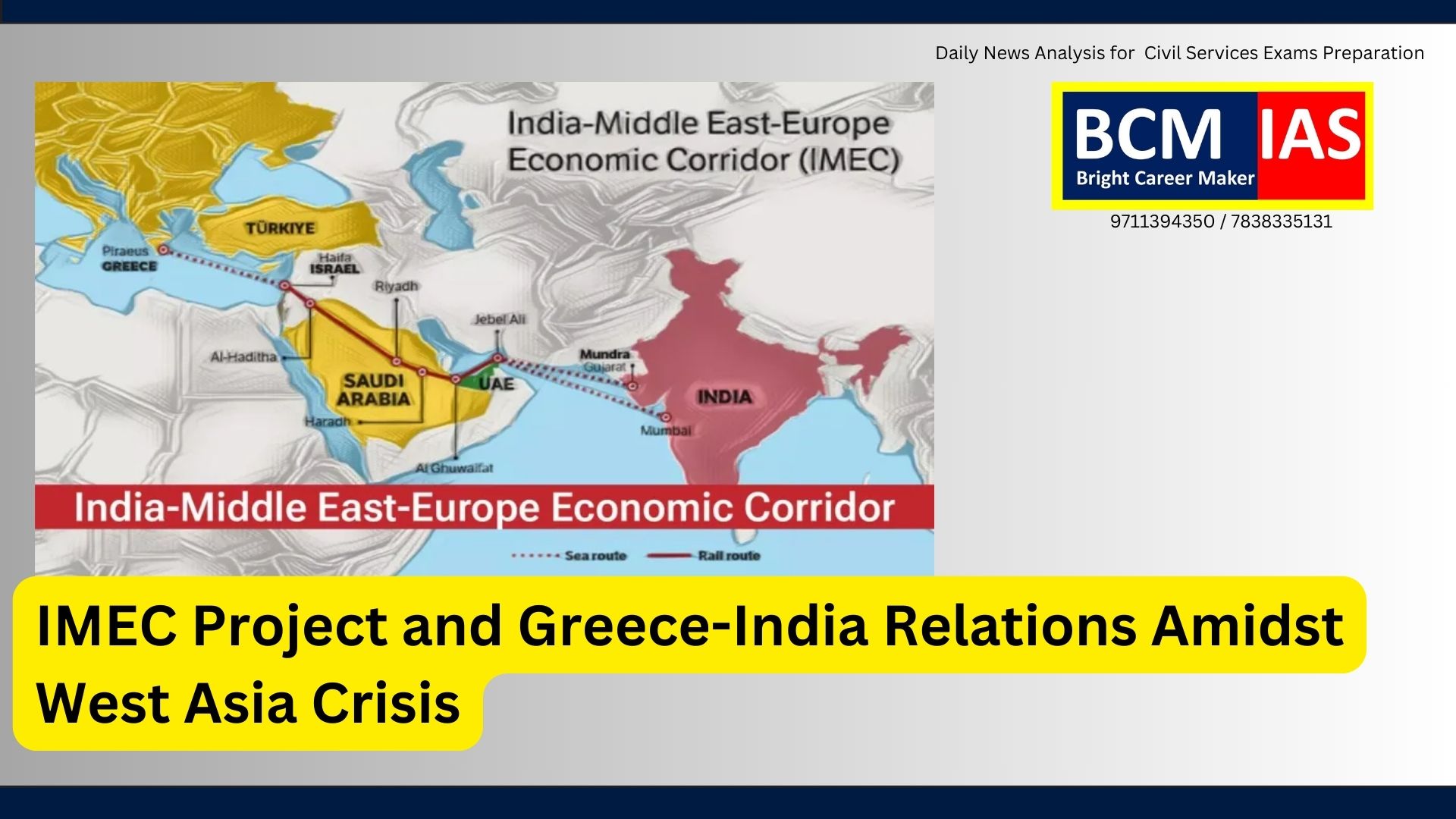
IMEC Project and Greece-India Relations
Amidst West Asia Crisis
1. Introduction
The India-Middle East-Europe Economic Corridor (IMEC)
was launched at the G20 Summit in September 2023 to establish a
strategic trade route from Western India to Europe via the UAE, Saudi
Arabia, Jordan, and Israel. However, ongoing West Asia conflicts,
particularly the Israel-Gaza war, have delayed its planning and
implementation. Greek Foreign Minister George Gerapetritis emphasized
the need to safeguard IMEC’s progress while strengthening bilateral
trade and connectivity with India.
2. Importance of IMEC in Global Trade and
Geopolitics
(A) Economic and Trade Benefits
- IMEC
aims to reduce trade transit time and costs between India, the
Middle East, and Europe.
- It
offers an alternative to China’s Belt and Road Initiative (BRI),
providing a secure and transparent trade corridor.
- The
involvement of India, the U.S., the EU, and Gulf nations enhances
its strategic significance.
(B) Greece’s Strategic Position in IMEC
- Greek
ports (Piraeus, Messina, and Marseille) are key European entry points for IMEC.
- Greece
aspires to be the "gateway to Europe" for Indian exports.
- Greek
ports such as Kavala and Volos are attracting Indian
investments, including the Adani Group.
(C) Impact of West Asia Conflicts on IMEC
- The
war in Gaza and tensions in Lebanon and Syria have delayed IMEC's
first stakeholder meeting beyond the agreed 60-day period.
- Regional
instability risks disrupting trade flows and infrastructure investments
in the corridor.
- Greece,
as a United Nations Security Council (UNSC) member, is advocating
for peaceful dispute resolution to stabilize IMEC's future.
3. Strengthening India-Greece Bilateral Relations
(A) Expanding Trade and Investment
- Bilateral
trade stood at $1.9 billion in 2022-23, with a target to double by 2030.
- Key
sectors of interest for Greece include construction materials, food
& beverages, and renewable energy.
- Potential
boost through India-EU Free Trade Agreement (FTA) once concluded.
(B) Connectivity and Port Investments
- Greece
plans to open new consulates in Mumbai and Bengaluru to facilitate
business and tourism.
- Greece
and India are exploring direct flight connectivity, which has been
delayed since an Air Services Agreement (2022).
- Greek
port modernization is attracting Indian investments, including those by the Adani
Group in Kavala and Volos ports.
(C) Migration Policy and Regularization
- Thousands
of undocumented Indian migrants use sea routes to reach Greece.
- Greece
and India are negotiating a Migration and Mobility MoU to create legal
migration pathways.
- Greece
follows a strict but fair policy, balancing security concerns
with economic opportunities.
4. Challenges and Way Forward
(A) IMEC’s Geopolitical Uncertainty
- The
success of IMEC depends on stability in West Asia.
- Diplomatic
efforts are
needed to prevent conflicts from disrupting supply chains.
(B) Enhancing Trade and Infrastructure
- Greece’s
role as a transshipment hub for Indian goods needs investment in
logistics and digital trade facilitation.
- Faster
progress on India-EU FTA could strengthen Greece’s role in India’s export
strategy.
(C) Strengthening Migration and Mobility Frameworks
- Creating
legal migration channels can address illegal immigration issues
while benefiting Greece’s labor market.
5. Conclusion
The IMEC project represents a transformational shift in
global trade dynamics, offering an alternative to China’s BRI.
Despite delays due to West Asia tensions, India and Greece remain
committed to advancing the corridor. Strengthening bilateral trade,
investment in ports, and migration agreements will deepen the strategic
partnership between the two nations. IMEC’s future hinges on regional
stability, diplomatic negotiations, and efficient infrastructure development,
making it a high-stakes initiative for global economic connectivity.
UPSC Mains Question
The India-Middle
East-Europe Economic Corridor (IMEC) has the potential to reshape global trade.
However, geopolitical challenges pose significant risks to its implementation.
Analyze the strategic importance of IMEC and suggest measures to ensure its successful
execution. (250 words)
Answer
Introduction
The India-Middle East-Europe Economic Corridor (IMEC)
is a transformative initiative launched during the G20 Summit in September
2023. Designed as an alternative to China’s Belt and Road Initiative
(BRI), it aims to establish a seamless trade route from India to Europe
via the Middle East. However, ongoing conflicts in West Asia,
particularly the Israel-Gaza war, pose serious obstacles to its
realization.
1. Strategic Importance of IMEC
(A) Economic and Trade Benefits
- Reduces
transit time and costs for trade between India, the Middle East, and Europe.
- Enhances
regional connectivity, increasing supply chain resilience.
- Encourages
infrastructure investments in ports, railways, and logistics hubs.
(B) Geopolitical and Strategic Significance
- Serves
as an alternative to China’s BRI, promoting a rules-based trade
system.
- Strengthens
India-Gulf-Europe relations, enhancing energy and commercial ties.
- Encourages
multipolar global trade, reducing reliance on Suez Canal and Red
Sea routes.
(C) Greece’s Role as a Gateway to Europe
- Greek
ports like Piraeus, Kavala, and Volos are key entry points for Indian
goods into the EU market.
- Greece’s
bilateral trade with India ($1.9 billion in 2022-23) is expected to
double by 2030.
2. Challenges to IMEC Implementation
(A) Geopolitical Uncertainty
- Ongoing
Israel-Gaza war and tensions in Lebanon and Syria have delayed
planning and stakeholder meetings.
- Risk
of disruptions to infrastructure and trade routes.
(B) Infrastructure and Investment Bottlenecks
- Requires
major funding from India, the EU, and Gulf nations.
- Delays
in port modernization and railway integration could slow progress.
(C) Regulatory and Logistical Issues
- Harmonizing
customs regulations and trade policies across multiple
jurisdictions is complex.
- Lack
of direct flights and digital trade infrastructure between India
and Greece hinders efficiency.
3. Measures for Successful Execution of IMEC
(A) Strengthening Diplomatic Engagement
- India,
Greece, and other IMEC partners should mediate peace efforts in West
Asia.
- Enhanced
security cooperation to safeguard trade routes.
(B) Infrastructure Development and Investment Mobilization
- Establish
a dedicated IMEC investment fund for logistics, ports, and digital
infrastructure.
- Fast-track
Indian investments in Greek ports to solidify IMEC’s European
gateway.
(C) Trade Facilitation and Policy Reforms
- Conclude
the India-European Union Free Trade Agreement (FTA) to enhance bilateral
trade flows.
- Implement
seamless customs clearance mechanisms across IMEC nations.
Conclusion
IMEC has the potential to reshape global trade dynamics,
reducing dependence on traditional routes and strengthening India’s economic
ties with Europe and the Middle East. However, geopolitical stability,
strong diplomatic collaboration, and robust infrastructure investments are
critical for its successful execution. If implemented effectively, IMEC can position
India as a global trade hub, boosting economic growth and strategic
influence in a rapidly evolving world order.
MCQs
Q1. With reference to the India-Middle East-Europe Economic
Corridor (IMEC), consider the following statements:
1.
IMEC was launched during the G20 Summit in
September 2023.
2.
The corridor aims to connect India with Europe via
the Middle East, bypassing traditional trade routes like the Suez Canal.
3.
Greece is not a part of IMEC but has shown interest in
supporting the project.
Which of the statements given above is/are correct?
(a) 1 and 2 only
(b) 2 and 3 only
(c) 1 and 3 only
(d) 1, 2, and 3
Answer: (a) 1
and 2 only
Q2. Which of the following are the expected benefits of IMEC
for India?
1.
Reduced trade transit time and costs for exports to Europe.
2.
Enhanced connectivity with Gulf countries and the European
Union.
3.
Increased dependency on China’s Belt and Road
Initiative (BRI) for
trade.
4.
Greater investment opportunities in infrastructure projects such as
ports and railways.
Select the correct answer using the codes given below:
(a) 1, 2, and 4 only
(b) 1, 3, and 4 only
(c) 2 and 3 only
(d) 1, 2, 3, and 4
Answer: (a) 1,
2, and 4 only
Q3. Which of the following ports are considered key entry
points for IMEC in Europe?
1.
Piraeus Port (Greece)
2.
Messina Port (Italy)
3.
Haifa Port (Israel)
4.
Chabahar Port (Iran)
Select the correct answer using the codes given below:
(a) 1 and 2 only
(b) 2, 3, and 4 only
(c) 1, 2, and 3 only
(d) 1, 3, and 4 only
Answer: (c) 1,
2, and 3 only
Q4. What is a major geopolitical challenge affecting the
implementation of IMEC?
(a)
Increasing protectionist trade policies by the European Union.
(b) Ongoing Israel-Gaza war and tensions in Lebanon and Syria.
(c) Resistance from China due to IMEC’s alignment with the Belt and Road
Initiative (BRI).
(d) Lack of participation from Gulf countries like UAE and Saudi Arabia.
Answer: (b) Ongoing
Israel-Gaza war and tensions in Lebanon and Syria.
Q5. Greece has proposed to strengthen its economic ties with
India through which of the following initiatives?
1.
Opening new consulates in Mumbai and Bengaluru to facilitate trade and tourism.
2.
Encouraging Indian investments in Greek ports such as Kavala and Volos.
3.
Signing a Free Trade Agreement (FTA) directly with
India bypassing the
European Union.
4.
Negotiating a Migration and Mobility MoU to address illegal immigration
issues.
Select the correct answer using the codes given below:
(a) 1, 2, and 4 only
(b) 2 and 3 only
(c) 1, 3, and 4 only
(d) 1, 2, 3, and 4
Answer: (a) 1,
2, and 4 only


Comments on “IMEC Project and Greece-India Relations Amidst West Asia Crisis”