

Daily
Current Affairs Analysis
10 June
2024
-------------------------------------------------------------------------------------------------------------
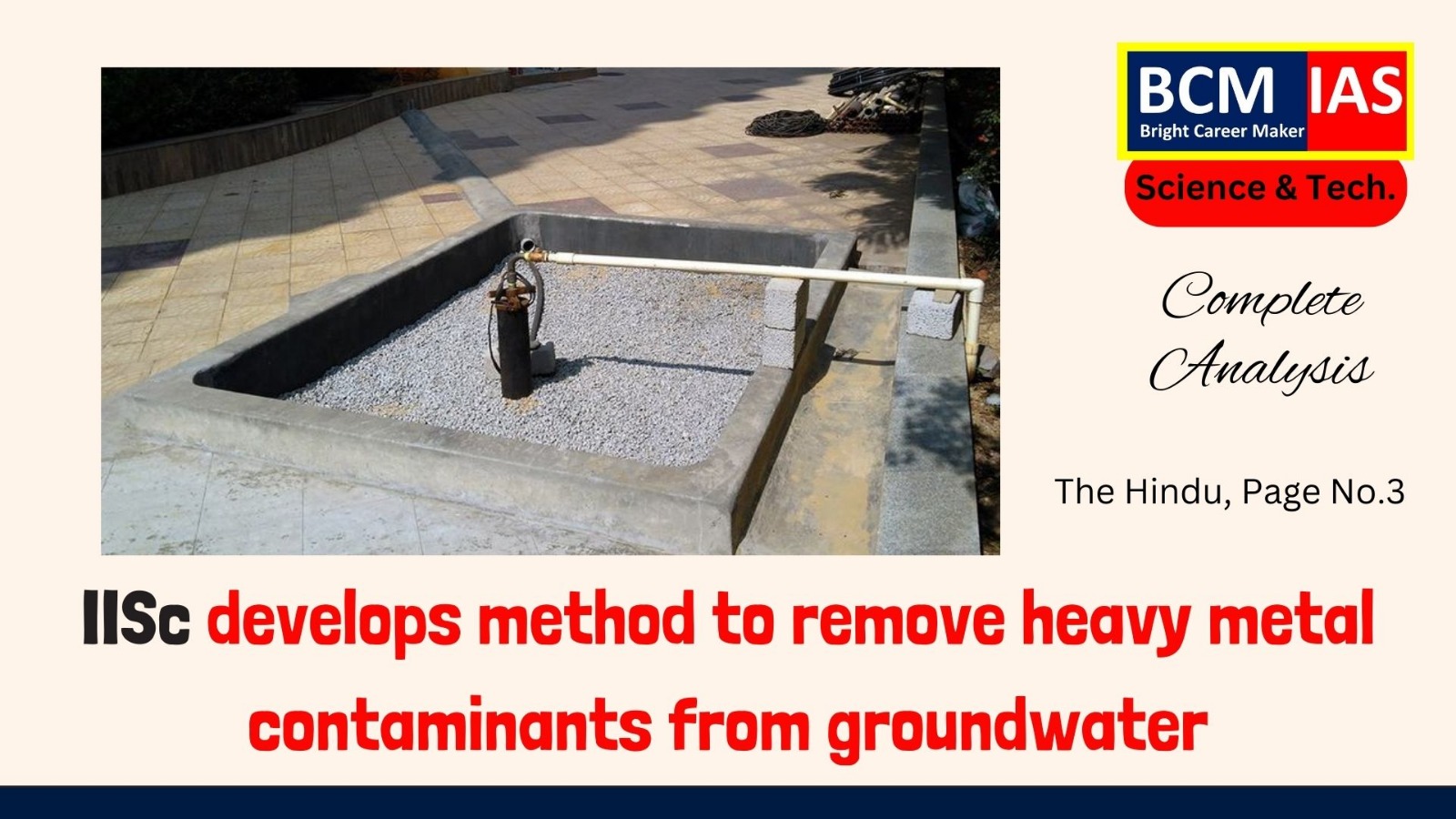
IISc develops method to remove heavy metal
contaminants from groundwater
Meaning of Headline-
·
The headline indicates that researchers at the Indian Institute of
Science (IISc) have created a new process for eliminating harmful heavy metal
pollutants, such as arsenic, from groundwater.
·
This innovation aims to improve water quality and ensure
environmental sustainability by preventing these contaminants from re-entering
the ecosystem.
Related Topic (as per UPSC
Syllabus)
Prelims:
General Studies Paper I:
- Environment and Ecology:
o
Basic concepts of environmental conservation and
pollution.
o
Initiatives and technologies related to environmental
protection.
Science and Technology:
- Recent developments in science and technology and their
applications and effects in everyday life:
o
Innovations in water purification and environmental
protection technologies.
Mains:
General Studies Paper III:
- Environmental Conservation:
o
Conservation, environmental pollution, and
degradation, environmental impact assessment.
o
Technologies for water conservation and management,
particularly those addressing pollution.
- Science and Technology:
o
Developments and their applications and effects in
everyday life.
o
Indigenous technology and developing new technology.
General Studies Paper II:
- Government policies and interventions:
o
Role of NGOs and public policies in environmental
sustainability.
o
Collaboration between research institutions and NGOs
for rural development and environmental conservation.
Essay Paper:
- Topics related to science and technology for sustainable
development, environmental conservation, and public health.
Interview:
- Current Affairs:
o
Questions on recent scientific developments and their
implications for environmental conservation.
o
Discussion on the role of scientific research in
solving environmental issues.
- Science and Technology:
o
Understanding and implications of new technologies in
environmental conservation.
o
Practical applications and benefits of the IISc's new
remediation process for groundwater purification.
This news is significant for the UPSC exam
as it covers important topics related to environmental conservation, science
and technology, and government policies, which are essential for both Prelims
and Mains. It also provides a contemporary example that can be useful in the
Interview stage.
News
Analysis
Key Points:
1. Significance of
Groundwater Contamination
o
Public health threat from heavy metals such as arsenic
and fluoride.
o
Environmental sustainability issues due to
recontamination.
2. IISc's Innovation
o
Development of a novel, patent-pending remediation
process.
o
Three-step method ensuring effective and sustainable
removal of contaminants.
3. Collaborative Efforts
o
Collaboration with NGOs for real-world deployment.
o
Focus on rural areas with high contamination levels.
4. Policy and
Implementation
o
Need for scaling and government support.
o
Strengthening of regulations and public awareness
campaigns.
Detailed Analysis:
Introduction
Groundwater contamination by heavy metals
poses a severe risk to public health and the environment. The Indian Institute
of Science (IISc) has developed a novel remediation process to address this
issue. This innovation aligns with sustainable development goals by ensuring
safe drinking water and environmental conservation.
1. Public Health Implications
- Health
Risks:
Long-term exposure to arsenic and fluoride in drinking water can lead to
serious health issues, including cancers, developmental problems, and bone
diseases.
- Clean
Water Access:
IISc's method ensures the removal of these harmful contaminants, providing
access to safe drinking water, which is crucial for public health.
2. Environmental Conservation
- Sustainable
Disposal: The
traditional disposal of heavy metal-laden sludge can lead to environmental
recontamination. IISc's process ensures that contaminants are disposed of
in an environmentally friendly manner, preventing re-entry into the
groundwater.
- Ecological
Balance: By
preventing recontamination, the method supports long-term ecological
balance and reduces pollution.
3. Technological Innovation
- Novel
Process:
IISc's three-step process is an innovative solution for groundwater
remediation, with its patent-pending status highlighting its originality.
- Real-world
Application:
Collaboration with NGOs ensures that the technology is implemented in
high-risk areas, particularly rural regions affected by groundwater
contamination.
4. Scaling and Implementation
- Government Support: For widespread
impact, the government needs to prioritize funding and integrate the
technology into national water quality management programs.
- Collaborative
Efforts:
Successful implementation requires collaboration between government
agencies, research institutions, and NGOs.
5. Policy and Regulation
- Stricter
Regulations:
Enforcing stricter limits on heavy metal levels in groundwater is
essential. Enhancing monitoring, reporting mechanisms, and compliance is
crucial for effective implementation.
- Incentives: Providing
subsidies and grants can encourage the adoption of advanced remediation
technologies.
6. Public Awareness and Community
Engagement
- Awareness
Campaigns:
Educating the public about the dangers of contaminated groundwater and the
benefits of new technologies is vital.
- Community
Involvement: Engaging local communities in monitoring and maintaining water
quality ensures sustainable, locally driven solutions.
7. Research and Development
- Continuous
Improvement:
Ongoing research is necessary to refine the remediation process, making it
more cost-effective and efficient.
- Interdisciplinary Collaboration: Encouraging
interdisciplinary research can lead to comprehensive solutions addressing
multiple contaminants.
8. International Collaboration
- Global
Issue: Heavy metal
contamination of groundwater is a global problem. Sharing knowledge and
technology with other countries can lead to collective progress.
- International
Forums:
Organizations focused on water quality and environmental sustainability
should facilitate knowledge exchange and collaborative projects.
Conclusion
IISc's new method for removing heavy metal
contaminants from groundwater is a significant step towards sustainable
development. By addressing public health concerns, promoting environmental
conservation, and fostering technological innovation, this process has the
potential to create a safer and more sustainable future. A concerted effort
involving policy support, community engagement, and continuous research and
development is essential to fully realize its benefits. Prioritizing the
implementation of such innovative technologies will ensure access to clean
water and protect the health of both people and the planet.
Mains Probable Question
"Discuss the
significance of IISc's new method for removing heavy metal contaminants from
groundwater in the context of sustainable development."
Answer for
UPSC Civil Services Mains Exam
1.
Introduction
Groundwater
contamination by heavy metals, such as arsenic and fluoride, poses a severe
threat to public health and environmental sustainability. The Indian Institute
of Science (IISc) has developed a novel remediation process aimed at removing
these hazardous contaminants from groundwater. This technological advancement
not only addresses the immediate health risks associated with heavy metal
contamination but also incorporates sustainable practices to prevent
recontamination. This essay explores the significance of IISc's new method
within the broader framework of sustainable development, highlighting its
potential impact on public health, environmental conservation, and
technological innovation.
2. Demand of
the Question
a. Public
Health Implications: Heavy metal contamination in groundwater is a
pressing public health issue in India, particularly in states with arsenic
levels exceeding 0.01 mg per liter and fluoride levels above 1.5 mg per liter.
Prolonged exposure to arsenic and fluoride can lead to severe health
conditions, including cancers, skin lesions, developmental effects, and bone
diseases. IISc's new method offers a viable solution to mitigate these health
risks by effectively removing heavy metals from groundwater. This is crucial in
ensuring access to clean and safe drinking water, a fundamental human
right and a key component of sustainable development.
b. Environmental
Conservation: Traditional methods of dealing with heavy metal-laden
sludge often result in environmental recontamination. IISc's three-step
process, which includes an innovative disposal mechanism, ensures that removed
heavy metals are not simply shifted from one part of the environment to another
but are instead managed in an environmentally friendly and sustainable
manner. This approach aligns with the principles of sustainable
development, which advocate for practices that do not compromise the ability of
future generations to meet their needs. By preventing the re-entry of heavy
metals into the environment, this method supports long-term ecological balance
and reduces the overall burden of environmental pollution.
c. Technological
Innovation: The development of IISc's novel remediation process
represents a significant advancement in the field of environmental technology.
The method’s patent-pending status underscores its originality and potential
for wide-scale application. By collaborating with NGOs like the INREM
Foundation and Earthwatch, the IISc team ensures that the technology is
deployed in real-world settings, particularly in rural areas that are
disproportionately affected by groundwater contamination. This technology
transfer and implementation model demonstrates a practical pathway for
bridging scientific research and community-level impact, fostering sustainable
development through innovation.
3. Way
Forward
a. Scaling
and Implementation: For IISc's method to have a significant impact,
it must be scaled up and implemented across regions affected by groundwater
contamination. This requires collaborative efforts between government
agencies, research institutions, and non-governmental organizations. The
government should prioritize funding for the deployment of this technology in
high-risk areas and integrate it into national water quality management
programs.
b. Policy
and Regulation: Strengthening policies and regulations regarding
groundwater contamination is essential. This includes enforcing stricter limits
on allowable levels of heavy metals in groundwater, enhancing monitoring and
reporting mechanisms, and ensuring compliance through regular inspections
and penalties for violations. Policymakers should also incentivize the
adoption of advanced remediation technologies through subsidies and grants.
c. Public
Awareness and Community Engagement: Raising public awareness about the
dangers of heavy metal contamination and the availability of new remediation
technologies is crucial. Community engagement programs should be designed to
educate local populations about the health risks associated with contaminated
groundwater and the benefits of using clean water technologies. Empowering
communities to participate in monitoring and maintaining water quality can
lead to more sustainable and locally driven solutions.
d. Research
and Development: Ongoing research and development are necessary to
refine and improve the remediation process. This includes exploring ways to
make the technology more cost-effective and efficient, as well as adapting it
to address other contaminants beyond heavy metals. Encouraging interdisciplinary
research collaborations can lead to the development of comprehensive
solutions that address multiple aspects of groundwater contamination.
e. International
Collaboration: Heavy metal contamination of groundwater is a global
issue. Sharing knowledge and technology with other countries facing similar
challenges can lead to collective progress. International organizations and
forums focused on water quality and environmental sustainability should
facilitate knowledge exchange and collaborative projects to replicate
successful models across different regions.
Conclusion
IISc's new
method for removing heavy metal contaminants from groundwater represents a
significant step towards achieving sustainable development. By addressing
public health concerns, promoting environmental conservation, and fostering
technological innovation, this remediation process has the potential to create
a safer and more sustainable future. To fully realize its benefits, a concerted
effort involving policy support, community engagement, and continuous research
and development is essential. By prioritizing the implementation and scaling of
such innovative technologies, we can ensure access to clean water and protect
the health of both people and the planet.
MCQs for Prelims Practice
1. What is
the primary health risk associated with heavy metal contamination in
groundwater as mentioned in the article?
a)
Respiratory problems
b)
Cardiovascular diseases
c)
Developmental effects and cancers
d)
Gastrointestinal issues
Answer: c)
Developmental effects and cancers
Explanation: Heavy metal
contamination in groundwater, such as arsenic and fluoride, can lead to severe
health conditions, including developmental effects and cancers. The article
specifically mentions these as significant health risks.
2. Which
Indian research institution developed a novel method for removing heavy metal
contaminants from groundwater?
a) Indian
Institute of Technology (IIT)
b) Indian
Institute of Science (IISc)
c) All India
Institute of Medical Sciences (AIIMS)
d) National
Institute of Technology (NIT)
Answer: b) Indian
Institute of Science (IISc)
Explanation: The article
highlights that researchers from the Indian Institute of Science (IISc) have
developed a novel remediation process for removing heavy metal contaminants
such as arsenic from groundwater.
3. What is
the significance of IISc's three-step remediation process for heavy metals in
groundwater?
a) It
completely eliminates all types of water contaminants.
b) It ensures
contaminants do not re-enter the environment.
c) It uses
biological methods to treat water.
d) It is the
most cost-effective method available.
Answer: b) It
ensures contaminants do not re-enter the environment.
Explanation: The IISc's
three-step method ensures that the removed heavy metals are disposed of in an
environmentally friendly and sustainable manner, preventing their re-entry into
the environment, which is a significant aspect mentioned in the article.
4. Which of
the following NGOs has collaborated with IISc to test the new groundwater
remediation systems?
a) Greenpeace
India
b) INREM
Foundation
c) World Wide
Fund for Nature (WWF)
d) Centre for
Science and Environment (CSE)
Answer: b) INREM
Foundation
Explanation: The article
mentions that the researchers have been working with the INREM Foundation and
Earthwatch to deploy and test these systems in rural areas.
5. According
to the article, which regulatory bodies set the permissible limits for arsenic
and fluoride levels in groundwater in India?
a) Indian
Council of Medical Research (ICMR) and Indian Standards Institute (ISI)
b) Bureau of
Indian Standards (BIS) and World Health Organisation (WHO)
c) Central
Pollution Control Board (CPCB) and Ministry of Environment, Forest and Climate
Change (MoEFCC)
d) Food
Safety and Standards Authority of India (FSSAI) and Indian Medical Association
(IMA)
Answer: b) Bureau of
Indian Standards (BIS) and World Health Organisation (WHO)
Explanation: The article
specifies that the permissible limits for arsenic and fluoride levels in
groundwater are set by the Bureau of Indian Standards (BIS) and the World
Health Organisation (WHO).


Comments on “IISc develops method to remove heavy metal contaminants from groundwater”