


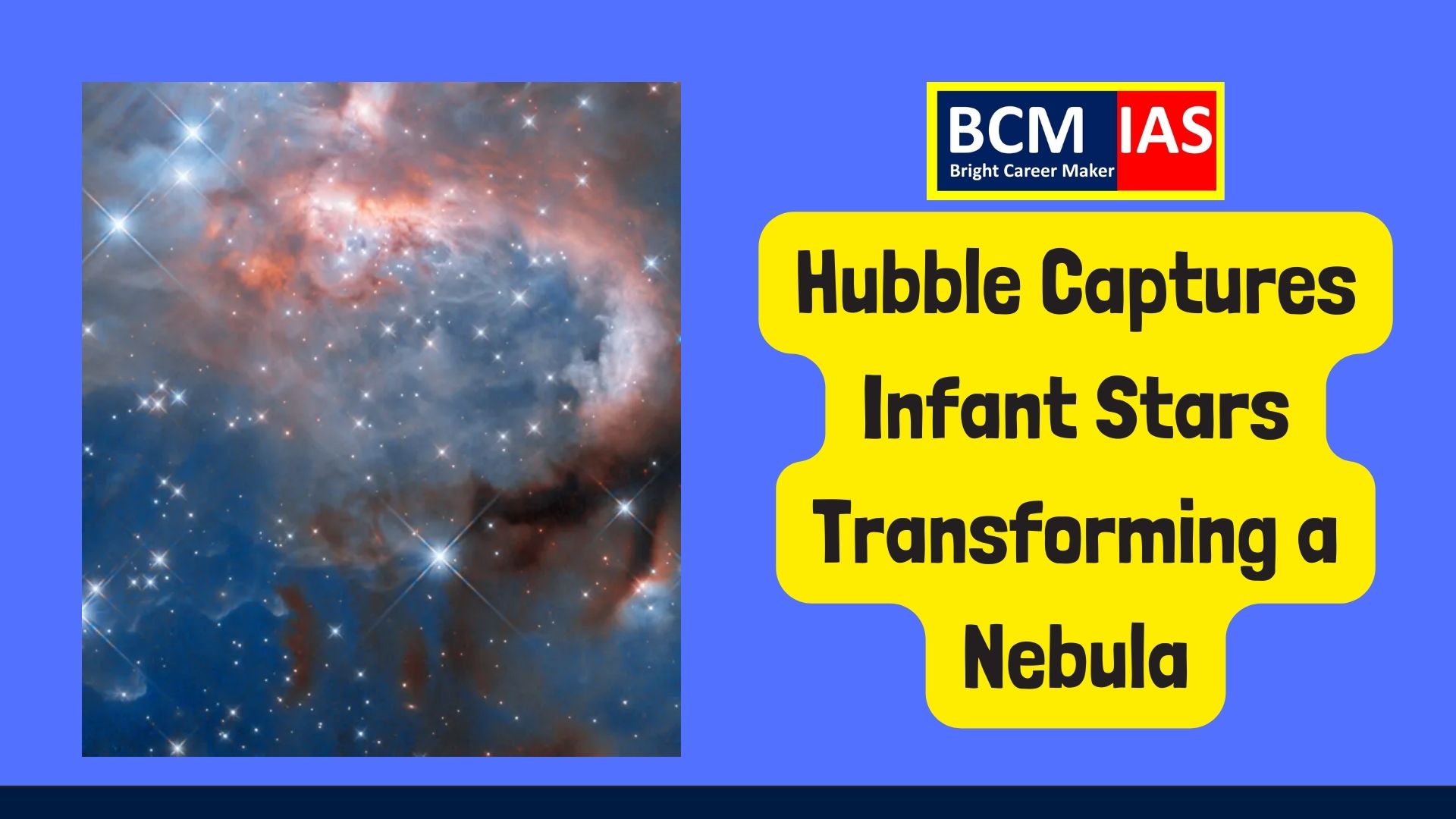
Hubble Captures Infant Stars
Transforming a Nebula
GS Paper 3- Science
& Technology ( UPSC CSE Prelims & Mains)
Analysis
Introduction
The Hubble Space Telescope has captured an awe-inspiring
image of the nebula RCW 7, located over 5,300 light-years away in the
constellation Puppis. This nebula is a rich tapestry of interstellar gas and
dust, which serves as the raw material for star formation. This article delves
into the intricate processes of star birth and the transformation of nebulae
into H II regions, emphasizing the role of protostars and the diverse types of
nebulae.
Formation and
Characteristics of RCW 7
- Nebulae
as Star Birthplaces: Nebulae like RCW 7 are regions where new stars form. Under the
force of gravity, parts of these molecular clouds collapse to form
protostars, which are young, developing stars surrounded by spinning discs
of leftover gas and dust.
- Massive
Protostars: In
RCW 7, massive protostars emit strongly ionizing radiation and fierce
stellar winds. These forces transform the nebula into an H II region,
characterized by hydrogen ions (H II).
The Nature of H II
Regions
- Ionization
Process: H II
regions are formed when ultraviolet radiation from massive protostars
ionizes the hydrogen in the nebula, causing it to emit light. This
ionization process is what gives RCW 7 its distinctive pinkish glow.
- Hubble’s
Observations:
The data for this image came from the study of a massive protostellar
binary named IRAS 07299-1651, observed using Hubble’s Wide Field Camera 3
in near-infrared light. This allows astronomers to see through the gas and
dust, capturing the protostars in their early stages.
Transformation and
Future of Nebula RCW 7
- Dispersal
of Gas: The
creation of an H II region marks the beginning of the end for a molecular
cloud like RCW 7. Over a few million years, radiation and winds from the
massive stars will disperse the nebula’s gas.
- Supernova
Explosions: As
the most massive stars end their lives in supernova explosions, they will
further disperse the nebula’s material. New stars will form from only a
fraction of the nebula’s gas, with the remainder spreading throughout the
galaxy.
Types of Nebulae and
Their Processes
Emission Nebulae
- Definition: Emission nebulae emit their
own light due to the ionization of gas by nearby stars. The Orion Nebula
is a famous example, illuminated by the Trapezium star cluster.
- Star
Formation: The
ultraviolet light from these stars ionizes the hydrogen gas, causing it to
glow and sculpting the nebula into various shapes.
Reflection Nebulae
- Definition: Reflection nebulae reflect the
light of nearby stars. They are typically bluish because of the way light
scatters through the interstellar medium.
- Examples: NGC 1999 near the Orion Nebula
and the nebula around the Pleiades star cluster.
Planetary Nebulae
- Definition: These nebulae form during the
death of low- to medium-mass stars. The stars expel their outer layers,
forming shells of gas and dust.
- Characteristics: The remaining core becomes a
white dwarf, and the nebula glows due to the ionizing radiation from the
white dwarf. The Helix Nebula is an example.
Supernova Remnants
- Definition: These remnants are the
aftermath of massive stars exploding in supernovae. The debris and
interstellar material swept up in the explosion glow brightly.
- Example: The Crab Nebula, which was
created by a supernova observed in 1054 AD.
Absorption Nebulae
- Definition: Also known as dark nebulae,
these clouds do not emit or reflect light but block the light from stars
or nebulae behind them.
- Characteristics: Bok globules are small, dense
regions within these nebulae that often contain forming stars.
Conclusion
Hubble's observation of RCW 7 and the detailed study of
various types of nebulae provide profound insights into the lifecycle of stars
and the dynamic processes within our galaxy. Nebulae, with their stunning
visuals and complex mechanisms, illustrate the perpetual cycle of star birth
and death, contributing to the ongoing evolution of the cosmos.
MCQs
Question 1
What is the nebula RCW 7 known for?
A. Being the closest nebula to Earth
B. Hosting a massive protostellar binary named IRAS 07299-1651
C. Containing the oldest stars in the universe
D. Being located in the Andromeda Galaxy
Answer: B. Hosting a massive protostellar binary named IRAS
07299-1651
Question 2
What causes the pinkish glow in the H II region of RCW 7?
A. Reflection of light from nearby stars
B. Emission of ultraviolet light from protostars
C. Ionization of hydrogen by ultraviolet radiation from massive protostars
D. Presence of helium ions in the nebula
Answer: C. Ionization of hydrogen by ultraviolet radiation
from massive protostars
Question 3
What is the primary purpose of Hubble's Wide Field Camera 3
in studying RCW 7?
A. Capturing high-resolution images in visible light
B. Observing in near-infrared light to see through gas and dust
C. Measuring the temperature of protostars
D. Detecting radio waves emitted by the nebula
Answer: B. Observing in near-infrared light to see through
gas and dust
Question 4
Which type of nebula is characterized by emitting its own
light due to ionization?
A. Reflection nebula
B. Planetary nebula
C. Emission nebula
D. Absorption nebula
Answer: C. Emission nebula
Question 5
What will happen to the molecular cloud RCW 7 within a few
million years?
A. It will form a black hole
B. It will be completely dispersed by radiation and stellar winds
C. It will merge with another nebula
D. It will become a supernova remnant
Answer: B. It will be completely dispersed by radiation and
stellar winds
Mains Practice Qn
Examine the processes
involved in the formation and evolution of nebulae, using the Hubble Space
Telescope's observations of RCW 7 as a case study. Discuss the different types
of nebulae and their roles in the lifecycle of stars.
Answer
Introduction
Nebulae are vast clouds of gas and dust in space, often
serving as the birthplaces of stars. The Hubble Space Telescope's recent
observations of the nebula RCW 7, located in the constellation Puppis, provide
a detailed view of these dynamic regions. This case study highlights the
processes involved in nebula formation and evolution, and explores the
different types of nebulae and their roles in the stellar lifecycle.
Formation and Evolution
of Nebulae
Nebulae form in regions where the interstellar medium becomes
dense enough to coalesce into clouds. This process can be driven by gravity
pulling gas and dust together or by the remnants of dying stars.
1.
Star Formation in Nebulae:
o Molecular
Clouds: Nebulae rich
in molecular hydrogen serve as nurseries for star formation. Gravity causes
parts of these clouds to collapse, forming protostars.
o Protostars: These are very young stars
surrounded by discs of leftover gas and dust. In RCW 7, massive protostars emit
ionizing radiation and stellar winds, transforming the nebula into an H II
region.
2.
Transformation into H II Regions:
o Ionization: Ultraviolet radiation from massive
protostars ionizes hydrogen atoms, causing them to emit light and create the
characteristic glow of H II regions. In RCW 7, this process gives the nebula
its soft pinkish hue.
o Dispersal: Over time, radiation and stellar
winds disperse the nebula’s gas. The most massive stars may end their lives in
supernova explosions, further spreading the nebula's material across the
galaxy.
Types of Nebulae
1.
Emission Nebulae:
o Characteristics: These nebulae emit their own light
due to the ionization of gas by nearby stars. They often appear red or pink due
to the Hα emission from hydrogen.
o Example: The Orion Nebula is a well-known
emission nebula, illuminated by the Trapezium star cluster.
2.
Reflection Nebulae:
o Characteristics: These nebulae reflect the light of
nearby stars. They do not emit light themselves but scatter the light from
surrounding stars, often appearing bluish due to the scattering of shorter
wavelengths.
o Example: NGC 1999 near the Orion Nebula
reflects light from the star V380 Orionis.
3.
Planetary Nebulae:
o Characteristics: Formed during the death of low- to
medium-mass stars, these nebulae are the outer layers expelled by dying stars.
The remaining core becomes a white dwarf, which ionizes the expelled gas.
o Example: The Helix Nebula, which looks like
a ring from Earth's perspective but is a tunnel of glowing gases.
4.
Supernova Remnants:
o Characteristics: These nebulae are the remnants of
massive stars that have exploded in supernovae. The material from the explosion
forms complex structures and glows due to the interaction with interstellar
material.
o Example: The Crab Nebula, the result of a
supernova observed in 1054 AD, is a rapidly expanding cloud of debris.
5.
Absorption Nebulae:
o Characteristics: Also known as dark nebulae, these
clouds contain large amounts of dust that block light from stars or nebulae
behind them. They do not emit or reflect light.
o Example: Bok globules are small, dense
regions within dark nebulae that often harbor star formation.
Role in the Lifecycle of
Stars
Nebulae play a critical role in the lifecycle of stars,
acting as both the birthplace and the graveyard of stars.
- Star
Birth: In
molecular clouds, gravity leads to the formation of protostars. Over time,
these stars grow by accreting material from the surrounding nebula.
- Star
Death:
Planetary nebulae and supernova remnants are the end stages of stellar
evolution. They contribute to the recycling of materials, spreading
elements essential for new star formation across the galaxy.
Conclusion
The Hubble Space Telescope's observations of RCW 7 offer
valuable insights into the processes of star formation and nebula evolution. By
studying different types of nebulae, we gain a deeper understanding of the
dynamic and cyclical nature of the universe. Nebulae are not just visually
stunning but are also fundamental to the ongoing process of star birth and
death, contributing to the perpetual evolution of the cosmos.


Comments on “Hubble Captures Infant Stars Transforming a Nebula”