


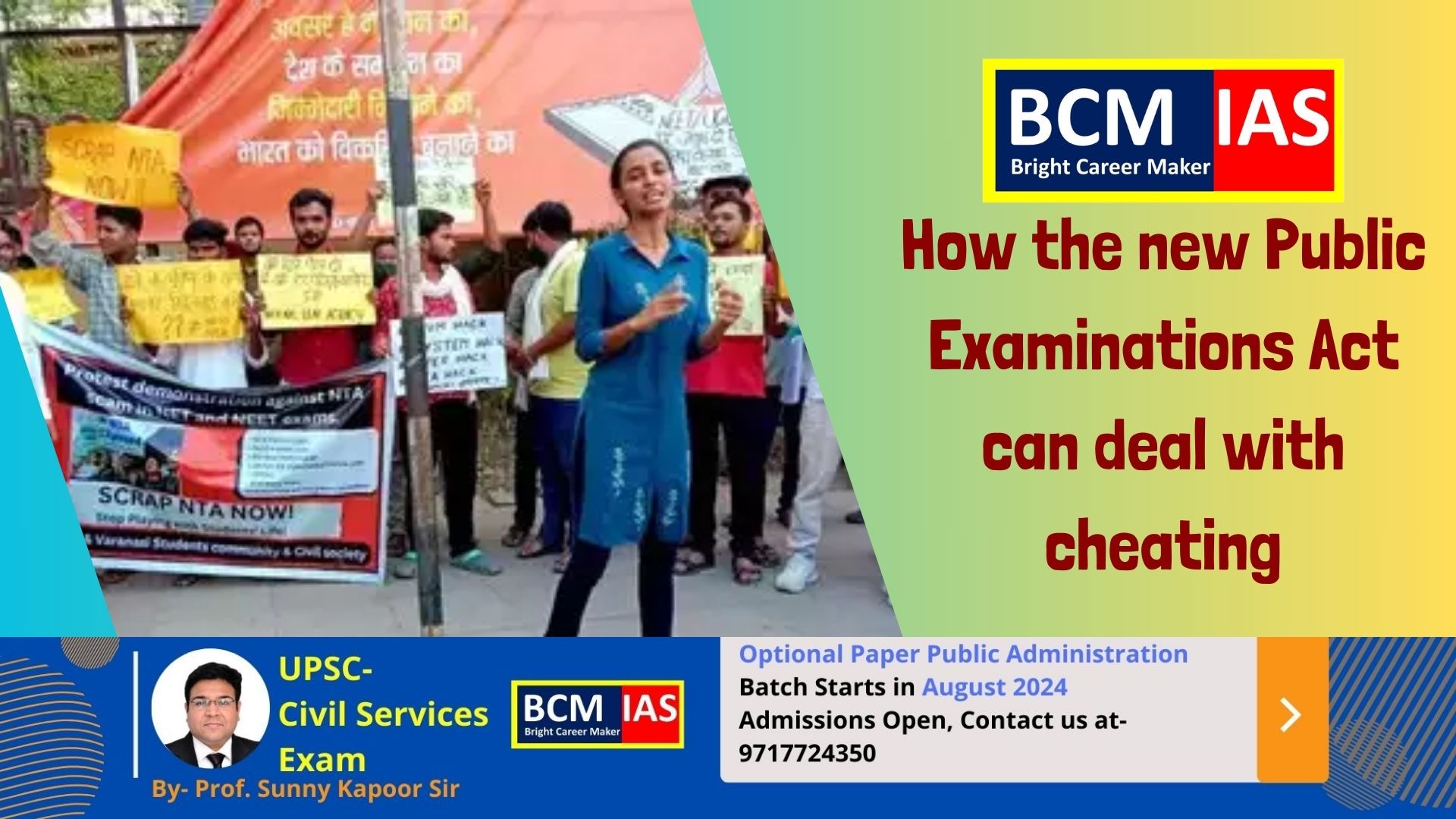
How the new Public Examinations
Act can deal with cheating
Analysis-
·
The newly notified Rules under The Public Examinations
(Prevention of Unfair Means) Act, 2024 aim to address the pervasive issue of
cheating in public examinations in India.
·
This
legislation, passed by Parliament in February and operational since June 21,
2024, seeks to establish a robust framework to prevent unfair practices,
enhance transparency, and uphold the integrity of public examinations.
·
With recent
controversies and exam cancellations, this Act has become crucial in reassuring
stakeholders about the fairness of examination processes.
Key Provisions of the Act
1. Computer-Based Tests (CBT):
- Parameters
and Procedures:
The Rules detail the complete lifecycle of Computer Based Tests, including
candidate registration, centre allocation, admit card issuance, question
paper handling, answer evaluation, and result recommendations.
- Security
Measures:
Specific protocols are established for downloading, distributing, and
securing question papers digitally, ensuring they reach only authorized
candidates.
2. Centre Coordinator:
- Role
and Appointment:
A Centre Coordinator, who can be a serving or retired government employee,
will represent the examination authority at each centre. This role is
critical in coordinating activities and ensuring compliance with the
prescribed norms, standards, and guidelines.
3. Service Providers:
- Definition
and Responsibilities: The Act defines "service providers" involved in the
examination process and delineates their responsibilities. This includes
ensuring infrastructure and procedural adherence, and reporting incidents
of unfair means.
Definition of Public Examinations and
Candidates
1. Covered Examinations:
- The
Act applies to exams conducted by designated authorities such as UPSC,
SSC, RRBs, IBPS, and NTA. Additionally, other government ministries and
departments conducting recruitment exams fall under its purview.
2. Candidate Definition:
- A
candidate is anyone permitted to take a public examination, including
those authorized as scribes.
Unfair Means and Penalties
1. Unfair Practices:
- The
Act lists 15 specific actions considered unfair, including question paper
leaks, unauthorized possession of exam materials, tampering with answer
sheets, and providing unauthorized solutions during exams.
2. Reporting and Action:
- A
detailed reporting framework is provided, including the use of designated
forms for venue in-charges to report incidents. The Centre Coordinator and
Regional Officer are tasked with further investigation and, if necessary,
initiating legal action.
Rationale and Impact
1. Addressing Cheating Incidents:
- The
Act is a response to numerous instances of exam malpractices, including
paper leaks, which have disrupted recruitment processes and affected
millions of candidates.
2. Legal Framework:
- Previously,
there was no specific law addressing exam cheating comprehensively. This
Act fills that gap by providing stringent measures, including fines up to
Rs 1 crore and imprisonment up to 10 years.
3. Enhancing Credibility:
- By
establishing clear guidelines and strict penalties, the Act aims to
restore confidence in the examination system, ensuring that sincere
efforts by candidates are justly rewarded.
Conclusion
The Public Examinations (Prevention of Unfair Means) Act,
2024, along with its operational Rules, represents a significant step towards
curbing cheating in public examinations. By introducing stringent measures,
detailed protocols, and severe penalties, the Act aims to bring transparency
and fairness to the examination process.
This legislation not only addresses the immediate concerns of
exam malpractices but also sets a precedent for maintaining the integrity of
public examinations in the future.
As the government implements these measures, it is expected
that the credibility and reliability of public examinations will be
significantly enhanced, benefiting millions of candidates and ensuring a fair
selection process.
Mains Qn for Practice
Q: How does The Public Examinations (Prevention
of Unfair Means) Act, 2024 aim to prevent cheating in public examinations, and
what impact is it expected to have on the integrity of these examinations?
Answer
Introduction:
Cheating in public examinations has been a persistent issue,
undermining the credibility of the selection process for various prestigious
positions. The Public Examinations (Prevention of Unfair Means) Act, 2024,
along with its recently notified Rules, seeks to address this problem
comprehensively. This legislation aims to prevent the use of unfair means in
public examinations, ensure transparency, and uphold the integrity of the
examination process.
Body:
Key Provisions of the Act:
1.
Computer-Based Tests (CBT):
o The Act lays
down detailed parameters for CBTs, covering the entire examination process from
candidate registration to result declaration.
o Security
measures include protocols for the secure handling and distribution of question
papers digitally, ensuring only authorized access.
2.
Centre Coordinator:
o The Rules
mandate the appointment of a Centre Coordinator, a government or public sector
employee, to oversee examination activities at each center.
o The Coordinator
ensures compliance with norms and coordinates between service providers and
examination authorities.
3.
Service Providers:
o Defined as
entities involved in conducting exams, their responsibilities include
maintaining infrastructure standards and adhering to procedural guidelines.
o They are also
responsible for reporting incidents of unfair means.
Definition and Scope:
1.
Public Examinations:
o The Act applies
to examinations conducted by major public examination authorities such as UPSC,
SSC, RRBs, IBPS, and NTA.
o It also covers
exams conducted by various ministries and departments of the central
government.
2.
Candidates:
o Defined as
individuals permitted to appear for public exams, including those authorized to
act as scribes.
Unfair Means and Penalties:
1.
Unfair Practices:
o The Act
identifies 15 actions as unfair means, including question paper leaks, unauthorized
possession of exam materials, and tampering with answer sheets.
o Providing
unauthorized solutions during exams and tampering with candidate documents are
also considered unfair practices.
2.
Reporting and Legal Action:
o A structured
reporting system involves venue in-charges, Centre Coordinators, and Regional
Officers. Incidents are reported in designated forms, and if necessary, legal
action is initiated.
o Severe penalties
include fines up to Rs 1 crore and imprisonment up to 10 years.
Rationale and Expected Impact:
1.
Addressing Malpractices:
o The Act responds
to numerous cases of exam malpractices that have disrupted recruitment
processes and affected millions of candidates.
o It provides a
much-needed legal framework to address these issues comprehensively.
2.
Enhancing Examination Credibility:
o By establishing
clear guidelines and strict penalties, the Act aims to restore confidence in
the examination system.
o It ensures that
sincere and genuine efforts by candidates are fairly rewarded, enhancing the
integrity of the selection process.
3.
Future Implications:
o The Act serves
as a model for state governments to adopt similar measures.
o It is expected
to significantly reduce incidents of cheating, ensuring a fair and transparent
examination process.
Conclusion:
The Public Examinations (Prevention of Unfair Means) Act,
2024, represents a significant step towards eliminating cheating in public
examinations. Its comprehensive provisions, stringent penalties, and clear
guidelines are designed to enhance the credibility and fairness of the
examination process. By ensuring transparency and accountability, the Act aims
to protect the interests of genuine candidates and maintain the integrity of
public examinations. As the government implements these measures, it is expected
that the reliability and trust in public examinations will be greatly enhanced,
benefiting the overall recruitment and selection process.
MCQs for Prelims Practice
1. The Public Examinations (Prevention of Unfair Means) Act,
2024 was notified to come into force on which date?
a) June 15, 2024
b) June 21, 2024
c) June 24, 2024
d) February 1, 2024
Answer: b) June 21, 2024
2. Who is responsible for overseeing the compliance of norms,
standards, and guidelines at examination centers as per the Act?
a) Centre Coordinator
b) Venue In-charge
c) Regional Officer
d) Examination Authority
Answer: a) Centre Coordinator
3. What is the maximum fine that can be imposed under The
Public Examinations (Prevention of Unfair Means) Act, 2024?
a) Rs 50 lakh
b) Rs 75 lakh
c) Rs 1 crore
d) Rs 1.5 crore
Answer: c) Rs 1 crore
4. Which of the following is NOT considered an unfair means
under the Act?
a) Leakage of question paper
b) Tampering with answer sheets
c) Authorized access to question paper
d) Providing unauthorized solutions during exams
Answer: c) Authorized access to question paper
5. The Act applies to examinations conducted by which of the
following authorities?
a) Union Public Service Commission (UPSC)
b) Staff Selection Commission (SSC)
c) Railway Recruitment Boards (RRBs)
d) All of the above
Answer: d) All of the above
6. What is the role of the venue in-charge as per the Rules
notified under the Act?
a) To prepare and report incidents of unfair means
b) To appoint service providers
c) To evaluate answer sheets
d) To issue admit cards
Answer: a) To prepare and report incidents of unfair means
7. Which section of The Public Examinations (Prevention of
Unfair Means) Act, 2024 defines “public examination”?
a) Section 1(a)
b) Section 2(k)
c) Section 3(d)
d) Section 4(b)
Answer: b) Section 2(k)
8. Which of the following actions is listed as an unfair
means for “monetary or wrongful gain” under the Act?
a) Providing authorized solutions
b) Accessing question papers with authority
c) Tampering with any document necessary for short-listing of candidates
d) Issuance of genuine admit cards
Answer: c) Tampering with any document necessary for short-listing of candidates
9. The Act provides for how many years of imprisonment for
those found guilty of using unfair means?
a) Up to 5 years
b) Up to 7 years
c) Up to 10 years
d) Up to 12 years
Answer: c) Up to 10 years
10. Which body is responsible for preparing the norms,
standards, and guidelines for Computer Based Tests (CBTs) as per the Act?
a) Ministry of Personnel, Public Grievances and Pensions
b) National Recruitment Agency
c) Union Public Service Commission
d) Staff Selection Commission
Answer: b) National Recruitment Agency


Comments on “How the new Public Examinations Act can deal with cheating”