


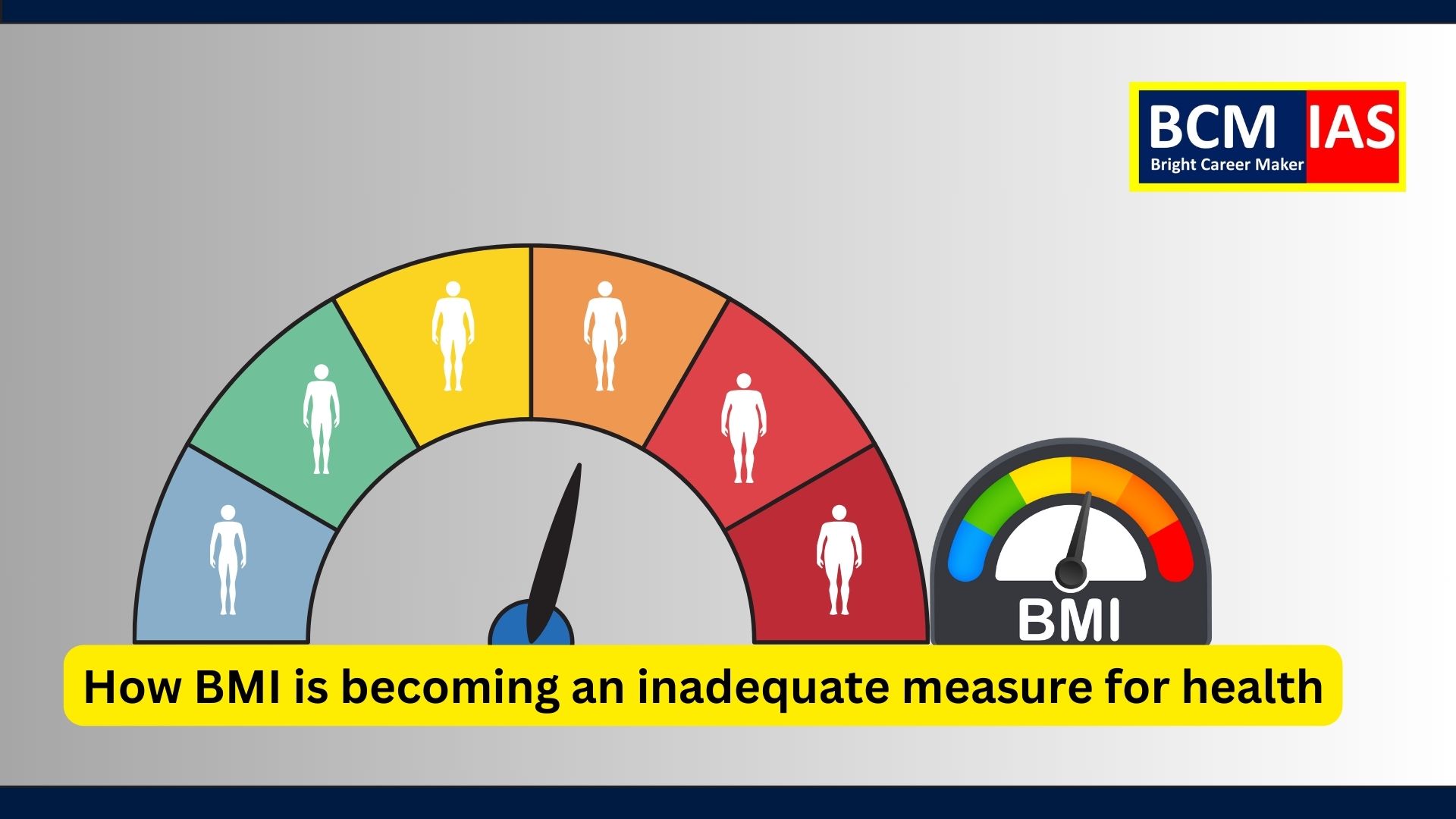
How BMI is becoming an
inadequate measure for health
·
The article explores the limitations of the Body
Mass Index (BMI) as a measure of health and introduces alternative metrics,
such as the Body Roundness Index (BRI) and waist-to-height ratios, that
may provide more accurate indicators of health risks. Here's a detailed
analysis and explanation of the key points:
Limitations
of BMI as a Health Indicator:
1. Inability
to Differentiate Between Fat and Muscle:
o BMI is
calculated as weight (in kilograms) divided by height (in meters) squared. It
classifies individuals into categories such as underweight, normal weight,
overweight, or obese based on their BMI score.
o One major
limitation of BMI is that it does not distinguish between different types of
body weight. For instance, an athletic person with high muscle mass may have a
high BMI, but that does not indicate excessive body fat or poor health. Muscle
is denser than fat, meaning a muscular individual can appear
"overweight" or "obese" by BMI standards, even if their
body fat is low.
2. Fat
Distribution Matters:
o BMI fails to
account for fat distribution, which is crucial in determining health
risks. The location of fat in the body, especially visceral fat around the
abdomen, has a significant impact on health. Studies show that abdominal fat,
or visceral adipose tissue, is associated with a higher risk of metabolic
disorders such as type 2 diabetes, cardiovascular diseases, and hypertension.
o People can have
normal BMIs but carry excess fat around their abdomen, a condition often
referred to as "skinny fat." This means that even individuals who
appear thin might be at risk of serious health problems if their fat is stored
in harmful areas.
3. Ethnic
Differences in Fat Composition:
o BMI was
developed based on data from 19th-century Europeans, which means it may not
accurately reflect the health risks for individuals from other ethnic groups.
For example, Indians tend to have a higher percentage of body fat compared to
Caucasians at the same BMI, making them more prone to metabolic issues like
insulin resistance and diabetes.
o Recognizing
these differences, experts have suggested that the BMI threshold for Asians
should be lower. In 2002, it was proposed that a BMI of 23 should be the
"action point" for Asian populations, as opposed to 25 for others.
This adjustment, however, still doesn't fully address the issue of fat
distribution.
4. Children
and Thin Individuals Are Also at Risk:
o BMI gives the
impression that only overweight or obese individuals are at risk of chronic
diseases, but this is not true. Even thin individuals or children can develop
metabolic issues like high blood glucose levels, elevated blood pressure, and
high cholesterol. This underscores the need for a more comprehensive health
assessment that goes beyond BMI.
Introduction
of the Body Roundness Index (BRI):
1. What
is BRI?
o Developed by
U.S. mathematician Diana Thomas, the Body Roundness Index (BRI) provides
an alternative to BMI by measuring how "round" a person is. Unlike
BMI, BRI takes into account both height and waist circumference, which
gives a better indication of body fat levels and its distribution.
o The BRI score
ranges from 1 to 15, with values above 6.9 or below 3.41 considered high-risk
for health conditions. The more round a person is, the more visceral fat they
likely have, which increases their risk of diseases like diabetes and
cardiovascular problems.
2. Advantages
of BRI Over BMI:
o Fat
Distribution: BRI
offers insight into where fat is stored, particularly around the abdomen. This
is crucial because abdominal fat is more strongly linked to health risks than
fat in other areas.
o Percent Body
Fat: BRI calculates
an individual's body fat percentage, providing a more precise measure of their
health status than BMI, which only accounts for overall weight.
o Green Zone
Concept: BRI
includes a "green zone" that represents the optimal body fat
percentage for good health. Individuals who fall outside of this zone are
considered at higher risk for metabolic diseases.
3. Higher
Predictive Power:
o Several studies
have shown that BRI may be a better predictor of health risks than BMI. For
example, a 2021 study conducted by researchers at JIPMER in Puducherry found
that BRI had a significantly higher predictive capacity for identifying
metabolic syndrome (MetS) than BMI.
o Another large
cohort study of over 32,000 U.S. adults found that both the lowest and highest
BRI groups had a significantly higher risk of all-cause mortality,
suggesting that BRI may be a promising new tool for predicting health outcomes.
Other
Alternatives to BMI:
1. Waist-Height
Ratio:
o A simple but
effective alternative to BMI is the waist-to-height ratio. It suggests
that if a person's waist circumference is less than half of their height, they
are likely to be in good health. This method is intuitive and easy to
calculate, making it accessible for people to monitor their own health.
o Waist-to-height
ratio directly addresses the issue of visceral fat, which BMI ignores, and has
been found to correlate more closely with risks of metabolic diseases.
2. Limitations
of BRI and Other Metrics:
o While BRI and
waist-height ratios offer more insight into health risks than BMI, they are not
without limitations. For instance, measuring waist circumference can be subject
to human error, which could lead to inaccurate assessments. Research has
shown that even trained professionals can make mistakes when measuring waist
circumference, which could undermine the reliability of BRI.
o Additionally,
BRI is a relatively new metric and does not yet have the extensive data backing
that BMI does, making it more difficult for healthcare providers to universally
adopt it as a standard measure.
Conclusion:
While BMI remains a widely used tool for assessing health, it
is increasingly clear that it has significant limitations, particularly
regarding body fat distribution and its applicability across different ethnic
groups. BMI's inability to differentiate between fat, muscle, and water, along
with its failure to account for where fat is stored, can lead to misleading
conclusions about an individual's health.
Newer metrics like the Body Roundness Index (BRI) and
waist-height ratio provide a more nuanced approach by accounting for fat
distribution and body shape, which are better indicators of metabolic health
and disease risk. However, like any metric, these alternatives are not perfect
and are still subject to practical challenges like measurement errors. As
research continues, it is likely that a combination of indices, rather than
reliance on a single measure like BMI, will become the future of health assessments.
For now, individuals can use simple tools like the waist-to-height ratio to
better understand their health and make informed decisions about their
lifestyle.
MCQs for Practice
1. What is the major limitation of the Body Mass Index (BMI)
as a measure of health?
a) It overestimates the health risks of thin individuals
b) It fails to account for body fat distribution and muscle mass
c) It is applicable only to children
d) It is only relevant for people over the age of 50
Answer: b) It fails to account for body fat distribution and muscle mass
2. How is the Body Roundness Index (BRI) different from the
Body Mass Index (BMI)?
a) BRI measures body fat distribution, considering waist
circumference
b) BRI is only used to measure muscle mass
c) BRI disregards height and focuses only on weight
d) BRI measures bone density instead of fat
Answer: a) BRI measures body fat distribution, considering waist circumference
3. Which health condition is most strongly associated with
high levels of visceral fat, often missed by BMI calculations?
a) Tuberculosis
b) Cardiovascular diseases and diabetes
c) Osteoporosis
d) Skin diseases
Answer: b) Cardiovascular diseases and diabetes
4. Why is BMI considered less accurate for Asian populations
compared to other ethnic groups?
a) Asian populations have lower bone density
b) Asians tend to have a higher percentage of body fat at the same BMI compared
to others
c) BMI was designed for children, not adults
d) BMI does not apply to non-European populations
Answer: b) Asians tend to have a higher percentage of body fat at the same BMI
compared to others
5. Which of the following is an alternative method for
assessing health risks that focuses on the ratio of waist circumference to
height?
a) Body Density Index (BDI)
b) Waist-to-Height Ratio
c) Body Muscle Index
d) Height-to-Age Ratio
Answer: b) Waist-to-Height Ratio


Comments on “How BMI is becoming an inadequate measure for health”