


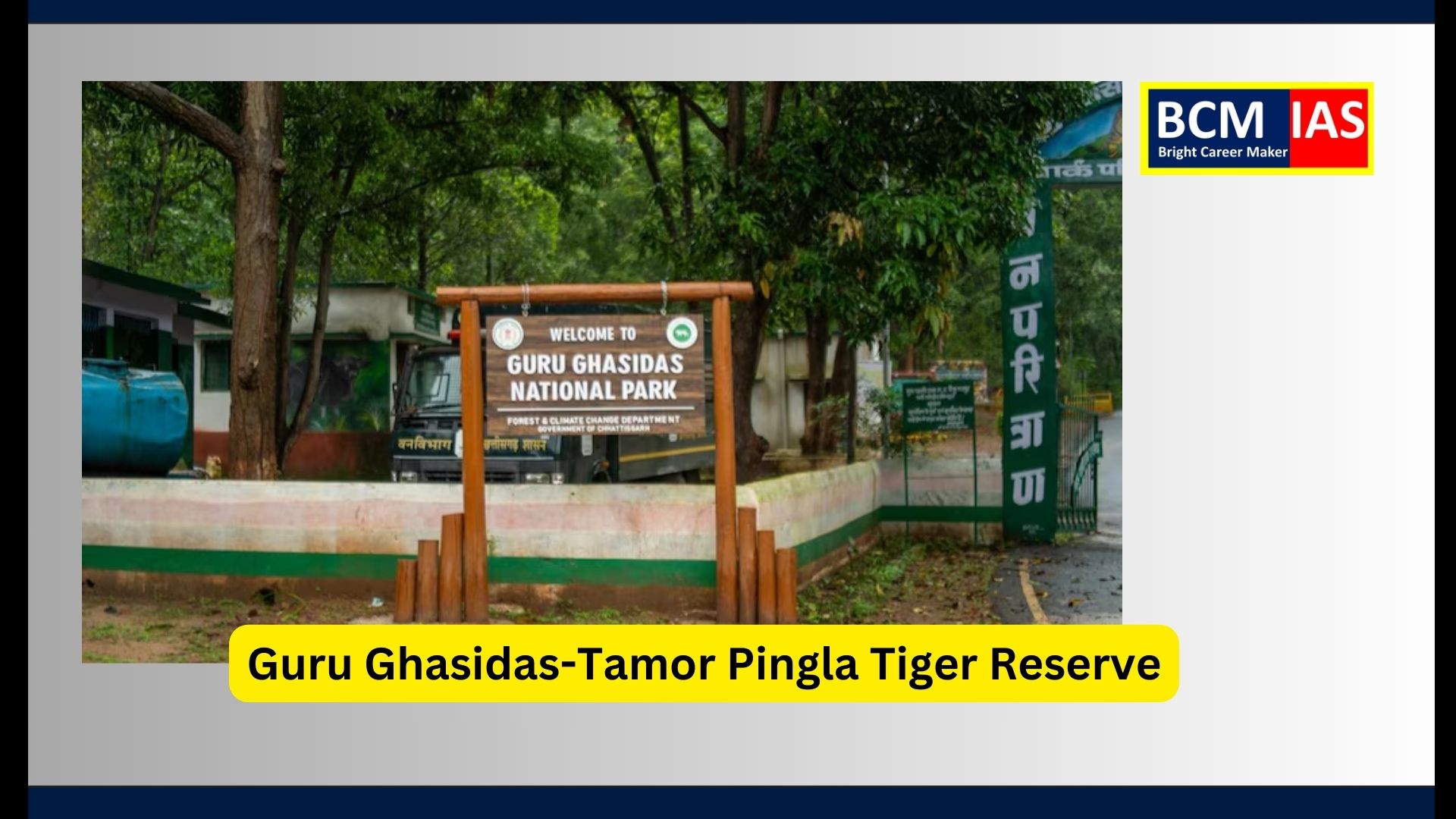
Guru Ghasidas-Tamor Pingla Tiger
Reserve
1. Why in News?
- Recent Notification: Guru
Ghasidas-Tamor Pingla Tiger Reserve (GGTP) in Chhattisgarh has been
declared as India's 56th tiger reserve.
- Significance: It highlights India's
commitment to tiger conservation and ecological balance.
2. Key Features of GGTP Tiger
Reserve
- Location and Size:
- Located in the Chota Nagpur Plateau and
partly in the Baghelkhand Plateau.
- Comprises a core area of 2,049.2 sq. km
(Guru Ghasidas National Park and Tamor Pingla Wildlife Sanctuary) and a buffer
zone of 780.15 sq. km.
- Third-largest tiger reserve in India after Nagarjunasagar-Srisailam
and Manas.
- Biodiversity:
- Species Richness:
Documented by the Zoological Survey of India with 753 species,
including 365 invertebrates and 388 vertebrates.
- Landscape Approach:
- Promotes ecological connectivity with nearby
tiger reserves like:
- Sanjay Dubri (Madhya Pradesh)
- Bandhavgarh (Madhya Pradesh)
- Palamau (Jharkhand).
- Aligns with the National Wildlife Plan
(2017-2031) to enhance habitat preservation and sustainable
biodiversity conservation.
3. Notification of Tiger Reserves
- Legal Framework:
- Governed by the Wildlife (Protection) Act,
1972.
- Amended by the Wildlife (Protection)
Amendment Act, 2022.
- Notified by State Governments on the
recommendation of the National Tiger Conservation Authority (NTCA).
4. Comparison with Existing Tiger
Reserves in Chhattisgarh
- Before GGTP's notification, Chhattisgarh had
three tiger reserves:
- Indravati Tiger Reserve in
Bijapur district.
- Udanti-Sitanadi Tiger Reserve in
Gariaband district.
- Achanakmar Tiger Reserve in
Mungeli district.
5. Significance
- Ecological: Strengthens India's tiger
conservation network by improving connectivity between reserves and
preserving unique biodiversity.
- Strategic: Highlights India's adherence
to conservation frameworks like the National Wildlife Plan.
6. Related UPSC Previous Year
Questions
- Q1 (2012): Bandipur, Manas, and
Sundarbans are declared tiger reserves, while Bhitarkanika is not.
- Correct Answer: (b) 1, 3, and 4
only.
- Q2 (2017): Sathyamangalam Tiger Reserve
serves as an essential ecological link between the Eastern and Western
Ghats.
- Correct Answer: (a) Sathyamangalam
Tiger Reserve.
Mains Question and Answer
Question:
Discuss the significance of the Guru
Ghasidas-Tamor Pingla Tiger Reserve in strengthening India’s biodiversity
conservation efforts. How does the landscape approach adopted in this tiger
reserve contribute to ecological connectivity and sustainable conservation?
Answer:
Introduction
The Guru Ghasidas-Tamor Pingla
Tiger Reserve (GGTP), recently notified as India’s 56th tiger reserve, is a
significant addition to the country’s biodiversity conservation initiatives.
Located in Chhattisgarh, it showcases a rich ecosystem and adopts the
innovative landscape approach to enhance habitat preservation and ecological
connectivity.
Significance of GGTP Tiger Reserve
1. Ecological
Importance:
o Biodiversity
Hotspot: GGTP houses 753 species, including 365 invertebrates
and 388 vertebrates, contributing to India’s rich biodiversity.
o Critical
Habitat: It ensures the survival of endangered species, including
tigers, by providing a contiguous core and buffer habitat spanning 2,829.35
sq. km.
2. Strategic
Connectivity:
o Acts as a
link between neighboring reserves such as Sanjay Dubri (MP), Bandhavgarh
(MP), and Palamau (Jharkhand).
o Promotes
the genetic flow of wildlife, essential for species survival and adaptation.
3. Conservation
Goals:
o Aligns with
India’s National Wildlife Plan (2017-2031), emphasizing a landscape
approach to strengthen tiger populations and protect forest ecosystems.
Landscape Approach for Ecological
Connectivity
1. Interconnected
Habitats:
o Establishes
ecological corridors between reserves to mitigate habitat fragmentation.
o Reduces
human-animal conflict by ensuring alternative pathways for wildlife movement.
2. Promotes
Sustainability:
o Integrates
conservation efforts with sustainable development, ensuring minimal disruption
to local communities.
o Facilitates
adaptive management strategies based on changing ecological dynamics.
3. Climate
Resilience:
o Helps
ecosystems adapt to climate change by preserving diverse landscapes and
supporting carbon sequestration.
Challenges
- Human-Wildlife Conflict:
Increased wildlife movement in interconnected habitats could heighten
conflicts.
- Resource Constraints:
Requires substantial funding and technical expertise for effective
management.
- Community Involvement:
Balancing conservation goals with the livelihoods of local communities is
critical.
Way Forward
- Strengthen local community participation
through eco-tourism and alternative livelihoods.
- Enhance funding mechanisms for tiger
reserve management under NTCA and state initiatives.
- Promote research and monitoring of wildlife
corridors to assess their effectiveness in conservation.
Conclusion
The Guru Ghasidas-Tamor Pingla
Tiger Reserve exemplifies India’s commitment to sustainable biodiversity
conservation. By adopting the landscape approach, it not only strengthens
ecological connectivity but also aligns conservation efforts with broader
environmental and developmental goals, setting a benchmark for other protected
areas.
MCQs for Practice
1. Consider the following
statements regarding the Guru Ghasidas-Tamor Pingla Tiger Reserve (GGTP):
1. It is
located in the Western Ghats.
2. It has been
notified as the 56th tiger reserve of India.
3. The reserve
promotes ecological connectivity with Sanjay Dubri and Bandhavgarh Tiger
Reserves.
Which of the statements given above
is/are correct?
(a) 1 and 2 only
(b) 2 and 3 only
(c) 1 and 3 only
(d) 1, 2, and 3
Answer: (b) 2 and 3 only
2. Which of the following is NOT
true about the Guru Ghasidas-Tamor Pingla Tiger Reserve?
(a) It is situated in the Chota
Nagpur Plateau.
(b) It has a core habitat spanning over 2,000 sq. km.
(c) It is the largest tiger reserve in India.
(d) It aligns with the National Wildlife Plan (2017-2031).
Answer: (c) It is the largest tiger
reserve in India.
3. Which of the following tiger
reserves are ecologically connected to the Guru Ghasidas-Tamor Pingla Tiger
Reserve?
1. Bandhavgarh
2. Kanha
3. Sanjay
Dubri
4. Palamau
Select the correct answer using the
code given below:
(a) 1, 2, and 3 only
(b) 1, 3, and 4 only
(c) 2, 3, and 4 only
(d) 1, 2, 3, and 4
Answer: (b) 1, 3, and 4 only
4. Under which of the following
Acts can Tiger Reserves in India be notified?
(a) Environment (Protection) Act,
1986
(b) Wildlife (Protection) Act, 1972
(c) Forest Conservation Act, 1980
(d) Biological Diversity Act, 2002
Answer: (b) Wildlife (Protection)
Act, 1972
5. With reference to India’s tiger
reserves, consider the following pairs:
|
Tiger Reserve |
State |
|
1. Sathyamangalam |
Tamil Nadu |
|
2. Indravati |
Maharashtra |
|
3. Nagarjunasagar-Srisailam |
Andhra Pradesh |
|
4. Bandhavgarh |
Madhya Pradesh |
Which of the pairs given above are
correctly matched?
(a) 1, 2, and 3 only
(b) 1, 3, and 4 only
(c) 2 and 3 only
(d) 1 and 4 only
Answer: (b) 1, 3, and 4 only


Comments on “Guru Ghasidas-Tamor Pingla Tiger Reserve”