


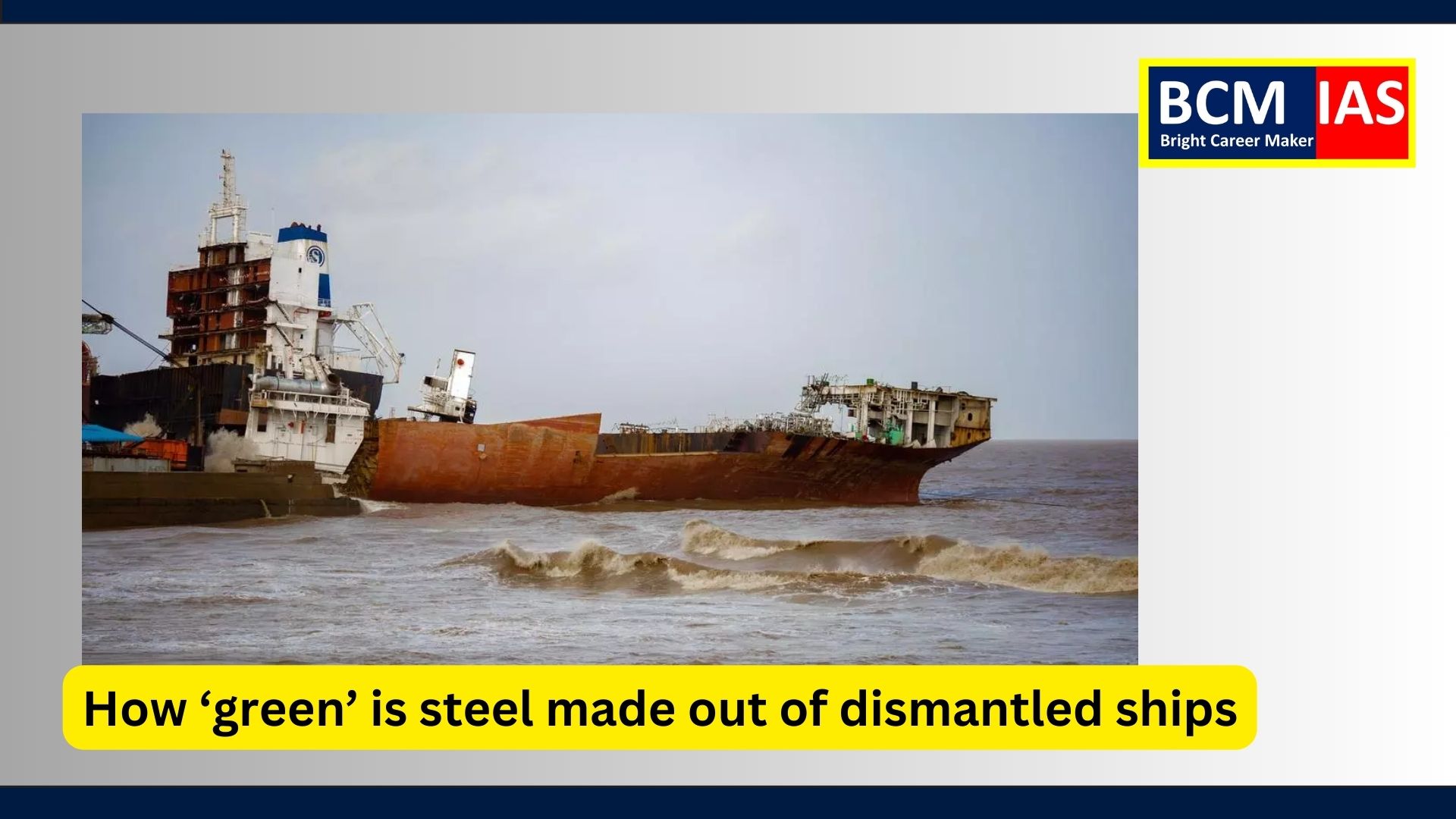
How ‘green’
is steel made out of dismantled ships?
Green Steel from
Dismantled Ships
Core Topic:
The article examines the
proposition of using ferrous scrap from dismantled ships to produce "green
steel" through electric arc furnaces. While the idea aligns with the
global push to reduce carbon emissions, it raises critical questions about
environmental sustainability, worker safety, and the ethics of ship recycling
practices in South Asia. The focus is on whether such steel can truly be
considered "green," given the associated environmental and social
costs.
Key Points of the Analysis
1. Green Steelmaking and
Ship Recycling
- What is Green Steel?:
- Green steel is produced using methods that
significantly reduce carbon emissions, such as electric arc furnaces
fueled by renewable energy.
- Incorporating ferrous scrap into the raw
material mix can cut CO₂ emissions by up to 75% compared to
traditional coal-fired furnaces.
- Role of Ship Recycling:
- Ships, once decommissioned, are dismantled to
extract steel, which serves as scrap for green steelmaking.
- South Asian countries like India (Alang),
Bangladesh (Chattogram), and Pakistan (Gadani) dominate the
ship recycling market.
2. Environmental and
Ethical Concerns
- Ship Recycling as a Polluting Industry:
- Ship recycling is among the most polluting
and hazardous sectors, often with poor regard for environmental and
labor safety.
- Beaching Method:
- Ships are dragged onto
environmentally-sensitive beaches and dismantled.
- This method releases toxic materials
into coastal ecosystems, causing irreversible damage.
- Contrasts with the more sustainable dry dock
method used in developed countries.
- Flag of Convenience (FOC):
- Major ship owners, especially from Europe, evade
accountability for pollution by registering ships under FOC in countries
like Panama, Cyprus, and Marshall Islands.
- These ships are then sold to brokers in South
Asia, bypassing stricter environmental and labor regulations.
- Human and Labor Rights Violations:
- Workers in South Asian yards often face poor
working conditions, inadequate safety protocols, and exposure to
hazardous materials like asbestos and heavy metals.
3. Regulatory Framework
and its Limitations
- Hong Kong Convention (HKC):
- Adopted in 2009 and ratified by India, the HKC
aims to ensure safer and environmentally sound ship recycling practices.
- Implementation Deadline:
Comes into effect in June 2025.
- Provisions:
- Mandates shipyards to prepare a dismantling
plan and list hazardous materials.
- Focuses on improving worker safety and
health but does not mandate a shift from beaching to dry docks.
- Limitations:
- Does not entirely prevent beaching.
- Falls short of ensuring true environmental
sustainability.
- European Convention (EC):
- More stringent regulations in Europe since 2018
have largely shifted the recycling burden to South Asia, where
enforcement is weaker.
4. Sustainability of
Green Steel through Ship Recycling
- Global North's Role:
- Western countries promote ship recycling in
South Asia as a source for green steel while evading their own environmental
responsibilities.
- The current system allows Western shipowners to
offload pollution costs onto developing nations.
- India’s Challenges:
- Alang and other South Asian yards are
ill-equipped to meet global environmental standards without significant
investment in dry dock infrastructure.
- Current Scenario:
- About 50% of yards in Alang comply with
HKC standards, but these do not ensure a fully sustainable process.
- Over-reliance on scrap from dismantled ships for
green steel undermines the broader goal of environmental sustainability.
5. Recommendations for
India
- Focus on Alternative Green Steel Methods:
- Transition to electric arc furnaces powered by
renewable energy.
- Invest in ferrous scrap from automobiles
or other domestic sources to reduce dependency on ship recycling.
- Modernize Ship Recycling Yards:
- Upgrade facilities to adopt dry dock methods,
reducing environmental impact.
- Enforce strict compliance with HKC standards and
beyond.
- Demand Accountability from Global North:
- Advocate for shipowners to dismantle ships in
certified yards directly, bypassing middlemen.
- Push for equitable international regulations
that prevent shifting environmental burdens to the Global South.
Conclusion
While ship recycling offers a
significant source of ferrous scrap for green steel production, its current
practices in South Asia raise serious environmental and ethical concerns. The
process disproportionately harms local ecosystems and labor forces, with the
Global North often shirking responsibility. For India, the path to truly
"green" steel lies in modernizing its recycling infrastructure,
adopting alternative methods, and demanding global accountability. Without
these changes, steel from dismantled ships cannot be genuinely considered
"green."
MCQs
1. What is the primary
environmental concern with the beaching method used for ship recycling in South
Asia?
A. It is more expensive than the
dry dock method.
B. It releases toxic materials into environmentally-sensitive coastal areas.
C. It requires high energy inputs and generates carbon emissions.
D. It damages ships beyond salvageable condition.
Answer: B. It
releases toxic materials into environmentally-sensitive coastal areas.
2. What does the term "Flag of
Convenience (FOC)" refer to in the context of ship recycling?
A. A certification for
environmentally friendly ships.
B. A system where ships are flagged in countries with lax environmental and
labor laws.
C. A global initiative to track decommissioned ships.
D. A method of financing ship recycling projects.
Answer: B. A
system where ships are flagged in countries with lax environmental and labor
laws.
3. What is the primary goal of the
Hong Kong Convention (HKC) for ship recycling?
A. To phase out the use of ferrous
scrap in steelmaking.
B. To completely ban ship recycling in environmentally-sensitive regions.
C. To ensure safer and environmentally sound practices in ship dismantling.
D. To shift all ship recycling activities to Europe.
Answer: C. To
ensure safer and environmentally sound practices in ship dismantling.
4. What proportion of shipyards in
Alang, Gujarat, is currently compliant with the Hong Kong Convention?
A. 25%
B. 50%
C. 75%
D. 100%
Answer: B. 50%
5. Why is the claim of "green
steel" from ship-recycled ferrous scrap criticized in the editorial?
A. It is too costly to produce.
B. The process does not align with global steelmaking standards.
C. Environmental and labor costs in ship recycling are ignored.
D. It produces less durable steel.
Answer: C.
Environmental and labor costs in ship recycling are ignored.


Comments on “Green Steel from Dismantled Ships”