


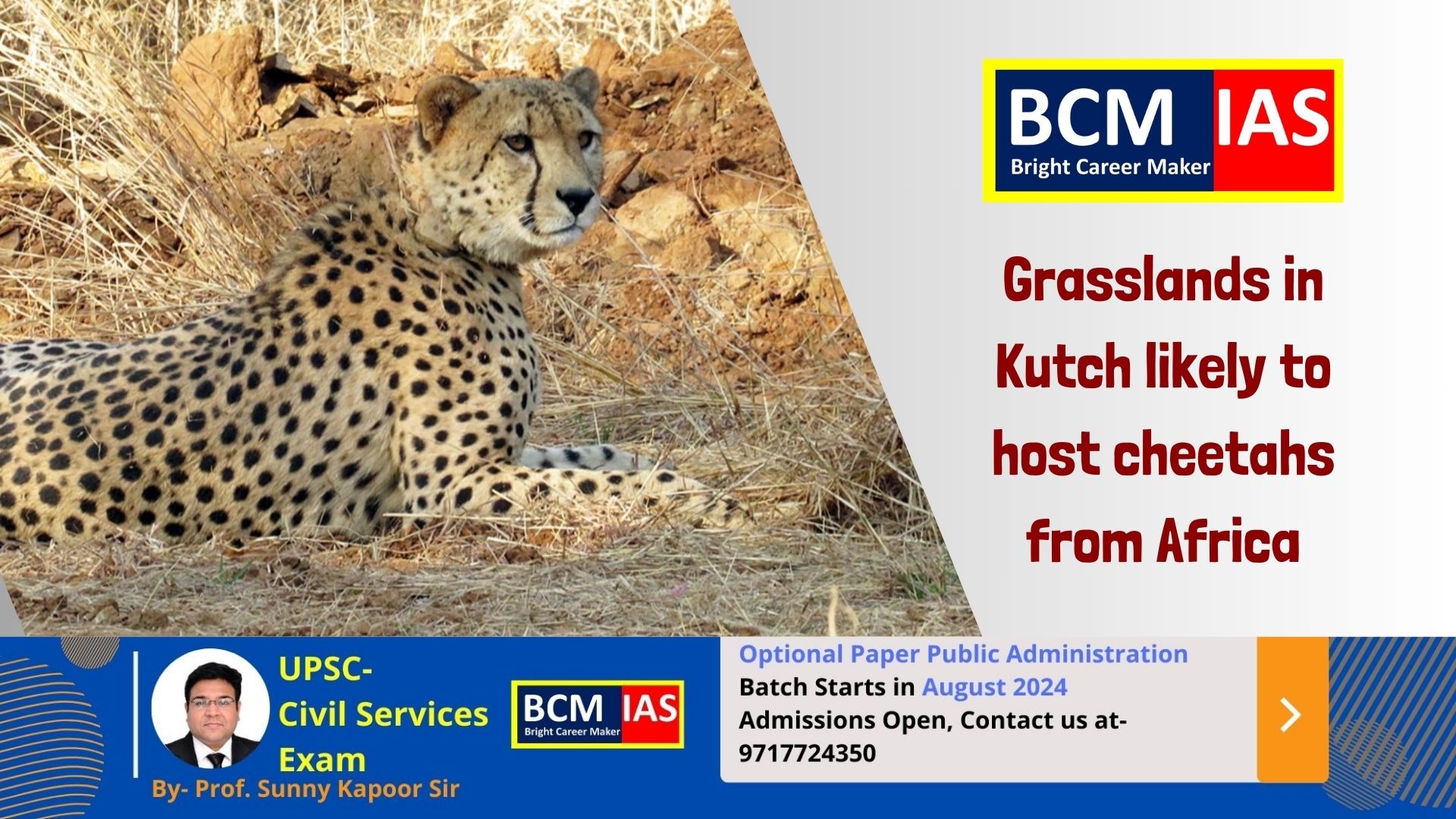
Grasslands in Kutch likely to host cheetahs from Africa
NEWS ANALYSIS
1.
Project Cheetah:
o As part of the
next phase of Project Cheetah, some of the cheetahs being brought from Africa
may be sent to a cheetah-breeding and conservation center in the grasslands of
Banni in the Rann of Kutch, Gujarat.
2.
Preferred Location and Alternatives:
o While the Gandhi
Sagar sanctuary in Madhya Pradesh is the preferred location for the next lot of
cheetahs, Banni is also being prepared as a potential habitat.
o Banni has been
considered a potential habitat for cheetahs for over a decade, and there is an
urgency to establish infrastructure to get it ready.
3.
Habitat and Prey:
o Banni is a vast
grassland covering nearly 3,500 square kilometers, providing ample space for
cheetahs.
o Antelope species
like chinkara and blackbuck, which are prey for cheetahs, are present in the
Banni landscape. However, there are not enough antelope to sustain a viable
cheetah population immediately.
4.
Long-Term Plans and Challenges:
o It will take
years to develop a sustainable cheetah population in Banni, requiring regular
introduction of fresh batches of cheetahs.
o An official
noted that there is no official plan yet, but the site is under consideration.
5.
Current Status of Cheetahs in India:
o Since September
2022, 20 cheetahs were brought to Kuno in Madhya Pradesh, with 13 surviving as
of the report, and 13 cubs making it 26 animals in total.
o The current
maximum capacity for Kuno is 21 adult cheetahs.
6.
Government's Import Plans:
o The Indian
government aims to import between 10 and 12 additional cheetahs annually.
o Preparations for
releasing these animals into the wild involve addressing infection and
acclimatization issues, which have led to fatalities in some cases.
Implications:
1.
Biodiversity and Conservation:
o Introducing
cheetahs to Banni could enhance biodiversity and support conservation efforts
in the region.
o The
establishment of a new habitat helps in spreading the cheetah population,
reducing the risk of disease and genetic bottlenecks.
2.
Habitat Restoration:
o Developing Banni
as a viable habitat for cheetahs will involve significant efforts in habitat
restoration and prey base augmentation.
o This could have
positive spillover effects on other species and the overall ecosystem health.
3.
Long-Term Planning and Monitoring:
o Successful
cheetah reintroduction requires long-term planning, scientific input, and
continuous monitoring to address challenges related to prey availability,
habitat suitability, and health management.
o Regular
scientific assessments and adaptive management strategies will be crucial for
the project's success.
4.
Community and Local Involvement:
o Involving local
communities in conservation efforts and ensuring they benefit from eco-tourism
and other activities can enhance support for the project.
o Education and
awareness programs will help in mitigating potential human-wildlife conflicts.
Conclusion:
The article highlights the potential for the grasslands of
Banni in the Rann of Kutch, Gujarat, to host cheetahs from Africa as part of
Project Cheetah. While Gandhi Sagar sanctuary in Madhya Pradesh remains the
preferred location, preparations are underway to establish Banni as a viable
habitat. The initiative is part of a broader effort to reintroduce cheetahs to
India, requiring significant habitat restoration, long-term planning, and
community involvement to ensure success.
UPSC Mains Question:
"Discuss the significance of Project
Cheetah in India's wildlife conservation efforts, with a focus on the potential
of Banni grasslands in Kutch to host African cheetahs. What challenges and
measures are involved in ensuring the success of this project?"
Answer:
Introduction
Project Cheetah is a pioneering initiative in India's
wildlife conservation efforts aimed at reintroducing the African cheetah to the
Indian subcontinent. This essay examines the significance of this project,
particularly focusing on the potential of Banni grasslands in Kutch to host
African cheetahs, and discusses the challenges and measures required to ensure
its success.
Significance of Project Cheetah
1.
Restoration of Ecological Balance:
o The
reintroduction of cheetahs can help restore the ecological balance by reviving
the predator-prey dynamics in Indian grasslands.
o Cheetahs play a
crucial role in controlling the population of herbivores, thus maintaining the
health of grassland ecosystems.
2.
Biodiversity Enhancement:
o Introducing
cheetahs enhances biodiversity and contributes to the conservation of grassland
habitats, which are often neglected in conservation priorities.
o It supports the
overall goal of preserving various species and their habitats.
3.
Conservation Awareness and Eco-Tourism:
o Project Cheetah
raises awareness about wildlife conservation and the importance of protecting
endangered species.
o Successful
reintroduction can boost eco-tourism, providing economic benefits to local
communities and funding for further conservation efforts.
Potential of Banni Grasslands in Kutch
1.
Vast and Suitable Habitat:
o Banni is a vast
grassland covering nearly 3,500 square kilometers, providing ample space for
cheetahs.
o The habitat is
conducive to cheetah survival, with open grasslands that mimic their natural
environment in Africa.
2.
Presence of Prey Species:
o The presence of
antelope species like chinkara and blackbuck, which are primary prey for
cheetahs, makes Banni a suitable habitat.
o However, there
is a need to augment the prey base to sustain a viable cheetah population.
3.
Long-Term Conservation Potential:
o Developing Banni
as a cheetah habitat can spread the population across different regions,
reducing risks related to disease and genetic diversity.
o It offers an
alternative site to Gandhi Sagar sanctuary, ensuring that the cheetah
population is not concentrated in a single location.
Challenges and Measures for Success
1.
Habitat and Prey Base Management:
o Challenge: Insufficient prey base and habitat
suitability are significant challenges for establishing a sustainable cheetah
population.
o Measures: Intensive habitat restoration and
prey augmentation programs, including breeding and release of prey species, are
necessary. Continuous monitoring and adaptive management strategies should be
implemented.
2.
Health and Acclimatization:
o Challenge: Health issues and acclimatization
problems can lead to fatalities among relocated cheetahs.
o Measures: Rigorous health screening,
quarantine protocols, and gradual acclimatization processes must be followed.
Veterinary support and emergency response systems should be in place.
3.
Community Involvement and Conflict Mitigation:
o Challenge: Potential human-wildlife conflicts
and lack of local community support can hinder conservation efforts.
o Measures: Engaging local communities through
awareness programs and involving them in conservation activities is crucial.
Developing eco-tourism and other livelihood opportunities can incentivize
community support. Conflict mitigation strategies, such as compensation schemes
and rapid response teams, should be established.
4.
Scientific Research and Monitoring:
o Challenge: Lack of continuous scientific
research and monitoring can impede adaptive management of the project.
o Measures: Establishing research and
monitoring frameworks to study cheetah behavior, health, and ecological impacts
is essential. Collaborations with academic and research institutions can
enhance the scientific basis for conservation strategies.
Conclusion
Project Cheetah represents a significant milestone in India's
wildlife conservation efforts, with the potential to restore ecological
balance, enhance biodiversity, and promote conservation awareness. The Banni
grasslands in Kutch offer a promising habitat for hosting African cheetahs,
complementing other sites like the Gandhi Sagar sanctuary. However, ensuring
the success of this project requires addressing challenges related to habitat
and prey management, health and acclimatization, community involvement, and
continuous scientific research. With comprehensive planning and collaborative
efforts, Project Cheetah can achieve its goal of reintroducing cheetahs to
India, contributing to global conservation endeavors.
MCQs for UPSC Prelims
1.
What is the primary goal of Project Cheetah in India?
o A) To develop
new agricultural techniques
o B) To
reintroduce the African cheetah to the Indian subcontinent
o C) To increase
the population of tigers in India
o D) To promote
urban development
Answer: B) To reintroduce the African cheetah to the Indian
subcontinent
2.
Which grassland in Gujarat is being prepared to host
African cheetahs as part of Project Cheetah?
o A) Sundarbans
o B) Deccan
Plateau
o C) Banni
Grasslands in the Rann of Kutch
o D) Nilgiri Hills
Answer: C) Banni Grasslands in the Rann of Kutch
3.
Why is the Banni grassland considered a suitable
habitat for cheetahs?
o A) It has dense
forests
o B) It covers
nearly 3,500 square kilometers of open grassland
o C) It is close
to urban areas
o D) It has a
large population of predators
Answer: B) It covers nearly 3,500 square kilometers of open
grassland
4.
What is one of the major challenges in developing
Banni as a habitat for cheetahs?
o A) Lack of
government funding
o B) Insufficient
prey base for the cheetahs
o C) Excessive
rainfall
o D) Presence of
too many other predators
Answer: B) Insufficient prey base for the cheetahs
5.
What role does the government foresee for local
communities in the success of Project Cheetah?
o A) Building
infrastructure
o B) Acting as
veterinarians
o C) Supporting
conservation through eco-tourism and awareness programs
o D) Relocating to
urban areas
Answer: C) Supporting conservation through eco-tourism and
awareness programs


Comments on “Grasslands in Kutch likely to host cheetahs from Africa”