


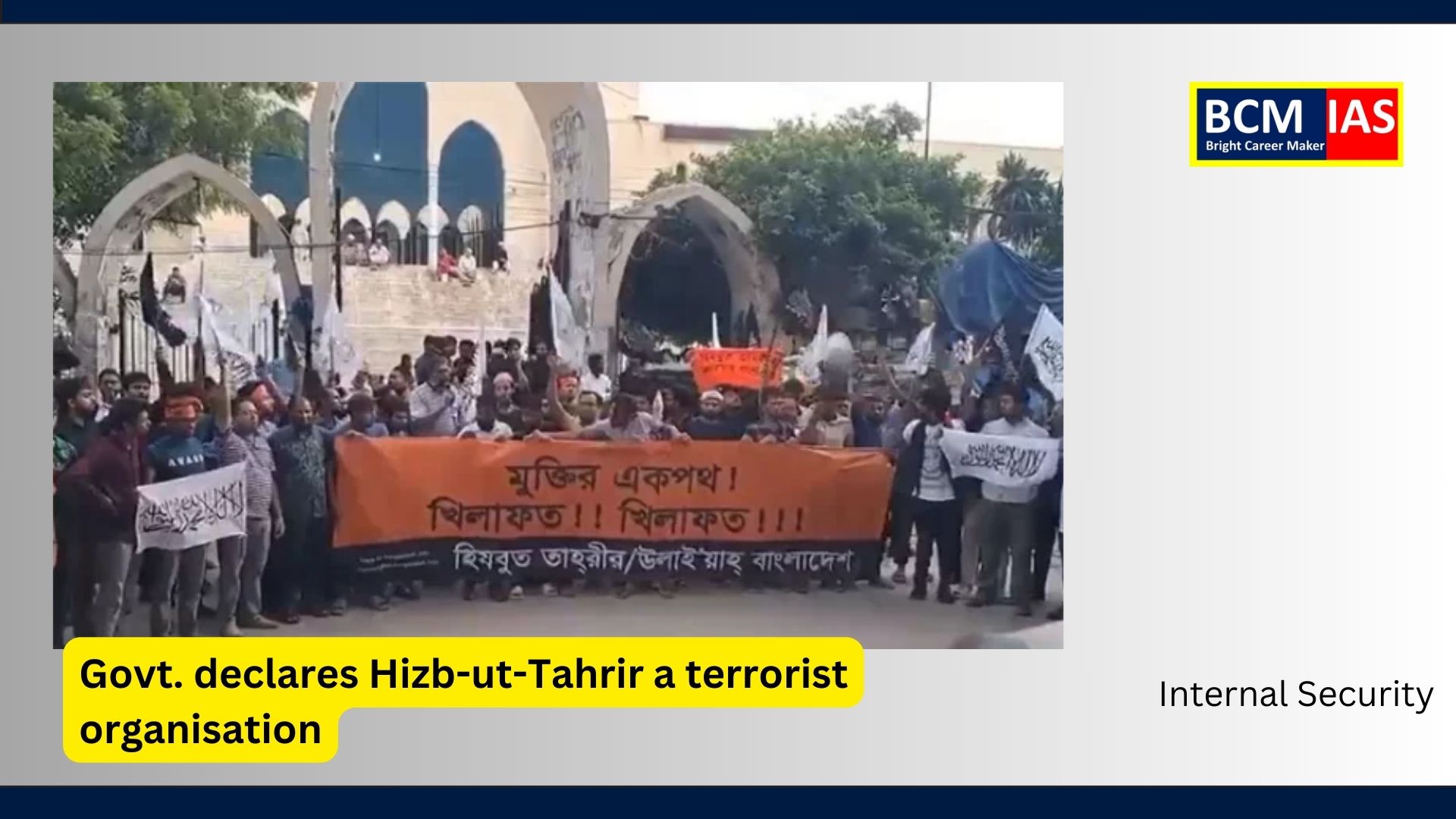
Govt. declares Hizb-ut-Tahrir a
terrorist organisation
The news reports that the Union Home Ministry of India
has declared Hizb-ut-Tahrir (HuT) as a terrorist organisation under the Unlawful
Activities (Prevention) Act (UAPA). This
move reflects the government's stance on addressing terrorist threats
and safeguarding national security.
Below is a detailed analysis and explanation of the
development, focusing on legal, security, and geopolitical aspects:
1.
What is Hizb-ut-Tahrir (HuT)?
- Hizb-ut-Tahrir (HuT) is a radical Islamist
organisation that seeks to establish a global Islamic State
(Caliphate) through jihad and overthrowing democratically
elected governments. Its ideological goal includes replacing nation-states
with a pan-Islamic caliphate.
- The
group has been known to engage in activities such as radicalisation of
youth, raising funds for terror activities, and promoting
extremism that poses a threat to national security and sovereignty
in countries like India, Bangladesh, and others.
2.
India’s Action Under UAPA:
- The
Indian government’s decision to declare HuT as a terrorist organisation
under the Unlawful Activities (Prevention) Act (UAPA) is a crucial
legal step. The UAPA is India’s primary anti-terror law aimed at curbing unlawful
and terrorist activities.
- By
designating HuT as a terrorist organisation, the government gains
the authority to take stringent actions against the group's members
and supporters, including:
- Arresting
and prosecuting individuals involved with the organisation.
- Seizing
funds or assets
linked to the group.
- Curbing
recruitment and propaganda efforts of the group.
- This
legal designation also sends a clear message about India’s zero-tolerance
policy toward terrorist activities.
3.
Role of HuT in Radicalisation:
- The
Home Ministry highlighted that HuT is involved in radicalising gullible
youths to join terrorist organisations, raising funds for terror
activities, and conducting activities aimed at destabilising national
security.
- Radicalisation
is a key concern in counter-terrorism efforts, as it involves influencing
individuals to adopt extreme views and partake in violent jihad. In
the case of HuT, their ability to recruit and radicalise individuals,
particularly vulnerable youth, is a major threat to internal
security.
4.
Geopolitical and Regional Security Threat:
- Hizb-ut-Tahrir is not limited to India but is
also active in Bangladesh and other South Asian countries. The
group’s cross-border activities can potentially increase regional
instability, especially in a politically and socially sensitive region
like South Asia.
- India’s
decision to declare HuT a terrorist organisation must be seen within the
broader context of addressing regional terrorism and cross-border
radicalisation. Collaborating with neighbouring countries like
Bangladesh in monitoring and countering the organisation’s influence will
be critical to ensuring the long-term security of the region.
5.
The Arrest of a HuT Member in Chennai:
- The National
Investigation Agency (NIA), which is India’s premier agency for
counter-terrorism investigations, arrested a suspected member of Hizb-ut-Tahrir
in Chennai. This arrest shows the active presence of HuT in
India and the ongoing efforts by law enforcement to dismantle its network.
- The
NIA's involvement indicates that the government is closely monitoring terror
cells and the movement of individuals connected to HuT, reinforcing
the need for heightened security measures.
6.
India’s Approach to Terrorism:
- The
Indian government’s approach, as reflected in this decision, aligns with
its policy of dealing with terrorism “with an iron fist.” This
phrase suggests a tough and uncompromising stance toward groups and
individuals who threaten the country’s security and democratic fabric.
- The Modi
government’s emphasis on national security includes taking decisive
action against terrorist organisations operating within and outside
India’s borders. The move to designate HuT as a terrorist organisation
also signals a broader strategy of strengthening India’s
counter-terrorism framework.
7.
Implications for India’s Internal and Regional Security:
- The
declaration of HuT as a terrorist organisation has several implications
for internal security:
- It
allows law enforcement agencies to proactively crack down on the
group’s members and disrupt its activities.
- It
acts as a deterrent to potential recruits and supporters of the
group by criminalizing involvement with HuT.
- The
arrest of HuT members in different parts of India may lead to further investigations
and uncovering sleeper cells or financial networks.
- Regionally,
it strengthens India’s position in counter-terrorism cooperation
with neighbouring countries like Bangladesh, which faces similar
threats from extremist organisations.
Conclusion:
India’s decision to declare Hizb-ut-Tahrir a terrorist
organisation under the Unlawful Activities (Prevention) Act reflects the
country’s commitment to combating terrorism and safeguarding its sovereignty.
The group’s activities of radicalising youth, promoting jihad, and
destabilising governments pose serious challenges to national security. By
taking this legal and proactive stance, India strengthens its counter-terrorism
efforts and reinforces its role as a key player in the global fight
against extremism. As regional cooperation deepens, it becomes crucial to
counter cross-border terrorism and ensure long-term peace and stability
in South Asia.
MCQs for Practice
1. Which act has the Indian government used to declare
Hizb-ut-Tahrir (HuT) a terrorist organisation?
- A)
Prevention of Money Laundering Act (PMLA)
- B)
Unlawful Activities (Prevention) Act (UAPA)
- C)
National Security Act (NSA)
- D)
Public Safety Act (PSA)
Answer: B) Unlawful Activities (Prevention) Act (UAPA)
2. What is the primary objective of Hizb-ut-Tahrir (HuT) as
mentioned in the news?
- A) To
establish a democratic government
- B) To
promote global trade and commerce
- C) To
establish an Islamic State and Caliphate globally, including in India
- D) To
advocate for environmental protection
Answer: C) To establish an Islamic State and Caliphate globally, including in
India
3. According to the Indian Home Ministry, what is one of the
main activities of Hizb-ut-Tahrir in India?
- A)
Promoting cultural exchanges
- B)
Radicalising youths and raising funds for terror activities
- C)
Supporting government welfare schemes
- D)
Organising educational workshops
Answer: B) Radicalising youths and raising funds for terror activities
4. In which other country, apart from India, is
Hizb-ut-Tahrir known to be active?
- A)
Sri Lanka
- B)
Nepal
- C)
Bangladesh
- D)
Bhutan
Answer: C) Bangladesh
5. Which Indian agency arrested an alleged member of
Hizb-ut-Tahrir in Chennai, as mentioned in the report?
- A)
Central Bureau of Investigation (CBI)
- B)
Intelligence Bureau (IB)
- C)
National Investigation Agency (NIA)
- D)
Directorate of Revenue Intelligence (DRI)
Answer: C) National Investigation Agency
(NIA)


Comments on “Govt. declares Hizb-ut-Tahrir a terrorist organisation”