


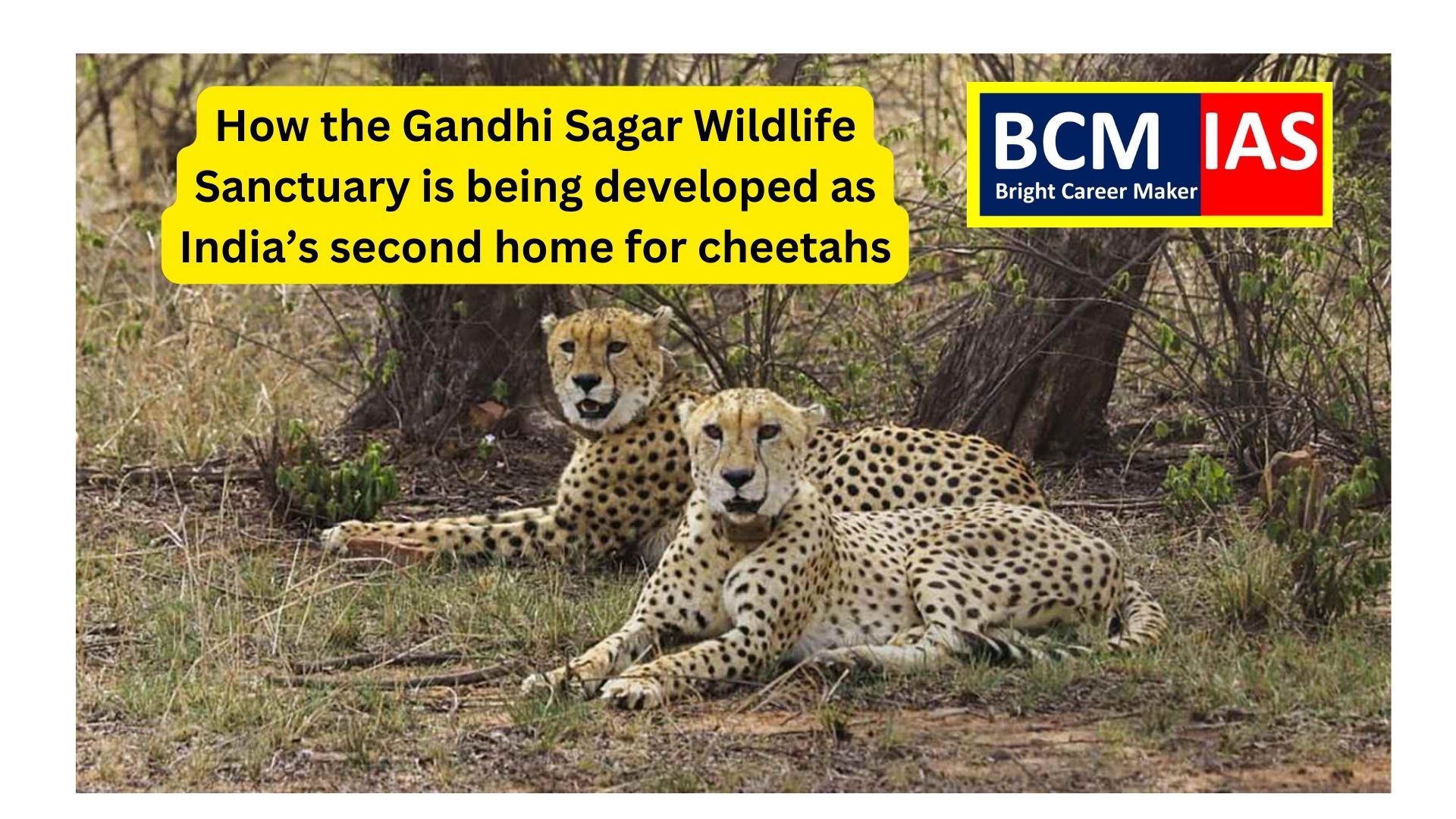
Gandhi
Sagar Wildlife Sanctuary
( GS 3- Environment & Ecology)
Anslysis-
The Gandhi Sagar Wildlife Sanctuary, located in the western
part of Madhya Pradesh, is poised to become the second home for cheetahs in
India, following the Kuno National Park. This sanctuary is a critical
ecological zone known for its unique vegetation, rocky terrain, and
archaeological significance.
Ecological and Geographical Significance:
1.
Location and Geography:
o Western
Madhya Pradesh:
Gandhi Sagar Wildlife Sanctuary is situated in the Nimar region of western
Madhya Pradesh, touching the border with Rajasthan.
o Rocky
Terrain: The
sanctuary sits atop a flat rocky plateau, with the Chambal River bisecting it
into two nearly equal halves. The rocky terrain and exposed sheetrock result in
shallow topsoil.
2.
Vegetation and Ecosystem:
o Khathiar-Gir
Dry Deciduous Forest:
The sanctuary is part of the Khathiar-Gir dry deciduous forest, featuring trees
like Salai, Kardhai, Dhawda, Tendu, and Palash.
o Savanna
Ecosystem: The
shallow topsoil supports a savanna ecosystem characterized by open grasslands
interspersed with dry deciduous trees and shrubs.
3.
Wildlife and Conservation:
o Cheetah
Reintroduction:
Gandhi Sagar is set to become a second home for cheetahs, aiding in the
species' conservation and reintroduction efforts in India.
o Biodiversity: The sanctuary supports diverse flora
and fauna, contributing to its ecological richness.
Archaeological and Cultural Importance:
1.
Rock Shelters and Paintings:
o Chaturbhuj
Nala Rock Shelters:
These world-famous rock shelters are part of the sanctuary, showcasing ancient
rock paintings and contributing to its archaeological significance.
2.
Religious Sites:
o Chaturbhujnath
Temple: The
sanctuary is also home to notable religious sites like the Chaturbhujnath
temple, adding cultural and historical value.
Environmental Characteristics:
1.
Dry and Rocky Region:
o Dry Deciduous
Forest: Due to the
shallow topsoil and rocky terrain, the vegetation includes dry deciduous trees
and shrubs.
o Grasslands: The presence of open grasslands
within the sanctuary supports the savanna ecosystem.
2.
Hydrological Features:
o Gandhi Sagar
Dam Backwater: The
sanctuary encompasses areas surrounding the backwaters of the Gandhi Sagar Dam,
contributing to the region's biodiversity and ecological health.
Way Forward
Conservation and Management:
1.
Cheetah Conservation:
o Habitat
Preparation: Ensure
the habitat is well-prepared to support the cheetah population, including prey
availability and suitable shelter.
o Monitoring
and Research:
Implement robust monitoring and research programs to study the cheetah's
adaptation and health in the new environment.
2.
Biodiversity Protection:
o Vegetation
Management: Manage
and protect the unique vegetation of the sanctuary to maintain its ecological
balance.
o Wildlife
Corridors: Establish
and maintain wildlife corridors to facilitate the movement and genetic
diversity of the animal populations.
Archaeological and Cultural Preservation:
1.
Rock Art and Shelters:
o Protection
Measures: Implement
measures to protect the rock shelters and paintings from natural and
human-induced damage.
o Awareness
Programs: Conduct
awareness programs to educate visitors about the archaeological significance
and promote responsible tourism.
2.
Cultural Sites:
o Maintenance
and Preservation:
Ensure the maintenance and preservation of cultural sites like the
Chaturbhujnath temple to retain their historical value.
Sustainable Tourism Development:
1.
Eco-Tourism:
o Responsible
Tourism Practices:
Promote eco-tourism practices that minimize environmental impact and support
conservation efforts.
o Community
Involvement: Involve
local communities in tourism initiatives to provide economic benefits and
encourage conservation participation.
2.
Infrastructure Development:
o Visitor
Facilities: Develop
sustainable infrastructure to support tourism without compromising the
ecological integrity of the sanctuary.
o Guided Tours: Offer guided tours to educate
visitors about the sanctuary's ecological, archaeological, and cultural
significance.
Conclusion
The Gandhi Sagar Wildlife Sanctuary's designation as a second
home for cheetahs underscores its ecological importance and highlights the need
for comprehensive conservation efforts. Its unique vegetation, rocky terrain,
archaeological sites, and cultural heritage make it a significant natural
reserve. By focusing on habitat preparation, biodiversity protection,
archaeological preservation, and sustainable tourism, Gandhi Sagar can serve as
a model for wildlife conservation and cultural preservation in India.
MCQs for Prelims Practice
1.
Consider the following statements about the Gandhi
Sagar Wildlife Sanctuary:
1.
It is located in eastern Madhya Pradesh.
2.
The sanctuary is part of the Khathiar-Gir dry
deciduous forest.
3.
It features a savanna ecosystem due to shallow
topsoil.
Which of the statements given above is/are correct?
o a) 1 only
o b) 2 and 3 only
o c) 1 and 2 only
o d) 1, 2 and 3
Answer: b) 2 and 3 only
Explanation: Statement 1 is incorrect because Gandhi Sagar Wildlife
Sanctuary is located in western Madhya Pradesh. Statements 2 and 3 are correct
as it is part of the Khathiar-Gir dry deciduous forest and features a savanna
ecosystem due to shallow topsoil.
2.
Which of the following features are associated with
the Gandhi Sagar Wildlife Sanctuary?
1.
Chaturbhuj Nala rock shelters
2.
Savanna ecosystem
3.
Evergreen forest
Select the correct answer using the code given below:
o a) 1 and 2 only
o b) 1 and 3 only
o c) 2 and 3 only
o d) 1, 2 and 3
Answer: a) 1 and 2 only
Explanation: Gandhi Sagar Wildlife Sanctuary is associated with the
Chaturbhuj Nala rock shelters and a savanna ecosystem. It does not feature an
evergreen forest.
3.
Consider the following statements:
1.
Gandhi Sagar Wildlife Sanctuary is set to become the
second home for cheetahs in India.
2.
The sanctuary is located near the backwaters of the
Gandhi Sagar Dam.
3.
The Chambal River cuts the sanctuary into two equal
halves.
Which of the statements given above is/are correct?
o a) 1 and 2 only
o b) 2 and 3 only
o c) 1 and 3 only
o d) 1, 2 and 3
Answer: d) 1, 2 and 3
Explanation: All the statements are correct. Gandhi Sagar Wildlife
Sanctuary is set to become the second home for cheetahs in India, is located
near the backwaters of the Gandhi Sagar Dam, and the Chambal River cuts the
sanctuary into two almost equal halves.
4.
Which trees are commonly found in the Gandhi Sagar
Wildlife Sanctuary?
1.
Salai
2.
Tendu
3.
Teak
Select the correct answer using the code given below:
o a) 1 and 2 only
o b) 2 and 3 only
o c) 1 and 3 only
o d) 1, 2 and 3
Answer: a) 1 and 2 only
Explanation: The common trees in the Gandhi Sagar Wildlife Sanctuary
include Salai and Tendu. Teak is not mentioned as a common tree in this
sanctuary.
5.
Which of the following statements is/are true about
the ecosystem of the Gandhi Sagar Wildlife Sanctuary?
1.
It consists of dry deciduous trees and shrubs.
2.
It has a savanna ecosystem due to deep topsoil.
3.
It is part of the Khathiar-Gir dry deciduous forest.
Select the correct answer using the code given below:
o a) 1 only
o b) 1 and 3 only
o c) 2 and 3 only
o d) 1, 2 and 3
Answer: b) 1 and 3 only
Explanation: Statements 1 and 3 are true as the sanctuary consists of
dry deciduous trees and shrubs and is part of the Khathiar-Gir dry deciduous
forest. Statement 2 is incorrect because the savanna ecosystem is due to
shallow topsoil, not deep topsoil.


Comments on “Gandhi Sagar Wildlife Sanctuary”