


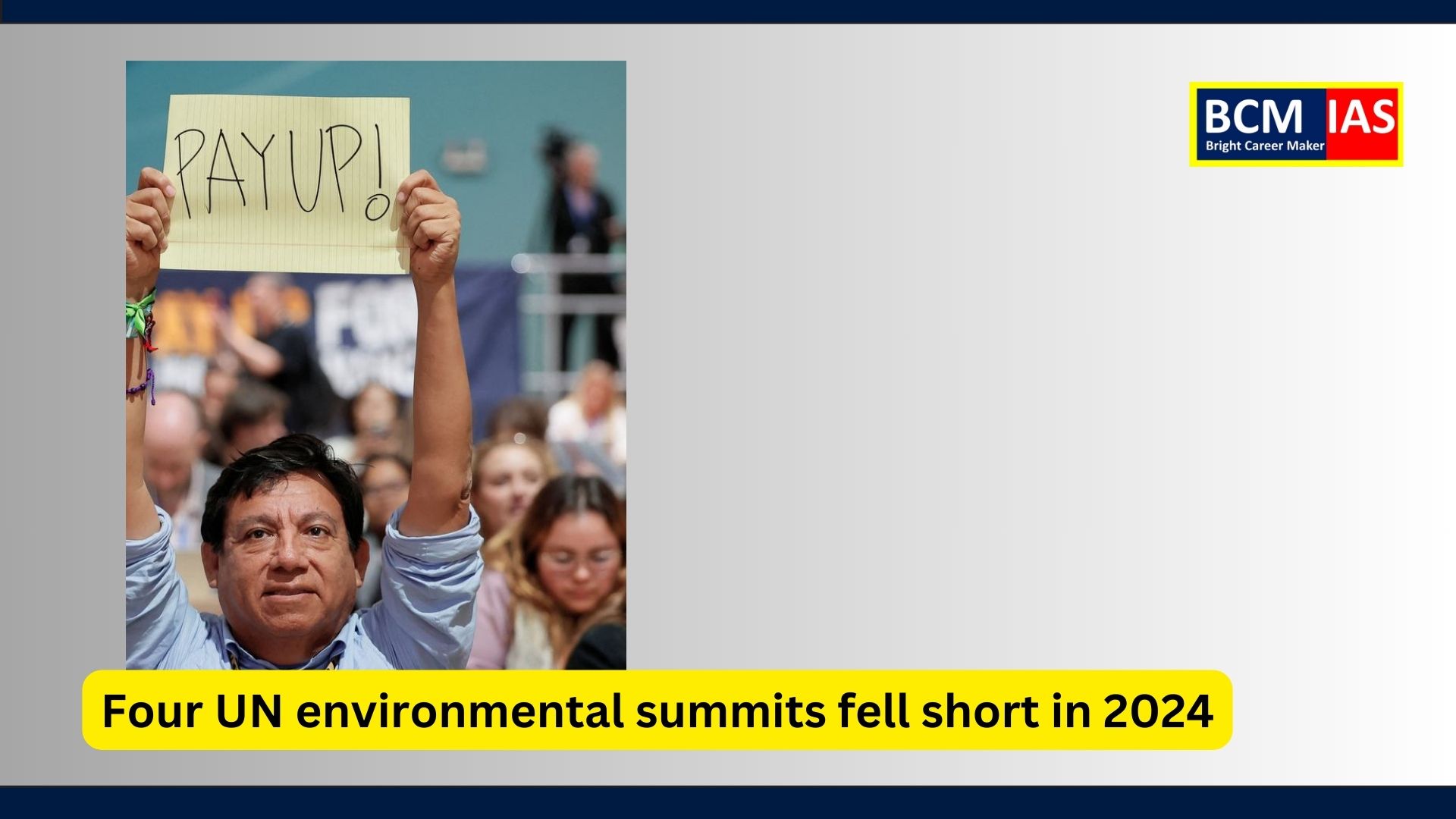
Four UN
environmental summits fell short in 2024.
The article
highlights the failure of four
major United Nations environmental summits in 2024—focused on biodiversity, climate change, land
degradation, and plastic pollution—to deliver meaningful outcomes. These
failures underscore the growing challenges of global environmental governance
amid divergent national priorities, geopolitical tensions, and insufficient
financial and technological commitments.
Key
Points
1.
The Summits and Their Goals
1. Biodiversity (Colombia):
o Objective: Agreement on financing mechanisms to support
biodiversity conservation and sustainable land use.
o Outcome:
Deadlock over the required $700 billion/year funding for conservation, with
countries failing to scale their ambitions.
2. Climate Change (Azerbaijan, COP29):
o Objective: Discuss transitioning away from fossil fuels,
implementing the Paris
Agreement’s global stocktake, and mobilizing $1.3 trillion
annually for developing countries.
o Outcome:
No consensus on fossil fuel transition; vague agreements on raising funds from
multiple sources, including private investments.
3. Land Degradation (Saudi Arabia):
o Objective: Establish a legally binding drought protocol for
mitigating land degradation and desertification.
o Outcome:
Industrialized nations and African countries clashed over whether the framework
should include concrete financial commitments.
4. Plastic Pollution (South Korea):
o Objective: Negotiate a legally binding treaty to curb
plastic pollution.
o Outcome:
Countries with economies dependent on plastic production resisted binding
measures, favoring recycling and proper usage instead.
2.
Causes of the Setbacks
1. Divergent National Priorities:
o Developing Nations’ Demands:
§ Greater climate
finance and technology
transfer from developed countries to address climate
vulnerabilities and economic constraints.
§ Specific funding targets, such as $1.3 trillion/year for
climate finance.
o Developed Nations’ Reluctance:
§ Cited domestic political pressures, economic challenges,
and limited willingness to commit additional resources.
o Example: The biodiversity talks in Colombia faltered due
to disagreements over financing sustainable land-use practices.
2. Global Crises:
o Economic instability, geopolitical conflicts (e.g.,
Russia-Ukraine war), and COVID-19 recovery efforts diverted attention and
resources away from environmental priorities.
o Governments prioritized short-term concerns over
long-term sustainability goals.
3. Accountability and Monitoring Gaps:
o Disagreements over accountability frameworks for emission
reductions and global stocktake under the Paris Agreement further complicated
negotiations.
o Example: In Azerbaijan, high-emission nations resisted
stricter accountability measures.
4. Resistance to Binding Treaties:
o Countries with vested economic interests in fossil fuels
or plastics opposed legally binding agreements, favoring voluntary frameworks.
o Example: Plastic-dependent economies at the South Korea
summit resisted a binding treaty on plastic pollution.
5. Inadequate Focus on Interconnections:
o Environmental issues like biodiversity loss, climate
change, and plastic pollution are interconnected. Fragmented approaches failed
to address their synergistic impacts comprehensively.
3.
Implications of the Failures
1. Delayed Global Action:
o Postponement of critical measures increases the risk of
crossing irreversible
tipping points in biodiversity loss, climate change, and
pollution.
2. Fragmented Efforts:
o Countries may turn to regional or unilateral actions, risking
incoherence and inefficiency in addressing global environmental challenges.
3. Erosion of Trust:
o Repeated failures undermine confidence in multilateral
processes, making future negotiations even more challenging.
4. Greater Vulnerability for Developing Nations:
o Delayed financial and technological support exacerbates
the climate vulnerabilities of poorer nations, leading to worsening
environmental and socio-economic conditions.
4.
The Way Forward
1. Climate Finance Commitments:
o Developed nations must honor their financial obligations,
such as the $100 billion/year target under the Paris Agreement, and increase
contributions to meet demands like the $1.3 trillion/year sought by developing
nations.
2. Strengthen Accountability Mechanisms:
o Robust frameworks to monitor progress, enforce
commitments, and hold nations accountable for failures are essential.
3. Inclusive Diplomacy:
o Negotiations must prioritize equitable participation,
ensuring vulnerable nations’ voices are heard and addressed.
4. Integrated Approaches:
o Environmental strategies should recognize
interconnections:
§ Address climate change alongside biodiversity loss, land
degradation, and plastic pollution.
§ Example: Restoring degraded lands can sequester carbon,
enhancing biodiversity while mitigating climate change.
5. Focus on Implementation:
o Shift from ambitious pledges to tangible, measurable outcomes
backed by actionable plans.
5.
Lessons for Future Summits
The failures in 2024
highlight the need for multilateral cooperation rooted in trust, equity, and
shared responsibility. Global environmental crises demand urgent collective
action beyond short-term national interests. Future summits must focus on
bridging divides, fostering transparency, and ensuring robust implementation to
achieve meaningful progress.
Conclusion
The 2024 UN environmental
summits reflect the increasing complexities of addressing global environmental
challenges amid diverging national interests and geopolitical tensions.
Bridging the divide between developed and developing nations, honoring
financial commitments, and adopting integrated, actionable strategies are
crucial for advancing global environmental goals. The stakes are immense, and
failure to act decisively risks exacerbating ecological and socio-economic
crises for generations to come.
Mains
Question:
"The failures of
key United Nations environmental summits in 2024 highlight the growing
challenges of global environmental governance." Critically analyze the
causes, implications, and the way forward to address such setbacks. (250 words)
Answer:
Introduction
In 2024, four major United Nations environmental summits on biodiversity
(Colombia), climate change (Azerbaijan), land degradation (Saudi Arabia), and
plastic pollution (South Korea) failed to produce meaningful outcomes. This
underscores the growing challenges in achieving consensus on global
environmental governance amidst diverging national priorities and crises.
Causes of the Setbacks
1. Divergent National Priorities:
o Developing nations demanded financial and technological
support (e.g., $1.3 trillion/year for climate finance) to address
vulnerabilities, while developed nations cited economic constraints and
domestic pressures.
o Example: Colombia talks stalled over a $700 billion/year
biodiversity financing gap.
2. Accountability Disputes:
o High-emission nations resisted stricter accountability
for emission reductions under the Paris Agreement.
3. Economic Interests:
o Plastic-dependent economies resisted legally binding
agreements, favoring voluntary measures.
4. Global Crises:
o COVID-19 recovery, geopolitical tensions, and inflation
diverted resources and focus from environmental priorities.
Implications
1. Delayed Action:
Increases the risk of crossing irreversible
tipping points in climate change and biodiversity loss.
2. Erosion of Trust:
Undermines confidence in multilateral processes, complicating future
negotiations.
3. Fragmented Efforts:
Countries may resort to unilateral or regional measures, risking inefficiency
and incoherence.
Way Forward
1. Honoring Climate Finance Commitments: Developed nations must deliver promised funds and
increase support for vulnerable countries.
2. Inclusive Diplomacy: Ensure equitable participation of developing nations in
decision-making.
3. Integrated Strategies: Link biodiversity, climate change, and pollution in
comprehensive global policies.
4. Implementation Focus: Shift from ambitious pledges to measurable, actionable
outcomes.
Conclusion
Global environmental governance requires overcoming short-term national
interests to address urgent environmental crises. Transparent, equitable, and
action-oriented multilateral cooperation is crucial to achieving sustainable
global outcomes. The stakes are too high for further stalemates.
MCQs
1. Which of the following countries hosted the COP29 climate change
conference in 2024?
a) Saudi Arabia
b) Azerbaijan
c) Colombia
d) South Korea
Answer: b) Azerbaijan
2. What was the primary demand of developing nations during the
Azerbaijan climate summit?
a) A legally binding treaty to phase out fossil fuels
b) Financial support of $1.3 trillion annually from developed nations
c) Implementation of a global drought protocol
d) A ban on single-use plastics globally
Answer: b) Financial support of $1.3 trillion annually from
developed nations
3. Which key issue caused a deadlock during the Colombia
biodiversity summit in 2024?
a) Transitioning away from fossil fuels
b) Financing mechanisms for biodiversity conservation
c) Agreement on plastic recycling practices
d) Monitoring mechanisms for greenhouse gas emissions
Answer: b) Financing mechanisms for biodiversity conservation
4. What is a significant criticism of the South Korea summit on
plastic pollution?
a) It failed to address the recycling of plastic waste.
b) It concluded without a legally binding treaty due to opposition from
plastic-dependent economies.
c) It focused solely on plastic production and ignored marine pollution.
d) It did not include participation from developing nations.
Answer: b) It concluded without a legally binding treaty due to
opposition from plastic-dependent economies.
5. Which of the following was a major cause of the failures of the
2024 UN environmental summits?
1. Diverging national priorities between developed and
developing nations.
2. Lack of financial commitments from developed countries.
3. Economic and geopolitical crises distracting global
attention.
4. Over-reliance on private investment to finance
environmental actions.
Select
the correct answer using the code below:
a) 1 and 2 only
b) 1, 2, and 3 only
c) 2, 3, and 4 only
d) All of the above
Answer: b) 1, 2, and 3 only


Comments on “Four UN environmental summits fell short in 2024.”