


Daily Current Affairs Analysis
13 June 2024
-------------------------------------------------------------------------------------------------------------
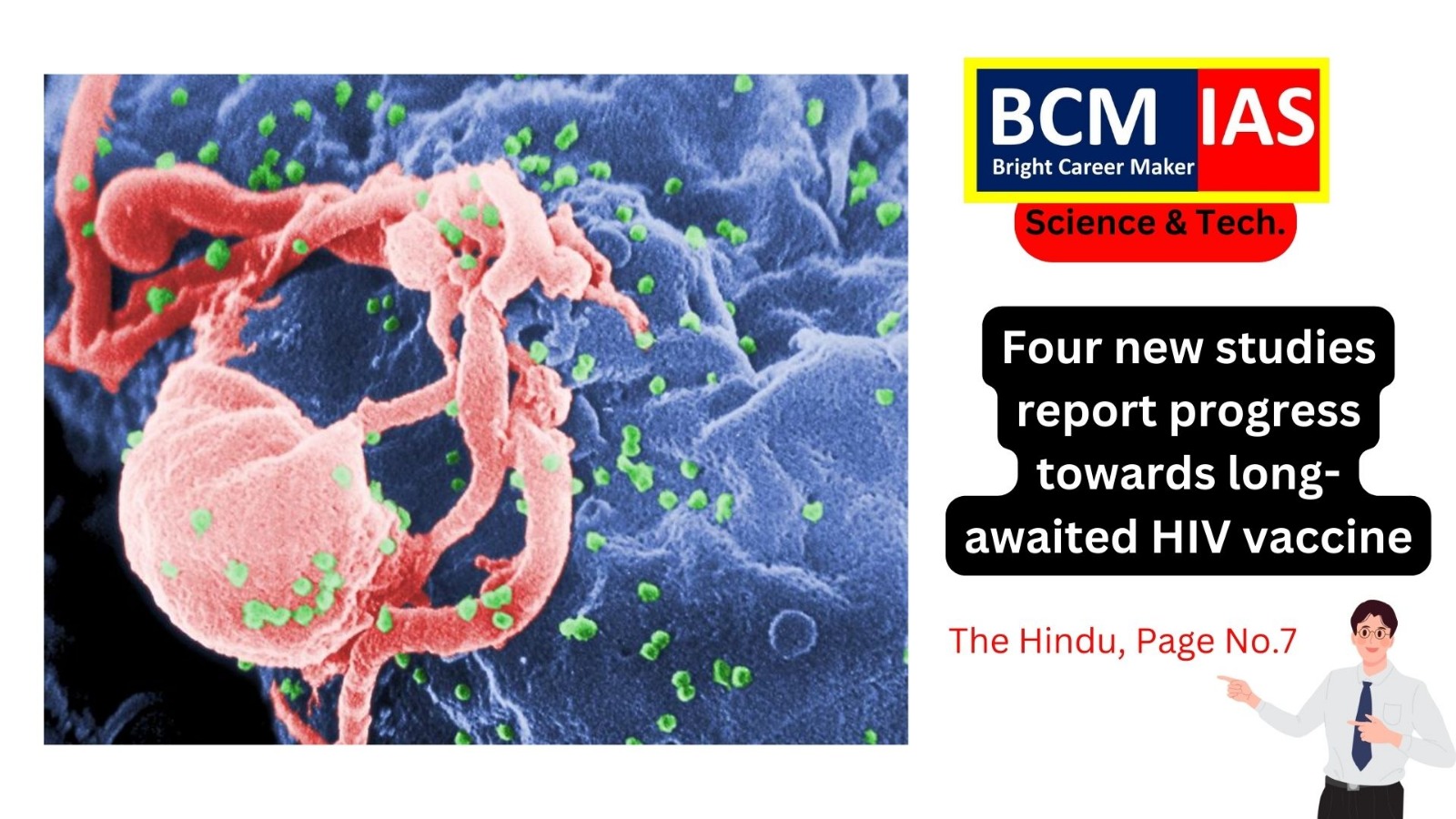
Four new studies report progress towards
long-awaited HIV vaccine
Meaning of Headline-
·
This headline means that recent research efforts have resulted in
significant advancements in developing a vaccine for HIV.
·
Four separate studies have provided promising results, indicating
that scientists are closer to creating a vaccine that could potentially prevent
HIV infection, a goal that has been pursued for many years.
Related Topic (as per UPSC
Syllabus)
1. Prelims:
o
General Science:
§
Basic understanding of HIV/AIDS.
§
Recent developments in the field of medical science
and technology.
o
Current Events:
§
Recent scientific advancements and discoveries.
2. Mains:
o
General Studies Paper II:
§
Issues relating to the development and management of
Social Sector/Services relating to Health, Education, Human Resources.
§
Government policies and interventions for development
in various sectors and issues arising out of their design and implementation.
o
General Studies Paper III:
§
Science and Technology:
§
Developments and their applications and effects in
everyday life.
§
Achievements of Indians in science & technology;
indigenization of technology and developing new technology.
§
Awareness in the fields of IT, Space, Computers,
robotics, nanotechnology, bio-technology, and issues relating to intellectual
property rights.
o
Essay Paper:
§
Topics related to health issues, scientific
advancements, and their impact on society.
3. Interview:
o
Current Affairs:
§
Questions regarding recent developments in medical
science and technology.
§
Discussions on public health issues, especially the
impact of HIV/AIDS and the significance of finding a vaccine.
o
Analytical and Opinion-based Questions:
§
Implications of a potential HIV vaccine on public
health policies.
§
Challenges in developing vaccines for viruses like HIV
that have multiple strains and high mutation rates.
This news can be linked to the broader
themes of public health, scientific research, and technological innovation,
which are significant areas of focus in the UPSC syllabus.
News
Analysis
Key Points:
1. Researchers
Involved:
o
Scripps Research Institute
o
Massachusetts Institute of Technology (MIT)
2. Vaccine
Candidates:
o
N332-GT5
o
eOD-GT8
3. Mechanism:
o
Help the body make two classes of broadly neutralizing
antibodies to attack HIV.
4. Historical
Context:
o
Early research by Dr. Michael Gottlieb at UCLA Medical
Center.
o
First reported cases of AIDS in the early 1980s.
5. Challenges:
o
High genetic variability of HIV.
o
Difficulty in creating a vaccine due to multiple
strains.
6. Current
Progress:
o
Vaccine candidates have shown efficacy in mice and
macaques.
o
Phase-I clinical trials underway.
Key Highlights:
1. Historical
Context and Importance:
o
Dr. Michael Gottlieb's early research and the first
documented cases of AIDS.
o
The lack of a vaccine for AIDS despite decades of
research.
o
HIV's high genetic variability compared to other
viruses like influenza.
2. Scientific
and Technological Aspects:
o
Development of nanoparticle-based vaccine candidates.
o
The mechanism of inducing broadly neutralizing
antibodies (bnAbs).
o
Use of animal models (mice and macaques) for initial
efficacy studies.
3. Current
Research Progress:
o
Phase-I clinical trials.
o
Potential for these vaccines to overcome previous
challenges in HIV vaccine development.
4. Public
Health and Policy Implications:
o
Importance of a successful HIV vaccine in global
health.
o
Impact on public health policies and future research
directions.
Mains Probable Question
Question - Discuss
the recent advancements in HIV vaccine development and their potential impact
on global public health. (1500 words)
Model Suggested Answer
Introduction
Human
Immunodeficiency Virus (HIV) remains one of the most significant public health
challenges worldwide, with millions of people affected globally. The virus,
which leads to Acquired Immunodeficiency Syndrome (AIDS), has evaded vaccine
development due to its high genetic variability and the complexity of the
immune response required to combat it. However, recent advancements,
particularly the development of two nanoparticle-based vaccine candidates,
N332-GT5 and eOD-GT8, by researchers at the Scripps Research Institute and the
Massachusetts Institute of Technology (MIT), offer renewed hope. These vaccines
aim to induce broadly neutralizing antibodies (bnAbs), which can target
multiple strains of HIV. This essay will discuss these advancements, their potential
impact on global public health, and the way forward.
Demand
of the Question
The recent
studies on HIV vaccine candidates have brought significant attention to the
ongoing efforts to develop an effective vaccine. These efforts are crucial
given the historical context and the immense challenge that HIV poses due to
its genetic diversity. The development of N332-GT5 and eOD-GT8 represents a
potential breakthrough in this field. These vaccines are designed to elicit a
broad immune response by stimulating the production of bnAbs, which are capable
of neutralizing a wide range of HIV strains.
The progress
in these studies indicates that we are moving closer to overcoming the
long-standing barriers in HIV vaccine development. The phase-I clinical trials
of these vaccine candidates will provide critical data on their efficacy and
safety in humans. If successful, these vaccines could revolutionize the
prevention of HIV, potentially leading to a significant reduction in new
infections and improving the quality of life for millions of people globally.
The impact of
a successful HIV vaccine on global public health cannot be overstated. It would
not only prevent new infections but also alleviate the social and economic
burden associated with HIV/AIDS. The development and deployment of an effective
vaccine would complement existing prevention and treatment strategies, leading
to comprehensive HIV control. Furthermore, it would serve as a model for
vaccine development against other complex viruses, leveraging the advancements
in immunology and biotechnology.
Way
Forward
1. Continued Research and Development:
o
The promising results from
recent studies need to be followed by rigorous clinical trials to establish the
efficacy and safety of the vaccine candidates. It is essential to conduct these
trials across diverse populations to ensure the vaccines' effectiveness
globally.
o
Collaborative efforts between
research institutions, governments, and private sectors should be strengthened
to accelerate the development process. Adequate funding and resource allocation
are crucial to sustain long-term research efforts.
2. Regulatory and Ethical Considerations:
o
Regulatory agencies must
streamline the approval processes for promising vaccine candidates while
ensuring that safety and efficacy standards are met. This involves close
monitoring of clinical trial data and expediting approvals without compromising
on thorough evaluations.
o
Ethical considerations,
including informed consent and equitable access to trials, must be prioritized.
Communities most affected by HIV should be actively involved in the research
process to address their specific needs and concerns.
3. Global Access and Distribution:
o
Once an HIV vaccine is
developed, a robust global distribution strategy is essential. This includes
scaling up production capacities, ensuring affordable pricing, and establishing
efficient supply chains to reach remote and underserved areas.
o
International cooperation and
support from organizations such as the World Health Organization (WHO) and the
Global Fund are vital to achieve widespread vaccination coverage. Efforts
should be made to overcome logistical challenges and ensure that the vaccine is
accessible to all, regardless of socio-economic status.
4. Public Health Integration:
o
An HIV vaccine should be
integrated into existing public health frameworks to maximize its impact. This
includes combining vaccination efforts with other prevention strategies such as
antiretroviral therapy (ART), condom use, and educational campaigns.
o
Continuous monitoring and
evaluation of vaccination programs will help identify areas for improvement and
ensure that the desired outcomes are achieved. Data-driven approaches should be
used to adapt strategies based on real-world evidence.
5. Addressing Socio-economic Factors:
o
The success of an HIV vaccine
program also depends on addressing the underlying socio-economic factors that
contribute to the spread of HIV. This includes tackling stigma and
discrimination, promoting gender equality, and improving access to healthcare and
education.
o
Community engagement and
education campaigns are essential to raise awareness about the importance of
vaccination and encourage uptake. Building trust within communities through
transparent communication and addressing misconceptions will be critical.
6. Innovation and Future Directions:
o
The advancements in HIV
vaccine development can pave the way for innovations in other areas of medical
science. The technologies and methodologies used in developing bnAbs can be
applied to other challenging diseases, fostering a new era of vaccine research.
o
Ongoing investment in
biotechnology, genomics, and immunology will drive further breakthroughs.
Encouraging young scientists and fostering interdisciplinary collaborations
will be key to sustaining momentum in this field.
Conclusion
The recent advancements in HIV
vaccine development, particularly the promising results of the N332-GT5 and
eOD-GT8 candidates, signify a potential turning point in the fight against
HIV/AIDS. The development of these vaccines represents a significant scientific
achievement, reflecting decades of dedicated research and innovation. If
successful, these vaccines could transform global public health by preventing
new infections and reducing the burden of HIV/AIDS.
However, the journey towards an
effective HIV vaccine is far from over. Continued research, ethical
considerations, global access strategies, and integration into public health
frameworks are essential to realize the full potential of these advancements.
Addressing socio-economic factors and fostering innovation will further enhance
the impact of an HIV vaccine.
As we move forward, the collaborative
efforts of researchers, governments, and global health organizations will be
crucial. The fight against HIV/AIDS requires sustained commitment and a
multifaceted approach, leveraging scientific breakthroughs to achieve a future
where HIV is no longer a global health threat. The potential impact of an
effective HIV vaccine is profound, promising a healthier and more equitable
world for all.
MCQs for Prelims Practice
Which
institutions are involved in the recent studies reporting progress towards an
HIV vaccine?
A. Harvard
University and Stanford University
B. Scripps
Research Institute and MIT
C. Johns
Hopkins University and Cambridge University
D. University
of California and Oxford University
Answer: B.
Scripps Research Institute and MIT
Explanation: The recent
studies mentioned in the headline are conducted by researchers from Scripps
Research Institute and MIT.
What
are the names of the two nanoparticle-based vaccine candidates mentioned in the
studies?
A. N332-GT5
and eOD-GT8
B. N323-GT5
and eOD-GT7
C. N332-GT6
and eOD-GT9
D. N331-GT5
and eOD-GT8
Answer: A.
N332-GT5 and eOD-GT8
Explanation: The vaccine
candidates outlined in the studies are N332-GT5 and eOD-GT8.
Why
is HIV particularly challenging to create a vaccine for?
A. It has a
single strain.
B. It has
high genetic variability with multiple strains.
C. It does
not affect the immune system.
D. It is
easily curable with medication.
Answer: B. It
has high genetic variability with multiple strains
Explanation: HIV's high
genetic variability and multiple strains make it difficult to create a vaccine.
What
was the significance of Dr. Michael Gottlieb's paper published in the early
1980s?
A. It
discovered a cure for HIV.
B. It was the
first report of acquired immunodeficiency syndrome (AIDS).
C. It
described the structure of HIV.
D. It
developed the first HIV vaccine.
Answer: B. It
was the first report of acquired immunodeficiency syndrome (AIDS)
Explanation: Dr.
Gottlieb's paper was significant as it was the first report of AIDS.
What
stage are the current vaccine candidates (N332-GT5 and eOD-GT8) in?
A. Laboratory
testing
B. Phase-I
clinical trials
C. Phase-III
clinical trials
D. Approved
for public use
Answer: B.
Phase-I clinical trials
Explanation: The vaccine candidates are currently being evaluated in phase-I clinical trials.


Comments on “Four new studies report progress towards long-awaited HIV vaccine”