


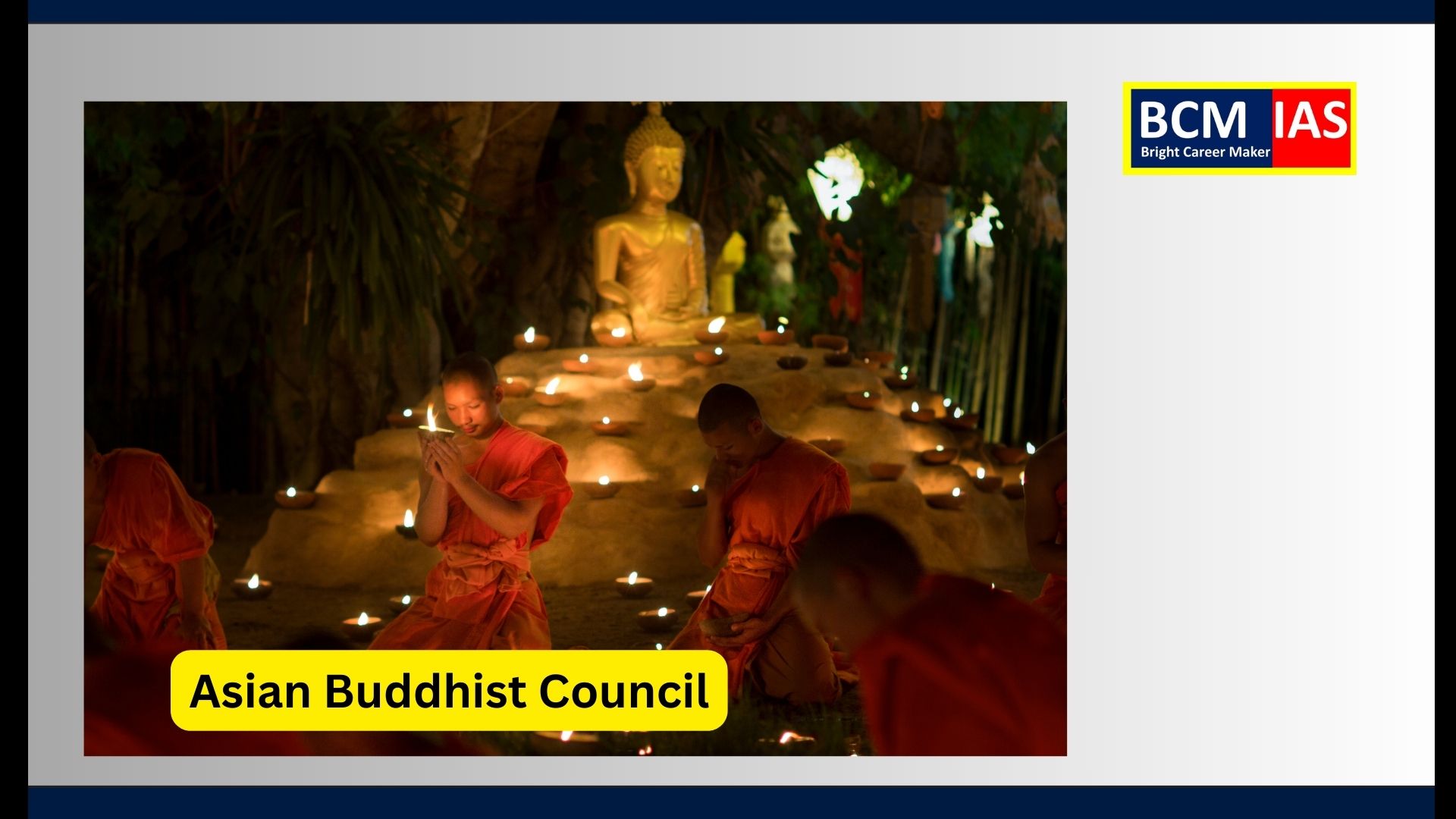
First Asian Buddhist Summit
Why in News?
The
first Asian Buddhist Summit (ABS) was recently organized by the Ministry
of Culture in collaboration with the International Buddhist
Confederation (IBC) in New Delhi, India.
Key Highlights of the
1st Asian Buddhist Summit
1. About
the Summit:
o A significant international gathering aimed at fostering
dialogue, promoting understanding, and addressing contemporary challenges in
the Buddhist community across Asia.
o Theme: "Role of
Buddha Dhamma in Strengthening Asia," emphasizing collective, inclusive,
and spiritual development in Asia.
2. Key
Themes Discussed:
o Buddhist
Art, Architecture, and Heritage:
§ Explored the cultural significance of landmarks such as Sanchi
Stupa and Ajanta Caves.
o Buddha
Cārikā and Dissemination of Buddha Dhamma:
§ Focused on Buddha’s travels and their impact on spreading
his teachings across India and Asia.
o Role
of Buddhist Relics and Their Relevance:
§ Highlighted their importance in promoting peace,
compassion, and pilgrimage tourism.
o Buddhist
Literature and Philosophy in the 21st Century:
§ Discussed the relevance of Buddhist teachings in modern
philosophical discourse.
o Buddha
Dhamma in Scientific Research and Well-being:
§ Integrated Buddhist principles with science to enhance
mental and physical health.
3. Exhibition:
o A special exhibition titled "India as the Dhamma
Setu" showcased India's role in spreading Buddhism across Asia.
Significance for India
1. Act
East Policy and Neighborhood First Policy:
o The summit supports these policies by fostering cultural
and spiritual connections with Asian nations.
2. Promoting
Buddhist Heritage:
o Reaffirms India’s commitment to preserving Buddhist sites
and manuscripts, enhancing tourism and cultural exchange.
3. Global
Buddhist Leadership:
o Strengthens India’s role as a key player in global
Buddhist diplomacy and cultural preservation.
Related Facts
1. Buddha
Bhoomi Vandan Yatra:
o In 2022, the Indian Council of Cultural Relations
(ICCR) facilitated a visit by scholars from countries like Japan and Sri
Lanka to explore India's Buddhist heritage.
2. IBC
(International Buddhist Confederation):
o A Buddhist umbrella body based in New Delhi, serving as a
platform for global Buddhist dialogue and collaboration.
India’s Recent
Initiatives to Support Buddhism
1. Buddhist
Tourism Circuit:
o Promotes pilgrimage tourism across Buddhist heritage
sites in India.
2. First
Global Buddhist Summit:
o Aimed at enhancing international Buddhist cooperation.
3. Asian
Buddhist Conference for Peace:
o Encourages dialogue among Buddhist-majority countries.
4. Classical
Status to Pali Language:
o Supports the preservation and study of ancient Buddhist
texts.
5. International
Abhidhamma Diwas:
o Celebrates Buddhist teachings and philosophy.
UPSC Relevance
- Prelims
Questions:
- Topics include
Buddhism’s sects (e.g., Mahayana, Hinayana), Buddhist heritage, and
cultural exchanges.
- Recent
recognition of Pali and Prakrit as classical languages could feature in
questions related to Indian languages and their historical significance.
- Mains Questions:
- Buddhism’s role
in fostering peace, cultural diplomacy, and environmental sustainability.
This
summit reinforces India’s position as a global leader in Buddhist cultural
diplomacy, leveraging ancient teachings to address modern challenges and
foster unity across Asia.
MCQs for Practice-
Q1.
With reference to the Asian Buddhist Summit, consider the following statements:
1. The theme of the summit was "Role of Buddha Dhamma
in Strengthening Asia."
2. The summit was organized by the Ministry of External
Affairs and the International Buddhist Confederation.
3. The exhibition at the summit highlighted India's role as
"Dhamma Setu" connecting Asia.
Which
of the statements given above is/are correct?
(a) 1 and 2 only
(b) 2 and 3 only
(c) 1 and 3 only
(d) 1, 2, and 3
Answer: (c) 1 and 3 only
Q2.
Consider the following Buddhist principles:
1. The Four Noble Truths
2. The Eightfold Path
3. The concept of Bodhisattva
Which
of the above is/are emphasized in Mahayana Buddhism?
(a) 1 and 2 only
(b) 2 and 3 only
(c) 3 only
(d) All of the above
Answer: (d) All of the above
Q3.
With reference to India’s initiatives to promote Buddhist heritage, which of
the following is correct?
1. India has granted classical language status to Pali and
Prakrit.
2. The Indian Council of Cultural Relations (ICCR) organizes
Buddha Bhoomi Vandan Yatra.
3. India launched the Buddhist Tourism Circuit under the
National Mission on Pilgrimage Tourism.
Select
the correct answer using the code given below:
(a) 1 and 2 only
(b) 2 and 3 only
(c) 1 and 3 only
(d) All of the above
Answer: (d) All of the above
Q4.
Which of the following statements is/are correct regarding Mahayana Buddhism?
1. Deification of the Buddha is a characteristic feature of
Mahayana Buddhism.
2. Mahayana Buddhism focuses on the Bodhisattva ideal.
3. It rejected the practice of image worship.
Select
the correct answer using the code given below:
(a) 1 and 2 only
(b) 2 and 3 only
(c) 1 and 3 only
(d) All of the above
Answer: (a) 1 and 2 only
Q5.
Which of the following features are associated with Buddhist architecture in India?
1. Stupas
2. Rock-cut caves
3. Chaityas and Viharas
Select
the correct answer using the code given below:
(a) 1 and 2 only
(b) 2 and 3 only
(c) 1 and 3 only
(d) All of the above
Answer: (d) All of the above
Mains
Practice Question
"Buddhism has the
potential to address contemporary global challenges such as sectarianism,
environmental crises, and socio-political conflicts. Discuss with reference to
its core teachings and India's role in promoting Buddhist diplomacy."
(GS Paper 1: Indian Culture – Salient
aspects of Art Forms, Literature, and Architecture from ancient to modern
times.)
Suggested
Answer
Introduction
Buddhism,
with its emphasis on non-violence, compassion, and the middle path, offers
timeless solutions to pressing global challenges. In the modern context, its
principles address not only spiritual needs but also issues such as
sectarianism, environmental sustainability, and socio-political conflicts.
India's historical role as the birthplace of Buddhism strengthens its position
as a promoter of Buddhist diplomacy.
Core Teachings of
Buddhism Relevant to Global Challenges
1. Countering
Sectarianism:
o Non-Violence
and Compassion (Ahimsa and Karuna):
§ Encourages harmony by rejecting violence and embracing
mutual respect.
o Middle Path:
Avoids extremes, fostering dialogue and coexistence among conflicting groups.
2. Environmental
Sustainability:
o Interdependence
and Mindfulness (Pratityasamutpada):
§ Promotes respect for nature, emphasizing the
interconnectedness of all life.
o Non-Greed
(Aparigraha):
§ Counters consumerism and over-exploitation of resources.
3. Socio-Political
Conflicts:
o Four
Noble Truths and Eightfold Path:
§ Advocates self-awareness, ethical conduct, and peaceful
resolution of conflicts.
o Bodhisattva
Ideal:
§ Encourages individuals to act selflessly for the welfare
of society.
India’s Role in
Promoting Buddhist Diplomacy
1. Cultural
Leadership:
o Preservation
of Buddhist Heritage:
§ Maintenance of sites like Bodh Gaya and Sarnath as global
pilgrimage destinations.
o Promotion
of Buddhist Art and Literature:
§ Recognition of Pali and Prakrit as classical languages.
2. Buddhist
Tourism and Pilgrimage Circuits:
o Development of the Buddhist Tourism Circuit
linking key heritage sites.
o Encouragement of cross-border pilgrimages, strengthening
cultural ties with Asian nations.
3. Diplomatic
Initiatives:
o Global Buddhist Summit and Asian Buddhist Summit: Platforms for fostering peace and cooperation.
o Act East Policy and Dhamma Setu Initiatives: Strengthening ties with Buddhist-majority countries like
Japan, Sri Lanka, and Thailand.
4. Educational
and Research Support:
o Encouraging Buddhist studies and research through
universities and cultural organizations.
o Hosting international Buddhist conferences to promote
dialogue and understanding.
Challenges in
Leveraging Buddhism for Global Issues
1. Sectarian
Divisions:
o Variations among Buddhist traditions (Theravada,
Mahayana, Vajrayana) can hinder unity.
2. Geopolitical
Rivalries:
o Competition among nations like China and India in
leveraging Buddhism diplomatically.
3. Preservation
of Heritage:
o Protection of ancient Buddhist manuscripts and relics
remains a challenge.
Conclusion
Buddhism’s
timeless principles of peace, compassion, and interdependence provide valuable
guidance in addressing contemporary global challenges. By promoting Buddhist
diplomacy and preserving its heritage, India can play a pivotal role in
fostering global harmony and sustainable development. However, efforts must
focus on overcoming challenges to ensure Buddhism’s enduring relevance in the
modern world.
Way Forward
1. Enhance collaboration with Buddhist-majority nations
through cultural exchange programs.
2. Expand the Buddhist Tourism Circuit to attract global
pilgrims.
3. Invest in preserving Buddhist texts and promoting Pali
and Prakrit studies.
This
integrated approach will reaffirm Buddhism’s global significance while
strengthening India’s leadership in Buddhist diplomacy.


Comments on “First Asian Buddhist Summit”