


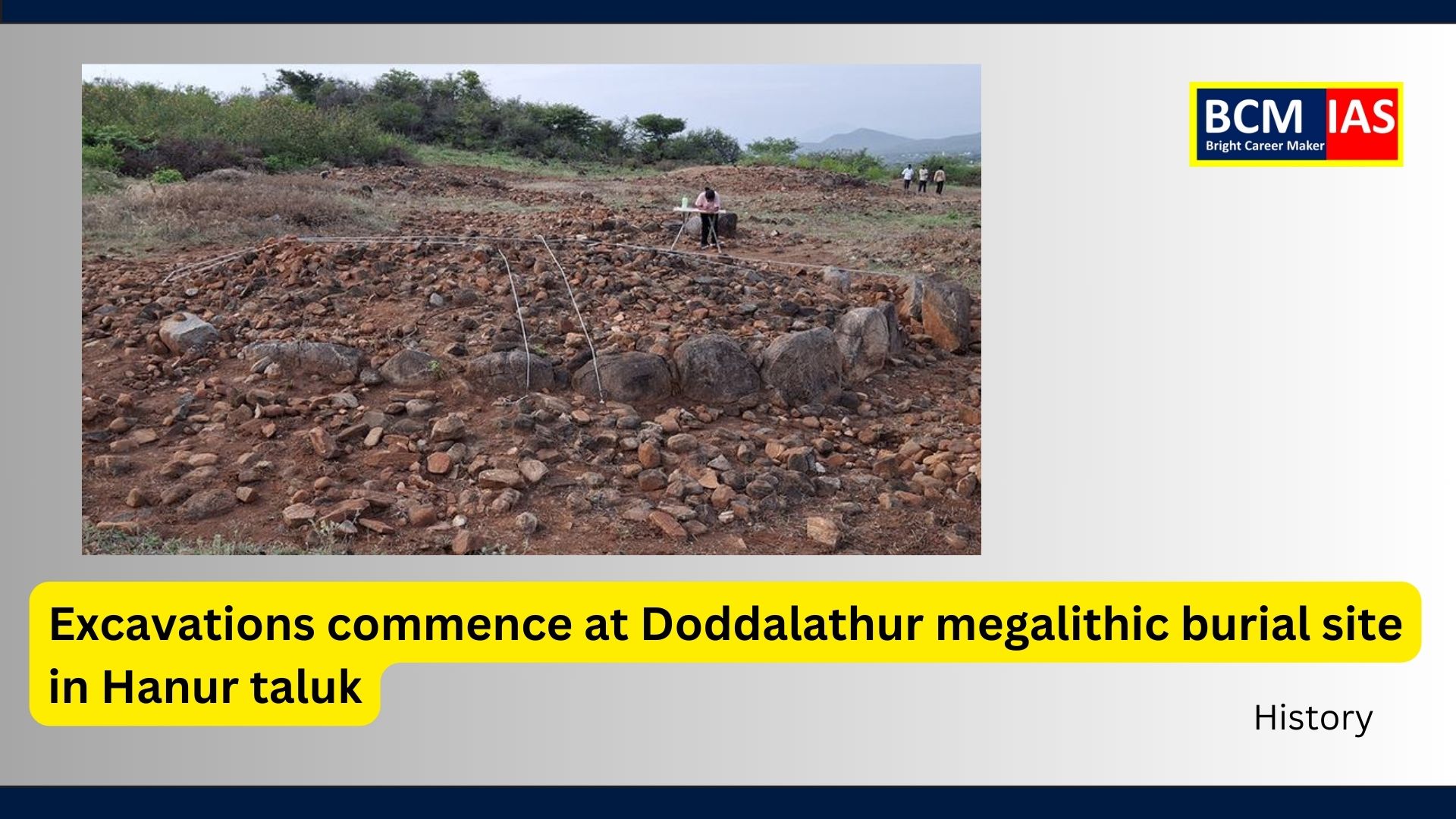
Excavations commence
at Doddalathur megalithic burial site in Hanur taluk
News Analysis
·
The article discusses the ongoing excavation at
the Doddalathur megalithic burial site in Hanur taluk,
Chamarajanagar district, Karnataka.
·
The excavation is being conducted by a team of
archaeologists, history scholars, and students from the University of Mysore,
in collaboration with the Mythic Society of Bengaluru.
·
This initiative aims to uncover more information about
the megalithic-iron age culture in southern Karnataka, a period that
spans from around 1200 BCE to 300 CE.
Key Points of the
Excavation:
1. Megalithic
Burial Sites:
o The megalithic
burial site at Doddalathur was first discovered by C. Krishnamurti
of the Archaeological Survey of India (ASI) in 1961.
o Megaliths are large stone structures or
circles made of large boulders, which were often used in burials during the Iron
Age. These burials were spread across the landscape, with many burials
still intact despite disturbances caused by agriculture and settlement
expansion.
o This site,
located in a valley formed by the Male Mahadeshwara Hills, once
contained more than 1,000 burials. The Iron Age is an important
period in human history as it marks the widespread use of iron technology.
2. Importance
of the Site:
o The Doddalathur
site is significant because it provides insights into the megalithic-iron
age culture that existed in South India, specifically in the hilly
regions of Karnataka. The excavation may reveal more information about the funerary
practices, settlements, social structures, and technological
advancements of that time.
o The Iron Age
in South India is notable for the introduction and widespread use of iron
for tools and weapons, which contributed to advancements in agriculture,
warfare, and craftsmanship.
3. Challenges
and Threats:
o Many of the
original burials have vanished due to agricultural expansion, land
development, and settlement activities. This poses a significant
threat to the preservation of such ancient sites, which are crucial for
understanding early human history in the region.
o Despite these
challenges, the site still holds potential for excavation, as a large
number of burials remain intact and undisturbed.
4. Educational
and Research Objectives:
o In addition to
the research aspects, the excavation project also serves as field training
for students of archaeology, providing them with hands-on experience in
excavation techniques and the study of ancient sites.
o This excavation
will likely yield more artifacts and remains that will contribute to our
understanding of Iron Age burial practices, material culture, and
society.
5. Collaboration
and Expertise:
o The excavation
project is co-directed by C.B. Patil (retd.), a Superintending
Archaeologist from the ASI, which adds a level of expertise to the endeavor.
This collaboration between academic institutions (University of Mysore)
and archaeological bodies (ASI and Mythic Society) highlights the
importance of interdisciplinary approaches in archaeological research.
Historical Significance:
·
The megalithic period is a significant phase in
Indian history, particularly in the Deccan region.
·
The Iron Age, which overlaps with the
megalithic period, marks the transition from the Bronze Age and is
characterized by the use of iron tools and weapons, which brought
significant changes in agricultural productivity and warfare.
- Megalithic
burials offer
valuable insights into the social and cultural practices of early
communities. The burials often contain grave goods such as pottery,
tools, weapons, and ornaments, which can provide clues about the belief
systems, status, and occupations of the people.
- The Doddalathur site
is expected to reveal such cultural artifacts and contribute to our
understanding of the regional dynamics of the Iron Age in Southern
India, complementing findings from other megalithic sites across South
India, such as Brahmagiri, Adichanallur, and Hirebenakal.
Connection to the UPSC
History Syllabus:
The Doddalathur megalithic burial site excavation is
relevant to several key themes in the Ancient and Medieval History
sections of the UPSC Civil Services Exam syllabus:
1. Prehistoric
and Protohistoric Period:
o The excavation
touches upon the Iron Age in South India, which is an essential part of protohistoric
archaeology. The Iron Age is a crucial phase in India's prehistory,
marking the development of complex societies, the use of advanced technology,
and significant cultural shifts.
2. Archaeological
Sources of Ancient Indian History:
o Inscriptions, excavations, and material
remains are integral to reconstructing ancient Indian history. The Doddalathur
site provides valuable archaeological evidence that will shed light on the funerary
practices, material culture, and economic activities of the
Iron Age period.
3. Social
and Cultural Developments in South India:
o The site offers
insight into the socio-cultural development of South Indian societies
during the Iron Age. This is crucial for understanding the transformation of
societies, from early agricultural communities to more complex, settled
societies with distinct burial practices and social stratification.
4. Archaeology
as a Tool of Historical Research:
o The ongoing
excavations serve as a case study in how archaeology contributes to the
understanding of historical periods, especially in reconstructing periods where
written records are scarce or non-existent.
o The methodology
used in excavating the burial sites and the study of artifacts will be
significant in understanding the historical context of the Iron Age in South
India.
Conclusion:
The Doddalathur excavation is a vital archaeological initiative that aims to
explore the megalithic burial sites of the Iron Age in Southern
India. By uncovering the artifacts and remains at the site, the
project hopes to provide a deeper understanding of the socio-economic and
cultural practices of the time. The excavation also serves as an essential
training ground for students of archaeology, offering them a practical
experience in uncovering India’s rich ancient history.
This excavation is not only crucial for academic and
archaeological research but also underscores the importance of preserving
historical sites that are under threat from modern development activities.
The project is expected to yield significant findings that will contribute to
our understanding of the Iron Age in the Deccan region, further
enriching the study of Indian history.
Example Mains Question:
Discuss the significance of megalithic burial
sites in understanding the socio-economic and cultural developments of Iron Age
South India, with special reference to the ongoing excavations at Doddalathur.
( Submit your Answers for feedback at 9717724350-whatsapp)
Prelims MCQs for Practice:
1.
What is the significance of megalithic burials in
Indian archaeology?
a) They are sites of early human habitation.
b) They contain evidence of the transition from stone tools to bronze tools.
c) They provide insights into the social and cultural practices of the Iron
Age.
d) They mark the first use of written inscriptions in India.
Answer: c) They provide insights into the social and cultural practices of the
Iron Age.
2.
In which of the following time periods is the Iron Age
in South India generally placed?
a) 1500 BCE - 500 BCE
b) 1200 BCE - 300CE
c) 500 BCE - 200 CE
d) 1000 CE - 1500 CE
Answer: b) 1200 BCE - 300 CE
3.
The Doddalathur burial site is located near which
prominent hill range in Karnataka?
a) Nallamala Hills
b) Nilgiri Hills
c) Male Mahadeshwara Hills
d) Anamalai Hills
Answer: c) Male Mahadeshwara Hills
4.
Which organization is leading the excavation at
Doddalathur megalithic site?
a) Archaeological Survey of India
(ASI)
b) Indian National Trust for Art and Cultural Heritage (INTACH)
c) University of Mysore in collaboration with Mythic Society
d) National Institute of Advanced Studies (NIAS)
Answer: c) University of Mysore in collaboration with Mythic Society
5.
The term 'megalith' refers to:
a) A large stone used in prehistoric structures.
b) A method of pottery-making in the Neolithic period.
c) A type of early Iron Age weapon.
d) A burial method used during the Chalcolithic period.
Answer: a) A large stone used in prehistoric structures.


Comments on “Excavations commence at Doddalathur megalithic burial site in Hanur taluk”