


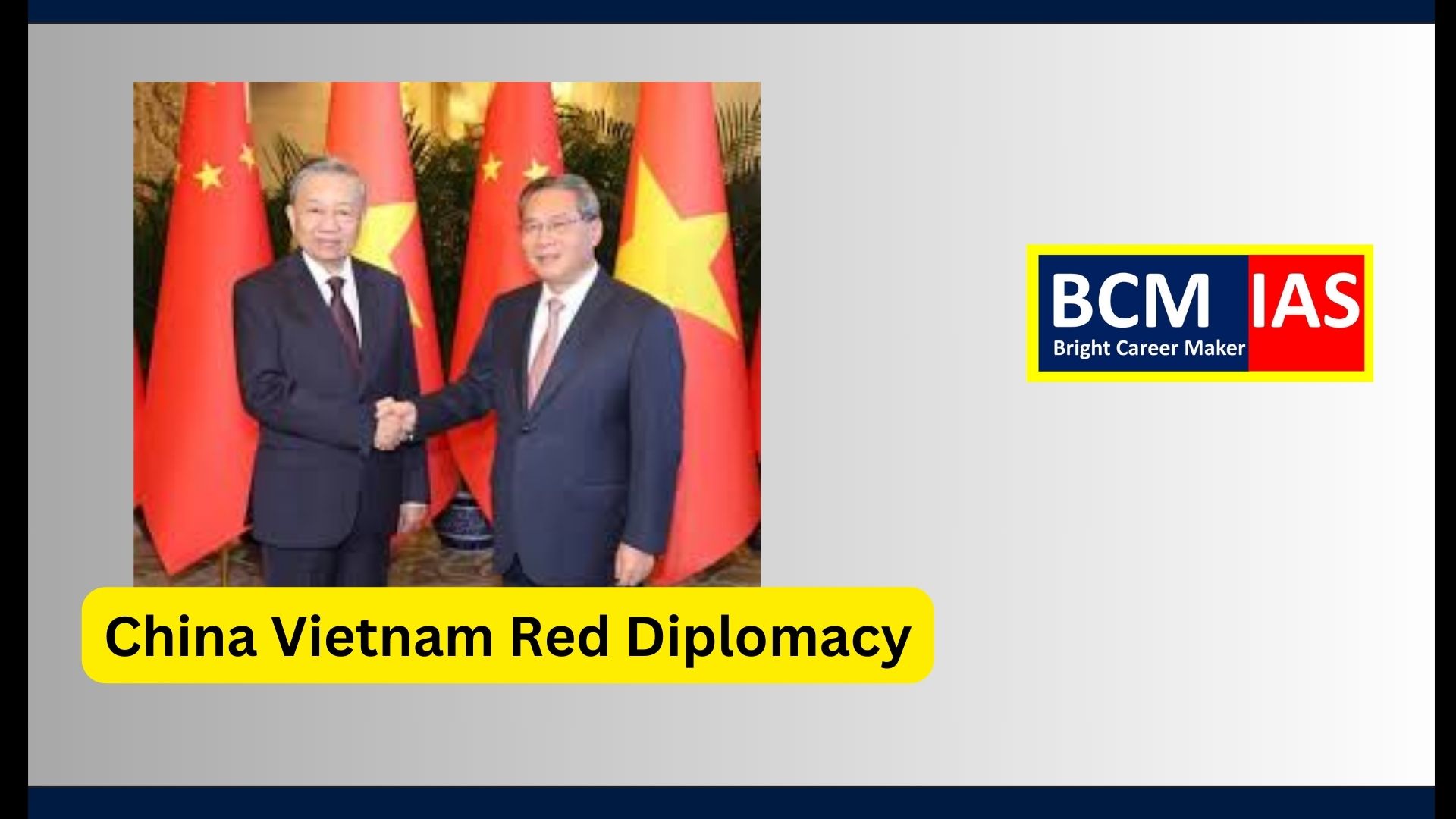
EDITORIAL- CHINA VIETNAM’s RED DIPLOMACY
News Analysis
·
The article discusses the diplomatic relations between Vietnam and China,
focusing on Vietnamese President Vo Van Thuong’s visit to China.
·
It explores how Vietnam and China are working to
revive historical ties, particularly invoking the legacy of Mao Zedong and Ho
Chi Minh's camaraderie to foster mutual trust in their contemporary bilateral
relationship.
Key Highlights of the Article:
1. Historical Context and Strategic Diplomacy:
o The article
emphasizes how Vietnam, frustrated with Western alliances (especially in the
context of tensions in the South China Sea involving the U.S. and the
Philippines), is looking to strengthen ties with China.
o President
Thuong’s visit comes in the backdrop of geopolitical tensions where the U.S.
and its allies are seen to be cornering China in the region, particularly in
the South China Sea.
o The connection
to Mao Zedong and Ho Chi Minh's historical friendship plays a symbolic role in
refreshing the ideological bond between the two countries.
2. Vietnam's Prioritization of China:
o Unlike its
relationship with the U.S., which is scrutinized for its concerns regarding
human rights and governance, Vietnam’s ties with China are built on mutual
appreciation of each other's political systems.
o Both countries
issued a joint statement during the visit, aiming to “strengthen the
comprehensive strategic cooperative partnership” and establish a “Vietnam-China
community with a shared future.”
3. Shared Ideology and Governance:
o President
Thuong’s visit included working sessions with the Central Party School of the
Communist Party of China (CPC). This visit emphasized the importance of
learning from China’s governance and cadre training models.
o The two
countries seek to deepen cooperation in governance, socialism, and fighting
corruption, which aligns with the CPC’s goals for regional diplomacy and
socialist development.
4. Economic Cooperation and Investments:
o China remains
Vietnam’s largest investment partner, contributing significantly to the
country’s economic development. In 2023, China invested $4.47 billion in
Vietnam, an increase from previous years.
o The visit also
highlighted China’s heavy involvement in Vietnam's infrastructure and projects.
With 29.7% of all new projects in the first seven months of 2024 attributed to
China, economic interdependence continues to grow.
o Vietnam signed
14 agreements during the visit, expanding cooperation in sectors like
healthcare, technology, infrastructure, and trade.
5. Territorial Disputes:
o Despite close
ties, territorial disputes remain a significant area of tension, particularly
over the Paracel and Spratly Islands in the South China Sea.
o These disputes,
alongside trade deficits and security concerns, prevent a fully harmonious
relationship, but both countries are working through diplomatic mechanisms like
the “Bamboo Diplomacy” to manage these issues.
6. Complex Global Positioning:
o Vietnam is
balancing its relationships with both China and other global powers, including
the U.S., Russia, and India.
o For Vietnam,
China serves as a close ideological partner, but the country also engages in
strategic alliances with other nations for broader regional security and
economic reasons.
o India, in
particular, is mentioned as an important partner for Vietnam, with strong
religious and cultural ties, along with shared resistance to colonialism.
7. Implications for Global Power Structures:
o Vietnam’s
efforts to strengthen its relations with China reflect its strategic position
within regional and global geopolitics. The country is navigating complex
diplomatic waters, enhancing its ties with China while also expanding its
partnerships with other powers like India and the U.S.
Conclusion:
The article presents a nuanced picture of China-Vietnam
relations, rooted in historical ties but also shaped by contemporary strategic
needs. While the two countries share a socialist ideology and cooperate closely
in areas of governance, economy, and diplomacy, territorial disputes and
regional politics present challenges to a fully harmonious relationship.
Vietnam is carefully balancing its global alliances to secure both ideological
alignment and economic development for the future.
Question:
Discuss the historical and strategic dimensions
of China-Vietnam relations, highlighting the key areas of cooperation and
challenges in the current geopolitical landscape.
Answer:
China-Vietnam relations have deep historical roots, shaped
significantly by their shared communist ideologies and the camaraderie between
leaders Mao Zedong and Ho Chi Minh. However, their bilateral ties are also
shaped by modern-day geopolitical and economic interests, creating a relationship
characterized by both cooperation and conflict.
Historical Context of China-Vietnam Relations:
·
The foundation of modern China-Vietnam relations was
laid during the anti-colonial struggle when both countries sought independence
from foreign powers. The strong ideological bond between their communist
movements continues to play a symbolic role in diplomacy today.
·
President Vo Van Thuong’s visit to China in 2024
sought to revive this camaraderie by invoking historical ties, particularly the
Mao-Ho Chi Minh friendship, in an effort to bolster mutual trust amidst global
geopolitical tensions.
·
Vietnam’s strategic choice to strengthen ties with
China comes against the backdrop of increasing Western pressure in the South
China Sea, where U.S. and Philippine alliances attempt to counter China’s
territorial claims. In this context, China offers a diplomatic buffer for
Vietnam, particularly in terms of socialist ideology and governance.
Key Areas of Cooperation:
1.
Economic Cooperation:
o China remains
Vietnam’s largest investment partner, investing $4.47 billion in 2023 and
participating in over 700 infrastructure projects. This economic
interdependence is a cornerstone of their relationship.
o The signing of
14 new agreements during the 2024 visit further consolidates their cooperation
across sectors such as healthcare, connectivity, trade, and customs.
2.
Ideological Alignment and Governance:
o Both countries
emphasize governance cooperation, with Vietnam’s Communist Party seeking to
learn from China’s governance and cadre training models. This reflects a deeper
alignment in their socialist trajectories.
o A joint
statement issued by both nations emphasizes a shared strategic future, aimed at
building a “Vietnam-China community with a shared future,” reflecting their
mutual commitment to socialist governance.
3.
Regional Diplomacy and Security:
o Vietnam’s
“Bamboo Diplomacy” aims to engage China while balancing relationships with
other regional powers. The ongoing cooperation in diplomatic and strategic
areas highlights China’s importance in Vietnam’s broader regional strategy.
Challenges in the Relationship:
1.
Territorial Disputes:
o Despite the
cooperative rhetoric, territorial disputes in the South China Sea—especially
over the Paracel and Spratly Islands—remain a significant source of tension.
o Both nations
have competing claims over these strategic maritime regions, with disputes
occasionally flaring up into diplomatic spats.
2.
Vietnam’s Growing Geopolitical Balancing Act:
o While Vietnam
seeks to deepen ties with China, it is also expanding its partnerships with
other powers like the U.S., India, and Russia. This careful diplomatic
balancing act reflects Vietnam’s desire to safeguard its sovereignty while
leveraging global powers for economic and security benefits.
o India, for
instance, holds a special place in Vietnam’s diplomatic outreach due to shared
religious, cultural, and anti-colonial ties, making it a critical partner for
strategic cooperation in the Indo-Pacific region.
3.
Domestic and External Pressures:
o Internally,
Vietnam has to balance its growing dependence on Chinese investments with
concerns about over-reliance on China’s economy. Externally, it faces pressure
from the U.S. and its allies, especially regarding human rights and governance
issues, which are less emphasized in Vietnam-China relations.
Conclusion:
·
China-Vietnam relations are shaped by a mix of
historical ties, ideological alignment, and strategic necessity.
·
While cooperation in areas like economic development
and governance remains strong, significant challenges persist, particularly
territorial disputes and Vietnam’s need to balance its relationships with
global powers.
·
As Vietnam continues to engage with China, it is
likely to maintain its “Bamboo Diplomacy,” navigating a complex geopolitical landscape to
safeguard its national interests and sovereignty.


Comments on “EDITORIAL- CHINA VIETNAM’s RED DIPLOMACY”