


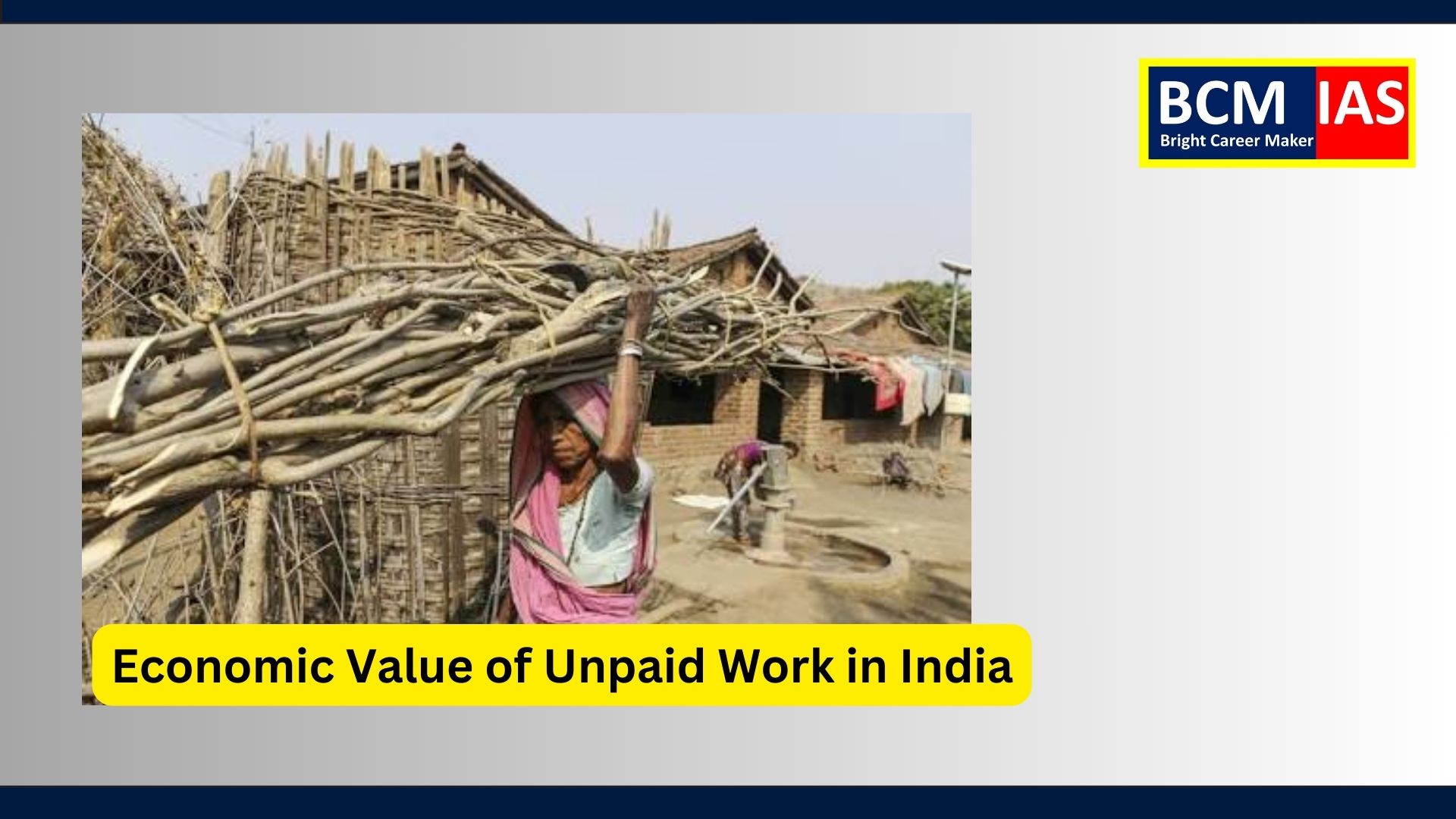
Economic
Value of Unpaid Work in India
1. Context and Background
A recent research paper has spotlighted the
significant economic value of unpaid work, with a particular focus on the
contributions of women. Unpaid work, which includes domestic chores and
caregiving responsibilities, is an essential but undervalued sector of the
economy. Recognizing its value could have far-reaching implications for gender
equality, economic inclusion, and policy reform.
2. Key Concepts and Definitions
- Unpaid
Work: Refers to non-remunerated
activities that people, especially women, perform at home or in
communities. It includes:
- Domestic
Tasks: Cooking, cleaning, and
childcare.
- Care
Work: Taking care of the elderly,
children, or sick family members.
- Community
Services: Volunteering and social
work without pay.
- Subsistence
Production: Activities like farming
or crafting for personal use, not for sale.
- Care
Economy: The sector of the economy
that deals with caregiving and domestic work, which is often unpaid and
disproportionately undertaken by women.
3. Importance of Recognizing Unpaid
Work
- Economic
Contribution: Unpaid work significantly
contributes to the economy, sometimes representing a considerable share of
the GDP, especially in developing nations.
- Gender
Disparities: Women disproportionately
bear the burden of unpaid work, often limiting their access to education,
skill development, and paid employment.
- Alignment
with SDGs: Recognizing unpaid work
aligns with SDG 5 (Gender Equality), which emphasizes valuing
unpaid care and domestic work to promote gender equality.
4. Key Findings of the Research on
Unpaid Work
a. Quantifying Unpaid Work
·
Data Source: The research uses the Consumer
Pyramids Household Survey (CPHS) by the Centre for Monitoring Indian Economy
(CMIE) from September 2019 to March 2023, covering individuals aged 15
and above.
·
Time Spent on Unpaid Work:
o
Women not in the labor force spend over 7 hours daily on unpaid tasks, while employed
women spend around 5.8 hours.
o
Men contribute significantly less, averaging under 4 hours for
unemployed men and 2.7 hours for employed men.
b. Valuation Methods
- Opportunity Cost Method (GOC): Values unpaid labor by estimating wages
individuals forgo by engaging in unpaid tasks.
- Replacement Cost Method (RCM): Assigns value to unpaid tasks by calculating
what it would cost to hire market workers for similar work.
- Valuation Results:
- Using GOC, the value of unpaid work in
2019-20 was Rs 49.5 lakh crore, accounting for 24.6% of India’s
GDP.
- Using RCM, the estimated value rose to
Rs 65.1 lakh crore (32.4% of GDP).
c. Policy Implications
- Encouraging
Workforce Participation:
Recognizing unpaid work could promote gender equity and improve female
labor force participation, potentially increasing India’s GDP by 27%.
- System of
National Accounts (SNA): The current SNA includes household
production but excludes unpaid care work, indicating a need for revision
to better reflect unpaid contributions.
5. Key Statistics on Unpaid Work in India
- Periodic Labour Force Survey
(PLFS) 2023-24:
- 36.7% of females and 19.4% of the workforce
participate in unpaid work within household enterprises.
- Time Use Survey 2019
(National Statistical Office):
- 81% of females aged 6+ spend over five hours daily on unpaid
domestic work, with even higher figures for those aged 15-59.
- In contrast, only 24.5% of men aged 6+
spend more than an hour on unpaid domestic work.
- Caregiving:
26.2% of women aged 6+ spend over two hours daily on caregiving, compared
to just 12.4% of men.
6. Why Are Women More Involved in
Unpaid Work?
- Cultural
Norms: Societal expectations
position women as primary caregivers, making unpaid work a normalized
responsibility.
- 53% of women are outside the labor force due to
caregiving responsibilities, compared to 1.1% of men.
- Economic
Constraints: Many households rely on
unpaid work by women as a cost-saving measure, especially in low-income
families where hiring help is unaffordable.
- Limited
Employment Opportunities:
Rural women or those with lower education levels may have fewer job
opportunities, resulting in unpaid work being their primary contribution
to family welfare.
- Policy
Gaps: Lack of family-friendly
policies and flexible work arrangements often restrict women's employment
options and reinforce the burden of unpaid work.
7. Policy Recommendations to Address
Unpaid Work Inequality
- Invest in
Early Childhood Care and Education (ECCE):
Increase funding to make childcare accessible and affordable, reducing the
unpaid care burden on women.
- Flexible
Work Policies: Encourage companies to
implement flexible arrangements and extend paid family leave to include
caregiving for elderly or special needs family members.
- Legal
Frameworks: Introduce laws that formally
recognize unpaid care work as a valuable economic contribution and promote
gender equality in labor rights.
- Promote
Shared Responsibility: National campaigns to
shift societal norms, encouraging shared domestic and caregiving
responsibilities between genders.
8. Conclusion
Recognizing the economic value of unpaid work is
essential for gender equality and economic growth. By valuing
unpaid work in economic metrics and implementing supportive policies, India can
address disparities, empower women’s workforce participation, and promote
sustainable economic development. Integrating unpaid work into official
accounts and promoting fair labor practices are critical steps toward a more
equitable society and stronger economy.
Probable Mains Question
Question:
Discuss the economic and social impact of unpaid work on women in India. What
measures can be taken to recognize and reduce the burden of unpaid work to
promote gender equality and economic growth?
Answer:
Introduction:
Unpaid work, primarily performed by women, includes domestic chores and
caregiving responsibilities that remain unaccounted for in official economic statistics.
Despite its significant contribution to the economy, unpaid work perpetuates
gender disparities, limits women’s economic independence, and hampers the
realization of gender equality.
Economic and Social Impact of Unpaid Work on Women
in India:
1.
Economic Contribution but Lack of
Recognition:
o
Unpaid work supports the economy
by providing essential services, facilitating the participation of others in
paid labor. Research estimates its value to be 24.6%–32.4% of India’s GDP
if monetized. However, it remains invisible in national accounts, undervaluing
women’s contribution.
2.
Restricted Access to Paid
Employment:
o
Due to the burden of unpaid work,
women have limited time for formal employment, skill development, and
education, reinforcing economic dependency and inequality. This restricts their
ability to gain financial independence, which is crucial for empowerment.
3.
Gender Disparities and Social
Inequities:
o
Women spend an average of 5.8–7
hours daily on unpaid tasks, while men contribute significantly less. This
disparity reinforces traditional gender roles and limits women’s participation
in public and professional spheres, entrenching cycles of inequality.
4.
Impact on Health and Well-being:
o
The physical and emotional toll
of unpaid work is substantial, often affecting women’s health and mental
well-being. The lack of rest and social interaction associated with these
responsibilities can lead to burnout and stress.
Measures to Recognize and Reduce the Burden of
Unpaid Work:
1.
Incorporate Unpaid Work in
National Accounts:
o
Updating the System of
National Accounts (SNA) to include unpaid care work would formally
acknowledge its economic value. This would highlight the scale of unpaid work
and help policymakers make informed decisions.
2.
Investment in Childcare and
Caregiving Infrastructure:
o
Increased government spending on Early
Childhood Care and Education (ECCE) and community childcare services can
alleviate women’s unpaid caregiving burden, enabling them to pursue paid
employment and education.
3.
Flexible Work Policies:
o
Employers can support women by
offering flexible work options, remote work, and family-friendly policies,
making it easier for women to balance work with unpaid responsibilities.
Extending paid leave policies for caregiving can also encourage more equitable
sharing of responsibilities.
4.
Promote Shared Domestic
Responsibility:
o
National campaigns challenging
traditional gender roles can encourage men to take a more active role in
household duties. Education and awareness programs in schools can promote
equality in caregiving responsibilities from an early age.
5.
Legal Frameworks and Economic
Incentives:
o
Implementing policies that
recognize unpaid work as a legitimate economic contribution, such as tax
credits for caregivers or social security benefits for homemakers,
can provide economic support to women engaged in unpaid work.
Conclusion:
Recognizing and valuing unpaid work is essential for achieving gender equality
and empowering women in India. Incorporating unpaid work into economic measures
and implementing policies that reduce this burden will enable more women to
participate in the labor market, thereby enhancing their economic independence
and contributing to the country’s economic growth. A more inclusive economic
framework that values women’s unpaid contributions will pave the way for a
fairer, more equitable society.


Comments on “Economic Value of Unpaid Work in India”