


Daily Current Affairs Analysis
14 June 2024
-------------------------------------------------------------------------------------------------------------
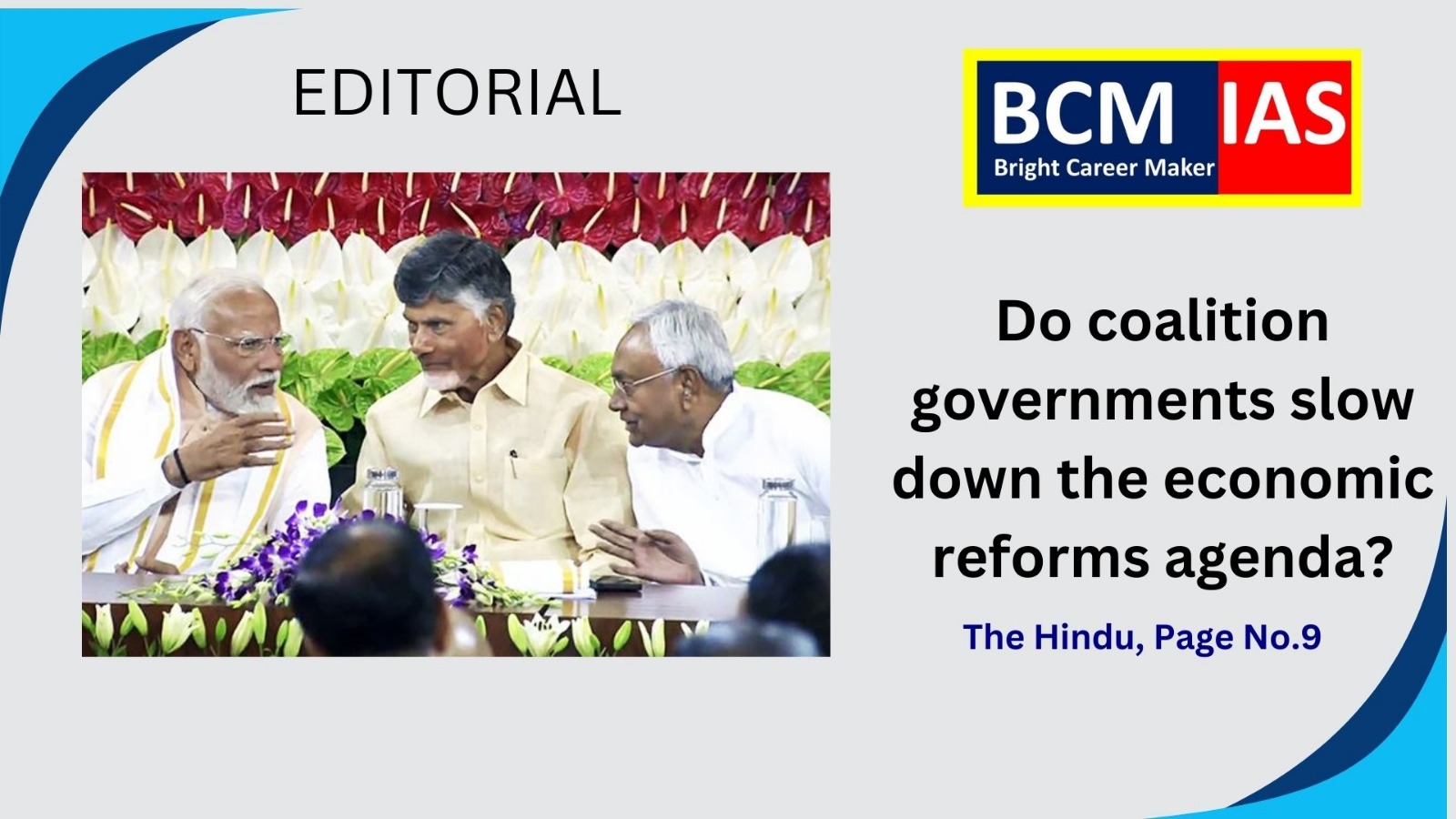
Do coalition governments slow down the economic
reforms agenda
Meaning of Headline-
·
The headline poses a question about whether coalition governments,
which are formed by multiple political parties, tend to hinder the pace and
implementation of economic reforms compared to single-party governments.
·
It suggests an exploration of the dynamics and effectiveness of
coalition governments in pursuing economic policy changes and reforms.
Related Topic (as per UPSC
Syllabus)
Prelims:
- Polity and
Governance:
o
Structure, organization, and functioning of the
Executive and the Legislature.
o
Issues related to the development and management of
Social Sector/Services relating to Health, Education, Human Resources.
Mains:
- General Studies
Paper II (GS-II):
o
Indian Constitution:
§
Historical underpinnings, evolution, features,
amendments, significant provisions, and basic structure.
o
Polity:
§
Functions and responsibilities of the Union and the
States, issues, and challenges pertaining to the federal structure, devolution
of powers and finances up to local levels, and challenges therein.
o
Governance:
§
Role of civil services in a democracy.
- General Studies
Paper III (GS-III):
o
Economy:
§
Indian Economy and issues relating to planning,
mobilization, of resources, growth, development, and employment.
§
Government Budgeting.
§
Effects of liberalization on the economy, changes in
industrial policy, and their effects on industrial growth.
§
Infrastructure: Energy, Ports, Roads, Airports,
Railways, etc.
o
Investment Models:
§
Economic reforms in various sectors.
Interview:
- Current Affairs:
o
Understanding of the implications of coalition
politics on economic policies and governance.
o
Analytical ability to evaluate the stability and
efficacy of coalition governments in the Indian political context.

News
Analysis
Introduction:
The article titled "Do coalition governments
slow down the economic reforms agenda?" is a discussion featuring K.K.
Kailash and Sanjay Ruparelia, moderated by Sobhana K. Nair. It explores whether
coalition governments impede economic reforms compared to single-party
governments, with references to India's political history and current
scenarios.
Body:
Key Points:
1. Context
and Historical Background:
o
The article begins by highlighting that until the 2014
Lok Sabha elections, India experienced coalition governments for 21 years.
o
The BJP's victory in 2014 brought a single-party
majority, but the return to coalition politics raises questions about the
impact on economic reforms.
2. K.K.
Kailash's Perspective:
o
Kailash argues that the notion that single-party
governments are inherently better for economic reforms is based on flawed
assumptions.
o
Comparative studies suggest that single-party
governments do not necessarily behave as unitary actors and that the
differences between coalition and single-party governments are not as
significant as presumed.
o
He points out that coalition governments involve
compromises and negotiations, which can lead to more stable and long-term
policies due to broader support.
3. Sanjay
Ruparelia's Perspective:
o
Ruparelia notes that coalition governments can indeed
slow down the decision-making process due to the need for negotiation and
compromise.
o
He cites the United Progressive Alliance (UPA)
government as an example where reforms faced multiple veto points, resulting in
delays and compromises.
o
Despite this, he acknowledges that coalition
governments can still achieve significant reforms, as seen in the
implementation of the Goods and Services Tax (GST).
4. Debate on
State and Central Relations:
o
Kailash discusses the tension between the Centre and
States, particularly in terms of fiscal federalism and the division of taxes.
o
He argues that increased centralization of
decision-making has led to conflicts, and coalitions can provide a more
balanced approach by incorporating diverse regional interests.
5. Economic
Policies and Reforms:
o
The article addresses the impact of coalition politics
on economic policies, with a focus on how the National Democratic Alliance
(NDA) and UPA managed economic reforms.
o
Ruparelia mentions that while coalitions might slow
down the process, they also ensure that policies are debated and refined
through broader consensus.
6. The Role
of Ideological Commitment:
o
Both discussants agree that the ideological commitment
of the parties involved plays a crucial role in determining the success of
economic reforms.
o
They highlight that even within coalitions, strong
leadership and clear policy agendas can drive significant reforms.
Conclusion:
The article concludes that while coalition
governments may introduce delays and require more negotiation, they do not
necessarily hinder economic reforms. Instead, they can lead to more stable and
well-rounded policies due to the involvement of multiple stakeholders. The
success of economic reforms in a coalition setup largely depends on the
leadership, ideological commitment, and ability to navigate the complexities of
coalition politics.
Overall, the discussion provides a nuanced
view of the impact of coalition governments on economic reforms, emphasizing
that the process might be slower but can result in more inclusive and
sustainable policies.
Mains Probable Question
"Examine the impact of coalition
governments on the economic reform agenda in India with examples and suggest
measures for improvement."
Model Suggested Answer:
1.
Introduction
Coalition
governments, formed when no single political party secures a majority in the
legislature, have been a recurrent feature in Indian politics, especially since
the late 1980s. These governments, comprising multiple political parties with
varied ideologies and policy priorities, often face challenges in maintaining
stability and coherence in policy implementation. This dynamic poses
significant implications for the country's economic reform agenda, which
requires decisive and cohesive policymaking. Economic reforms, aimed at
liberalizing and modernizing the economy, often involve difficult decisions
that may not align with the diverse interests of coalition partners. This essay
explores the impact of coalition governments on economic reforms in India,
evaluates the challenges and successes, and suggests measures for improvement.
2.
Demand of the Question
Impact on Economic Reforms
Policy
Paralysis and Compromises: Coalition governments
frequently encounter policy paralysis due to the need for consensus among
diverse coalition partners. This often results in diluted policies or
compromises that do not fully address the required economic reforms. The lack
of a unified vision can lead to delays and inefficiencies in the implementation
of critical reforms.
Examples
of Coalition Government Challenges: One of the notable examples
is the United Progressive Alliance (UPA) government (2004-2014), which faced
significant hurdles in implementing economic reforms due to internal
disagreements. The introduction of the Goods and Services Tax (GST) was delayed
due to opposition from coalition partners and states governed by different
parties. Similarly, the economic liberalization measures in sectors like retail
and insurance faced resistance from coalition partners, leading to partial
implementation or significant delays.
Policy Continuity and
Stability: Coalition governments often struggle with
maintaining policy continuity and stability. Frequent changes in government or
in the composition of the coalition can lead to reversals or significant
modifications of previously initiated reforms. This uncertainty can deter
investment and hinder long-term economic planning. For instance, the National
Democratic Alliance (NDA) government (1999-2004) initiated several economic
reforms, but the subsequent UPA government reversed or stalled some of these
initiatives, affecting policy stability.
Balanced Regional
Development: On the positive side, coalition governments can
promote balanced regional development by ensuring that the interests of various
regions are considered in policymaking. This inclusivity can lead to more
equitable economic growth and development. The inclusion of regional parties in
the central government ensures that regional issues and priorities are
addressed, leading to policies that cater to a broader spectrum of the
population.
Successes in Economic
Reforms
Consensus Building: Despite the
challenges, coalition governments have achieved significant economic reforms
through consensus building and negotiation. The implementation of the GST in
2017, under the NDA government, is a testament to the success of coalition
politics in achieving major economic reforms. The government engaged in
extensive negotiations with states and political parties to build consensus,
resulting in the implementation of a landmark tax reform that aimed to unify
the country's tax structure.
Economic
Liberalization: The coalition government led by Prime
Minister P.V. Narasimha Rao in the early 1990s initiated significant economic
liberalization reforms, despite not having a clear majority. These reforms,
including deregulation, reduction of import tariffs, and opening up of various
sectors to foreign investment, were crucial in transforming India's economy.
The support and cooperation from coalition partners were critical in pushing
through these reforms.
Decentralization and
Fiscal Federalism: Coalition governments have also
contributed to greater decentralization and fiscal federalism. By involving
regional parties in decision-making, coalition governments ensure that fiscal
policies are more attuned to the needs of different states. This can lead to
more effective allocation of resources and better implementation of development
programs at the regional level.
3.
Way Forward
Strengthening Institutional
Mechanisms
Improving
Decision-Making Processes: To mitigate the challenges of
coalition politics, it is essential to strengthen institutional mechanisms that
facilitate efficient decision-making. Establishing robust frameworks for
inter-party consultation and conflict resolution can help in managing disagreements
and ensuring smoother policy implementation. Regular meetings of coalition
coordination committees can help in ironing out differences and aligning policy
priorities.
Enhancing Parliamentary
Committees: Strengthening the role of
parliamentary committees can also improve the effectiveness of coalition
governments. These committees can provide a platform for detailed discussions
and negotiations, leading to more informed and consensual policymaking. Enhancing
the capacity and authority of these committees can ensure that diverse
viewpoints are considered, and policies are thoroughly vetted before
implementation.
Encouraging Political
Accountability
Transparency and
Accountability: Increasing transparency and
accountability in coalition agreements can help in maintaining policy coherence
and stability. Publicly available coalition agreements detailing policy
commitments and mechanisms for resolving disputes can reduce uncertainties and
build public trust. Clear accountability mechanisms can ensure that coalition
partners adhere to agreed-upon policies and do not undermine the reform agenda
for political gains.
Electoral Reforms:
Electoral
reforms that encourage stable and coherent coalition governments can also be
beneficial. For instance, introducing measures to incentivize pre-election
coalitions can help in ensuring that coalition partners have a clear mandate
and a shared vision, reducing post-election instability. Reforms that promote
proportional representation can also ensure that coalition governments better
reflect the diverse political landscape of the country.
Promoting Economic
Inclusivity
Inclusive Growth
Policies: To address the economic concerns of diverse
coalition partners, it is essential to design inclusive growth policies that
cater to the needs of various regions and communities. Policies that promote
regional development, social equity, and economic inclusion can help in
building broader consensus and reducing resistance to economic reforms.
Ensuring that the benefits of economic growth are equitably distributed can
enhance public support for reform initiatives.
Strengthening
Federalism: Strengthening the federal structure
can also contribute to more effective coalition governance. Empowering states
with greater fiscal autonomy and decision-making authority can reduce the
centralization of power and ensure that regional interests are adequately
addressed. Enhanced cooperation and coordination between the center and states
can lead to more effective implementation of economic reforms.
Conclusion
Coalition governments, despite their
inherent challenges, have played a significant role in India's political
landscape. Their impact on the economic reform agenda has been mixed, with
instances of both policy paralysis and successful reforms. Strengthening
institutional mechanisms, encouraging political accountability, and promoting
economic inclusivity are crucial steps to enhance the effectiveness of
coalition governments in pursuing economic reforms. By addressing these
challenges, India can ensure that coalition politics becomes a catalyst for
inclusive and sustainable economic growth, rather than an impediment to
progress.
MCQs for Prelims Practice
1-
Which of the following is a potential disadvantage of
coalition governments in India?
- A) Enhanced policy stability
- B) Reduced regional representation
- C) Policy paralysis due to lack of consensus
- D) Centralization of power
Answer: C) Policy
paralysis due to lack of consensus
2- The Goods and
Services Tax (GST) in India was implemented under which coalition government?
- A) United Progressive Alliance (UPA)
- B) National Democratic Alliance (NDA)
- C) Third Front
- D) Left Front
Answer: B) National
Democratic Alliance (NDA)
3- Which Prime
Minister's coalition government is credited with initiating significant
economic liberalization reforms in the early 1990s in India?
- A) Atal Bihari Vajpayee
- B) Manmohan Singh
- C) P.V. Narasimha Rao
- D) H.D. Deve Gowda
Answer: C) P.V.
Narasimha Rao
4- One of the major
challenges for coalition governments in implementing economic reforms is:
- A) Lack of political experience
- B) Need for constant consensus-building
- C) Excessive executive power
- D) Unitary nature of government
Answer: B) Need for
constant consensus-building
5- Which of the
following reforms faced delays due to opposition from coalition partners in the
UPA government?
- A) Digital India initiative
- B) GST implementation
- C) Financial Inclusion programs
- D) Make in India initiative
Answer: B) GST
implementation
Other Important Links
|
|
Follow us
on-
|
|
ADMISSIONS
OPEN For
Details, Contact us- 9711394350 / 9717724350 |
|


Comments on “Do coalition governments slow down the economic reforms agenda”