


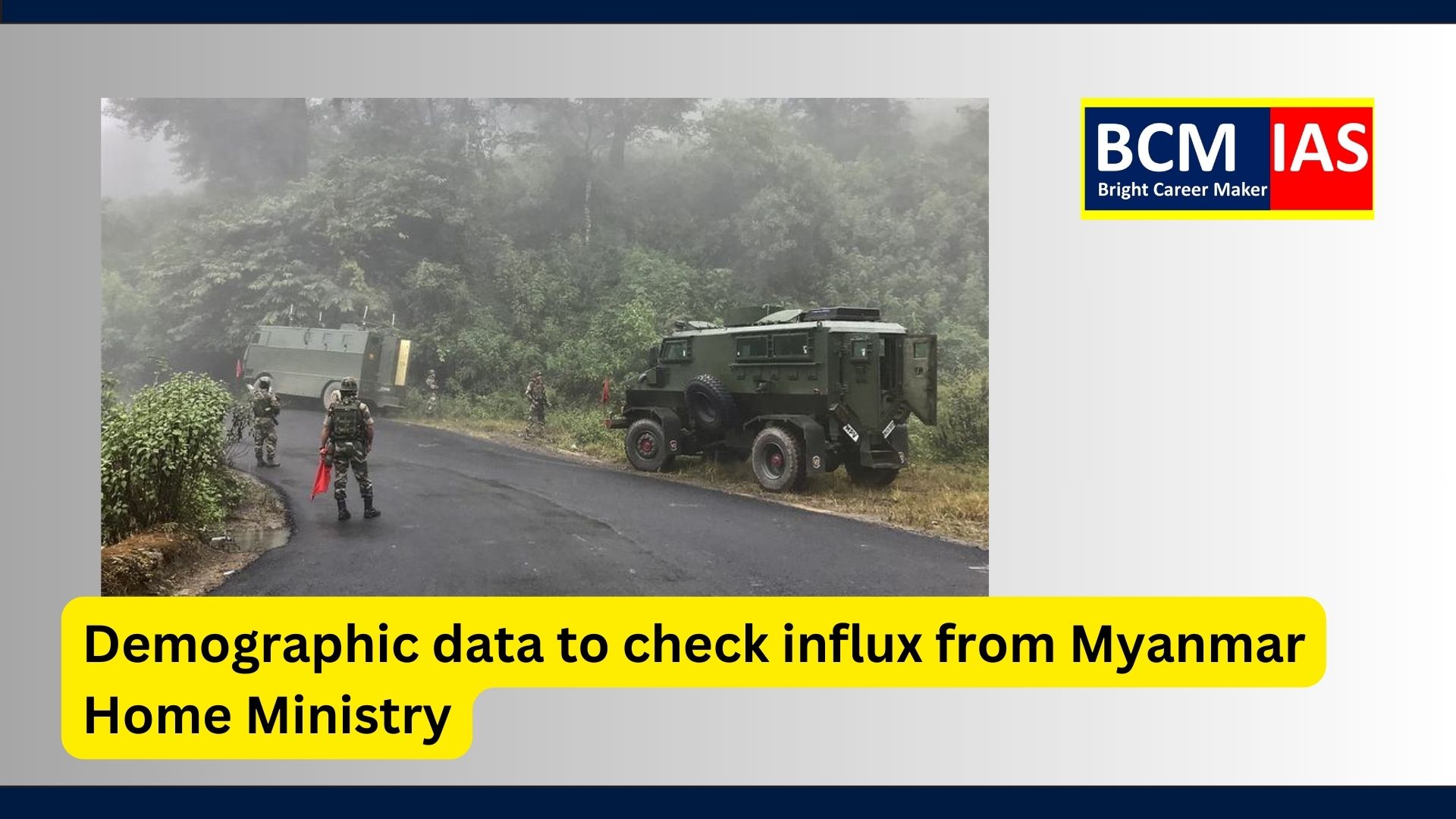
Demographic
data to check influx from Myanmar- Home Ministry
Key
Issues Highlighted
The
Home Ministry's review for 2024 touches on critical national security and
development challenges, with a focus on:
1. Border Management: Demographic mapping and securing the
India-Myanmar border.
2. Northeast Development: Peace-building and resource mapping.
3. Left-Wing Extremism (LWE): Achievements in curbing insurgency.
4. Drug Trafficking: Comprehensive efforts to dismantle
cartels.
Key
Aspects
1. Border Management and Influx from
Myanmar:
o Challenges:
§ Myanmar shares a 1,643 km largely
unfenced border with India.
§ Infiltration concerns, especially in
Nagaland, Mizoram, and Manipur, could affect the demographic structure and
security of northeastern states.
o Free Movement Regime (FMR):
§ The FMR allowed residents within 16 km
of the border to travel across for social and economic purposes.
§ The Ministry has decided to suspend
the FMR to ensure better control over cross-border movements.
o Recent Developments:
§ A new protocol reduces the movement
limit to 10 km, but the formal notification is pending.
§ Fencing and demographic mapping are
critical for better border control.
2. Northeast Development:
o Peace and Prosperity:
§ The Ministry claims success in
reducing insurgency and fostering unity in the region.
o Resource Mapping:
§ Extensive mapping for mineral, oil,
and coal reserves is planned.
§ States will benefit financially from
royalties on these resources.
o Implications:
§ Economic development could strengthen
the region’s integration with the rest of the country.
§ However, there is a need for
environmental safeguards and equitable sharing of benefits.
3. Combatting Left-Wing Extremism
(LWE):
o Successes:
§ Security forces eliminated 287
Naxalites and arrested 992, including key decision-makers.
o Future Plans:
§ The Ministry aims to end the LWE
menace by March 2026.
§ Comprehensive schemes for the
development of affected communities will be introduced in collaboration with
state governments.
o Impact:
§ A reduction in LWE activities signals
a significant step toward internal security and development.
§ Socio-economic initiatives are crucial
for long-term peace.
4. Drug Trafficking:
o Achievements:
§ Major drug busts include 3,132 kg of
drugs by NCB, Navy, and Gujarat Police.
§ High-profile seizures: ₹900 crore
worth cocaine and 4,134 kg narcotics from deep seas.
o Measures:
§ The Ministry emphasizes a
"whole-of-the-government approach" to combat drug trafficking.
§ Disposal of seized drugs is being
expedited to send a strong message to cartels.
o Challenges:
§ The scale of trafficking highlights
the persistence of organized crime networks.
§ Continued international cooperation is
essential for curbing cross-border drug trade.
Analysis
The
review reflects a multi-dimensional approach to addressing security and
development challenges:
1. Border Management:
o Demographic mapping and fencing are
vital to secure the Northeast, but diplomatic coordination with Myanmar is
crucial.
o Suspension of FMR will tighten
security but may disrupt cross-border communities reliant on traditional ties.
2. Development in the Northeast:
o Mapping mineral resources could
transform the region economically.
o Careful implementation is required to
balance development with environmental and cultural preservation.
3. LWE and Drug Trafficking:
o Security forces’ successes indicate
progress in tackling internal threats.
o Holistic socio-economic programs are
necessary to ensure sustainable peace.
o The scale of drug seizures underlines
the importance of robust law enforcement and inter-agency coordination.
Conclusion
The
Home Ministry’s year-end review highlights significant strides in internal
security and regional development. While progress in combating LWE and drug
trafficking is commendable, challenges remain in managing border security and
ensuring inclusive growth in the Northeast. A coordinated approach involving
local stakeholders, regional governments, and international partners is
essential to sustain these efforts.
Mains Question
Q: Critically
evaluate the Home Ministry’s measures in border security, combating LWE, drug
trafficking, and Northeast development, and their implications for internal
security and regional progress.
Answer
Introduction
India's
internal security faces diverse challenges, including cross-border
infiltration, insurgency, and drug trafficking. The Ministry of Home Affairs
(MHA) has outlined its efforts in addressing these issues while promoting peace
and development in vulnerable regions like the Northeast. This dual approach
reflects the government's intent to secure the nation and foster regional
integration.
Achievements
and Measures
1. Border Management:
o Measures:
§ Demographic mapping along the
India-Myanmar border for fencing and controlling infiltration.
§ Suspension of the Free Movement Regime
(FMR) to tighten border security.
o Implications:
§ Enhances internal security in border
states such as Nagaland, Mizoram, and Manipur.
§ However, reduced cross-border movement
may disrupt the social and economic ties of border communities.
2. Development in the Northeast:
o Measures:
§ Resource mapping for minerals, oil,
and coal to generate royalties for states.
§ Integration of peace-building
initiatives to reduce insurgency.
o Implications:
§ Economic growth and resource
utilization could improve livelihoods and infrastructure.
§ Potential environmental degradation
and displacement of local communities need to be addressed.
3. Combating Left-Wing Extremism
(LWE):
o Measures:
§ Security forces eliminated 287
extremists and arrested 992 in 2024.
§ Comprehensive schemes for affected
communities are being planned.
o Implications:
§ LWE activities have declined
significantly, indicating progress in restoring normalcy.
§ Long-term peace depends on effective
implementation of socio-economic programs.
4. Drug Trafficking:
o Measures:
§ Massive drug seizures, including
methamphetamine and cocaine worth ₹900 crore.
§ Destruction of 1,17,284 kg of
narcotics in 2024.
o Implications:
§ The crackdown sends a strong message
to drug cartels.
§ Sustained inter-agency and
international cooperation is required to dismantle trafficking networks.
Challenges
1. Border Management:
o Fencing may face resistance from
border communities with historical ties across the border.
o Coordinating with Myanmar is critical
for effective implementation.
2. Northeast Development:
o Resource extraction must balance
economic gains with environmental sustainability.
o Inclusive governance is essential to
ensure benefits reach marginalized communities.
3. LWE and Drug Trafficking:
o Resurgence of extremism due to
socio-economic grievances could undermine gains.
o The scale of drug trafficking indicates
persistent organized crime networks requiring vigilance.
Recommendations
1. Comprehensive Border Strategy:
o Combine fencing with technological
surveillance for better efficiency.
o Strengthen bilateral ties with Myanmar
for coordinated border management.
2. Sustainable Development:
o Ensure environmental impact
assessments before resource extraction.
o Promote local participation in
developmental planning to address grievances.
3. Strengthening Anti-Drug Measures:
o Enhance coordination among central and
state agencies for intelligence sharing.
o Promote community-based rehabilitation
for drug-affected areas.
4. Addressing LWE:
o Focus on employment generation,
education, and health in affected regions.
o Involve local leaders to foster trust
and participation in governance.
Conclusion
The
MHA’s measures demonstrate a balanced approach to internal security and
regional development. While achievements in combating LWE and drug trafficking
are commendable, sustainable development and inclusive governance are critical
for long-term success. By addressing challenges in implementation, India can
achieve both security and prosperity for its vulnerable regions.
MCQs
1.
What is the primary objective of suspending the Free Movement Regime (FMR)
along the India-Myanmar border?
a)
Promote cross-border trade
b) Strengthen internal security and demographic stability
c) Facilitate cultural exchanges
d) Expand the territorial boundary
Answer: b) Strengthen internal security
and demographic stability
2.
Which Northeastern states share a border with Myanmar, as mentioned in the
review?
a)
Assam, Nagaland, Arunachal Pradesh, and Manipur
b) Arunachal Pradesh, Nagaland, Manipur, and Mizoram
c) Meghalaya, Manipur, Mizoram, and Nagaland
d) Arunachal Pradesh, Tripura, Mizoram, and Nagaland
Answer: b) Arunachal Pradesh, Nagaland,
Manipur, and Mizoram
3.
What significant milestone has the Home Ministry set to eliminate Left-Wing
Extremism (LWE)?
a)
Eliminate LWE by March 31, 2025
b) End LWE activities by March 31, 2026
c) Reduce LWE activities by 50% by 2030
d) Introduce peace talks with Naxal groups by 2024
Answer: b) End LWE activities by March
31, 2026
4.
Which initiative aims to financially benefit Northeastern states as part of the
region’s development?
a)
Establishing special economic zones
b) Extensive mapping of mineral, oil, and coal reserves
c) Introduction of tax holidays for industries
d) Expanding the Free Movement Regime
Answer: b) Extensive mapping of mineral,
oil, and coal reserves
5.
What approach has the Home Ministry emphasized to tackle drug trafficking in
the country?
a)
Strengthening only coastal surveillance systems
b) Promoting regional anti-drug campaigns in cities
c) Adopting a "whole-of-the-government" approach
d) Introducing new narcotics legislation
Answer: c) Adopting a
"whole-of-the-government" approach


Comments on “Demographic data to check influx from Myanmar- Home Ministry”