


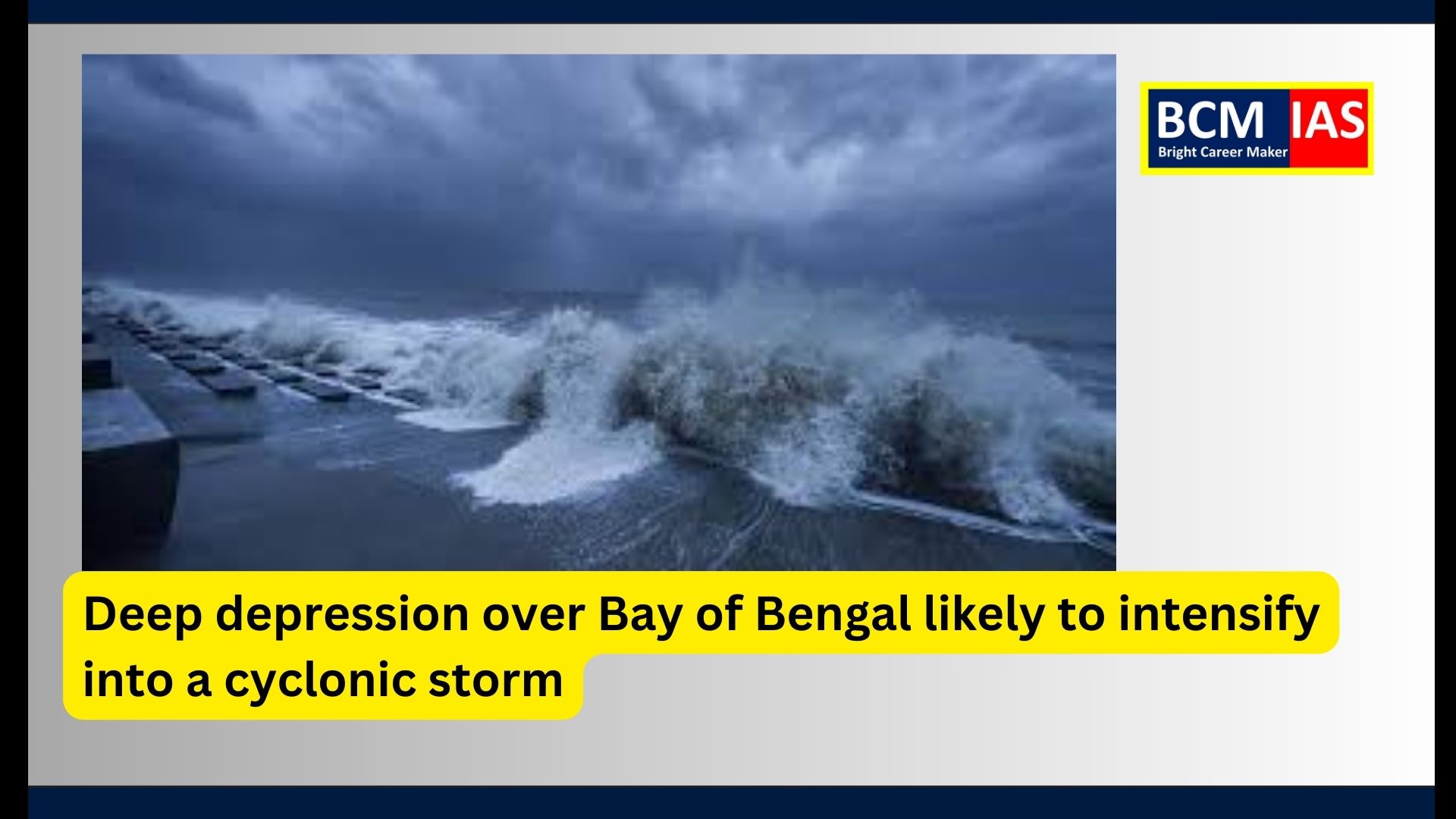
Deep depression over Bay of Bengal
likely to intensify into a cyclonic storm
Analysis
of the News
Overview
A
deep depression over the southwest Bay of Bengal is expected to intensify into a cyclonic storm. The storm poses significant weather
threats to coastal regions of Tamil Nadu and Puducherry, with heavy rainfall
and gusty winds predicted. Meteorological authorities are closely monitoring
the system’s development, path, and potential impact.
Details and
Key Highlights
Development of the System:
1. Formation:
o The system began as a depression and
developed into a deep depression by Tuesday.
o At 5:30 p.m. on Tuesday, the
depression was located:
§ 240 km southeast of Trincomalee (Sri Lanka).
§ 520 km south-southeast of Nagapattinam (Tamil Nadu).
§ 640 km south-southeast of Puducherry.
§ 720 km south-southeast of Chennai.
2. Movement and Speed:
o The system is moving north-northwestwards at a speed
of 8 kmph.
o It is expected to skirt the Sri Lankan coast and approach
Tamil Nadu within the next two days.
3. Intensification:
o The Regional Meteorological Centre
(RMC) predicts the depression will evolve into a cyclonic storm by Wednesday.
o The exact location of landfall remains uncertain, and
updated forecasts are expected by Wednesday evening.
Weather Forecast and Alerts:
1. Rainfall Predictions for Wednesday:
o Light to moderate rain is expected in many areas.
o Heavy to very heavy rain:
§ Areas under Red Alert:
§ Cuddalore, Mayiladuthurai districts,
and Karaikal (risk of extremely heavy rainfall at isolated spots).
§ Areas under Orange Alert:
§ Chennai, Tiruvallur, Kancheepuram,
Chengalpattu, Villuppuram, Ariyalur, Thanjavur, Tiruvarur, Nagapattinam, and
Pudukkottai districts, and Puducherry (isolated heavy to very heavy rainfall).
2. Potential Impacts:
o Gusty winds and heavy rain could
disrupt life, causing:
§ Flooding in low-lying areas.
§ Damage to infrastructure and crops,
particularly in coastal regions.
§ Risk to marine activities.
3. Landfall Predictions:
o Meteorological models have yet to
converge on the exact landfall point.
o One model intriguingly suggests the
possibility of the system splitting into two.
Significance of Monitoring:
1. Continuous Watch:
o Meteorologists, led by S.
Balachandran (Additional Director-General of Meteorology, RMC), are closely
monitoring the system's development to refine predictions and issue timely
warnings.
2. Uncertainty in Path:
o Predicting cyclone paths is
inherently complex, as systems are influenced by:
§ Atmospheric pressure systems.
§ Sea surface temperatures.
§ Geographical influences.
3. Model Divergence:
o Divergent model outputs highlight the
difficulty of forecasting tropical systems.
o These variations necessitate vigilant
observation and dynamic updates.
Potential Implications for
Tamil Nadu and Puducherry:
1. Urban Areas (e.g., Chennai):
o Likely disruption to daily life due to
waterlogging and localized flooding.
o Impact on transportation systems,
including roads, railways, and air traffic.
2. Rural and Coastal Areas:
o Risk to agriculture and fisheries, with crops and
marine livelihoods potentially affected.
o Vulnerability to coastal erosion and flooding in
low-lying regions.
3. Preparedness Measures:
o District authorities in affected
regions must:
§ Activate disaster response
teams.
§ Ensure readiness of shelters and evacuation plans.
§ Communicate warnings to fishermen and
restrict marine activities.
Broader Context:
1. Climatic Trends:
o The Bay of Bengal is prone to
cyclonic activity during the post-monsoon season
(October to December), driven by conducive sea temperatures and atmospheric
conditions.
2. Lessons from Past Cyclones:
o Effective early warnings and
preparedness have significantly reduced casualties in recent years.
o However, infrastructural resilience
in flood-prone areas remains a challenge.
Conclusion:
This
weather event underscores the need for proactive disaster management to
mitigate the impact on vulnerable communities. Continuous monitoring,
dissemination of accurate updates, and coordinated efforts by government
agencies will be critical in managing potential risks associated with the
intensifying storm. As more information emerges, adaptive strategies will be
key to safeguarding lives and property.
Mains Question
Q: Cyclones pose significant challenges to coastal
regions in India. Discuss the factors contributing to cyclone formation in the
Bay of Bengal and the measures required to mitigate their impact on vulnerable
communities.
Answer
Introduction
Cyclones
are intense low-pressure systems that form over warm ocean waters. The Bay of Bengal, owing to its geographical and
climatic conditions, is highly susceptible to cyclonic activity, particularly
during the pre-monsoon (April-May) and post-monsoon (October-December) seasons.
These cyclones cause extensive damage to life, property, and livelihoods,
especially in India's coastal regions.
Factors Contributing to
Cyclone Formation in the Bay of Bengal
1. Climatic and Geographical Conditions:
o Warm sea surface temperatures
(>27°C) provide the energy for cyclone formation.
o High humidity in the mid-troposphere
aids in sustaining cyclonic systems.
o Weak vertical wind shear allows the
system to strengthen.
2. Geographical Funnel Effect:
o The Bay of Bengal acts as a funnel,
channeling cyclonic systems toward the coasts of India, Bangladesh, and
Myanmar.
3. Interplay of Pressure Systems:
o The Inter-Tropical Convergence Zone
(ITCZ) and monsoonal winds often create low-pressure areas that can evolve into
cyclones.
4. Limited Dissipation:
o The absence of strong winds and large
landmasses in the Bay of Bengal reduces the dissipation of cyclonic systems,
allowing them to intensify.
5. Climatic Changes:
o Rising global temperatures and
changing climatic patterns are increasing the frequency and intensity of
cyclones.
Challenges Posed by Cyclones
1. Human and Economic Loss:
o Loss of lives, displacement of
populations, and damage to critical infrastructure like roads, bridges, and
power supplies.
o Economic losses due to disruption of
agriculture, fisheries, and industries.
2. Environmental Impact:
o Coastal erosion and destruction of
mangroves.
o Salinization of freshwater sources
and agricultural land.
3. Healthcare Risks:
o Outbreaks of diseases like cholera
and dengue due to waterlogging and poor sanitation in affected areas.
Measures to Mitigate Cyclone
Impact
1. Early Warning Systems:
o Strengthening meteorological
forecasting systems like Doppler Radars and using advanced satellite imagery
for accurate predictions.
o Timely dissemination of warnings to
vulnerable communities.
2. Disaster Preparedness:
o Regular mock drills and community
training for cyclone-prone areas.
o Pre-identified evacuation shelters
with adequate provisions.
3. Infrastructure Resilience:
o Constructing cyclone-resistant
housing and critical infrastructure.
o Strengthening coastal embankments and
restoring natural barriers like mangroves.
4. Policy and Governance:
o Effective implementation of the Disaster Management Act, 2005.
o Collaboration between central and
state governments for coordinated disaster response.
5. Post-Disaster Recovery:
o Prompt relief measures, including
food, water, and medical assistance.
o Financial assistance and insurance
schemes for affected communities.
6. Long-term Measures:
o Promoting sustainable coastal zone
management.
o Enhancing livelihood resilience
through skill development and diversification.
Conclusion
Cyclones
in the Bay of Bengal are an inevitable natural phenomenon, but their
devastating impacts can be mitigated through a combination of scientific,
infrastructural, and community-based measures. A proactive and holistic
disaster management approach, aligned with climate-resilient development, is essential to safeguard India's
coastal populations and ensure sustainable development.
MCQs
1. Cyclone Formation
What
are the necessary conditions for the formation of cyclones in the Bay of
Bengal?
a)
High atmospheric pressure and cold sea surface temperatures
b) Warm sea surface temperatures and weak vertical wind shear
c) Strong vertical wind shear and low humidity in the atmosphere
d) Cold sea surface temperatures and absence of the Inter-Tropical Convergence
Zone (ITCZ)
Answer: b) Warm sea surface temperatures and
weak vertical wind shear
2. Alerts and Preparedness
Which
areas were issued a Red
Alert due to
the likelihood of extremely heavy rainfall during the cyclonic system mentioned
in the news?
a)
Chennai and Puducherry
b) Cuddalore, Mayiladuthurai, and Karaikal
c) Kancheepuram and Chengalpattu
d) Nagapattinam and Pudukkottai
Answer: b) Cuddalore, Mayiladuthurai, and
Karaikal
3. Cyclone Tracking
According
to the news, what is the primary challenge in accurately predicting the
landfall of cyclones?
a)
Lack of data on sea surface temperatures
b) Divergence in forecasting models
c) Poor satellite imagery
d) Inadequate meteorological infrastructure
Answer: b) Divergence in forecasting models
4. Cyclone Movement
The
cyclonic system mentioned in the news was moving in which direction as of
Tuesday evening?
a)
East-northeast
b) South-southeast
c) North-northwest
d) West-southwest
Answer: c) North-northwest
5. Impact of Cyclones
What
are the likely effects of cyclones on coastal regions, as per the news?
a)
Increased rainfall, waterlogging, and potential crop damage
b) Heatwaves and rising sea levels
c) Droughts and deforestation
d) Earthquakes and tsunami risk
Answer: a) Increased rainfall, waterlogging,
and potential crop damage


Comments on “Deep depression over Bay of Bengal likely to intensify into a cyclonic storm”