


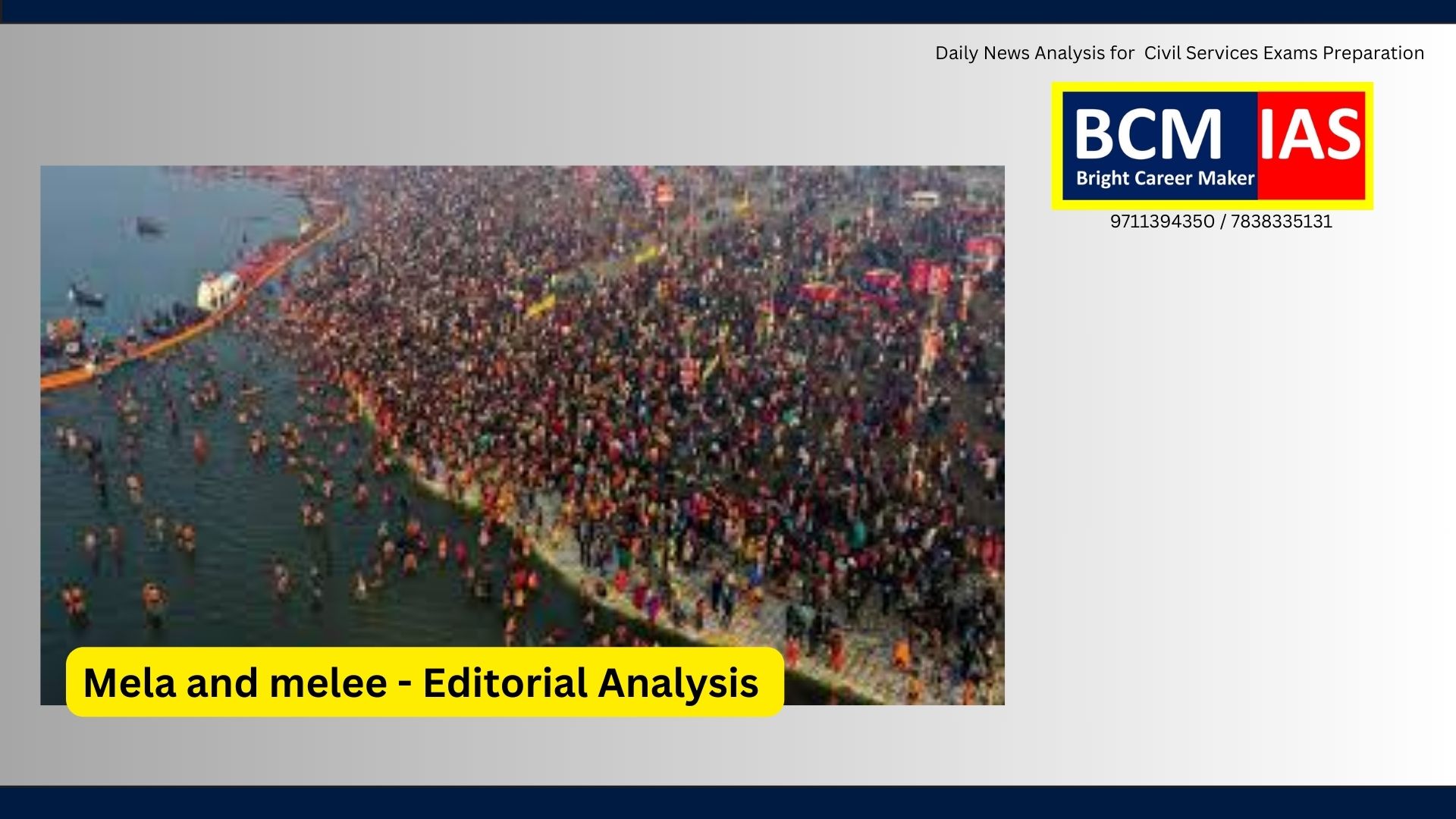
Crowd Management and Safety Issues at
Maha Kumbh Mela
The Maha Kumbh Mela in
Prayagraj, Uttar Pradesh, is one of the largest religious
gatherings in the world, drawing millions of
pilgrims. While the event holds immense cultural, spiritual,
and economic significance, recent incidents,
including crowd crushes leading to fatalities,
highlight glaring deficiencies in planning,
coordination, and crowd control measures.
This analysis examines:
1.
The gap between planning and
execution
2.
Causes of crowd disasters
3.
Failures in crisis response
4.
Lessons from global crowd
management strategies
5.
Recommendations for future
events
1. The Gap
Between Planning and Execution
The Maha Kumbh Mela was
promoted as an ultra-modern, well-organized event
with:
- AI-powered
surveillance to monitor crowds
- Special-purpose
trains and buses for pilgrims
- Hospitals
and medical infrastructure in a makeshift town
- Water
filtration systems to keep the rivers
clean
Despite a ₹7,500
crore budget, the on-ground experience
has been chaotic, leading to fatal
incidents of crowd mismanagement.
📌 Key Issues:
- Lack of Real-time Crowd Control → Technology alone is insufficient;
human interventions are needed for effective crowd movement.
- Overloading of Rail and Road Transport → Special arrangements failed to
accommodate the sheer
volume of people.
- Unclear Communication to Pilgrims → Many people were confused due to misinformation at railway
stations.
- Infrastructure Gaps →
Local railway stations lack
redevelopment to handle large crowds.
2. Causes
of Crowd Disasters at Religious Gatherings
Crowd crushes at large
religious events are a recurring issue
worldwide (e.g., Hajj
stampedes, South Korean Itaewon incident). Experts
identify several factors that contribute to such tragedies:
🔹 Human Factors:
- Mass Panic & Anxiety →
Fear of missing a train or being stranded
- Overcrowding & Restricted Movement → More people than the space can
accommodate
- Lack of Awareness →
Pilgrims unfamiliar with emergency exits
🔹 Organizational Failures:
- Overbooking & Overselling of Tickets → In the New Delhi Railway Station
incident, the Railways
sold 2,600 additional tickets, leading to congestion.
- Inadequate Crowd Management Measures → Insufficient barricades, security
personnel, and clear entry-exit
routes.
- Confusing Announcements →
A train announcement led people to rush towards the wrong platform,
worsening the situation.
📌 Lessons from Fire & Safety Experts:
- Crowds
become dangerous
when there is a trigger
(e.g., miscommunication, sudden rush).
- Lack of alternative options (e.g., missing a train means financial
loss) creates panic.
- Dispersal mechanisms like
clear directional
signage, barriers, and controlled ticketing reduce risks.
3. Failures
in Crisis Response
Despite visible
crowd distress, the official response was
slow and ineffective:
🔹 Denial of Casualties:
- Officials
initially refused
to confirm deaths, while hospitals reported fatalities.
- Some
blamed pilgrims
instead of acknowledging
systemic failures.
🔹 Inadequate Emergency Preparedness:
- Delayed rescue and medical aid → No rapid action teams were deployed to
control the crowd.
- Lack of Coordination Between Agencies → Railways, Police, and Disaster
Management Teams did not have real-time
intervention plans.
📌 A Smarter Approach Was Possible:
✅ Fixed Platforms for Special
Trains → Implemented after the
disaster, but should have been planned beforehand.
✅ Multilingual & Clear
Announcements → Could have prevented
confusion at stations.
✅ Preemptive Ticketing Controls → Overcrowding could have been avoided
with restricted ticket sales.
4.
International Best Practices for Crowd Management
Countries that handle mass
gatherings efficiently use the following strategies:
✅ Saudi Arabia (Hajj Management
System) →
- Uses
smart wristbands
with GPS to track
pilgrims in real-time.
- Segmented
crowd management with designated paths.
✅ Japan (Tokyo’s Shibuya Crossing
& Train Systems) →
- AI-powered
crowd flow predictions with staff interventions at critical
points.
- Automated
gates that regulate entry based on real-time
density.
✅ UK (London Transport System) →
- Pre-booked
access to events (reduces sudden rush).
- Trained
response teams stationed at crowd hotspots.
📌 What India Can Learn:
🔸 Smart Ticketing System → Only allow as many passengers as a station can handle.
🔸 Real-time Crowd Mapping → Use mobile-based alerts to redirect
crowds.
🔸 Better Coordination Between
Agencies → Railways,
State Police, and Local Administration must have joint
emergency protocols.
5.
Recommendations for Future Large-scale Religious Events
✅ 1. Pre-emptive Crowd Control
Strategies
- Limit
the number of people allowed at critical entry points.
- Use
pre-registered
travel slots for trains and buses.
✅ 2. Upgraded Infrastructure for
Mass Gatherings
- Expand
and modernize railway
stations and transit hubs in pilgrimage cities.
- Design
wider entry-exit
lanes and emergency
escape routes.
✅ 3. Smart Communication &
Technology Usage
- Digital
Signboards & AI-based Monitoring
to redirect flows
before congestion builds up.
- Crowd
Safety Announcements in Multiple Languages.
✅ 4. Accountability &
Governance
- Independent
Audit of Disaster Management Plans before the
event.
- Legal
accountability for organizers who fail to implement
safety measures.
📌 Governments must prioritize human safety over political showmanship.
Conclusion:
Need for Policy Shift in Handling Mass Gatherings
The Maha Kumbh Mela
mismanagement reflects a
broader failure in India’s approach to crowd safety.
The gap between grand planning and ground reality
must be addressed.
UPSC Mains Question
"Examine the
challenges associated with managing large religious gatherings in India, with
reference to the recent Maha Kumbh Mela crowd incidents. Suggest measures to
ensure effective crowd management while balancing religious and cultural
sensitivities."
Introduction
India hosts some of the largest
religious gatherings in the world, including the Kumbh
Mela, Amarnath Yatra, and Rath Yatra, drawing millions of
pilgrims. However, crowd mismanagement has
often led to fatal incidents, as
seen in the recent Maha Kumbh Mela crowd crush and New Delhi
railway station mishap. The challenge lies in ensuring efficient
crowd control, infrastructure readiness, and public safety
while respecting religious traditions and sentiments.
Challenges
in Managing Large Religious Gatherings in India
1. Lack of
Preemptive Crowd Control Measures
- Unrestricted
entry without crowd segmentation leads to overcrowding at key locations.
- Overselling
of tickets and transport congestion aggravates
panic situations, as seen at the New
Delhi Railway Station incident.
2. Poor
Infrastructure and Inadequate Transit Planning
- Many
railway stations
and bus terminals lack modern facilities to handle mass
pilgrim influx.
- Insufficient
footbridges,
barricades, and exit routes create bottlenecks.
3. Weak
Coordination Between Agencies
- Different
agencies—Railways,
local police, state administration—often function in silos, delaying
response times.
- Example:
Delayed
acknowledgment of deaths at the Maha Kumbh Mela shows lapses in emergency
response.
4.
Ineffective Use of Technology for Real-Time Monitoring
- While
AI-based surveillance was promised, no
real-time intervention mechanisms were in place to control
swelling crowds.
- Inadequate
multilingual announcements and confusing signboards
led to chaos at train stations.
5.
Political Aspirations vs. Safety Prioritization
- Governments
often promote record-breaking
footfalls to showcase religious tourism success,
increasing risk.
- The
target of 45 crore
visitors to Maha Kumbh Mela was unrealistic,
leading to logistical failures.
Measures
for Effective Crowd Management
1. Smart
Ticketing and Controlled Access
✅ Implement
pre-registered slots for train and bus travel to
regulate pilgrim influx.
✅ Adopt
RFID-based passes to track visitor movement and prevent
overcrowding.
2.
Upgrading Infrastructure & Transit Hubs
✅ Expand
and modernize transport hubs at major religious sites.
✅ Develop dedicated
pedestrian zones, wider entry-exit lanes, and emergency footbridges.
3.
Strengthening Multi-Agency Coordination
✅ Establish
a centralized command center integrating Railways,
Police, and Disaster Response teams.
✅ Conduct
pre-event simulation drills for emergency preparedness.
4.
Leveraging Technology for Real-Time Monitoring
✅ Deploy
AI-powered heat maps to predict and redirect large crowds.
✅ Install multi-language
digital signage and emergency alert systems.
5.
Balancing Cultural Sensitivities with Safety Protocols
✅
Engage religious leaders and community
volunteers to educate pilgrims on
safety measures.
✅ Limit
promotional hype and set realistic attendance caps to
avoid overburdening resources.
Conclusion
Efficient crowd management at religious
events requires a shift from reactive to proactive planning.
Governments must prioritize safety over political spectacle,
ensuring scientific planning, robust
infrastructure, and smart technology deployment. By
integrating global best practices,
India can conduct safe, spiritually fulfilling religious
gatherings, preventing avoidable
tragedies in the future.
📌 Way Forward: The Maha
Kumbh Mela crisis should serve as a wake-up call for
implementing a National Mass Gathering Safety Framework
applicable across all large-scale events in India. 🚨


Comments on “Crowd Management and Safety Issues at Maha Kumbh Mela”