


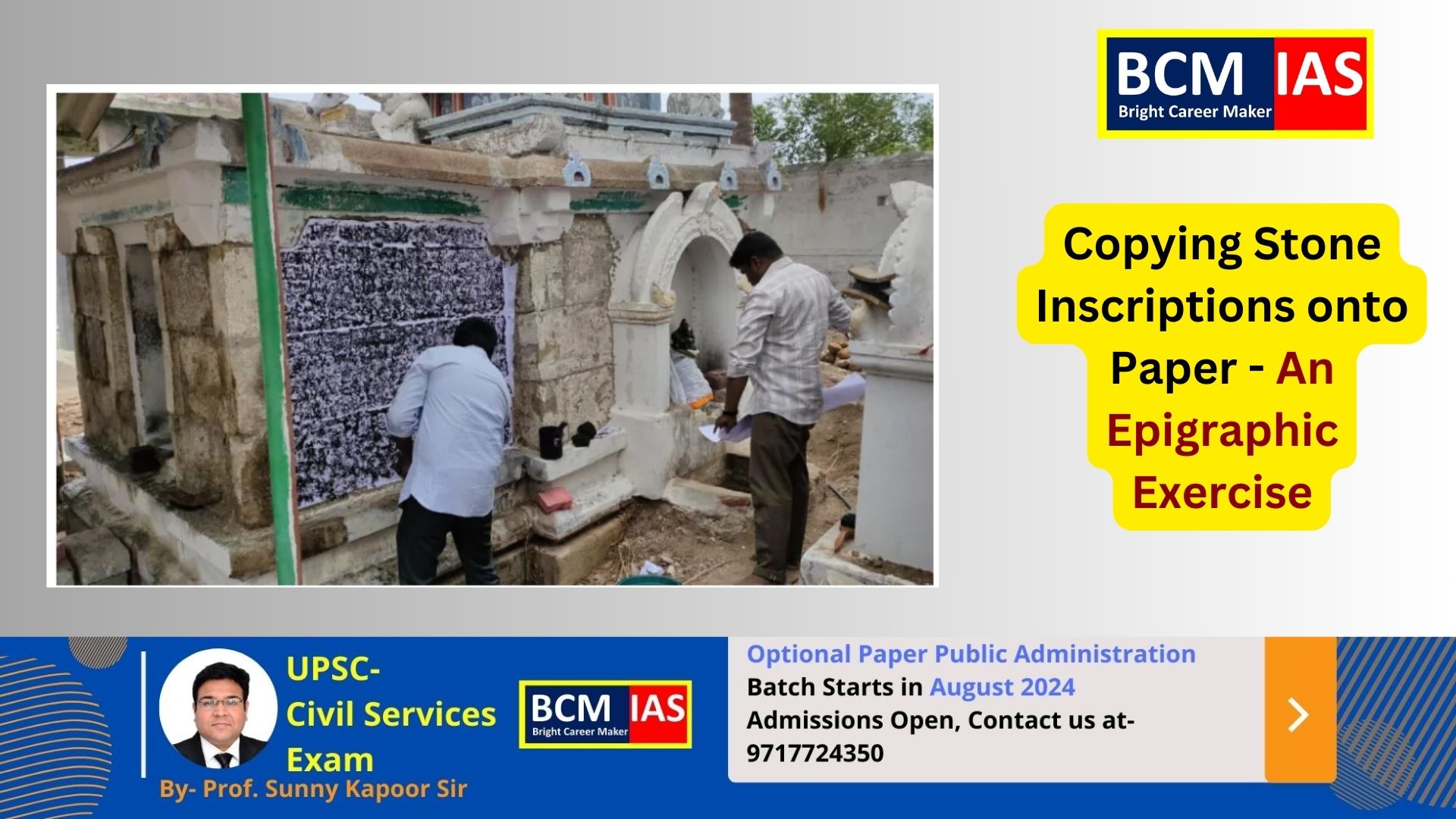
Copying Stone Inscriptions onto
Paper - An Epigraphic Exercise
News Analysis: Copying
Stone Inscriptions onto Paper - An Epigraphic Exercise
· Recently, a team
of epigraphists from the Archaeological Survey of India (ASI) undertook a
significant project to copy stone inscriptions from the Thalishwarar
temple in Kovilpalayam and other sites in the Tiruppur district
of Tamil Nadu.
·
This exercise, involving the ancient "estampage method,"
is crucial for preserving historical data and gaining insights into the
socio-political and cultural history of the region.
Key Highlights:
1. Thalishwarar Temple Inscriptions:
o Temple
Overview:
Thalishwarar temple, an ancient granite stone structure in the Kongu region,
contains inscriptions dedicated to its presiding deity, Thaleekeeiswarar. The
ASI identified eight significant inscriptions within the temple complex.
o Inscriptions
Details:
§ One inscription,
in Vattezhuthu script, likely dates back to the 9th century, while the other
seven, in Tamil, are from the 12th century.
§ The Vattezhuthu
inscription consists of 12 lines on the Arthamandapam of the shrine and was
deciphered by Prof. Y Subarayalu, revealing that the temple was built by the
medieval Chera ruler Kokkandan Viranarayanan.
o Historical
Context: The
inscription mentions that the temple, built by the Chera ruler, should be
protected at all costs, and any damage to it would result in severe
consequences for the perpetrator’s lineage.
2. Significance of the Chera Dynasty:
o Chera Rulers: The Cheras were significant rulers
in South India, particularly during the Sangam period, governing parts of
modern Kerala. Their capital was Vanji, and they were known for their seaports
like Tondi and Musiri.
o Cultural
Impact: The
inscriptions from the Chera period provide invaluable insights into the
cultural, religious, and political history of the region.
3. Methodology - Estampage:
o Estampage
Method: The
estampage technique is a traditional method used by archaeologists to replicate
inscriptions from stone surfaces onto inked paper. This process creates an
exact copy of the inscription, allowing for detailed analysis and preservation.
o Importance of
Estampage: This
method is crucial for preserving inscriptions, especially when the original
stone inscriptions are vulnerable to weathering or other forms of degradation.
It also allows for further analysis without causing damage to the original
inscriptions.
4. Creating Awareness:
o Public
Involvement: The
exercise also aimed at raising awareness about the importance of epigraphy
among the public and students. Experts emphasized the need for the public to
alert the ASI if they come across any rare inscriptions, as these are primary
sources for writing history.
o Educational
Outreach: Students
from Bharathiar University were involved in the exercise, providing them with
hands-on experience in the field of epigraphy.
5. Role of the Archaeological Survey of India (ASI):
o Mandate of
ASI: The ASI, under
the Ministry of Culture, is responsible for archaeological research and the
protection of India’s cultural heritage. It operates under the Ancient
Monuments and Archaeological Sites and Remains Act, 1958, and the Antiquities
and Art Treasure Act, 1972.
o Epigraphy as
a Discipline:
Epigraphy, the study of inscriptions, is essential for understanding historical
contexts, languages, and scripts. It provides a direct link to the past,
offering insights into the lives, beliefs, and governance of ancient
civilizations.
Conclusion:
The ASI's exercise to copy stone inscriptions at the
Thalishwarar temple and other sites is a crucial effort in preserving India’s
rich historical and cultural heritage. Through the estampage method, valuable
inscriptions are not only preserved but also made accessible for further
academic research and public education. The involvement of students and public
awareness initiatives highlights the importance of collaborative efforts in
safeguarding historical knowledge. As epigraphy continues to uncover the stories
of our past, it remains a vital tool in understanding and preserving the
cultural narratives that shape our present and future.
MCQs for Prelims Practice
1. What is the primary method used by the Archaeological
Survey of India (ASI) to copy stone inscriptions onto inked papers?
a) Lithography
b) Estampage
c) Block printing
d) Digital scanning
Answer: b) Estampage
2. The inscription in Vattezhuthu script found at the
Thalishwarar temple likely dates back to which century?
a) 5th century
b) 7th century
c) 9th century
d) 12th century
Answer: c) 9th century
3. Who was the medieval Chera ruler mentioned in the
Vattezhuthu inscription at the Thalishwarar temple?
a) Kulothunga Chola
b) Rajaraja Chola
c) Kokkandan Viranarayanan
d) Marthanda Varma
Answer: c) Kokkandan Viranarayanan
4. The Chera rulers, who are mentioned in the inscription at
the Thalishwarar temple, were associated with which modern-day Indian state?
a) Tamil Nadu
b) Karnataka
c) Andhra Pradesh
d) Kerala
Answer: d) Kerala
5. What is the significance of the estampage method used by
ASI in the context of preserving historical inscriptions?
a) It allows for the digital
archiving of inscriptions.
b) It enables archaeologists to
analyze inscriptions without damaging the original.
c) It creates a permanent ink copy of
inscriptions for museum displays.
d) It helps in translating
inscriptions into modern languages.
Answer: b) It enables archaeologists to analyze inscriptions without damaging
the original.


Comments on “Copying Stone Inscriptions onto Paper - An Epigraphic Exercise”