


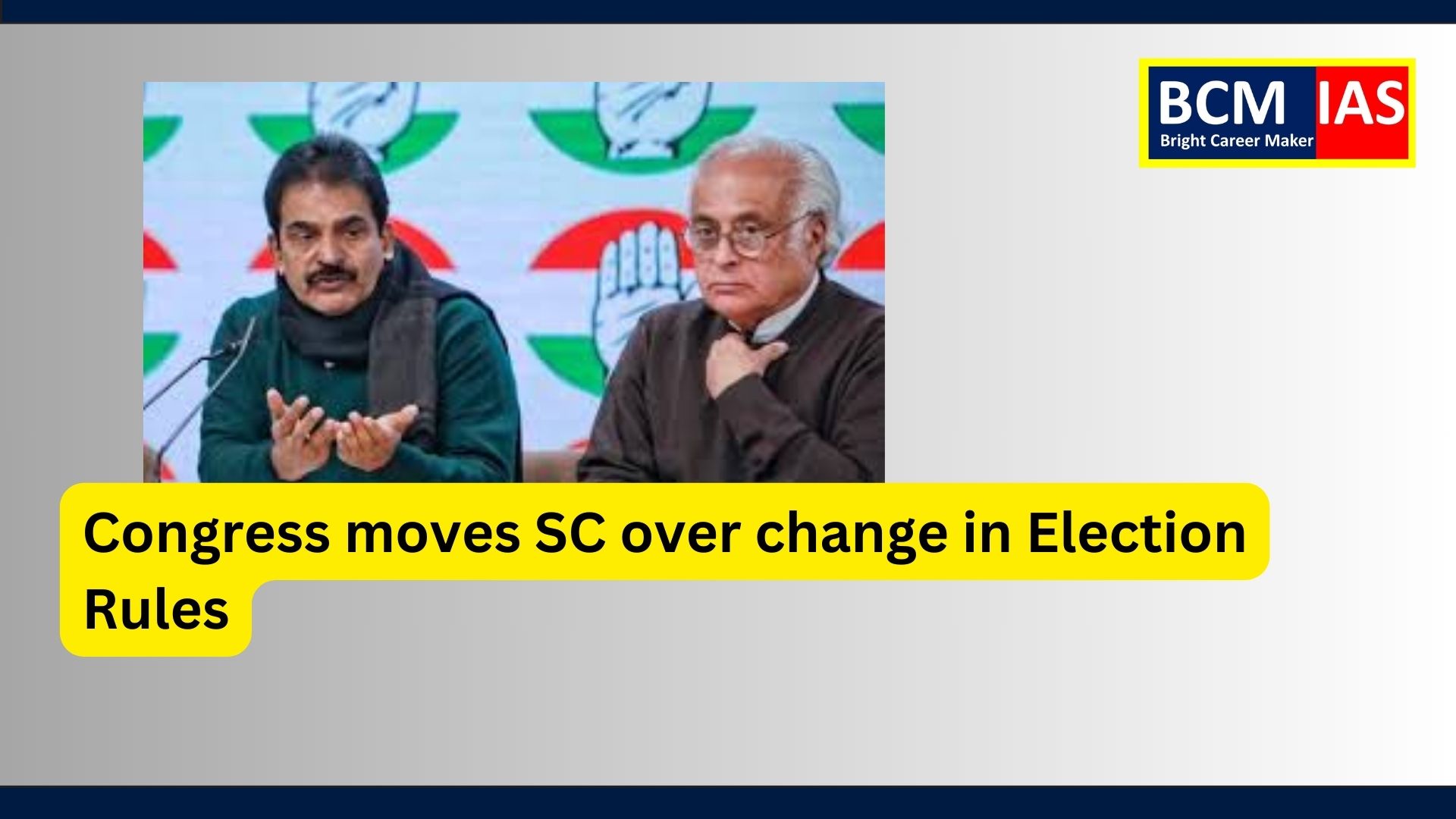
Congress moves SC over change in Election Rules
The Congress party’s
challenge in the Supreme Court regarding the amendment to the Conduct of
Election Rules, 1961 raises critical questions about electoral
transparency, accountability, and public access to crucial election records.
1.
The Context of the Amendment:
A. Rule
93(2) of the 1961 Rules (Before Amendment):
- Allowed unrestricted public access to
election-related records, including CCTV footage and video recordings from
polling booths.
- Promoted transparency and accountability in the
electoral process by enabling scrutiny of election procedures.
B.
Amendment to Rule 93(2):
- Notified on December 20, 2023, by the Union Law
and Justice Ministry.
- Restricts access to only specific election
records mentioned in the Rules, excluding certain critical materials like
CCTV footage and video recordings.
2.
Justification for the Amendment:
- Officials claim the amendment aims to prevent
misuse or doctoring of electronic records, which could lead to
false narratives and undermine the electoral process.
- The move is ostensibly to safeguard the
credibility of elections from external manipulation.
3.
The Triggering Event:
- The amendment follows a Punjab and Haryana
High Court order directing the Election Commission to release
election-related records, including CCTV footage, to an advocate who
sought them for the Haryana Assembly election.
- The timing raises concerns about whether the
amendment was a reactive measure to limit scrutiny of election processes.
4.
Concerns Raised by the Congress:
A. Lack of
Public Consultation:
- The amendment was made unilaterally by the
Election Commission, without any public debate or stakeholder involvement.
- Congress leader Jairam Ramesh has criticized this
as a “brazen” move that undermines democratic principles.
B. Impact
on Transparency and Accountability:
- Restricting access to essential election records
reduces public oversight, potentially eroding trust in the electoral
process.
- Access to materials like CCTV footage is vital
for detecting irregularities and ensuring fair conduct of elections.
C. Threat
to Free and Fair Elections:
- The amendment could be perceived as a step
towards shielding the electoral process from scrutiny, raising questions
about the integrity of elections.
- Critics argue that the lack of transparency could
embolden electoral malpractices.
5.
Broader Implications:
A.
Constitutional Concerns:
- The Election Commission, as a constitutional
body, is entrusted with ensuring free and fair elections under
Article 324 of the Constitution.
- The amendment’s restriction of public access
might conflict with this mandate by reducing the scope for independent
scrutiny.
B.
Potential for Misuse:
- Limiting access to electronic records could raise
suspicions of arbitrary actions by election officials and weaken
public confidence in the democratic process.
C. Judicial
Oversight:
- The Supreme Court’s intervention is critical to
determining whether the amendment aligns with constitutional principles of
transparency, accountability, and fairness in governance.
6.
Way Forward:
A. Need for
Public Consultation:
- Any changes to election laws or rules that impact
transparency and accountability should be made following extensive public
debate and stakeholder consultation.
B. Balance
Transparency with Security:
- Safeguards can be implemented to prevent misuse
of election-related materials without entirely restricting public access.
C. Judicial
Review:
- The Supreme Court’s decision on this matter could
set an important precedent on the balance between protecting the integrity
of the electoral process and upholding citizens’ rights to access
information.
Conclusion:
The amendment to the Conduct
of Election Rules, 1961 highlights a critical debate between ensuring
electoral integrity and maintaining transparency. While the stated goal of
preventing misuse of electronic records is valid, restricting public access
without consultation raises concerns about the erosion of democratic
accountability. The Supreme Court’s review will be pivotal in restoring public
trust in India’s electoral processes and reinforcing the principles of free and
fair elections.


Comments on “Congress moves SC over change in Election Rules”