

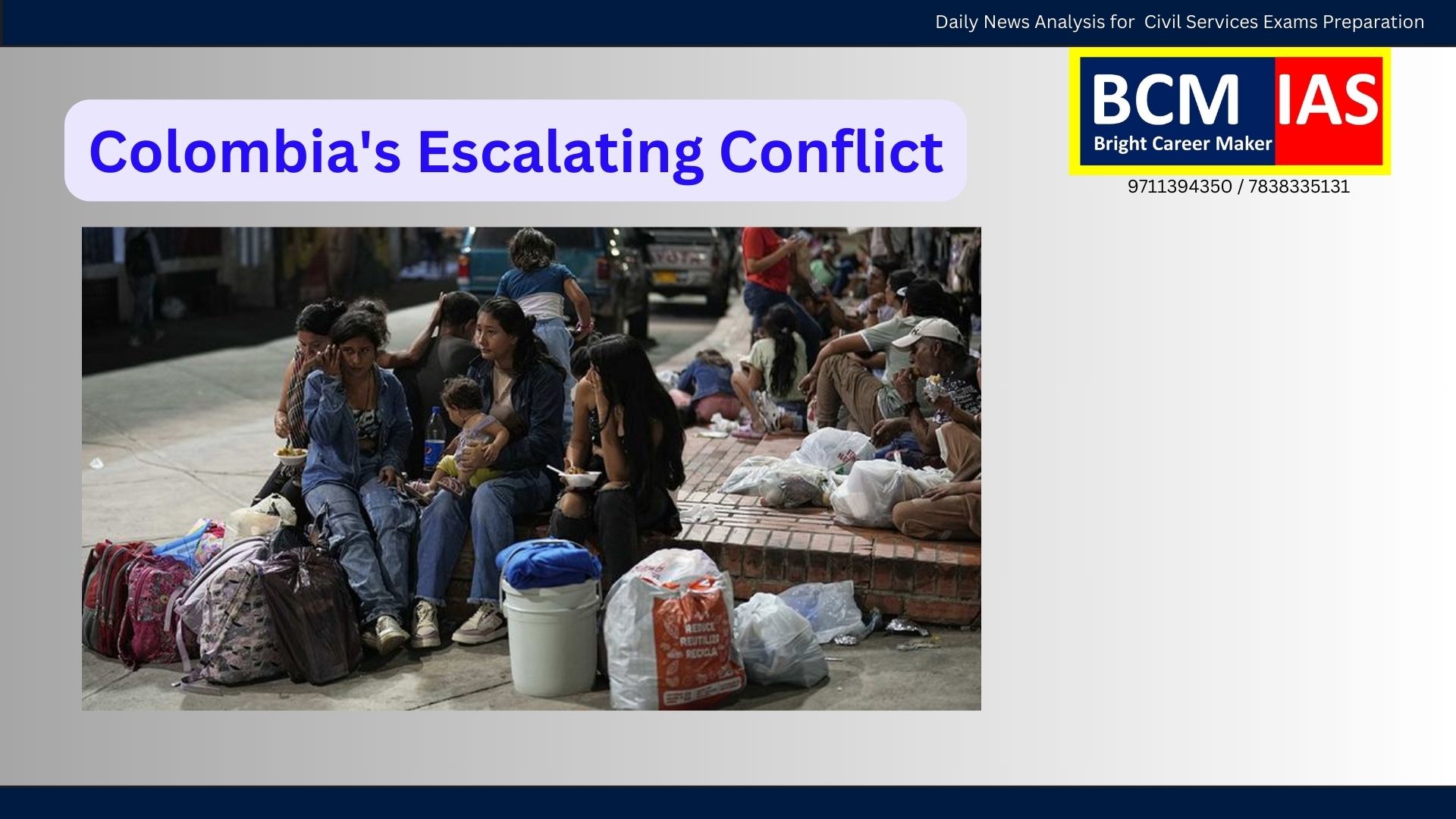
Colombia's Escalating Conflict
Colombia is currently facing a resurgence of
violence as rival militias clash over territorial control, jeopardizing its
fragile peace process. This situation underscores the challenges in sustaining
long-term peace in post-conflict regions.
Key Issues:
1. Renewed
Violence by Guerilla Groups:
o Guerilla
factions that rejected the peace accords of 2016 are engaging in violent
clashes.
o These
groups are vying for control of strategic territories, particularly those rich
in coca leaf plantations, the primary ingredient for cocaine production.
2. Strategic
Border Regions and Cocaine Economy:
o The
conflict is concentrated in border areas, vital for illegal drug trafficking
routes.
o Colombia’s
coca production has made it the world's largest cocaine producer, fueling the
militias' funding and operations.
3. Humanitarian
Crisis:
o The
violence has led to the displacement of hundreds of people seeking safety in
cities like Tibu.
o Refugee
shelters have been established, but they signal an escalating humanitarian
crisis.
4. State
Response:
o A
state of emergency has been declared, with military deployments aimed at
restoring order and mitigating violence.
o This
move, while necessary, highlights the ongoing reliance on militarization to
address internal conflicts.
Geopolitical Context:
·
Peace Accords of 2016:
The landmark peace deal between the Colombian government and the Revolutionary
Armed Forces of Colombia (FARC) ended decades of civil war but left gaps, as
not all guerilla factions accepted the agreement.
·
Drug Trafficking Nexus:
Control over coca-rich regions is critical for funding these groups, as cocaine
production is a lucrative trade with global implications.
·
Regional Stability:
Colombia's conflict impacts neighboring countries, as displaced populations
often cross borders, straining regional resources and security.
Geographical Significance:
1. Gateway
to South America:
o Colombia
connects South America with Central and North America, making it a strategic
location for trade, migration, and unfortunately, drug trafficking routes.
2. Natural
Richness:
o Despite
covering less than 1% of Earth's land, Colombia is home to 10% of the world's
animal species, showcasing its rich biodiversity.
o Its
diverse geography includes grasslands (Los Llanos) and access to both the
Pacific and Atlantic Oceans.
Implications:
1. Domestic:
o Renewed
conflict undermines trust in the peace process, complicating future
negotiations.
o Prolonged
violence risks deeper social and economic instability.
2. International:
o Cocaine
production fuels global drug markets, making Colombia's conflict an
international concern.
o Countries
involved in counter-narcotics operations (like the U.S.) may increase
interventions.
3. Humanitarian:
o Displacement
and violence strain Colombia’s resources, requiring international humanitarian
support.
Conclusion:
Colombia’s escalating conflict highlights the
fragility of post-conflict peace and the challenges of addressing systemic
issues like drug production and guerilla violence. While military deployments
provide immediate relief, a sustainable solution requires addressing the root
causes, including economic inequality, illicit trade, and inclusive governance.
The international community must play a supportive role in Colombia’s pursuit
of lasting peace.
Mains
Practice Question
Q: Discuss the
implications of Colombia's escalating internal conflict on regional stability
and international relations. Suggest measures to address the situation.
Answer:
Colombia's renewed internal conflict, driven
by guerilla groups fighting for control over strategic border regions and coca
production, has far-reaching implications for regional stability and global
relations.
Implications of Colombia’s Conflict:
1. Regional Stability:
- Cross-border
Refugees: Displacement caused by violence
increases pressure on neighboring countries like Venezuela and Ecuador,
straining their resources and stability.
- Drug
Trafficking Routes: Cocaine production and
smuggling through Central America exacerbate regional security challenges.
- Militarization
Risks: Colombia’s reliance on military action
risks escalating tensions with neighboring states if conflicts spill over
borders.
2. International Relations:
- Global
Drug Trade: As the world's largest cocaine
producer, Colombia's conflict fuels the international narcotics market,
impacting countries like the U.S., which invests heavily in
counter-narcotics efforts.
- Strained
Peace Accords: Failure to sustain the 2016 peace
deal undermines international confidence in Colombia’s governance and
long-term peace-building efforts.
- Human
Rights Concerns: Widespread violence and
displacement draw criticism from global organizations, potentially
affecting Colombia’s international partnerships.
3. Economic Impact:
- Trade
Disruption: Instability in Colombia’s border
regions can affect trade routes and economic exchanges with neighboring
countries.
- Foreign
Investment Decline: Escalating violence
discourages foreign investment in Colombia, hindering economic growth and
development.
Measures to Address the Conflict:
1. Strengthening Peace Processes:
- Reintegration
of Factions: Re-engage guerilla groups that
rejected the 2016 peace accords through dialogue and economic incentives.
- Inclusive
Governance: Address socio-economic inequalities in
rural regions to prevent recruitment into armed groups.
2. Regional Cooperation:
- Joint
Security Efforts: Collaborate with neighboring
countries to secure borders and dismantle drug trafficking networks.
- Humanitarian
Assistance: Establish coordinated refugee
management systems to address displacement effectively.
3. International Support:
- Counter-Narcotics
Initiatives: Strengthen partnerships with
international agencies and countries like the U.S. to curb cocaine
production and smuggling.
- Development
Aid: Encourage global financial institutions
to provide aid for infrastructure and socio-economic development in
conflict-prone areas.
4. Community-Based Interventions:
- Alternative
Livelihood Programs: Promote crop
substitution programs to reduce coca cultivation.
- Capacity
Building: Train local leaders to mediate
conflicts and build trust among communities.
Conclusion:
Colombia’s internal conflict poses a
significant challenge to regional stability and global efforts to combat the
drug trade. While military action may address immediate concerns, sustainable
peace requires a multi-pronged approach focusing on dialogue, socio-economic
development, and regional collaboration. The international community’s
involvement is essential to support Colombia in addressing the underlying
causes of violence and ensuring long-term stability.
MCQs
1. What is the primary reason for the resurgence of violence in
Colombia?
(a) Political instability in the capital.
(b) Guerilla groups vying for control over coca leaf plantations.
(c) Increased foreign intervention in Colombia’s peace process.
(d) Natural disasters in border regions.
Ans: (b)
2. Which of the following factors makes Colombia a strategic location
for drug trafficking?
1. Its
proximity to North and Central America.
2. Vast coca
leaf plantations.
3. Its
access to both the Pacific and Atlantic Oceans.
Select the correct answer using the codes below:
(a) 1 and 2 only
(b) 2 and 3 only
(c) 1 and 3 only
(d) 1, 2, and 3
Ans: (d)
3. Which of the following was a key outcome of the 2016 peace accord in
Colombia?
(a) Complete disarmament of all guerilla factions.
(b) Termination of the conflict with the Marxist–Leninist guerillas.
(c) Legalization of coca leaf cultivation for commercial purposes.
(d) Establishment of a military-led government in conflict zones.
Ans: (b)
4. What is a significant environmental or geographical fact about
Colombia?
(a) It covers 5% of Earth’s land area and has 10% of its animal species.
(b) Its grasslands, known as Los Llanos, connect directly to the Amazon.
(c) Despite covering less than 1% of Earth’s land, it is home to 10% of the
world’s animal species.
(d) It has no access to oceans despite being called the "gateway to South
America."
Ans: (c)
5. How does Colombia's internal conflict impact regional stability?
(a) It strengthens cross-border cooperation among neighboring countries.
(b) It increases refugee flows, straining resources in neighboring countries.
(c) It reduces drug trafficking activities across Central America.
(d) It promotes regional trade by increasing coca leaf exports.
Ans: (b)


Comments on “Colombia's Escalating Conflict”