

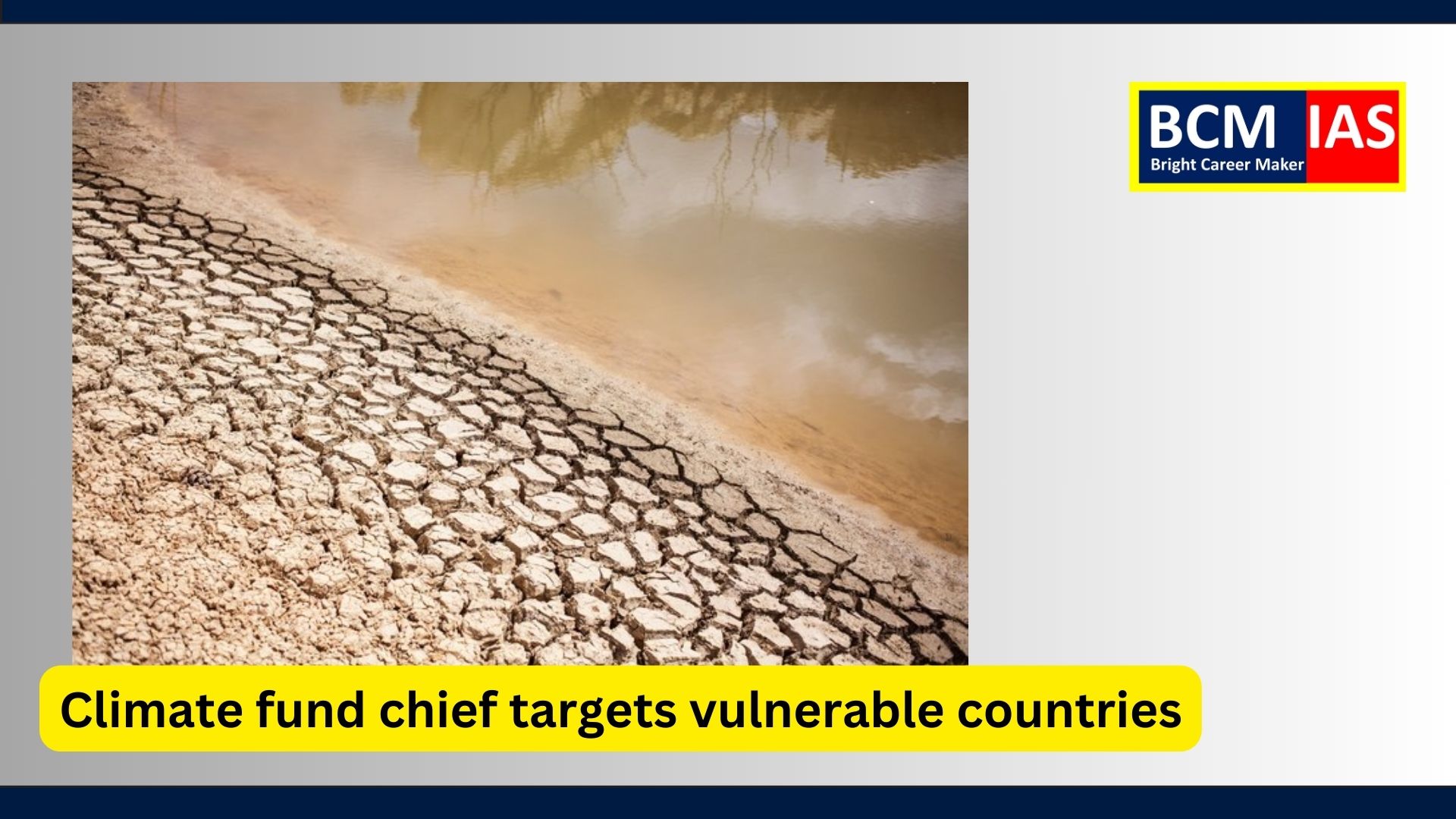
"Climate fund chief targets
vulnerable countries":
1.
Introduction:
The article discusses the efforts of Mafalda Duarte,
the chief of the Green Climate Fund (GCF), an organization established
under the United Nations to channel financial assistance to developing
countries that are disproportionately impacted by climate change. Despite
their low contribution to carbon emissions, these countries are suffering from
the worst effects of global warming, such as rising sea levels, intensified
storms, droughts, and heatwaves.
The GCF, which was set up over a decade ago, aims to support
these countries by providing funds to both mitigate the effects of climate
change and help them adapt to the changing environment. The fund has recently
identified 19 vulnerable nations that have received minimal or no financial
support so far and has prioritized them for future climate financing.
2.
Key Elements and Analysis:
A. Mission and Objectives of the Green Climate
Fund (GCF)
- The
GCF was created as a flagship organization under the United Nations
to help developing countries that are severely affected by climate
change.
- It is
the world's largest dedicated source of climate finance, primarily
focused on providing funds to help countries reduce their greenhouse
gas emissions and implement adaptation projects.
- The
fund plays a crucial role in supporting these nations to develop
resilience against the negative effects of climate change, including floods,
droughts, and other climate-induced disasters.
B. Targeting Vulnerable Nations
- Mafalda
Duarte has
highlighted that 19 climate-vulnerable nations, including Algeria, Central
African Republic, Chad, Iraq, Lebanon, Mozambique,
Papua New Guinea, South Sudan, and others, have received
limited to no financial aid.
- These
countries, despite contributing minimally to global warming, are
experiencing some of the most catastrophic climate effects.
- The
GCF’s priority is to help these nations by providing them with the
necessary funding to implement both mitigation strategies (such as
reducing carbon emissions) and adaptation measures (such as
improving infrastructure to cope with changing climates).
C. Case of Somalia
- Somalia is mentioned as an example of a
country facing severe climate-related challenges. In the past year,
Somalia was affected by major floods, and it continues to suffer from
prolonged droughts. The country is struggling with extreme weather
events that threaten its agriculture, economy, and the livelihood of
its people.
- The
GCF has pledged more than $100 million in the next year to assist
Somalia in unlocking investment opportunities and developing climate
adaptation projects.
D. Strategic Priorities of the GCF under
Mafalda Duarte’s Leadership
- Mafalda
Duarte is
determined to position the GCF as a trusted partner for these
vulnerable countries, ensuring that the organization provides targeted,
need-based funding where it is most needed.
- The
goal is not just to deliver financial assistance but also to work closely
with governments to create sustainable climate solutions.
- The
GCF's approach is to equip these nations with the tools and investments
required to adapt to the worsening climate crisis and reduce their
dependence on external assistance over time.
3.
Way Forward:
A. Increasing Accessibility of Funds
- One
of the key goals should be to make the GCF’s funds more accessible
to the nations that need them the most. Bureaucratic hurdles often prevent
timely disbursement of funds, and simplifying the process could make a big
difference.
- There
must be capacity-building programs to help countries, especially
the least developed, in navigating international funding channels
and effectively using the financial assistance they receive.
B. Enhancing Collaboration with Local
Governments
- The
GCF should continue working closely with local governments to
develop customized climate resilience plans. These plans must be context-specific,
addressing the unique climate vulnerabilities of each country.
- Strengthening
partnerships with civil society organizations and local
communities will also ensure that the funds are directed to the right
projects and yield long-lasting benefits.
C. Scaling Up Global Climate Finance
- The
current amount of global climate finance is insufficient to meet the
growing needs of climate-vulnerable nations. The GCF needs more financial
commitments from developed nations to continue and expand its
operations.
- Developed
countries have a responsibility under the Paris Agreement to
provide financial resources to support climate action in developing
countries, especially those facing acute environmental stress.
D. Encouraging Sustainable Development and
Green Technologies
- The
GCF’s long-term vision should also focus on promoting sustainable
development and the use of green technologies. Investing in
renewable energy, reforestation projects, and sustainable agricultural
practices will help these nations reduce their reliance on
carbon-intensive activities and build a sustainable economy.
E. Monitoring and Accountability
- There
should be mechanisms in place to monitor the effective use of funds
provided by the GCF. Transparency and accountability are critical to
ensuring that climate finance is used for its intended purpose and that
the projects lead to tangible results in reducing vulnerability.
Conclusion:
The article highlights the critical role of the Green
Climate Fund in supporting climate-vulnerable nations that have not
received adequate financial assistance in the past. Under the leadership of Mafalda
Duarte, the GCF aims to channel resources to these countries, ensuring they
receive the funds necessary to adapt to climate change and mitigate its
effects. Going forward, the focus must be on improving the accessibility of
funds, enhancing collaboration with local governments, and ensuring
transparency in the disbursement and use of financial resources. The GCF’s work
will be crucial in ensuring that developing nations can build climate
resilience and contribute to global efforts in combating climate change.
Mains Question for Practice
Critically analyze the role of the Green Climate Fund (GCF) in
addressing climate change challenges faced by vulnerable nations. How can the
GCF enhance its impact on climate-vulnerable countries?
Answer:
1.
Introduction
The Green Climate Fund
(GCF), established under the framework of the United Nations Framework
Convention on Climate Change (UNFCCC), plays a crucial role in supporting developing
nations that are disproportionately affected by climate change. These
countries, despite having contributed little to global greenhouse gas
emissions, face severe consequences from climate-induced disasters such as rising
sea levels, intense storms, droughts, and heatwaves.
The GCF’s mission is to provide these nations with financial resources to help
them both mitigate the effects of climate change and implement adaptation
measures.
In recent years, the GCF has
expanded its focus to target climate-vulnerable countries that have
received limited financial assistance, with a view to ensuring more equitable
distribution of funds. Under the leadership of Mafalda Duarte, the GCF
has prioritized its efforts to assist 19 such countries, including Somalia,
Algeria, Chad, Papua New Guinea, and Mozambique,
among others.
2.
Demand of the Question: Role of the Green Climate Fund in Supporting Vulnerable
Nations
A. Objectives and Importance of the Green
Climate Fund
The GCF is the world’s
largest climate finance institution, with the aim to provide financial
assistance to help developing countries:
- Mitigate climate change by reducing greenhouse gas
emissions.
- Adapt to the impacts of climate change, such as extreme weather
events, sea-level rise, and resource scarcity.
This dual approach helps
vulnerable nations build resilience against the adverse effects of climate
change while ensuring they can continue pursuing sustainable development
goals (SDGs). The fund also seeks to support the Paris Agreement
targets, by channeling financial support to countries most in need.
B. Challenges Faced by Vulnerable Nations
Countries like Somalia,
Mozambique, Chad, and others identified by the GCF are
particularly vulnerable to the impacts of climate change due to:
1. Geographic exposure: Many of these
nations are located in regions prone to floods, droughts, and sea-level
rise, making them more susceptible to the direct impacts of climate change.
2. Limited resources: These countries often lack
the financial, technical, and institutional capacity to
implement large-scale climate adaptation or mitigation strategies.
3. Political instability and conflict: In
countries like Somalia and South Sudan, ongoing conflicts
exacerbate the challenges posed by climate change, further limiting the ability
to mobilize resources for resilience-building projects.
4. Economic constraints: Many of these
nations are low-income economies, where immediate economic needs take
precedence over long-term climate action. Without adequate external support,
these countries are unable to invest in critical infrastructure or adaptive
capacity.
C. GCF’s Contributions and Initiatives
1. Grant Disbursement: The GCF has been disbursing
grants and financial aid for over a decade. In its efforts to address
climate change, the fund provides financial support for projects that aim to
reduce emissions, promote renewable energy use, and enhance climate
resilience.
2. Focus on Vulnerable Nations:
Under Mafalda Duarte’s leadership, the GCF has shifted its focus towards 19
climate-vulnerable nations that have received minimal support so far. These
countries, which include Algeria, Central African Republic, and Papua
New Guinea, are now prioritized for targeted assistance.
3. Somalia’s Case: As a specific example, the
GCF has pledged more than $100 million to support Somalia, a country
experiencing major challenges like floods and droughts. This
financial support will help Somalia invest in climate adaptation projects
and attract more climate investment in the future.
4. Adaptation and Mitigation Projects:
The GCF funds projects aimed at both mitigating emissions (through
renewable energy projects, forest conservation, and emission-reduction
strategies) and adaptation (such as building resilient infrastructure,
improving water management systems, and developing early-warning systems for
climate-related disasters).
D. Key Challenges Faced by the GCF
Despite its successes, the
GCF faces several challenges in achieving its mission:
1. Bureaucratic Delays: Many developing
countries have reported delays in accessing funds due to the complex
approval processes and bureaucratic hurdles involved in
disbursement.
2. Limited Financial Resources:
The GCF relies on contributions from developed countries, many of whom
have not met their pledges for climate finance. This has restricted the GCF’s
ability to fully support all vulnerable nations.
3. Need for Capacity Building:
Many of the countries that the GCF seeks to support do not have the
institutional capacity to properly utilize the funds. There is a need for capacity-building
efforts to ensure that nations can effectively develop and implement
climate projects.
3.
Way Forward: Enhancing the Impact of the GCF
For the GCF to maximize its
impact, certain strategic actions need to be taken:
A. Simplifying Fund Access and Reducing
Bureaucracy
To ensure that the GCF’s
resources reach the most vulnerable countries in a timely manner, there must be
efforts to simplify the process of fund application and disbursement.
The GCF should work on streamlining approval mechanisms, reducing
administrative delays, and ensuring that countries with limited institutional
capacity can access funds more easily.
B. Enhancing Financial Contributions from
Developed Nations
The GCF’s resources are
limited by the funding commitments made by developed nations. To address
this issue:
- There needs to be a reaffirmation of financial
commitments by developed countries, ensuring that they meet their
obligations under the Paris Agreement.
- The GCF can also explore alternative financing
mechanisms, such as leveraging private sector investment and public-private
partnerships, to bolster its resource base.
C. Strengthening Capacity Building
Countries that are unable to
fully utilize the funds due to technical or institutional weaknesses
should receive assistance in capacity building. This would include
providing technical expertise, establishing better governance mechanisms,
and helping countries develop sustainable projects that attract further
investment.
D. Focus on Long-Term Sustainable Development
The GCF should prioritize
projects that not only address immediate climate challenges but also contribute
to long-term sustainability. This includes:
- Investing in renewable energy technologies that
provide a cleaner, sustainable source of energy while reducing greenhouse
gas emissions.
- Supporting reforestation and conservation
efforts to enhance carbon sinks.
- Developing climate-resilient infrastructure that
can withstand extreme weather events, ensuring that countries are better
prepared for the future impacts of climate change.
E. Enhancing Monitoring and Accountability
The GCF must ensure that the
funds are used effectively and transparently. This can be achieved by:
- Implementing robust monitoring and evaluation
frameworks to track the progress and impact of funded projects.
- Ensuring that funds are targeted towards the most
vulnerable populations, especially in regions where corruption or
mismanagement might pose a risk to effective disbursement.
F. International Cooperation and Partnerships
Climate change is a global
challenge that requires a multilateral approach. The GCF should continue
to work closely with other international organizations, governments, NGOs, and
private entities to maximize its impact. This includes sharing best
practices, ensuring knowledge exchange, and collaborating on
large-scale projects that can have a broader regional or global impact.
Conclusion
The Green Climate Fund
plays a pivotal role in helping climate-vulnerable nations adapt to and
mitigate the adverse effects of climate change. However, to maximize its
impact, the GCF must address challenges related to fund accessibility, capacity
building, and funding shortfalls. By simplifying processes,
increasing financial contributions, and focusing on long-term sustainable
development, the GCF can significantly enhance its effectiveness in
supporting the world's most climate-vulnerable nations. Additionally,
strengthening international cooperation and accountability mechanisms
will ensure that the GCF continues to be a vital resource for developing
nations as they navigate the complexities of the climate crisis.
MCQs for Practice
1. Which of the following is the primary objective of the
Green Climate Fund (GCF)?
A) To support developed countries in mitigating climate
change.
B) To fund technological advancements in carbon capture and storage.
C) To provide financial resources to developing countries for climate change
mitigation and adaptation.
D) To fund global research on climate change without focus on specific
countries.
Answer: C)
Explanation: The Green Climate Fund was set up under the UNFCCC to
support developing countries by providing financial resources for both climate
change mitigation (reducing emissions) and adaptation (building
resilience to climate impacts).
2. Which of the following correctly describes a major focus
area of the Green Climate Fund (GCF)?
A) Providing subsidies for fossil fuel exploration in
developing countries.
B) Funding only adaptation measures in response to climate disasters.
C) Supporting both mitigation of greenhouse gases and adaptation to climate
impacts.
D) Supporting only developed countries in developing climate policies.
Answer: C)
Explanation: The GCF provides financing for both mitigation
(reducing emissions and transitioning to renewable energy) and adaptation
(building resilience to climate impacts like droughts and floods) in developing
countries.
3. Which of the following challenges is most commonly
associated with the disbursement of funds by the Green Climate Fund (GCF)?
A) Lack of political will from developing countries to use
climate finance.
B) Delays due to complex bureaucratic processes and approval mechanisms.
C) Lack of technological expertise in developed countries.
D) Opposition from environmental NGOs.
Answer: B)
Explanation: One of the main challenges the GCF faces is delays in
fund disbursement due to bureaucratic hurdles and complex approval
processes. This can hinder vulnerable nations from receiving timely support.
4. Which of the following international agreements is the
Green Climate Fund (GCF) associated with?
A) Kyoto Protocol
B) Paris Agreement
C) Montreal Protocol
D) Rio Declaration
Answer: B)
Explanation: The Green Climate Fund is linked to the Paris Agreement,
which sets goals for reducing global greenhouse gas emissions and limiting
global temperature rise. The GCF provides the financial mechanism to assist
developing countries in meeting these goals.
5. Which of the following is NOT one of the Green Climate
Fund’s target countries for climate finance, according to recent reports?
A) Somalia
B) Central African Republic
C) Algeria
D) Australia
Answer: D)
Explanation: The Green Climate Fund focuses on providing financial
support to developing nations that are most vulnerable to climate change
impacts. Australia, being a developed country, is not a target nation
for GCF support.


Comments on “Climate fund chief targets vulnerable countries”