


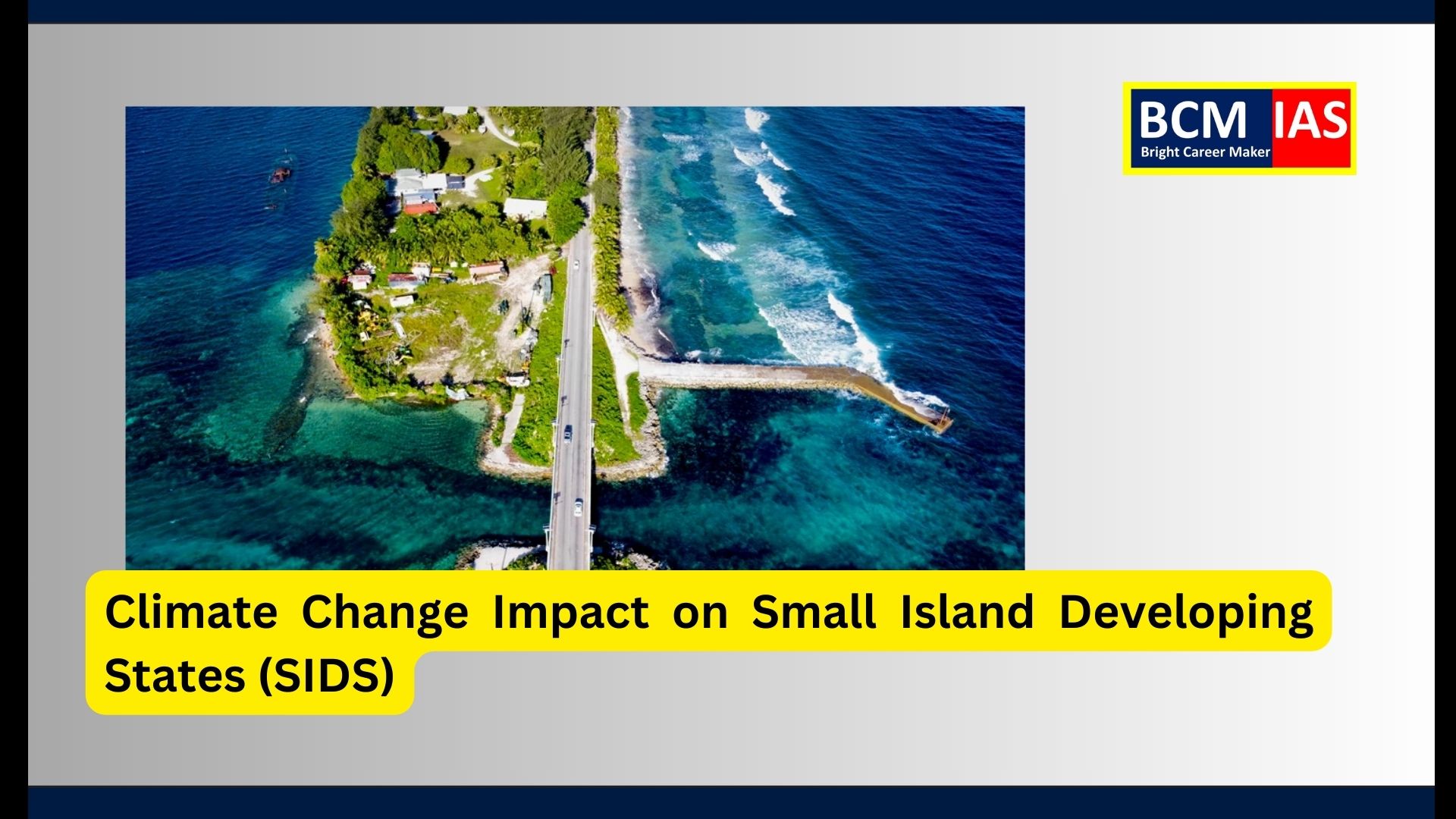
Climate
Change Impact on Small Island Developing States (SIDS)
Why in News?
At UNFCCC COP27 (2022)
in Sharm El Sheikh, a new Loss and Damage Fund was created to assist
climate-vulnerable nations, particularly Small Island Developing States
(SIDS). Despite this agreement, wealthier nations, the largest historical
carbon emitters, have largely failed to fulfill their financial commitments,
leaving SIDS without adequate support.
Small Island
Developing States (SIDS): Key Features
1.
Definition:
o SIDS
are small island nations that face unique social, economic, and
environmental vulnerabilities.
o Examples
include the Maldives, Seychelles, Solomon Islands, and Vanuatu.
2.
Geographical
Distribution:
o Located
across three regions:
§ Caribbean
§ Pacific
§ Atlantic,
Indian Ocean, and South China Sea (AIS)
3.
Recognition:
o Formally
recognized as a special case at the 1992 UN Conference on Environment and
Development due to their distinct challenges.
How is Climate Change
Affecting SIDS?
1.
Increased
Vulnerability:
o SIDS
experience 3-5 times more climate-related losses relative to government
revenues compared to other nations.
o Wealthier
SIDS, like Barbados and the Bahamas, face losses 4x higher than other
high-income nations.
2.
Direct
Impacts:
o Extreme
Weather Events: Cyclones, hurricanes, and floods destroy
homes, infrastructure, and public services.
§ Example:
Cyclone Winston (2016) in Fiji caused 44 deaths and extensive flooding.
o Sea-Level
Rise: Threatens the very existence of low-lying islands.
3.
Indirect
Impacts:
o Economic
recovery is slow due to high recovery costs, affecting tourism and agriculture.
§ Example:
Fiji’s GDP growth dropped by 1.4% after the 2016 cyclone.
o Prolonged
fiscal difficulties:
§ Example:
Dominica’s recovery from Hurricane Maria led to a 150% debt-to-GDP ratio.
4.
Cost
of Climate Change:
o Between
2000-2020, SIDS faced $141 billion in direct and indirect losses,
averaging $2,000 per person.
Major Initiatives to
Mitigate Impact on SIDS
1.
Alliance
of Small Island States (AOSIS):
o Advocates
for SIDS in international climate policy forums.
2.
Barbados
Programme of Action (1994):
o Focuses
on addressing vulnerabilities of SIDS related to climate change and sea-level
rise.
3.
SAMOA
Pathway (2014):
o Promotes
international cooperation and climate action for SIDS' development.
4.
Coalition
for Disaster Resilient Infrastructure (CDRI):
o Launched
by India in 2019 to enhance infrastructure resilience to climate risks.
5.
India’s
Assistance:
o India
has committed $70 million in project aid and $350 million in
concessional loans to SIDS for sustainable development.
Why Do Developed Nations
Need to Pay?
1.
Historical
Responsibility:
o Wealthier
nations are the largest historical carbon emitters and bear the responsibility
for funding climate resilience in vulnerable countries.
2.
Insufficient
Funding:
o Current
pledges are inadequate to address the scale of loss and damage, requiring billions
more annually.
o Example:
Losses for SIDS could reach $75.2 billion annually by 2050 under a 2°C
warming scenario.
3.
Marshall
Plan-Scale Support Needed:
o Calls
for a fund comparable to the Marshall Plan to ensure affected nations
receive adequate financial and technical assistance.
4.
Avoiding
Debt Traps:
o Concessional
finance and rapid disbursement mechanisms are critical to avoid increasing debt
burdens for SIDS.
Challenges
1.
Failure
to Meet Climate Commitments:
o Developed
countries have a history of failing to meet climate finance targets.
2.
Induced
Economic Losses:
o Indirect
economic losses, such as reduced GDP growth, exacerbate fiscal stress for SIDS.
3.
Scale
of Financial Requirements:
o The Loss
and Damage Fund needs to address both immediate recovery and long-term
resilience.
Conclusion
The creation of the Loss
and Damage Fund at COP27 marks a critical step toward addressing the
vulnerabilities of SIDS. However, for the fund to be effective, developed
nations must honor their financial commitments and provide adequate
resources. A global, collaborative approach is essential to ensure the sustainable
development of these nations and to mitigate the worst impacts of climate
change.
Way Forward
1.
Increase
Climate Finance Contributions:
o Wealthy
nations must fulfill existing commitments and scale up funding to address
growing climate challenges.
2.
Focus
on Resilience:
o Enhance
SIDS' capacity to withstand and recover from climate shocks through investments
in resilient infrastructure.
3.
Global
Cooperation:
o Strengthen
initiatives like AOSIS and SAMOA Pathway for coordinated global action.
4.
Rapid
Fund Disbursement:
o Ensure
timely and efficient use of funds to address immediate and long-term
challenges.
MCQs on SIDS and Climate
Change
Q1. Which of the following
regions hosts the majority of Small Island Developing States (SIDS)?
1. Caribbean
2. Pacific
3. Indian
Ocean
Select the correct answer:
- (a) 1 and 2 only
- (b) 1 and 3 only
- (c) 2 and 3 only
- (d) 1, 2, and 3
Answer: (d)
1, 2, and 3
Q2. The SAMOA Pathway
focuses on:
- (a) Promoting international trade
agreements.
- (b) Addressing vulnerabilities of SIDS
through international cooperation.
- (c) Establishing SIDS-specific tourism
guidelines.
- (d) Funding infrastructure development
in developed nations.
Answer: (b)
Addressing vulnerabilities of SIDS through international cooperation.
Q3. What is the primary
focus of the Loss and Damage Fund established at COP27?
- (a) To promote renewable energy projects
in SIDS.
- (b) To provide financial support for
climate-vulnerable nations, especially SIDS.
- (c) To fund research on climate
resilience.
- (d) To reduce global carbon emissions by
50%.
Answer: (b)
To provide financial support for climate-vulnerable nations, especially SIDS.
Q4. Which of the following
best describes the role of AOSIS?
- (a) A trade bloc of island nations.
- (b) A UN body regulating carbon
emissions.
- (c) An intergovernmental organization
advocating for SIDS in international climate policy.
- (d) A research organization focused on
sea-level rise.
Answer: (c)
An intergovernmental organization advocating for SIDS in international climate
policy.
Q5. What financial
commitment has India made to support SIDS in combating climate change?
- (a) $70 million in project aid and $350
million in concessional loans.
- (b) $150 million in grants for disaster
recovery.
- (c) $50 million under the Loss and
Damage Fund.
- (d) $100 million for tourism
development.
Answer: (a)
$70 million in project aid and $350 million in concessional loans.


Comments on “Climate Change Impact on Small Island Developing States (SIDS)”