


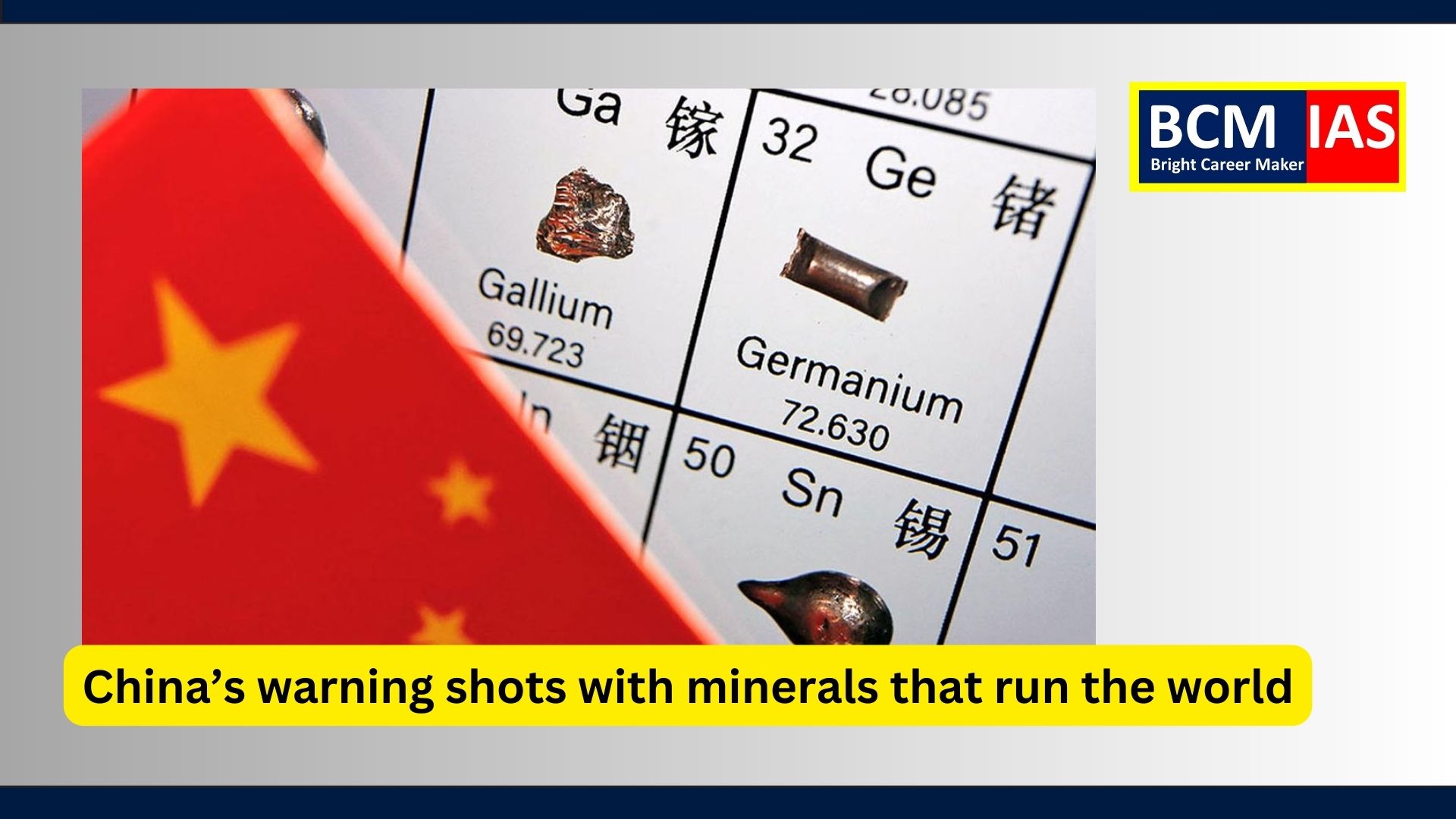
China’s warning shots with minerals that run
the world
·
This article by Abhishek Sharma analyzes
China's strategic use of critical minerals as a tool of coercion in its
foreign policy and the potential global implications, particularly for nations
like India, the U.S., and Japan, that are heavily
dependent on these minerals for their high-tech and defense sectors.
·
The piece explains China's dominance in the
global mineral supply chain, its history of leveraging that dominance, and the
strategic vulnerabilities it exposes in nations that rely on Chinese exports.
·
The article also calls for India and its
partners to rethink their strategies in order to mitigate this growing
dependency.
Key
Points of Analysis:
1. China's
Dominance in Critical Minerals:
o China controls a
significant portion of the global supply of critical minerals, with a
near-monopoly on the mining, processing, and refining of
minerals such as rare earth elements, antimony, gallium, germanium,
and others. It commands 60% of rare earth production and 80% of
global processing.
o These minerals
are vital for the production of military equipment (missiles, nuclear
weapons), renewable energy technologies (solar cells, EV batteries), and
high-tech industries (semiconductors, computer chips).
o China's control
over this sector allows it to wield significant geopolitical power, making any
decision it takes on the export of these minerals a global concern.
2. Weaponization
of Critical Minerals:
o China's recent
decision to restrict the export of antimony is part of a larger strategy
where critical minerals have moved from being a political tool to a weaponized
element of its foreign policy.
o This is not the
first instance of China leveraging its dominance in minerals. In 2010,
after a confrontation with Japan, China halted rare earth exports to Japan,
leading to international concerns about over-reliance on Chinese minerals.
o In 2023, after
the U.S. imposed restrictions on Chinese access to semiconductor equipment
and technologies, China retaliated by restricting the export of gallium
and germanium, minerals essential for high-tech sectors. It also imposed
restrictions on graphite, crucial for electric vehicle (EV) batteries
and nuclear reactors.
o These actions
signal China's intent to use critical mineral export controls to
undermine the West's technological and defense advancements, reflecting a
growing escalation in economic warfare between China and Western
nations.
3. Strategic
Foreign Policy Shift:
o The export
controls on minerals reflect China's growing hardline approach in its
foreign policy, transitioning from a cooperative stance to a coercive
one. By weaponizing mineral resources, China seeks to remind the West of
its strategic dependence on Chinese minerals.
o This is in line
with China's broader goals of limiting Western influence and slowing
down technological advancements in sectors where these critical minerals
are indispensable, such as defense equipment and renewable energy technologies.
o China's move can
be seen as part of a long-term strategy, where it seeks to increase mineral
exploration, expand reserves, and solidify its control over the
global supply chain of critical minerals over the next five years.
4. Impact
on India and Other Nations:
o Like its Quad
partners—Australia, Japan, and the U.S.—India remains highly vulnerable due
to its heavy reliance on imports of critical minerals from China, particularly lithium,
nickel, cobalt, and copper. In FY23, India’s mineral
imports amounted to around ₹34,000 crore.
o India’s
dependence on these critical minerals is projected to grow in the coming years,
making the country increasingly vulnerable to supply chain disruptions
caused by Chinese export restrictions.
o The article
calls for India to take urgent measures to reduce its dependence on
Chinese minerals, such as diversifying supply chains, forming partnerships
with like-minded nations, and investing in domestic production and
processing of critical minerals.
5. Global
Implications and Western Response:
o China’s actions
highlight the fragility of the global supply chain for critical minerals
and the strategic vulnerabilities of countries that depend on these resources.
o Western nations,
particularly the U.S., have been attempting to reduce their reliance on
China by building alternative supply chains, but China's near-monopoly
on the processing of minerals remains a significant hurdle.
o The West’s
attempts to decouple or de-risk from China in the critical minerals
sector face challenges, as building alternative processing capabilities will
require substantial investment and time.
Explanation:
1. China's Dominance and Strategy:
China's dominance in the critical minerals market gives it
significant geopolitical leverage. By controlling such a large share of
the global supply chain, China can dictate terms to countries that rely
on these resources. The restriction on antimony exports and similar
moves indicate that China is not just safeguarding its interests but using its monopoly
power to retaliate against perceived threats, such as the West's export
controls on high-tech equipment.
2. Weaponization of Minerals:
China's export restrictions on critical minerals represent a
shift from economic statecraft to a more aggressive geoeconomic
tactic. This approach uses economic resources as a means of coercion
and retaliation, targeting sectors where dependence on these minerals is
critical. For example, rare earth elements and other minerals are vital
for high-tech military equipment like fighter jets and submarines,
making China's restrictions a direct challenge to Western military
advancements.
3. India’s Vulnerability:
India’s reliance on critical minerals imported from China
exposes the country to supply chain risks. As India’s demand for
minerals grows—driven by sectors such as electric vehicles, renewable
energy, and high-tech manufacturing—the lack of diversified sources
for these resources could severely impact its industrial growth. The article
suggests that India needs to act swiftly by building strategic
partnerships with other countries and investing in alternative sources of
minerals to reduce its dependence on China.
4. Western Dependence and Countermeasures:
Countries like the U.S., Japan, and European nations are
increasingly aware of their vulnerabilities in the face of China's
control over critical minerals. Efforts to diversify supply chains and
invest in new mining and processing capabilities are underway, but they
will take time to mature. China’s actions are a wake-up call to the West
about the need for long-term strategies to reduce dependence on a single
dominant player for vital resources.
Conclusion:
China’s increasing reliance on its critical mineral
exports as a tool of coercion in foreign policy presents a significant geopolitical
challenge for nations that depend on these minerals. For countries like
India, the U.S., and Japan, the episode underscores the urgent need to reduce
their reliance on Chinese exports and develop alternative supply chains.
While China's aggressive tactics serve as a reminder of its dominance in the
critical mineral sector, they also highlight the global fragility of supply
chains, urging affected nations to explore new strategies to secure
their critical resource needs and safeguard their strategic industries.


Comments on “China’s warning shots with minerals that run the world”